## Why

We've added support for auth elicitation behind the auth_elicitation
flag, but servers need to explicitly check the capability before it
decides to send elicitations in order to be backward compatible. This PR
adds the capability advertising conditioned on the flag.

## What changed

- Build `client_elicitation_capability` from the `AuthElicitation`
feature state.
- Thread that capability through MCP config, session startup, and
`McpConnectionManager` so RMCP initialization advertises the correct
elicitation support.
- Advertise both `form` and `url` elicitation when the feature is
enabled, and preserve the empty default capability when it is disabled.
- Add coverage for the feature-derived config shape and the advertised
initialization payload.

## Testing

- `cargo test -p codex-mcp`
- `cargo test -p codex-core
to_mcp_config_preserves_auth_elicitation_feature_from_config`
- `cargo test -p codex-core` *(currently fails outside this change in
`tools::handlers::multi_agents::tests::tool_handlers_cascade_close_and_resume_and_keep_explicitly_closed_subtrees_closed`
with a stack overflow after unrelated tests have started running)*
## Why

Managed requirements can already centrally disable apps, but they could
not express the per-tool app approval rules that normal config already
supports. That left admins without a way to enforce connector tool
approvals through `/etc/codex/requirements.toml` or cloud requirements.

## What changed

- Extend app requirements with per-tool `approval_mode` entries.
- Merge managed app tool requirements across managed sources while
preserving higher-precedence exact tool settings.
- Apply managed tool approvals separately from user app config so
managed policy is matched only on raw MCP `tool.name`, while user config
keeps the existing raw-name-then-title convenience fallback.
- Add coverage for local requirements, cloud requirements parsing,
managed-over-user precedence, and a title-collision case that must not
widen managed auto-approval.

## Configuration shape

Local `/etc/codex/requirements.toml` and cloud requirements use the same
TOML shape:

```toml
[apps.connector_123123.tools."calendar/list_events"]
approval_mode = "approve"
```

This is a per-tool approval rule keyed by app ID and raw MCP tool name,
not an app-level boolean such as `apps.connector_123123.approve = true`.
## Why

Managed filesystem `deny_read` requirements are administrator-enforced
restrictions on specific paths. Once those requirements are active,
Codex should not drop them just because an execution path would
otherwise leave the sandbox.

Before this change, an explicit escalation, a prefix-rule allow, a
sandbox-denial retry, or an app-server legacy sandbox override could
rebuild the runtime policy without those managed read-deny entries and
expose a path the administrator had marked unreadable.

This is narrower than general sandbox-mode constraints. If an enterprise
only sets `allowed_sandbox_modes`, a trusted `prefix_rule(..., decision
= "allow")` can still run its matching command unsandboxed; this PR only
preserves managed filesystem `deny_read` restrictions across those
paths.

## What Changed

- Mark filesystem policies built from managed `deny_read` requirements
so callers can tell when those deny entries must survive escalation.
- Preserve managed deny-read entries when runtime permission profiles
are rebuilt through protocol, app-server, or legacy sandbox-policy
compatibility paths.
- Keep managed deny-read attempts inside the selected sandbox on the
first attempt and after sandbox-denial retries.
- Preserve the same behavior in the zsh-fork escalation path, including
prefix-rule-driven escalation.
- Add a regression test showing the opposite case too: without managed
deny-read, a prefix-rule allow still chooses unsandboxed execution.

## Verification

Targeted automated verification:

```shell
cargo test -p codex-core shell_request_escalation_execution_is_explicit -- --nocapture
cargo test -p codex-core prefix_rule_uses_unsandboxed_execution_without_managed_deny_read -- --nocapture
cargo test -p codex-core prefix_rule_preserves_managed_deny_read_escalation -- --nocapture
cargo test -p codex-protocol permission_profile_round_trip_preserves_filesystem_policy_metadata -- --nocapture
cargo test -p codex-protocol preserving_deny_entries_keeps_unrestricted_policy_enforceable -- --nocapture
cargo test -p codex-app-server-protocol permission_profile_file_system_permissions_preserves_policy_metadata -- --nocapture
cargo check -p codex-app-server -p codex-tui
```

Smoke-test invocations:

```shell
# macOS exact deny + allowed control
codex exec --skip-git-repo-check -C "$ROOT" \
  -c 'default_permissions="deny_read_smoke"' \
  -c 'permissions.deny_read_smoke.filesystem={":minimal"="read",":project_roots"={"."="write","secrets"="none","future-secret"="none","**/*.env"="none"}}' \
  'Run shell commands only. Print the contents of allowed.txt. Then test whether reading secrets/exact-secret.txt succeeds without printing that file if it does. End with exactly two lines: allowed=<contents> and exact_secret=<BLOCKED or READABLE>.'

# Linux exact deny + allowed control
codex exec --skip-git-repo-check -C "$ROOT" \
  -c 'default_permissions="deny_read_smoke"' \
  -c 'permissions.deny_read_smoke.filesystem={":minimal"="read",glob_scan_max_depth=3,":project_roots"={"."="write","secrets"="none","future-secret"="none","**/*.env"="none"}}' \
  'Run shell commands only. Print the contents of allowed.txt. Then test whether reading secrets/exact-secret.txt succeeds without printing that file if it does. End with exactly two lines: allowed=<contents> and exact_secret=<BLOCKED or READABLE>.'
```

Observed manual smoke matrix:

| Case | macOS Seatbelt | Linux bubblewrap |
| --- | --- | --- |
| `cat allowed.txt` | Pass | Pass |
| `cat secrets/exact-secret.txt` | Blocked | Blocked |
| `cat envs/root.env` | Blocked | Blocked |
| `cat envs/nested/one.env` | Blocked | Blocked |
| `cat envs/nested/two.env` | Blocked | Blocked |
| `cat alias-to-secrets/exact-secret.txt` | Blocked | Blocked |
| Missing denied path | A file created after sandbox setup remained
unreadable | Creation was blocked by the reserved missing-path
placeholder, and the placeholder was cleaned up after exit |
| Real `codex exec` shell turn | Pass | Pass |

Notes:

- The Linux smoke run used the fallback glob walker because the devbox
did not have `rg` installed.
- The smoke matrix verifies the end-to-end filesystem behavior on macOS
and Linux; the escalation-specific behavior is covered by the focused
tests above.

---------

Co-authored-by: Codex <noreply@openai.com>
Co-authored-by: Charlie Marsh <charliemarsh@openai.com>
## Summary
Restricts behavior of `is_known_safe_command` only to modes where it is
explicitly part of the documented behavior:
- when `environment_lacks_sandbox_protections`
- in `AskForApproval::UnlessTrusted`

Notably, as a result of this, escalations for commands that pass
`is_known_safe_commands` are no longer auto-approved in
AskForApproval::OnRequest or AskForApproval::Granular.

## Testing
- [x] Updated unit tests
- [x] Updated approvals scenario tests.

---------

Co-authored-by: Codex <noreply@openai.com>
This PR replaces the TUI’s file-only `@mention` popup with a unified
mentions experience. Typing `@...` now searches across filesystem
matches, installed plugins, and skills in one popup, with result types
clearly labeled and selectable from the same flow.

- Adds a unified `@mentions` popup that returns:
  - plugins
  - skills
  - files
  - directories

- Adds search modes so users can narrow the popup without changing their
query:
  - All Results _(default/same as Codex App)_
  - Filesystem Only
  - Plugins _(...and skills)_

- Preserves existing insertion behavior:
  - selected file paths are inserted into the prompt
  - paths with spaces are quoted
  - image file selections still attach as images when possible
  - selecting a plugin or skill inserts the corresponding `$name`
- the composer records the canonical mention binding, such as
`plugin://...` or the skill path

- Expanded `@mentions` rendering:
  - type tags for Plugin, Skill, File, and Dir
  - distinct plugin/filesystem colors
  - stable fixed-height layout (8 rows)
  - truncation behavior for narrow terminals

Note:
- The unified mentions popup does not display app connectors under
`@mention` results for Codex App parity. Connector mentions remain
available through the existing `$mention` path.


https://github.com/user-attachments/assets/f93781ed-57d3-4cb5-9972-675bc5f3ef3f
## Summary
- add SQLite init, backfill-gate, and fallback telemetry without
introducing a cross-cutting state-db access wrapper
- install one process-scoped telemetry sink after OTEL startup and let
low-level state/rollout paths emit through it directly
- add process-start metrics for the process owners that initialize
SQLite

---------

Co-authored-by: Owen Lin <owen@openai.com>
## Why

Long-running turns can accumulate enough denied auto-review decisions to
trip the global short-circuit even when those denials are spread far
apart. The breaker should still stop genuinely bad loops, but it should
judge recent behavior instead of lifetime turn history.

## What changed

- Replaced the lifetime `10 total denials` threshold with `10 denials in
the last 50 reviews`.
- Kept the existing `3 consecutive denials` interrupt behavior
unchanged.
- Tracked recent auto-review outcomes in the circuit breaker and updated
the warning copy to report the rolling-window count.
- Renamed the new rolling-window coverage to `auto_review_*` test names.
- Added coverage that confirms older denials fall out of the 50-review
window and no longer trigger the breaker.

## Validation

- `just fmt`
- `cargo test -p codex-core guardian_rejection_circuit_breaker --lib`
- `cargo test -p codex-core auto_review_rejection_circuit_breaker --lib`
## Why

Users have requested the ability to edit a goal's objective after a goal
has been created. This PR exposes a new `/goal edit` command in the TUI
to address this request.

In the process of implementing this, I also noticed an existing bug in
the goal runtime. When a goal's objective is updated through the
`thread/goal/set` app server API, the goal runtime didn't emit a new
steering prompt to tell the agent about the new objective. This PR also
fixes this hole.

## What Changed

- Adds `/goal edit` in the TUI, opening an edit box prefilled with the
current goal objective.
- Keeps active and paused goals in their current state, resets completed
goals to active, keeps budget-limited goals budget-limited, and
preserves the existing token budget.
- Changes the existing `thread/goal/set` behavior so editing an
objective preserves goal accounting instead of resetting it. The older
reset-on-new-objective behavior was left over from before
`thread/goal/clear`; clients that need to reset accounting can now clear
the existing goal and create a new one.
- Reuses the existing goal set API path; this does not add or change
app-server protocol surface area.
- Adds a dedicated goal runtime steering prompt when an externally
persisted goal mutation changes the objective, so active turns receive
the updated objective.

## Validation

- Make sure `/goal edit` returns an error if no goal currently exists
- Make sure `/goal edit` displays an edit box that can be optionally
canceled with no side effects
- Make sure that an edited goal results in a steer so the agent starts
pursuing the new objective
- Make sure the new objective is reflected in the goal if you use
`/goal` to display the goal summary
- Make sure that `/goal edit` doesn't reset the token budget, time/token
accounting on the updated goal
## Summary

This PR updates the goal continuation prompt to address feedback from
early adopters. There are two primary changes:

1. Goal continuation and budget-limit steering prompts now use hidden
user-context messages instead of hidden developer messages.
2. The goal continuation prompt is refined to improve the model's
ability to fully complete the active goal rather than stop at a smaller
or merely passing subset.

The user-message transition is important for two reasons. First, it
eliminates an issue where older steering messages could be responded to
again after a new turn. Second, it works better with compaction because
user messages are treated differently from developer messages during
compaction.

The prompt refinements make persistence explicit, ground work in current
evidence, encourage `update_plan` for multi-step progress visibility,
and require stronger completion audits before calling `update_goal`. It
also removes the elapsed-time reporting in the prompt; I saw evidence
that this was causing the model to shortcut work as it became nervous
about time.

These changes were tested with evals. Chriss4123 has also been running
independent evals in
[#19910](https://github.com/openai/codex/issues/19910), and many of the
improvements in this PR were suggested by him.

## Verification

- Tested with evals.
- Added and updated focused `codex-core` coverage for hidden goal user
context, continuation and budget-limit request shape, prompt rendering,
and objective delimiter escaping.
## Why
Dogfooder feedback exposed two correctness gaps in normal-loop overflow
recovery:

1. a sampling request that hit `ContextWindowExceeded` could keep
re-entering auto-compaction indefinitely if the compacted retry still
did not fit, and
2. local compact-history rebuilds flattened user messages down to text,
so an overflowing `[image, "what is this?"]` turn could be retried
without the image after compaction.

That means recovery could either fail to terminate cleanly or proceed
with a materially weakened version of the user request.

## What changed
- Move normal-loop `ContextWindowExceeded` handling into the sampling
retry loop, so successful rescue compaction consumes the provider retry
budget instead of creating an unbounded outer-turn loop.
- Keep compacted user-history rebuilds structured:
`collect_user_messages` now carries user `UserInput` content rather than
flattened strings, and `build_compacted_history` reconstructs full user
messages from that structured representation.
- Preserve image inputs while retaining the existing text-budget
truncation behavior for compacted user history.
- Preserve existing compaction-task failure handling and client-session
reset behavior while bounding repeated overflow retries.
- Add focused regression coverage for:
  - recovery after a normal-loop overflow,
  - retry-budget exhaustion after repeated overflow,
  - local recovery preserving image + text input,
  - remote recovery preserving image + text input,
  - remote compaction v2 preserving image + text input, and
  - compaction failure still terminating cleanly.

The main behavior changes are in `codex-rs/core/src/session/turn.rs` and
`codex-rs/core/src/compact.rs`.

## Verification
- Not run locally; relying on PR CI for this update.

---------

Co-authored-by: Codex <noreply@openai.com>
## Why

This is the next narrow step toward moving concrete tool families out of
core. After #22138 introduced `codex-tool-api`, we still needed a real
end-to-end seam that lets an extension own an executable tool definition
once and have core install it without the temporary `extension-api`
wrapper or a dependency on `codex-tools`.

`codex-tool-api` is the small extension-facing execution contract, while
`codex-tools` still has a different job: host-side shared tool metadata
and planning logic that is not “run this contributed tool”, like spec
shaping, namespaces, discovery, code-mode augmentation, and
MCP/dynamic-to-Responses API conversion

## What changed

- Moved the shared leaf tool-spec and JSON Schema types into
`codex-tool-api`, so the executable contract now lives with
[`ToolBundle`](c538758095/codex-rs/tool-api/src/bundle.rs (L19-L70)).
- Replaced the temporary extension-side tool wrapper with direct
`ToolBundle` use in `codex-extension-api`.
- Taught core to collect contributed bundles, include them in spec
planning, register them through
[`ToolRegistryBuilder::register_tool_bundle`](c538758095/codex-rs/core/src/tools/registry.rs (L653-L667)),
and dispatch them through the existing router/runtime path.
- Added focused coverage for contributed tools becoming model-visible
and dispatchable, plus spec-planning coverage for contributed function
and freeform tools.

## Verification

- Added `extension_tool_bundles_are_model_visible_and_dispatchable` in
`core/src/tools/router_tests.rs`.
- Added spec-plan coverage in `core/src/tools/spec_plan_tests.rs` for
contributed extension bundles.

## Related

- Follow-up to #22138
## Why

Git commit attribution is prompt policy, not session orchestration.
After #21737 adds the extension-registry seam, this moves that
prompt-only behavior out of `codex-core` so `Session` can consume
extension-contributed prompt fragments instead of owning a one-off
policy path itself.

Before this PR, `Session` injected the trailer instruction directly from
`codex-core` ([session
assembly](a57a747eb6/codex-rs/core/src/session/mod.rs (L2733-L2739)),
[helper
module](a57a747eb6/codex-rs/core/src/commit_attribution.rs (L1-L33))).
This branch moves that same responsibility into
[`codex-git-attribution`](b5029a6736/codex-rs/ext/git-attribution/src/lib.rs (L14-L100)).

## What changed

- Added the `codex-git-attribution` extension crate.
- Snapshot `CodexGitCommit` plus `commit_attribution` at thread start,
then contribute the developer-policy fragment through the extension
registry.
- Register the extension in app-server thread extensions.
- Remove the old `codex-core` helper module and direct `Session`
injection path.

This keeps the existing behavior intact: the prompt is only contributed
when `CodexGitCommit` is enabled, blank attribution still disables the
trailer, and the default remains `Codex <noreply@openai.com>`.

## Stack

- Stacked on #21737.
## Why

[#21736](https://github.com/openai/codex/pull/21736) introduces the
typed extension API, but the runtime does not yet carry a registry
through thread/session startup or give contributors host-owned stores to
read from. This PR wires that host-side path so later feature migrations
can move product-specific behavior behind typed contributions without
adding another bespoke seam directly to `codex-core`.

## What changed

- Thread `ExtensionRegistry<Config>` through `ThreadManager`,
`CodexSpawnArgs`, `Session`, and sub-agent spawn paths.
- Wire `ThreadStartContributor` and `ContextContributor`
- Expose the small supporting surface needed by non-core callers that
construct threads directly, including `empty_extension_registry()`
through `codex-core-api`.

This PR lands the host plumbing only: the app-server registry is still
empty, and concrete feature migrations are intended to follow
separately.
### Motivation
- Normalize persisted service tier so selecting the request value
`priority` (or legacy `fast`) is stored as `fast` while preserving
unknown tier IDs and keeping request-time behavior unchanged.

### Description
- Update persistence logic in `codex-rs/core/src/config/edit.rs` so
`ConfigEdit::SetServiceTier` maps request values: `priority`/`fast` ->
`"fast"`, `flex` -> `"flex"`, and leaves unknown strings unchanged.
- Add unit tests in `codex-rs/core/src/config/edit_tests.rs` that verify
a `priority` selection is written to `config.toml` as `"fast"` and that
unknown tiers are preserved.
- Add a config load test in `codex-rs/core/src/config/config_tests.rs`
to ensure `service_tier = "priority"` still resolves to the `priority`
request value at load time.
- Add the required import `use
codex_protocol::config_types::ServiceTier;` to the edited modules.

### Testing
- Ran `just fmt` and `just fix -p codex-core` to apply formatting and
lints and they completed successfully.
- Ran `cargo test -p codex-core --lib service_tier` (focused unit tests
for the change) and the tests passed.
- Ran `cargo test -p codex-protocol` and the protocol test suite passed.
- Note: an initial broader `cargo test -p codex-core service_tier`
invocation matched integration tests and produced unrelated
failures/hangs, so that run was interrupted and the focused `--lib`
unit-test invocation was used instead.

------
[Codex
Task](https://chatgpt.com/codex/cloud/tasks/task_i_69ffc5a1262c8321af91b69c9845147f)
## Why

[PR #1705](https://github.com/openai/codex/pull/1705) moved
`apply_patch` execution under the configured sandbox and called out the
need for integration coverage. We already covered textual `../` escapes,
but did not have coverage for link aliases that live inside a writable
workspace while pointing at, or aliasing, files visible outside it.

This PR locks in the current sandbox boundary without changing
production write semantics. Symlink escapes into a read-only outside
root should fail and leave the outside file unchanged. Existing hard
links are characterized separately: if a user-created hard link already
exists inside the writable root, sandboxed writes preserve normal
hard-link semantics rather than replacing the link and silently breaking
that relationship.

## What Changed

- Added
`apply_patch_cli_does_not_write_through_symlink_escape_outside_workspace`
to verify `apply_patch` cannot update a symlink that targets a file
outside the writable workspace.
- Added `apply_patch_cli_preserves_existing_hard_link_outside_workspace`
to verify `apply_patch` intentionally writes through an existing hard
link and does not unlink or replace it.
- Added `file_system_sandboxed_write_preserves_existing_hard_link` to
verify sandboxed `fs/writeFile` preserves an existing hard link and
writes the shared inode.

## Testing

- `cargo test -p codex-exec-server file_system_sandboxed_write`
- `cargo test -p codex-core
apply_patch_cli_does_not_write_through_symlink_escape_outside_workspace`
- `cargo test -p codex-core
apply_patch_cli_preserves_existing_hard_link_outside_workspace`
- `just fix -p codex-exec-server -p codex-core`
- `just fix -p codex-core`


---
[//]: # (BEGIN SAPLING FOOTER)
Stack created with [Sapling](https://sapling-scm.com). Best reviewed
with [ReviewStack](https://reviewstack.dev/openai/codex/pull/21819).
* #21845
* __->__ #21819
## Why

The model-visible `<network>` context currently repeats indentation and
a pair of XML tags for every allowed or denied domain. Large domain sets
spend a surprising amount of prompt budget on that scaffolding instead
of the actual policy values.

## What changed

- Render allowed domains as one comma-separated `<allowed>` value
instead of one element per domain.
- Render denied domains the same way.
- Keep the full allow/deny domain sets model-visible while updating the
serialization and settings-update coverage for the denser shape.

## Example

Before:
```xml
<network enabled="true">
  <allowed>api.example.test</allowed>
  <allowed>cdn.example.test</allowed>
  <denied>blocked.example.test</denied>
</network>
```

After:
```xml
<network enabled="true"><allowed>api.example.test,cdn.example.test</allowed><denied>blocked.example.test</denied></network>
```

## Validation

- `cargo test -p codex-core environment_context`
- `cargo test -p codex-core
build_settings_update_items_emits_environment_item_for_network_changes`
- Ran a local `codex` session with a real network context containing 121
allowed domains and 42 denied domains, then inspected the raw prompt
with `raw_token_viewer_cli.py`. With the same domain set, the rendered
`<network>` section shrank from 7,175 characters across 161 lines to
3,666 characters on one line, and the containing environment-context
block fell from 6,428 tokens to 5,379 tokens.
## Why

The app-server watcher relocation leaves the generic filesystem watcher
as the last watcher-specific implementation still living inside
`codex-core`. Moving that code to a small crate keeps `codex-core`
focused on thread execution and lets app-server depend on the watcher
without reaching back into core for filesystem watching primitives.

This PR is stacked on #21287.

## What changed

- Added a new `codex-file-watcher` crate containing the existing watcher
implementation and its unit tests.
- Updated app-server `fs_watch`, `skills_watcher`, and listener state to
import watcher types from `codex-file-watcher`.
- Removed the `file_watcher` module and `notify` dependency from
`codex-core`.
- Updated Cargo workspace metadata and `Cargo.lock` for the new internal
crate.

## Validation

- `cargo check -p codex-file-watcher -p codex-core -p codex-app-server`
- `cargo test -p codex-file-watcher`
- `cargo test -p codex-app-server
skills_changed_notification_is_emitted_after_skill_change`
- `just bazel-lock-update`
- `just bazel-lock-check`
- `just fix -p codex-file-watcher`
- `just fix -p codex-core`
- `just fix -p codex-app-server`
## Why

PR #21460 reverted the earlier move of skills change watching from
`codex-core` into app-server. This reapplies that boundary change so
app-server owns client-facing `skills/changed` notifications and core no
longer carries the watcher.

## What

- Restore the app-server `SkillsWatcher` and register it from thread
listener setup.
- Remove the core-owned skills watcher and its core live-reload
integration surface.
- Restore app-server coverage for `skills/changed` notifications after a
watched skill file changes.

## Validation

- `cargo test -p codex-app-server --test all
suite::v2::skills_list::skills_changed_notification_is_emitted_after_skill_change
-- --exact --nocapture`
- `cargo test -p codex-core --lib --no-run`
## Summary
- make EnvironmentProvider::snapshot path-free and keep providers
focused on provider-owned remote environments
- let provider snapshots request local inclusion via include_local, with
environments.toml including local and CODEX_EXEC_SERVER_URL excluding
local
- move reserved local environment construction into EnvironmentManager
using ExecServerRuntimePaths

Follow-up to https://github.com/openai/codex/pull/20667

## Testing
- just fmt
- git diff --check
- devbox: bazel build --bes_backend= --bes_results_url=
//codex-rs/exec-server:exec-server
- devbox: bazel test --bes_backend= --bes_results_url=
//codex-rs/exec-server:exec-server-unit-tests

Co-authored-by: Codex <noreply@openai.com>
## Summary

Startup tool construction currently depends on connector directory
metadata for `tool_suggest` discoverables. On a cold directory cache,
that can put slow connector-directory requests on the blocking path even
though the tools array only needs directory data for install
suggestions, not for the live connector MCP tools themselves.

This PR keeps the discoverables path off that cold network fetch:
- read connector directory metadata from cache only when building
discoverable tools
- persist connector directory metadata to
`~/.codex/cache/codex_app_directory/<hash>.json` and use it to hydrate
the in-memory cache on later runs before the normal refresh path updates
it
- use connector-directory-specific cache naming to distinguish this
metadata cache from the separate Codex Apps tools-spec cache

This reduces first-turn startup work without changing how live connector
MCP tools are sourced. Longer term, directory-backed install suggestions
should move to a search-based flow so they no longer need to be inlined
into the tools prompt at all.

## Testing

- `cargo test -p codex-connectors`
- `cargo test -p codex-chatgpt`
- `cargo test -p codex-core
request_plugin_install_is_available_without_search_tool_after_discovery_attempts`
- `cargo test -p codex-core
tool_suggest_uses_connector_id_fallback_when_directory_cache_is_empty`
## Summary
In https://github.com/openai/codex/pull/21584, we disabled doctests for
crates that lack any doctests. We can enforce that property via `cargo
shear --deny-warnings`: crates that lack doctests will be flagged if
doctests are enabled, and crates with doctests will be flagged if
doctests are disabled.
A few additional notes:
- By adding `--deny-warnings`, `cargo shear` also flagged a number of
modules that were not reachable at all. Some of those have been removed.
- This PR removes a usage of `windows_modules!` (since `cargo shear` and
`rustfmt` couldn't see through it) in favor of simple `#[cfg(target_os =
"windows")]` macros. As a consequence, many of these files exhibit churn
in this PR, since they weren't being formatted by `rustfmt` at all on
main.
- Again, to make the code more analyzable, this PR also removes some
usages of `#[path = "cwd_junction.rs"]` in favor of a more standard
module structure. The bin sidecar structure is still retained, but,
e.g., `windows-sandbox-rs/src/bin/command_runner.rs` was moved to
`windows-sandbox-rs/src/bin/command_runner/main.rs`, and so on.
---------
Co-authored-by: Codex <noreply@openai.com>
## Why

The legacy `AfterToolUse` hook path was still wired through core tool
dispatch even though the hooks registry never populated any handlers for
it. The supported hook surface is `PostToolUse`, so the old
infrastructure was dead code on the hot path.

## What changed

- Removed the legacy `AfterToolUse` dispatch from `codex-core` tool
execution.
- Removed the unused legacy hook payload types and exports from
`codex-hooks`.
- Simplified legacy notify handling now that `HookEvent` only carries
`AfterAgent`.

## Validation

- `cargo test -p codex-hooks`
- `cargo test -p codex-core registry`
## Why

`apply_patch` is now a freeform/custom tool. Keeping the old
JSON/function-style registration and parsing path left another way for
models and tests to invoke `apply_patch`, which made the tool surface
harder to reason about.

## What changed

- Removed the `ApplyPatchToolType::Function` variant, JSON `apply_patch`
spec, and handler support for function payloads.
- Kept `apply_patch_tool_type = freeform` as the supported model
metadata path, including Bedrock catalog metadata.
- Migrated `apply_patch` tests and SSE fixtures to custom/freeform tool
calls.

## Verification

- `cargo test -p codex-tools -p codex-protocol -p codex-model-provider`
- `cargo test -p codex-core tools::handlers::apply_patch --lib`
- `cargo test -p codex-core --test all
apply_patch_tool_executes_and_emits_patch_events`
- `cargo test -p codex-core --test all
apply_patch_reports_parse_diagnostics`
- `cargo test -p codex-exec test_apply_patch_tool`
- `just fix -p codex-core`
- `just fix -p codex-tools -p codex-protocol -p codex-model-provider -p
codex-exec`
## Summary
TL;DR: teaches `codex-rs` / app-server to request a desktop-provided
attestation token and attach it as `x-oai-attestation` on the scoped
ChatGPT Codex request paths.
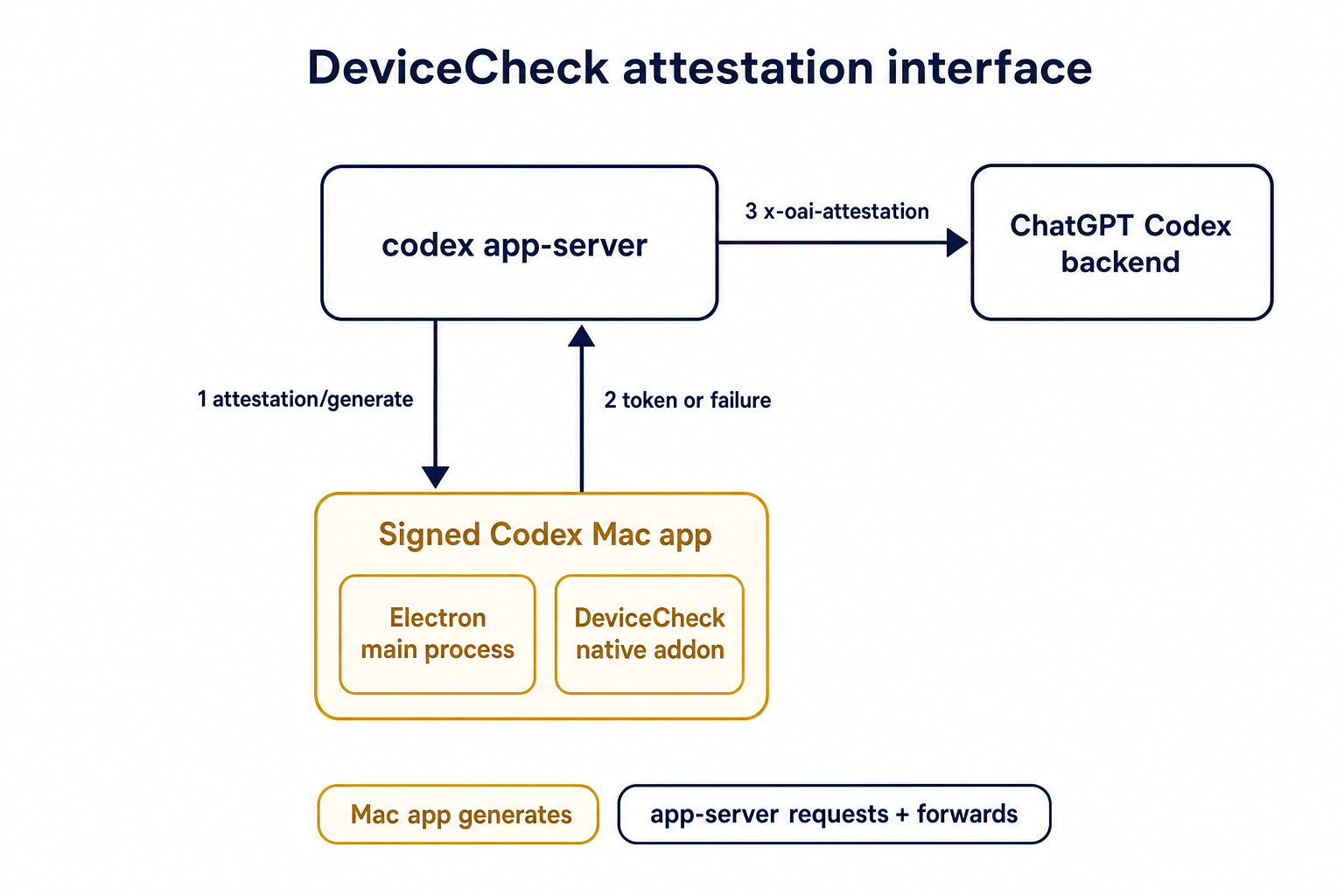
## Details
This PR teaches the Codex app-server runtime how to request and attach
an attestation token. It does not generate DeviceCheck tokens directly;
instead, it relies on the connected desktop app to advertise that it can
generate attestation and then asks that app for a fresh header value
when needed.
The flow is:
1. The Codex desktop app connects to app-server.
2. During `initialize`, the app can advertise that it supports
`requestAttestation`.
3. Before app-server calls selected ChatGPT Codex endpoints, it sends
the internal server request `attestation/generate` to the app.
4. app-server receives a pre-encoded header value back.
5. app-server forwards that value as `x-oai-attestation` on the scoped
outbound requests.
The code in this repo is mostly protocol and runtime plumbing: it adds
the app-server request/response shape, introduces an attestation
provider in core, wires that provider into Responses / compaction /
realtime setup paths, and covers the intended scoping with tests. The
signed macOS DeviceCheck generation remains owned by the desktop app PR.
## Related PR
- Codex desktop app implementation:
https://github.com/openai/openai/pull/878649
## Validation
<details>
<summary>Tests run</summary>
```sh
cargo test -p codex-app-server-protocol
cargo test -p codex-core attestation --lib
cargo test -p codex-app-server --lib attestation
```
Also ran:
```sh
just fix -p codex-core
just fix -p codex-app-server
just fix -p codex-app-server-protocol
just fmt
just write-app-server-schema
```
</details>
<details>
<summary>E2E DeviceCheck validation</summary>
First validated the signed desktop app boundary directly: launched a
packaged signed `Codex.app`, sent `attestation/generate`, decoded the
returned `v1.` attestation header, and validated the extracted
DeviceCheck token with `personal/jm/verify_devicecheck_token.py` using
bundle ID `com.openai.codex`. Apple returned `status_code: 200` and
`is_ok: true`.
Then ran the fuller app + app-server flow. The packaged `Codex.app`
launched a current-branch app-server via `CODEX_CLI_PATH`, and a local
MITM proxy intercepted outbound `chatgpt.com` traffic. The app-server
requested `attestation/generate` from the real Electron app process, and
the intercepted `/backend-api/codex/responses` traffic included
`x-oai-attestation` on both routes:
```text
GET /backend-api/codex/responses Upgrade: websocket x-oai-attestation: present
POST /backend-api/codex/responses Upgrade: none x-oai-attestation: present
```
The captured header decoded to a DeviceCheck token that also validated
with Apple for `com.openai.codex` (`status_code: 200`, `is_ok: true`,
team `2DC432GLL2`).
</details>
---------
Co-authored-by: Codex <noreply@openai.com>
## Why

`ToolName::display()` made it too easy to flatten tool identity and
accidentally compare rendered strings. Tool identity should stay
structural until a legacy string boundary actually requires the
flattened spelling.

## What

- Removes `ToolName::display()` and relies on the existing `Display`
impl for messages and errors.
- Adds structural ordering for `ToolName` and uses it for
sorting/deduping deferred tools.
- Carries `ToolName` through tool/sandbox plumbing, flattening only at
legacy boundaries such as hook payloads, telemetry tags, and Responses
tool names.
- Updates MCP normalization tests to assert `ToolName` structure instead
of rendered strings.

## Testing

- `cargo test -p codex-mcp test_normalize_tools`
- `cargo test -p codex-core unavailable_tool`
- `just fix -p codex-protocol`
- `just fix -p codex-mcp`
- `just fix -p codex-core`
## Why

The earlier PRs add stdio transport support and the config-backed
environment provider, but the feature remains inert until normal Codex
entrypoints construct `EnvironmentManager` with enough context to
discover `CODEX_HOME/environments.toml`. This final stack PR activates
the provider while preserving the legacy `CODEX_EXEC_SERVER_URL`
fallback when no environments file exists.

**Stack position:** this is PR 5 of 5. It is the product wiring PR that
activates the configured environment provider added in PR 4.

## What Changed

- Thread `codex_home` into `EnvironmentManagerArgs`.
- Change `EnvironmentManager::new(...)` to load the provider from
`CODEX_HOME`.
- Preserve legacy behavior by falling back to
`DefaultEnvironmentProvider::from_env()` when `environments.toml` is
absent.
- Make `environments.toml`-backed managers start new threads with all
configured environments, default first, while keeping the legacy env-var
path single-default.
- Update the app-server, TUI, exec, MCP server, connector, prompt-debug,
and thread-manager-sample callsites to pass `codex_home` and handle
provider-loading errors.

## Self-Review Notes

- The multi-environment startup path is intentionally tied to the
`environments.toml` provider. Using `>1` configured environment as the
only signal would also expand the legacy `CODEX_EXEC_SERVER_URL`
provider because it keeps `local` addressable alongside `remote`.
- The startup environment list is still derived inside
`EnvironmentManager`; the provider only says whether its snapshot should
start new threads with all configured environments.
- The thread-manager sample was updated to pass the current
`ThreadManager::new(...)` installation id argument so the stack compiles
under Bazel.

## Stack

- 1. https://github.com/openai/codex/pull/20663 - Add stdio exec-server
listener
- 2. https://github.com/openai/codex/pull/20664 - Add stdio exec-server
client transport
- 3. https://github.com/openai/codex/pull/20665 - Make environment
providers own default selection
- 4. https://github.com/openai/codex/pull/20666 - Add CODEX_HOME
environments TOML provider
- **5. This PR:** https://github.com/openai/codex/pull/20667 - Load
configured environments from CODEX_HOME

Split from original draft: https://github.com/openai/codex/pull/20508

## Validation

- `just fmt`
- `git diff --check`
- `bazel build --config=remote --strategy=remote
--remote_download_toplevel
//codex-rs/thread-manager-sample:codex-thread-manager-sample`
- `bazel test --config=remote --strategy=remote
--remote_download_toplevel
//codex-rs/exec-server:exec-server-unit-tests`
- `bazel test --config=remote --strategy=remote
--remote_download_toplevel --test_sharding_strategy=disabled
--test_arg=default_thread_environment_selections_use_manager_default_id
//codex-rs/core:core-unit-tests`
- `bazel test --config=remote --strategy=remote
--remote_download_toplevel --test_sharding_strategy=disabled
--test_arg=start_thread_uses_all_default_environments_from_codex_home
//codex-rs/core:core-unit-tests`

## Documentation

This activates `CODEX_HOME/environments.toml`; user-facing documentation
should be added before this stack is treated as a documented public
workflow.

---------

Co-authored-by: Codex <noreply@openai.com>
## Why

`/fast` was wired as a one-off slash command even though model metadata
now exposes service tiers as catalog data. That meant adding another
tier, such as a slower/cheaper tier, would require more hardcoded TUI
plumbing instead of letting the model catalog drive the available
commands.

This change makes service-tier commands data-driven: each advertised
`service_tiers` entry becomes a `/name` command using the catalog
description, while the request path sends the tier `id` only when the
selected model supports it.

## What Changed

- Removed the hardcoded `/fast` slash-command variant and introduced
dynamic service-tier command items in the composer and command popup.
- Added toggle behavior for service-tier commands: invoking `/name`
selects that tier, and invoking it again clears the selection.
- Preserved the existing Fast-mode keybinding/status affordances by
resolving the current model tier whose name is `fast`, while still
sending the tier request value such as `priority`.
- Persisted service-tier selections as raw request strings so non-fast
tiers can round-trip through config.
- Updated the Bedrock catalog entry to advertise fast support through
`service_tiers` with `id: "priority"` and `name: "fast"`.
- Added defensive filtering in core so unsupported selected service
tiers are omitted from `/responses` requests.

## Validation

- Added/updated coverage for dynamic service-tier slash command lookup,
popup descriptions, composer dispatch, TUI fast toggling, and
unsupported-tier omission in core request construction.
- Local tests were not run per request.

---------

Co-authored-by: Codex <noreply@openai.com>
## Why
Some consumers expect conventional hyphenated HTTP headers. Codex
already sends the session and thread IDs on outbound Responses requests,
but it only uses the underscore spellings today, which makes those IDs
harder to consume in systems that normalize or reject underscore header
names.

Full context here:
https://openai.slack.com/archives/C08KCGLSPSQ/p1778248578422369

## What changed
- `build_session_headers` now emits both `session_id` and `session-id`
when a session ID is present.
- It does the same for `thread_id` and `thread-id`.
- Added regression coverage in `codex-api/tests/clients.rs` and
`core/tests/suite/client.rs` so both the lower-level client tests and
the end-to-end request tests assert the two header spellings are
present.

## Test plan
- Added header assertions in `codex-api/tests/clients.rs`.
- Added request-header assertions in `core/tests/suite/client.rs` for
both the `/v1/responses` and `/api/codex/responses` request paths.
## Summary
- enable `apply_patch_freeform` by default in the feature registry

## Why
- make the freeform `apply_patch` tool available by default when model
metadata does not explicitly opt into another mode

## Validation
- `just fmt`
- did not run tests

---------

Co-authored-by: Codex <noreply@openai.com>
## Why

`service_tier` in `config.toml` and profile config was still modeled as
an enum, which blocked newer or experimental service tier IDs even
though the runtime paths already carry string IDs.

This change makes the TOML-facing config accept string service tier IDs
directly while keeping the legacy `fast` alias behavior by normalizing
it to the request value `priority`.

## What Changed

- change the TOML-facing `service_tier` fields in global and profile
config to `Option<String>`
- keep config-load normalization so legacy `fast` still resolves to
`priority`
- persist resolved service tier strings directly in config locks so
arbitrary IDs round-trip cleanly
- regenerate the config schema and add config coverage for arbitrary
string IDs plus legacy `fast` normalization

## Verification

- added config tests for arbitrary string service tiers and legacy
`fast` normalization
- ran `just write-config-schema`
- CI

---------

Co-authored-by: Codex <noreply@openai.com>
## Summary

API-key-auth remote compaction requests should not inherit
`service_tier` from normal `/responses` turns. This path needs to match
API auth expectations, while ChatGPT-auth remote compaction should keep
reusing the shared request fields that still apply there.

This change keeps the decision inline in
`codex-rs/core/src/compact_remote.rs` only. Under API key auth, the
classic remote `/responses/compact` path now omits `service_tier`; under
ChatGPT auth, it keeps reusing the configured tier.
`codex-rs/core/src/compact_remote_v2.rs` is unchanged. The remote
compaction parity coverage and snapshots were updated to assert the
API-key omission and preserve the ChatGPT-auth behavior.

## Testing

- Updated remote compaction parity coverage in
`codex-rs/core/tests/suite/compact_remote.rs` and the corresponding
snapshots.
## Why

We want terminal tool review analytics, but the reducer should not stamp
review timing from its own wall clock.

This PR plumbs review timing through the real protocol and app-server
seams so downstream analytics can consume the emitter's timestamps
directly. Guardian reviews keep their enriched `started_at` /
`completed_at` analytics fields by deriving those legacy second-based
values from the same protocol-native millisecond lifecycle timestamps,
rather than sampling a separate analytics clock.

## What changed

- add `started_at_ms` to user approval request payloads
- add `started_at_ms` / `completed_at_ms` to guardian review
notifications
- preserve Guardian review `started_at` / `completed_at` enrichment from
the protocol-native timing source
- stamp typed `ServerResponse` analytics facts with app-server-observed
`completed_at_ms`
- thread the new timing fields through core, protocol, app-server, TUI,
and analytics fixtures

## Verification

- `cargo test -p codex-app-server outgoing_message --manifest-path
codex-rs/Cargo.toml`
- `cargo test -p codex-app-server-protocol guardian --manifest-path
codex-rs/Cargo.toml`
- `cargo test -p codex-tui guardian --manifest-path codex-rs/Cargo.toml`
- `cargo test -p codex-analytics analytics_client_tests --manifest-path
codex-rs/Cargo.toml`

---
[//]: # (BEGIN SAPLING FOOTER)
Stack created with [Sapling](https://sapling-scm.com). Best reviewed
with [ReviewStack](https://reviewstack.dev/openai/codex/pull/21434).
* #18748
* __->__ #21434
* #18747
* #17090
* #17089
* #20514
## Why

Remote compaction v2 consumes a normal Responses stream, but that
compaction-specific stream consumer dropped the `response.completed` id.
As a result, the `responses_websocket_response_processed` lifecycle
notification was emitted for normal turn sampling but not after a v2
remote compaction response was fully processed.

## What changed

- Return the completed response id alongside the v2 `context_compaction`
output item.
- After v2 compacted history is installed, send `response.processed`
through the same websocket session when the feature is enabled.
- Add websocket regression coverage for a remote compaction v2 request
followed by `response.processed`.

## Verification

- `cargo test -p codex-core --test all
responses_websocket_sends_response_processed_after_remote_compaction_v2
-- --nocapture`
- `cargo test -p codex-core
collect_context_compaction_output_accepts_additional_output_items --
--nocapture`
## Why

After stdio transports and provider-owned defaults exist, Codex needs a
config-backed provider that can describe more than the single legacy
`CODEX_EXEC_SERVER_URL` remote. This PR adds that provider without
activating it in product entrypoints yet, keeping parser/validation
review separate from runtime wiring.

**Stack position:** this is PR 4 of 5. It builds on PR 3's
provider/default model and adds the `environments.toml` provider used by
PR 5.

## What Changed

- Add `environment_toml.rs` as the TOML-specific home for parsing,
validation, and provider construction.
- Keep the TOML schema/provider structs private; the public constructor
added here is `EnvironmentManager::from_codex_home(...)`.
- Add `TomlEnvironmentProvider`, including validation for:
  - reserved ids such as `local` and `none`
  - duplicate ids
  - unknown explicit defaults
  - empty programs or URLs
  - exactly one of `url` or `program` per configured environment
- Support websocket environments with `url = "ws://..."` / `wss://...`.
- Support stdio-command environments with `program = "..."`.
- Add helpers to load `environments.toml` from `CODEX_HOME`, but do not
wire entrypoints to call them yet.
- Add the `toml` dependency for parsing.

## Stack

- 1. https://github.com/openai/codex/pull/20663 - Add stdio exec-server
listener
- 2. https://github.com/openai/codex/pull/20664 - Add stdio exec-server
client transport
- 3. https://github.com/openai/codex/pull/20665 - Make environment
providers own default selection
- **4. This PR:** https://github.com/openai/codex/pull/20666 - Add
CODEX_HOME environments TOML provider
- 5. https://github.com/openai/codex/pull/20667 - Load configured
environments from CODEX_HOME

Split from original draft: https://github.com/openai/codex/pull/20508

## Validation

Not run locally; this was split out of the original draft stack.

## Documentation

This introduces the config shape for `environments.toml`; user-facing
documentation should be added before this stack is treated as a
documented public workflow.

---------

Co-authored-by: Codex <noreply@openai.com>
Route view_image through selected environments so image reads use the selected turn environment and cwd, with schema exposure limited to multi-environment toolsets.\n\nCo-authored-by: Codex <noreply@openai.com>
Remove the remote thread-store backend and checked-in protobuf
artifacts. We've moved these into another crate that link against this
one.

Also remove the config settings for thread store backend selection,
since we'll instead pass an instantiated thread store into the core-api
crate's main entrypoint.
Add Codex config for static trace span attributes and structured W3C
tracestate field upserts. The config flows through OtelSettings so
callers can attach trace metadata without touching every span call site.

Apply span attributes with an SDK span processor so every exported
trace span carries the configured metadata. Model tracestate as nested
member fields so configured keys can be upserted while unrelated
propagated state in the same member is preserved.

Validate configured tracestate before installing provider-global state,
including header-unsafe values the SDK does not reject by itself. This
keeps Codex from propagating malformed trace context from config.

Update the config schema, public docs, and OTLP loopback coverage for
config parsing, span export, propagation, and invalid-header rejection.
## Summary

`cargo test` has entails both running standard Rust tests and doctests.
It turns out that the doctest discovery is fairly slow, and it's a cost
you pay even for crates that don't include any doctests.

This PR disables doctests with `doctest = false` for crates that lack
any doctests.

For the collection of crates below, this speeds up test execution by
>4x.

E.g., before this PR:

```
Benchmark 1: cargo test     -p codex-utils-absolute-path     -p codex-utils-cache     -p codex-utils-cli     -p codex-utils-home-dir     -p codex-utils-output-truncation     -p codex-utils-path     -p codex-utils-string     -p codex-utils-template     -p codex-utils-elapsed     -p codex-utils-json-to-toml
  Time (mean ± σ):      1.849 s ±  4.455 s    [User: 0.752 s, System: 1.367 s]
  Range (min … max):    0.418 s … 14.529 s    10 runs
```

And after:

```
Benchmark 1: cargo test     -p codex-utils-absolute-path     -p codex-utils-cache     -p codex-utils-cli     -p codex-utils-home-dir     -p codex-utils-output-truncation     -p codex-utils-path     -p codex-utils-string     -p codex-utils-template     -p codex-utils-elapsed     -p codex-utils-json-to-toml
  Time (mean ± σ):     428.6 ms ±   6.9 ms    [User: 187.7 ms, System: 219.7 ms]
  Range (min … max):   418.0 ms … 436.8 ms    10 runs
```

For a single crate, with >2x speedup, before:

```
Benchmark 1: cargo test -p codex-utils-string
  Time (mean ± σ):     491.1 ms ±   9.0 ms    [User: 229.8 ms, System: 234.9 ms]
  Range (min … max):   480.9 ms … 512.0 ms    10 runs
```

And after:

```
Benchmark 1: cargo test -p codex-utils-string
  Time (mean ± σ):     213.9 ms ±   4.3 ms    [User: 112.8 ms, System: 84.0 ms]
  Range (min … max):   206.8 ms … 221.0 ms    13 runs
```

Co-authored-by: Codex <noreply@openai.com>
- Route ThreadManager rollout-path resume/fork through ThreadStore
history reads.
- Add in-memory store coverage proving path-addressed reads are used.

This isn't strictly necessary for the ThreadStore migration, since these
ThreadManager methods _only_ work for path-based lookups, but I'm trying
to migrate all the rollout recorder callsites to use the threadstore
were possible for consistency.
- Route live thread renames through `ThreadStore` metadata updates.
- Read resumed thread names from store metadata with legacy local
fallback preserved in the store.
## Why

This is the next stacked step after deleting the tool-handler kind
indirection. Specs should come from the registered handlers themselves
so registry construction has a single source of truth for handler
behavior and exposed tool definitions.

## What changed

- Added `ToolHandler::spec()` plus handler-provided parallel/code-mode
metadata, and made `ToolRegistryBuilder::register_handler` automatically
collect specs from registered handlers.
- Moved builtin tool spec construction into the corresponding handlers
and their adjacent `_spec` modules, including shell, unified exec, apply
patch, view image, request plugin install, tool search, MCP resource,
goals, planning, permissions, agent jobs, and multi-agent tools.
- Reworked configurable handlers to receive their tool-building options
through constructors, with non-optional handler options where the
handler is always spec-backed. Shell fallback handlers keep an explicit
no-spec mode because they are also registered as hidden dispatch
aliases.
- Kept `CodeModeExecuteHandler` on the explicit configured wrapper so
the code-mode exec spec can still be built from the nested registry.

## Verification

- `cargo check -p codex-core`
- `cargo test -p codex-core tools::spec_plan::tests`
- `cargo test -p codex-core tools::spec::tests`
- `cargo test -p codex-core tools::handlers::multi_agents_spec::tests`
- `RUST_MIN_STACK=16777216 cargo test -p codex-core
tools::handlers::multi_agents::tests`
- `cargo test -p codex-core tools::handlers::apply_patch::tests`
- `cargo test -p codex-core tools::handlers::unified_exec::tests`
- `just fix -p codex-core`
- `git diff --check`
## Why

App-server config writes were leaving existing threads partially stale.
After a config mutation, the app-server told each live thread to run
`Op::ReloadUserConfig`, but that path only re-read the user
`config.toml` layer. Settings that came from the app-server's
materialized config snapshot did not propagate to existing threads until
restart.

This change prevent a FS access from `core` for CCA.

## What changed

- add `CodexThread::refresh_runtime_config()` and
`Session::refresh_runtime_config()` so the app-server can push a freshly
rebuilt config snapshot into a live thread
- rebuild the latest config with each thread's `cwd` after config
mutations, then refresh the thread from that snapshot instead of asking
it to reload only `config.toml`
- keep session-static settings unchanged during refresh, while updating
runtime-refreshable state such as the config layer stack,
`tool_suggest`, and derived hook/plugin/skill state
- keep `reload_user_config_layer()` as the file-backed fallback for
legacy local reload flows, but route the shared refresh logic through
the new runtime refresh path

## Testing

- add a session test that verifies `refresh_runtime_config()` rebuilds
hooks from refreshed config
- add a session test that verifies runtime-refreshable fields update
while session-static settings like `model` and `notify` stay unchanged

---------

Co-authored-by: Codex <noreply@openai.com>
## Summary

This PR removes the synthetic `HashMap<String, ToolInfo>` keys from MCP
tool discovery. `McpConnectionManager::list_all_tools()` now returns
normalized `Vec<ToolInfo>`, and downstream code derives identity from
`ToolInfo::canonical_tool_name()`.

The motivation is to keep model-visible tool identity on
`ToolName`/`ToolInfo` instead of parallel string map keys, so future
namespace changes do not have to preserve otherwise-unused lookup keys.

## Changes

- Rename the MCP normalization path from `qualify_tools` to
`normalize_tools_for_model` and return tool values directly.
- Flow MCP tool lists through connectors, plugin injection, router/spec
building, code mode, and tool search as vectors/slices.
- Keep direct/deferred subtraction local to `mcp_tool_exposure`, using
`ToolName` values.
- Update tests to compare `ToolName` instances where MCP identity
matters.

## Validation

- `cargo test -p codex-mcp test_normalize_tools`
- `cargo test -p codex-core mcp_tool_exposure`
- `cargo test -p codex-core
direct_mcp_tools_register_namespaced_handlers`
- `cargo test -p codex-core
search_tool_registers_namespaced_mcp_tool_aliases`
- `just fix -p codex-mcp`
- `just fix -p codex-core`
## Why

Follow-up to #21180: turn diffs are operation-backed now, but a failed
`apply_patch` can still leave exact filesystem mutations behind. For
example, a move can write the destination file before failing to remove
the source. Treating the whole call as unknowable then drops a change
that Codex actually knows happened, so the emitted turn diff can drift
from the workspace.

## What changed

-
[`apply-patch`](f55724e027/codex-rs/apply-patch/src/lib.rs (L248-L345))
now returns `ApplyPatchFailure` with the exact committed prefix
accumulated before an error. If a write failure may already have mutated
the target, the delta is marked inexact instead of being reused blindly.
- Move handling now records the destination write before attempting
source removal, so a partially failed move can still report the
destination file that definitely landed
([code](f55724e027/codex-rs/apply-patch/src/lib.rs (L463-L521))).
-
[`ApplyPatchRuntime`](f55724e027/codex-rs/core/src/tools/runtimes/apply_patch.rs (L49-L67))
now accumulates committed deltas across attempts and forwards them even
when the visible tool result is failed or sandbox-denied ([runtime
path](f55724e027/codex-rs/core/src/tools/runtimes/apply_patch.rs (L223-L250)),
[event
path](f55724e027/codex-rs/core/src/tools/events.rs (L215-L225))).
- `TurnDiffTracker` now consumes committed exact deltas rather than only
fully successful patches; exact-empty failures leave the aggregate
unchanged, while inexact deltas still invalidate it.

## Verification

- Added a regression test covering a failed move that still emits the
committed destination diff:
[`apply_patch_failed_move_preserves_committed_destination_diff`](f55724e027/codex-rs/core/tests/suite/apply_patch_cli.rs (L1517-L1586)).
- Kept explicit coverage that an inexact delta clears the aggregate
instead of publishing a guessed diff:
[`apply_patch_clears_aggregated_diff_after_inexact_delta`](f55724e027/codex-rs/core/tests/suite/apply_patch_cli.rs (L1589-L1655)).

---------

Co-authored-by: Codex <noreply@openai.com>
## Summary
- replace filesystem-based turn diff tracking with an operation-backed
accumulator
- preserve enough verified apply_patch state to render move-overwrite
cases correctly
- keep the turn/diff/updated contract intact while removing remote-only
turn-diff test skips

This takes the assumption that no 3P services rely on the output format
of `apply_patch`

## Why
For the CCA file system isolation push

---------

Co-authored-by: Codex <noreply@openai.com>

