## Why

Managed requirements can already centrally disable apps, but they could
not express the per-tool app approval rules that normal config already
supports. That left admins without a way to enforce connector tool
approvals through `/etc/codex/requirements.toml` or cloud requirements.

## What changed

- Extend app requirements with per-tool `approval_mode` entries.
- Merge managed app tool requirements across managed sources while
preserving higher-precedence exact tool settings.
- Apply managed tool approvals separately from user app config so
managed policy is matched only on raw MCP `tool.name`, while user config
keeps the existing raw-name-then-title convenience fallback.
- Add coverage for local requirements, cloud requirements parsing,
managed-over-user precedence, and a title-collision case that must not
widen managed auto-approval.

## Configuration shape

Local `/etc/codex/requirements.toml` and cloud requirements use the same
TOML shape:

```toml
[apps.connector_123123.tools."calendar/list_events"]
approval_mode = "approve"
```

This is a per-tool approval rule keyed by app ID and raw MCP tool name,
not an app-level boolean such as `apps.connector_123123.approve = true`.
This PR replaces the TUI’s file-only `@mention` popup with a unified
mentions experience. Typing `@...` now searches across filesystem
matches, installed plugins, and skills in one popup, with result types
clearly labeled and selectable from the same flow.

- Adds a unified `@mentions` popup that returns:
  - plugins
  - skills
  - files
  - directories

- Adds search modes so users can narrow the popup without changing their
query:
  - All Results _(default/same as Codex App)_
  - Filesystem Only
  - Plugins _(...and skills)_

- Preserves existing insertion behavior:
  - selected file paths are inserted into the prompt
  - paths with spaces are quoted
  - image file selections still attach as images when possible
  - selecting a plugin or skill inserts the corresponding `$name`
- the composer records the canonical mention binding, such as
`plugin://...` or the skill path

- Expanded `@mentions` rendering:
  - type tags for Plugin, Skill, File, and Dir
  - distinct plugin/filesystem colors
  - stable fixed-height layout (8 rows)
  - truncation behavior for narrow terminals

Note:
- The unified mentions popup does not display app connectors under
`@mention` results for Codex App parity. Connector mentions remain
available through the existing `$mention` path.


https://github.com/user-attachments/assets/f93781ed-57d3-4cb5-9972-675bc5f3ef3f
## Summary
- add SQLite init, backfill-gate, and fallback telemetry without
introducing a cross-cutting state-db access wrapper
- install one process-scoped telemetry sink after OTEL startup and let
low-level state/rollout paths emit through it directly
- add process-start metrics for the process owners that initialize
SQLite

---------

Co-authored-by: Owen Lin <owen@openai.com>
## Why

Users have requested the ability to edit a goal's objective after a goal
has been created. This PR exposes a new `/goal edit` command in the TUI
to address this request.

In the process of implementing this, I also noticed an existing bug in
the goal runtime. When a goal's objective is updated through the
`thread/goal/set` app server API, the goal runtime didn't emit a new
steering prompt to tell the agent about the new objective. This PR also
fixes this hole.

## What Changed

- Adds `/goal edit` in the TUI, opening an edit box prefilled with the
current goal objective.
- Keeps active and paused goals in their current state, resets completed
goals to active, keeps budget-limited goals budget-limited, and
preserves the existing token budget.
- Changes the existing `thread/goal/set` behavior so editing an
objective preserves goal accounting instead of resetting it. The older
reset-on-new-objective behavior was left over from before
`thread/goal/clear`; clients that need to reset accounting can now clear
the existing goal and create a new one.
- Reuses the existing goal set API path; this does not add or change
app-server protocol surface area.
- Adds a dedicated goal runtime steering prompt when an externally
persisted goal mutation changes the objective, so active turns receive
the updated objective.

## Validation

- Make sure `/goal edit` returns an error if no goal currently exists
- Make sure `/goal edit` displays an edit box that can be optionally
canceled with no side effects
- Make sure that an edited goal results in a steer so the agent starts
pursuing the new objective
- Make sure the new objective is reflected in the goal if you use
`/goal` to display the goal summary
- Make sure that `/goal edit` doesn't reset the token budget, time/token
accounting on the updated goal
Addresses #22101

## Why

Side conversations are ephemeral forks of the active thread, but `/side`
was building its fork config from the app-level config after refreshing
it from disk. If the parent thread had runtime settings that differed
from the current persisted defaults, such as a changed model, reasoning
effort, permissions, reviewer, or fast-mode selection, the side
conversation could start with different behavior than its parent.

## What changed

- Build side fork config from the active parent `ChatWidget` config,
then overlay the parent thread's effective model, reasoning effort,
service tier, and fast-mode opt-out state.
- Forward model reasoning summary, verbosity, personality, web search
mode, and service-tier overrides through TUI app-server
start/resume/fork lifecycle params.
- Add focused tests for parent runtime inheritance, side developer
guardrail preservation, and lifecycle param forwarding.
## Summary

A user reported that `/goal` was not saved to the TUI command history,
which made it unavailable for later recall even though other accepted
input paths persist history entries.

This updates the TUI goal slash-command dispatch so successful `/goal`
invocations append the command text to message history. The change
covers the bare `/goal` menu command, goal control commands such as
`/goal pause`, and objective-setting commands such as `/goal improve
benchmark coverage`.

## Verification

- `cargo test -p codex-tui goal_slash_command -- --nocapture`
## Why

The TUI currently treats Markdown tables as ordinary wrapped text, which
makes table-heavy responses hard to read and brittle across narrow panes
and terminal resizes.

This change teaches the TUI to render Markdown tables responsively while
preserving the raw Markdown source needed to re-render streamed and
finalized transcript content after width changes. The goal is to keep
tables legible during streaming, after resize, and once a turn has
finished, without corrupting scrollback ordering.

## What Changed

- add table detection and responsive table rendering in the Markdown
renderer
- render standard tables with Unicode box-drawing borders when the pane
is wide enough
- add a vertical readability fallback for constrained or dense tables so
narrow panes still show each row clearly
- keep links and `<br>` content inside table cells instead of leaking
text outside the table
- avoid table normalization inside fenced or indented code blocks
- preserve raw streamed Markdown source and keep the active table as a
mutable tail until finalization
- consolidate finalized streamed content into source-backed transcript
cells so post-resize re-rendering stays correct
- add snapshot and targeted streaming/resize regression coverage for the
new table behavior

## How to Test

1. Start Codex TUI from this branch.
2. Paste this exact prompt:
`This is a session to test codex, no need to do any thinking, just end
different markdown tables, with columns exploring different markdown
contents, like links, bold italic, code, etc. Make them different sizes,
some 30+ rows, some not and intertwine them with some paragraphs with
complex formatting as well.`
3. Confirm the response includes several Markdown tables mixed with
richly formatted paragraphs.
4. Confirm wide-enough tables render with box-drawing borders instead of
plain wrapped pipe text.
5. Resize the terminal narrower while the answer is still streaming and
confirm the in-progress table stays coherent instead of duplicating
headers or leaving broken scrollback behind.
6. Resize again after the turn finishes and confirm the finalized
transcript re-renders cleanly at the new width.
7. In a narrow pane, verify dense tables fall back to the vertical
per-row layout instead of producing unreadable wrapped columns.
8. Also verify pipe-heavy fenced code blocks still render as code, not
as tables.

Targeted tests:
- `cargo test -p codex-tui table_readability_fallback --no-fail-fast`
- `cargo test -p codex-tui markdown_render --no-fail-fast`
- `cargo test -p codex-tui streaming::controller --no-fail-fast`
- `cargo test -p codex-tui table_resize_lifecycle --no-fail-fast`

## Docs

No developer docs update appears necessary.
## Why
Inside tmux, `Shift+Enter` can still reach Codex as a plain `Enter` even
when tmux has extended keys enabled. In `csi-u` tmux panes, Codex needs
to request `modifyOtherKeys` mode 2 so tmux moves the pane from `VT10x`
into extended-key mode and preserves the Shift modifier. Without that
extra request, composer `Shift+Enter` submits the draft instead of
inserting a newline.
Fixes#21699.
## What Changed
- Detect tmux sessions and read the active `extended-keys-format`,
preferring the pane-local value before falling back to the global
option.
- Request `modifyOtherKeys` mode 2 for tmux panes using `csi-u` extended
keys, and reset it when restoring keyboard reporting.
- Add unit coverage for tmux detection, the format gate, and the emitted
`modifyOtherKeys` escape sequence.
## How to Test
1. In tmux, configure:
```tmux
set-option -g extended-keys on
set-option -g extended-keys-format csi-u
```
2. Start Codex in a fresh tmux pane from this branch.
3. From another pane, confirm the Codex pane reports `mode=Ext 2`:
```bash
tmux list-panes -a -F '#{session_name}:#{window_index}.#{pane_index}
mode=#{pane_key_mode} cmd=#{pane_current_command}'
```
4. Type a draft in the composer and press `Shift+Enter`; confirm it
inserts a newline instead of submitting.
5. Also confirm plain `Enter` still submits as before.
Targeted tests:
- `cargo test -p codex-tui`
## Notes
- Manual verification used both real `Shift+Enter` in iTerm2/tmux and
`tmux send-keys ... S-Enter` to confirm the tmux pane changes from
`VT10x` to `Ext 2` and preserves newline behavior.
- On this checkout, the broader `codex-tui` test run currently reaches
unrelated existing failures in `status::tests::*` plus a later stack
overflow in
`tests::fork_last_filters_latest_session_by_cwd_unless_show_all`.
## Summary

`ChatWidget` has been carrying several independent domains in one large
state bag: transcript bookkeeping, turn lifecycle, queued input, status
surfaces, connectors, review mode, and protocol dispatch. That makes
otherwise-local changes hard to reason about because unrelated fields
and side effects live beside each other in `chatwidget.rs`.

This is the first cleanup PR in a larger decomposition effort. It does
not try to make `chatwidget.rs` small in one sweep; instead, it
establishes focused state boundaries that later handler, popup,
rendering, and effect-synchronization extractions can build on.

This PR keeps `ChatWidget` as the composition layer while moving focused
state into smaller `codex-tui` modules. The widget still owns effects
that touch the bottom pane, app events, command submission, redraw
scheduling, and terminal-title updates.

## Changes

- Add focused state modules under `codex-rs/tui/src/chatwidget/` for
input queues, turn lifecycle, transcript bookkeeping, status state,
connectors, review mode, and app-server protocol dispatch.
- Update `ChatWidget` to hold grouped state structs and route
input/lifecycle/status operations through those focused helpers.
- Move app-server notification dispatch into `chatwidget/protocol.rs`
while leaving feature handlers and side effects on `ChatWidget`.
- Replace the large manual `ChatWidget` test literal with the normal
constructor plus narrow test overrides, so future state moves do not
require every field to be restated in test setup.
- Update existing tests to access the new grouped state or narrower
helpers without changing snapshot behavior.

## Longer-term direction

Follow-up PRs can continue shrinking `chatwidget.rs` by moving behavior,
not just state, into focused modules:

- Extract input/submission flow, turn/stream handling, and tool-cell
lifecycles into domain modules that call the new state reducers.
- Move popup/settings builders and rendering helpers out of the main
widget file so `ChatWidget` stays focused on composition.
- Reduce direct `BottomPane` mutation by applying domain-specific sync
outputs at clearer boundaries.
## Why
Fixes#16688.
The TUI currently hydrates collab receiver metadata by awaiting
`thread/read` before each active-thread notification is rendered. During
large subagent fan-outs, the embedded app-server can be busy starting
agents and processing spawn work, so those synchronous metadata reads
queue behind the fan-out and block the TUI event loop. That makes the UI
appear frozen even though the underlying agent work can continue.
## What Changed
- Replaced eager `thread/read` metadata hydration on the active
notification path with local receiver-thread caching.
- Kept `ThreadStarted` and picker refreshes as the places that fill in
agent nickname/role metadata when it is available.
- Skipped caching receiver threads that are explicitly reported as
`NotFound`, avoiding live-looking ghost entries for failed stale-agent
calls.
- Added TUI tests covering both local receiver caching and `NotFound`
suppression.
## Verification
- `cargo test -p codex-tui collab_receiver_notification`
- `just fix -p codex-tui`
I also ran the full `cargo test -p codex-tui`; the new test passed, but
the full process later aborted with an unrelated stack overflow in
`tests::fork_last_filters_latest_session_by_cwd_unless_show_all`.
# Why
Hooks that need trust review were easy to miss, and the existing TUI
flow made users discover `/hooks` manually before they could decide
whether to inspect or trust them.

# What
- add a startup review prompt for new or changed hooks before normal
composer use
- add a top-level `t` shortcut in `/hooks` to trust every review-needed
hook at once
- make pending-review rows and helper copy use warning styling

## TUI

### Startup review interstitial

```text
Hooks need review
2 hooks are new or changed.
Hooks can run outside the sandbox after you trust them.

› 1. Review hooks
  2. Trust all and continue
  3. Continue without trusting (hooks won't run)
```

### Top-level `/hooks` page when review is needed

```text
Hooks
Lifecycle hooks from config and enabled plugins.

⚠ 1 hook needs review before it can run.

Event                 Installed   Active   Review   Description
PreToolUse            1           0        1        Before a tool executes
...

Press t to trust all; enter to review hooks; esc to close
```
## Why

On light terminal backgrounds, selected rows in several TUI pickers were
rendered with the same bright cyan accent used on dark themes. Against
the light menu surface, that made the current selection hard to
distinguish at a glance.

<table><tr>
<td>
<p align="center">Before</p>
<img width="1109" height="864" alt="SCR-20260509-nmtz"
src="https://github.com/user-attachments/assets/b31ce0d0-19c2-4bdd-a220-7acc77bd8e8e"
/>
</td>
<td>
<p align="center">After</p>
<img width="1164" height="844" alt="SCR-20260509-nmox"
src="https://github.com/user-attachments/assets/7b3fede0-4739-4a9f-a979-cdbb7451841f"
/>
</td>
</tr></table>

## What changed

- Added a shared background-aware accent style for active/selected TUI
controls.
- Use a darker cyan-family accent on light backgrounds while preserving
the existing bright cyan accent on dark or unknown backgrounds.
- Reused that accent across shared picker rows and the custom
selection-like surfaces that had drifted separately: picker tabs, hooks
browsing, external-agent migration choices, and /keymap affordances.
- Added focused tests for the light/dark accent rule and rendered
selected-row styling.

## How to Test

1. Start Codex in a terminal using a light background theme.
2. Type `/` to open the slash-command picker and move the selection
through a few rows.
3. Confirm that the selected row is visibly colored with strong contrast
instead of blending into the popup surface.
4. Open `/keymap` and confirm the active tab, selected rows, and picker
hint accents use the same light-theme accent treatment.
5. In a dark terminal theme, repeat the slash-picker check and confirm
the existing bright cyan selection styling is preserved.

Targeted tests:
- `cargo test -p codex-tui accent_style_uses_`
- `cargo test -p codex-tui selected_rows_use_the_shared_accent_style`
- `cargo test -p codex-tui
selected_event_rows_use_the_shared_accent_style`

Notes:
- A full `cargo test -p codex-tui` run reached the end of the suite but
hit an unrelated existing stack overflow in
`tests::fork_last_filters_latest_session_by_cwd_unless_show_all`.
## Why

Mixed prose lines that contained URLs started taking the URL-preserving
wrapping path, but that path could split ordinary words mid-token. A
follow-up issue remained in scrollback insertion: when already-rendered
indented rows were wrapped again, continuation rows could lose their
margin and fall back to terminal hard wrapping. Together those bugs made
normal Markdown output look broken around links, lists, blockquotes, and
indented content.

Separately, the local argument-comment lint wrappers failed under
environments that set `PYTHONSAFEPATH=1`, because Python no longer adds
the script directory to `sys.path` automatically. That prevented the
lint from reaching Rust callsites at all.

<img width="1778" height="1558" alt="CleanShot 2026-05-09 at 11 51 38"
src="https://github.com/user-attachments/assets/9274d150-1757-4f1a-89ac-5bdc9997d8cb"
/>

## What Changed

- Preserve URL tokens without turning every neighboring prose word into
a character-level split point.
- Add a mixed URL/prose wrapper that keeps ordinary words whole,
preserves leading whitespace, and re-splits long non-URL tokens against
the actual width available on continuation rows.
- Reuse a rendered history row's leading whitespace as the continuation
indent when scrollback insertion has to pre-wrap it again.
- Add regression coverage for markdown wrapping, history-cell rendering,
scrollback continuation margins, leading-indent width accounting, and
continuation-row re-splitting.
- Make both argument-comment lint entrypoints explicitly add their own
directory to `sys.path`, so sibling imports still work when
`PYTHONSAFEPATH=1`.

## How to Test

1. Start Codex and render a long Markdown response that mixes prose with
inline links, blockquotes, lists, and indented code-like text.
2. Confirm that ordinary words next to links stay whole instead of
breaking mid-word.
3. Resize or replay the transcript and confirm wrapped continuation rows
keep their expected left margin for blockquotes, lists, and indented
content.
4. Run the source argument-comment lint from a shell with
`PYTHONSAFEPATH=1` and confirm it starts normally instead of failing to
import `wrapper_common`.

Targeted tests:
- `cargo test -p codex-tui mixed_line --lib`
- `cargo test -p codex-tui preserves_prefix_on_wrapped_rows --lib`
- `cargo test -p codex-tui
agent_markdown_cell_does_not_split_words_after_inline_markdown --lib`
- `cargo test -p codex-tui
mixed_url_markdown_wraps_prose_without_splitting_words_snapshot --lib`
- `python3 tools/argument-comment-lint/test_wrapper_common.py`
- `just argument-comment-lint-from-source -p codex-tui -- --lib`

Notes:
- `cargo test -p codex-tui` currently reaches the new tests
successfully, then still aborts in the pre-existing
`tests::fork_last_filters_latest_session_by_cwd_unless_show_all`
stack-overflow failure.
## Why

Service-tier slash commands are built from model-catalog metadata. If
the catalog returns a name like `Fast`, the TUI currently exposes
`/Fast` and exact dispatch expects that casing, which is inconsistent
with the lowercase command style used elsewhere.

## What

- Lowercase service-tier command names when converting catalog tiers
into `ServiceTierCommand` values.
- Add regression coverage that seeds a catalog tier named `Fast` and
expects the generated command to be `fast`.

## Testing

Not run locally per repo instruction; PR CI should run the new
`service_tier_commands_lowercase_catalog_names` coverage.
## Summary
TL;DR: teaches `codex-rs` / app-server to request a desktop-provided
attestation token and attach it as `x-oai-attestation` on the scoped
ChatGPT Codex request paths.
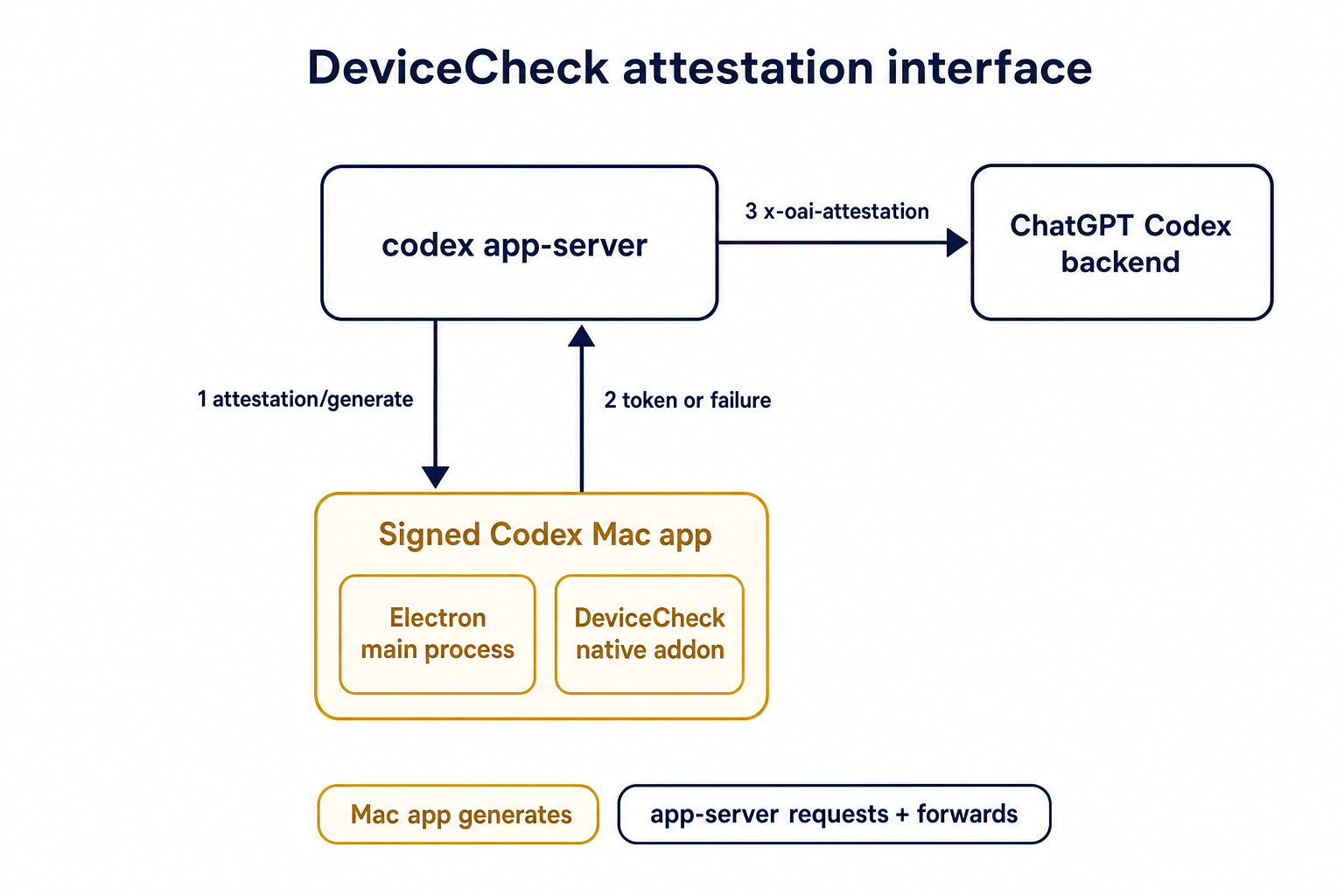
## Details
This PR teaches the Codex app-server runtime how to request and attach
an attestation token. It does not generate DeviceCheck tokens directly;
instead, it relies on the connected desktop app to advertise that it can
generate attestation and then asks that app for a fresh header value
when needed.
The flow is:
1. The Codex desktop app connects to app-server.
2. During `initialize`, the app can advertise that it supports
`requestAttestation`.
3. Before app-server calls selected ChatGPT Codex endpoints, it sends
the internal server request `attestation/generate` to the app.
4. app-server receives a pre-encoded header value back.
5. app-server forwards that value as `x-oai-attestation` on the scoped
outbound requests.
The code in this repo is mostly protocol and runtime plumbing: it adds
the app-server request/response shape, introduces an attestation
provider in core, wires that provider into Responses / compaction /
realtime setup paths, and covers the intended scoping with tests. The
signed macOS DeviceCheck generation remains owned by the desktop app PR.
## Related PR
- Codex desktop app implementation:
https://github.com/openai/openai/pull/878649
## Validation
<details>
<summary>Tests run</summary>
```sh
cargo test -p codex-app-server-protocol
cargo test -p codex-core attestation --lib
cargo test -p codex-app-server --lib attestation
```
Also ran:
```sh
just fix -p codex-core
just fix -p codex-app-server
just fix -p codex-app-server-protocol
just fmt
just write-app-server-schema
```
</details>
<details>
<summary>E2E DeviceCheck validation</summary>
First validated the signed desktop app boundary directly: launched a
packaged signed `Codex.app`, sent `attestation/generate`, decoded the
returned `v1.` attestation header, and validated the extracted
DeviceCheck token with `personal/jm/verify_devicecheck_token.py` using
bundle ID `com.openai.codex`. Apple returned `status_code: 200` and
`is_ok: true`.
Then ran the fuller app + app-server flow. The packaged `Codex.app`
launched a current-branch app-server via `CODEX_CLI_PATH`, and a local
MITM proxy intercepted outbound `chatgpt.com` traffic. The app-server
requested `attestation/generate` from the real Electron app process, and
the intercepted `/backend-api/codex/responses` traffic included
`x-oai-attestation` on both routes:
```text
GET /backend-api/codex/responses Upgrade: websocket x-oai-attestation: present
POST /backend-api/codex/responses Upgrade: none x-oai-attestation: present
```
The captured header decoded to a DeviceCheck token that also validated
with Apple for `com.openai.codex` (`status_code: 200`, `is_ok: true`,
team `2DC432GLL2`).
</details>
---------
Co-authored-by: Codex <noreply@openai.com>
## Why

The earlier PRs add stdio transport support and the config-backed
environment provider, but the feature remains inert until normal Codex
entrypoints construct `EnvironmentManager` with enough context to
discover `CODEX_HOME/environments.toml`. This final stack PR activates
the provider while preserving the legacy `CODEX_EXEC_SERVER_URL`
fallback when no environments file exists.

**Stack position:** this is PR 5 of 5. It is the product wiring PR that
activates the configured environment provider added in PR 4.

## What Changed

- Thread `codex_home` into `EnvironmentManagerArgs`.
- Change `EnvironmentManager::new(...)` to load the provider from
`CODEX_HOME`.
- Preserve legacy behavior by falling back to
`DefaultEnvironmentProvider::from_env()` when `environments.toml` is
absent.
- Make `environments.toml`-backed managers start new threads with all
configured environments, default first, while keeping the legacy env-var
path single-default.
- Update the app-server, TUI, exec, MCP server, connector, prompt-debug,
and thread-manager-sample callsites to pass `codex_home` and handle
provider-loading errors.

## Self-Review Notes

- The multi-environment startup path is intentionally tied to the
`environments.toml` provider. Using `>1` configured environment as the
only signal would also expand the legacy `CODEX_EXEC_SERVER_URL`
provider because it keeps `local` addressable alongside `remote`.
- The startup environment list is still derived inside
`EnvironmentManager`; the provider only says whether its snapshot should
start new threads with all configured environments.
- The thread-manager sample was updated to pass the current
`ThreadManager::new(...)` installation id argument so the stack compiles
under Bazel.

## Stack

- 1. https://github.com/openai/codex/pull/20663 - Add stdio exec-server
listener
- 2. https://github.com/openai/codex/pull/20664 - Add stdio exec-server
client transport
- 3. https://github.com/openai/codex/pull/20665 - Make environment
providers own default selection
- 4. https://github.com/openai/codex/pull/20666 - Add CODEX_HOME
environments TOML provider
- **5. This PR:** https://github.com/openai/codex/pull/20667 - Load
configured environments from CODEX_HOME

Split from original draft: https://github.com/openai/codex/pull/20508

## Validation

- `just fmt`
- `git diff --check`
- `bazel build --config=remote --strategy=remote
--remote_download_toplevel
//codex-rs/thread-manager-sample:codex-thread-manager-sample`
- `bazel test --config=remote --strategy=remote
--remote_download_toplevel
//codex-rs/exec-server:exec-server-unit-tests`
- `bazel test --config=remote --strategy=remote
--remote_download_toplevel --test_sharding_strategy=disabled
--test_arg=default_thread_environment_selections_use_manager_default_id
//codex-rs/core:core-unit-tests`
- `bazel test --config=remote --strategy=remote
--remote_download_toplevel --test_sharding_strategy=disabled
--test_arg=start_thread_uses_all_default_environments_from_codex_home
//codex-rs/core:core-unit-tests`

## Documentation

This activates `CODEX_HOME/environments.toml`; user-facing documentation
should be added before this stack is treated as a documented public
workflow.

---------

Co-authored-by: Codex <noreply@openai.com>
## Why

`/fast` was wired as a one-off slash command even though model metadata
now exposes service tiers as catalog data. That meant adding another
tier, such as a slower/cheaper tier, would require more hardcoded TUI
plumbing instead of letting the model catalog drive the available
commands.

This change makes service-tier commands data-driven: each advertised
`service_tiers` entry becomes a `/name` command using the catalog
description, while the request path sends the tier `id` only when the
selected model supports it.

## What Changed

- Removed the hardcoded `/fast` slash-command variant and introduced
dynamic service-tier command items in the composer and command popup.
- Added toggle behavior for service-tier commands: invoking `/name`
selects that tier, and invoking it again clears the selection.
- Preserved the existing Fast-mode keybinding/status affordances by
resolving the current model tier whose name is `fast`, while still
sending the tier request value such as `priority`.
- Persisted service-tier selections as raw request strings so non-fast
tiers can round-trip through config.
- Updated the Bedrock catalog entry to advertise fast support through
`service_tiers` with `id: "priority"` and `name: "fast"`.
- Added defensive filtering in core so unsupported selected service
tiers are omitted from `/responses` requests.

## Validation

- Added/updated coverage for dynamic service-tier slash command lookup,
popup descriptions, composer dispatch, TUI fast toggling, and
unsupported-tier omission in core request construction.
- Local tests were not run per request.

---------

Co-authored-by: Codex <noreply@openai.com>
Fixes#21665.
## Why
The TUI status line is the right place for compact, glanceable session
state. The original request was motivated by the need to see the active
permission posture without opening `/permissions` or `/status`,
especially when switching between safer and more permissive modes during
a session.
This PR intentionally separates `permissions` from `approval-mode`
instead of combining them into one status-line item. They answer related
but different questions: `permissions` describes the active
sandbox/profile shape, while `approval-mode` describes how command
approvals are handled. Keeping them separate makes each item
independently configurable and avoids long combined labels in an already
space-constrained status line.
The tradeoff is that users who want the full permission posture in the
status line need to opt into both items. In exchange, users can show
only the sandbox/profile label, only the approval behavior, or both, and
named user-defined profiles remain concise. Non-standard permission
shapes are rendered as `Custom permissions` rather than trying to
squeeze detailed profile contents into the status line; `/status`
remains the fuller explanatory surface.
## What changed
- Added a configurable `permissions` status-line item.
- Added a separate `approval-mode` status-line item, with `approval` as
an alias.
- Render standard permission states compactly as `Read Only`,
`Workspace`, or `Full Access`.
- Preserve user-defined permission profile names directly in the status
line.
- Render unnamed non-standard permission shapes as `Custom permissions`.
- Refresh status surfaces when `/permissions` updates the permission
profile, approval policy, or approval reviewer.
- Updated status-line preview snapshot coverage for the new items.
## Verification
- `cargo test -p codex-tui
status_permissions_non_default_workspace_write_uses_workspace_label`
- `cargo test -p codex-tui
permissions_selection_emits_history_cell_when_selection_changes`
- `cargo insta pending-snapshots --manifest-path tui/Cargo.toml`
## Why

The configurable `/statusline` and terminal title can display session
token usage. That display was using the raw total token count, which
includes cached input tokens, so it significantly overstated the token
usage compared with the blended token count shown elsewhere (in
`/status` and tracked in goals). This inconsistency resulted in user
confusion. We don't want to report cached tokens because we don't charge
for them and they are somewhat of an implementation detail that users
shouldn't care about.

## What changed

- Use `TokenUsage::blended_total()` for the `used-tokens` status surface
item so cached input is excluded.
- Add a brief comment to `tokens_in_context_window()` clarifying that it
returns raw `total_tokens`, whose meaning depends on whether the caller
has last-turn or accumulated usage.
## Summary
- Remove `perCwdExtraUserRoots` / `SkillsListExtraRootsForCwd` from the
`skills/list` app-server API.
- Drop Rust app-server and `codex-core-skills` extra-root plumbing so
skill scans are keyed by the normal cwd/user/plugin roots only.
- Regenerate app-server schemas and update docs/tests that only existed
for the removed extra-roots behavior.

## Validation
- `just write-app-server-schema`
- `just fmt`
- `cargo test -p codex-app-server-protocol`
- `cargo test -p codex-core-skills`
- `just fix -p codex-app-server-protocol`
- `just fix -p codex-core-skills`
- `just fix -p codex-app-server`
- `just fix -p codex-tui`

## Notes
- `cargo test -p codex-app-server --test all skills_list` ran the edited
skills-list cases, but the full filtered run ended on existing
`skills_changed_notification_is_emitted_after_skill_change` timeout
after a websocket `401`.
- `cargo test -p codex-tui --lib` compiled the changed TUI callers, then
failed two unrelated status permission tests because local
`/etc/codex/requirements.toml` forbids `DangerFullAccess`.
- Source-truth check found the OpenAI monorepo still has
generated/app-server-kit mirror references to the removed field; those
should be cleaned up when generated app-server types are synced or in a
companion OpenAI cleanup.
## Why

We want terminal tool review analytics, but the reducer should not stamp
review timing from its own wall clock.

This PR plumbs review timing through the real protocol and app-server
seams so downstream analytics can consume the emitter's timestamps
directly. Guardian reviews keep their enriched `started_at` /
`completed_at` analytics fields by deriving those legacy second-based
values from the same protocol-native millisecond lifecycle timestamps,
rather than sampling a separate analytics clock.

## What changed

- add `started_at_ms` to user approval request payloads
- add `started_at_ms` / `completed_at_ms` to guardian review
notifications
- preserve Guardian review `started_at` / `completed_at` enrichment from
the protocol-native timing source
- stamp typed `ServerResponse` analytics facts with app-server-observed
`completed_at_ms`
- thread the new timing fields through core, protocol, app-server, TUI,
and analytics fixtures

## Verification

- `cargo test -p codex-app-server outgoing_message --manifest-path
codex-rs/Cargo.toml`
- `cargo test -p codex-app-server-protocol guardian --manifest-path
codex-rs/Cargo.toml`
- `cargo test -p codex-tui guardian --manifest-path codex-rs/Cargo.toml`
- `cargo test -p codex-analytics analytics_client_tests --manifest-path
codex-rs/Cargo.toml`

---
[//]: # (BEGIN SAPLING FOOTER)
Stack created with [Sapling](https://sapling-scm.com). Best reviewed
with [ReviewStack](https://reviewstack.dev/openai/codex/pull/21434).
* #18748
* __->__ #21434
* #18747
* #17090
* #17089
* #20514
Supersedes the abandoned #19859, rebuilt on latest `main`.

# Why

PR #19705 adds discovery for hooks bundled with plugins, but `/plugins`
still only shows skills, apps, and MCP servers. This follow-up makes
bundled hooks visible in the same plugin detail view so users can
inspect the full plugin surface in one place.

We also need `PluginHookSummary` to populate Plugin Hooks in the app;
`hooks/list` is not enough there because plugin detail needs to show
hooks for disabled plugins too.

# What

- extend `plugin/read` with `PluginHookSummary` entries for bundled
hooks
- summarize plugin hooks while loading plugin details
- render a `Hooks` row in the `/plugins` detail popup

<img width="3456" height="848" alt="CleanShot 2026-04-27 at 11 45 34@2x"
src="https://github.com/user-attachments/assets/fe3a38d6-a260-4351-8513-fb04c93d725b"
/>
## Why

Reverts #20689 to restore the previous optional state DB plumbing. The
conflict resolution keeps the newer installation ID and session/thread
identity changes that landed after #20689, while removing the mandatory
state DB and agent graph store dependency from ThreadManager
construction.

## What changed

- Restored `Option<StateDbHandle>` through app-server, MCP server,
prompt debug, and test entry points.
- Removed the `codex-core` dependency on `codex-agent-graph-store` and
reverted descendant lookup back to the existing state DB path when
available.
- Kept newer `installation_id` forwarding by passing it beside the
optional DB handle.
- Kept local thread-name updates working when the optional state DB
handle is absent.

## Validation

- `git diff --check`
- `cargo test -p codex-thread-store`
- `cargo test -p codex-state -p codex-rollout -p
codex-app-server-protocol`
- Attempted `env CARGO_INCREMENTAL=0 cargo test -p codex-core -p
codex-app-server -p codex-app-server-client -p codex-mcp-server -p
codex-thread-manager-sample -p codex-tui`; blocked locally by a rustc
ICE while compiling `v8 v146.4.0` with `rustc 1.93.0 (254b59607
2026-01-19)` on `aarch64-apple-darwin`.
## Why

The alpha TUI can render the initial trust-directory prompt with stale
terminal text showing through spaces when startup begins below existing
shell output. The first inline viewport transition can happen while the
previous viewport is still empty, so the old clear path no-ops before
Ratatui draws the prompt. Ratatui then skips blank cells because its
previous buffer also thinks those cells are blank, leaving old terminal
contents visible inside the prompt.

## What Changed

- Clear from the new inline viewport top when the previous viewport is
empty during a viewport transition.
- Keep the existing clear-from-old-viewport behavior for normal viewport
updates.
- Add a VT100-backed regression test that pre-fills terminal contents,
performs the first viewport clear, and verifies stale text inside the
new viewport is removed while shell content above the viewport remains.

## How to Test

1. Start Codex alpha in a terminal that already has visible shell output
above the cursor.
2. Use a fresh untrusted project directory so the trust-directory prompt
appears.
3. Confirm the prompt text renders cleanly, with spaces staying blank
instead of showing fragments of previous shell output.
4. As a regression check, confirm content above the inline viewport is
still preserved in terminal scrollback.

Targeted tests:
- `cargo test -p codex-tui
first_viewport_change_clears_from_new_viewport_when_old_viewport_is_empty
-- --nocapture`
- `cargo test -p codex-tui`
Based on work from Vincent K -
https://github.com/openai/codex/pull/19060

<img width="1836" height="642" alt="CleanShot 2026-04-29 at 20 47 40@2x"
src="https://github.com/user-attachments/assets/b647bb89-65fe-40c8-80b0-7a6b7c984634"
/>

## Why

Compaction rewrites the conversation context that future model turns
receive, but hooks currently have no deterministic lifecycle point
around that rewrite. This adds compact lifecycle hooks so users can
audit manual and automatic compaction, surface hook messages in the UI,
and run post-compaction follow-up without overloading tool or prompt
hooks.

## What Changed

- Added `PreCompact` and `PostCompact` hook events across hook config,
discovery, dispatch, generated schemas, app-server notifications,
analytics, and TUI hook rendering.
- Added trigger matching for compact hooks with the documented `manual`
and `auto` matcher values.
- Wired `PreCompact` before both local and remote compaction, and
`PostCompact` after successful local or remote compaction.
- Kept compact hook command input to lifecycle metadata: session id,
Codex turn id, transcript path, cwd, hook event name, model, and
trigger.
- Made compact stdout handling consistent with other hooks: plain stdout
is ignored as debug output, while malformed JSON-looking stdout is
reported as failed hook output.
- Added integration coverage for compact hook dispatch, trigger
matching, post-compact execution, and the audited behavior that
`decision:"block"` does not block compaction.

## Out of Scope

- Hook-specific compaction blocking is not implemented;
`decision:"block"` and exit-code-2 blocking semantics are intentionally
unsupported for `PreCompact`.
- Custom compaction instructions are not exposed to compact hooks in
this PR.
- Compact summaries, summary character counts, and summary previews are
not exposed to compact hooks in this PR.

## Verification

- `cargo test -p codex-hooks`
- `cargo test -p codex-core
manual_pre_compact_block_decision_does_not_block_compaction`
- `cargo test -p codex-app-server hooks_list`
- `cargo test -p codex-core config_schema_matches_fixture`
- `cargo test -p codex-tui hooks_browser`

## Docs

The developer documentation for Codex hooks should be updated alongside
this feature to document `PreCompact` and `PostCompact`, the
`manual`/`auto` matcher values, and the compact hook payload fields.

---------

Co-authored-by: Vincent Koc <vincentkoc@ieee.org>
Adds marketplaceKinds to plugin/list for local, workspace-directory, and
shared-with-me; omitted params keep default local plus gated global
behavior, while explicit kinds are exact.

Exposes shareContext on plugin summaries from local share mappings and
remote workspace/shared responses, including remotePluginId and nullable
creator metadata.

Adds shared-with-me listing through /ps/plugins/workspace/shared,
renames the workspace remote namespace to workspace-directory, and keeps
direct remote read/share/install/update/delete paths gated by plugins
rather than remote_plugin.
## Summary
- mark TUI-created thread starts and forks with explicit `thread_source
= user`
- add focused coverage for embedded and remote lifecycle request
builders

## Why
Thread analytics now consume an explicit thread-level source
classification instead of inferring it from `session_source`. The TUI
still omitted that field, so TUI-created interactive threads would
continue to land as `null` even after the new analytics plumbing
shipped.

## Validation
- `cargo test -p codex-tui app_server_session --lib`
Fixes#21070.
This is a small cleanup around model metadata handling for
gateway/provider model names. It follows the report and proposed
direction from @dkbush by keeping the fallback metadata warning useful
without repeating it every turn, and by tightening the existing
provider-prefix lookup path.
- Track fallback metadata warning slugs in session state so each
unresolved model warns once per session.
- Keep warning emission outside the session-state lock and preserve the
existing warning text.
- Allow one-segment provider prefixes with hyphenated provider IDs,
while preserving the multi-segment rejection behavior.
- Add focused coverage for warning dedupe and hyphenated provider-prefix
metadata matching.
Testing:
- Ran `just fmt`.
- Ran `git diff --check`.
- Added tests for the new warning dedupe and provider-prefix lookup
behavior.
# Motivation

Browser Use origin-access prompts are MCP elicitations, not direct
tool-call approval prompts, so they were bypassing the Guardian approval
path. We need a generic opt-in that lets eligible MCP elicitations use
Guardian when the current turn already routes approvals there.

# Description

Add a generic elicitation reviewer hook in codex-mcp and wire codex-core
to pass a Guardian reviewer callback when creating the MCP connection
manager. The reviewer validates explicit mcp_tool_call opt-in metadata,
builds a Guardian MCP tool-call review request from
server/tool/connector metadata and tool params, and maps Guardian
approval, denial, timeout, and cancellation decisions back to MCP
elicitation responses.

The new option to trigger this in the `_meta` object is:
```
"codex_request_type": "approval_request",
```

# Testing

- RUST_MIN_STACK=8388608 NEXTEST_STATUS_LEVEL=leak cargo nextest run
--no-fail-fast --cargo-profile ci-test --test-threads 2
- cargo clippy --tests -- -D warnings
- cargo fmt -- --config imports_granularity=Item --check
- cargo shear
- pnpm run format
- python3 .github/scripts/verify_cargo_workspace_manifests.py
- python3 .github/scripts/verify_tui_core_boundary.py
- python3 .github/scripts/verify_bazel_clippy_lints.py
- git diff --check
## Why

The main branch started failing after #21351 merged because the merge
commit kept calling `AppCommand::add_to_history` from
`BottomPane::clear_composer_for_ctrl_c`, but main had already removed
that helper as part of the history persistence refactor. The PR head
passed because it was based on an older main commit where the helper
still existed.

This restores the Ctrl+C draft-stashing behavior using the current
app-event path instead of the removed command helper.

## What Changed

- Store the active `ThreadId` in `BottomPane` when history metadata is
provided.
- Emit `AppEvent::AppendMessageHistoryEntry` for Ctrl+C-cleared drafts.
- Update the slash-clear regression test to assert the current history
event shape.

## How to Test

Targeted tests:
- `cargo test -p codex-tui
slash_clear_after_ctrl_c_keeps_stashed_draft_recallable`

Broader local checks:
- `just fix -p codex-tui`
- `just argument-comment-lint -p codex-tui`
- `git diff --check origin/main...HEAD`
- `cargo test -p codex-tui` reached completion; the fixed test passed,
and the only local failures were
`status::tests::status_permissions_full_disk_managed_*`, blocked by this
machine config rejecting `DangerFullAccess` via
`/etc/codex/requirements.toml`.
## Why

When a user stashes a draft with Ctrl+C, then runs `/clear`, the fresh
chat session loses the in-memory composer history that held the stashed
draft. Pressing Up after `/clear` can then recall an older submitted
prompt instead of the draft the user explicitly saved for later.

## What Changed

- Record Ctrl+C-cleared composer text through the existing message
history path, so it survives the fresh session created by `/clear`.
- Keep `/clear` itself out of local slash-command recall so it does not
sit ahead of the stashed draft.
- Add regression coverage for the full flow: submit a prompt, stash a
later draft with Ctrl+C, run `/clear`, then recall the stashed draft
before the older prompt.

## How to Test

1. Start Codex with `just c`.
2. Submit a short prompt such as `ok` and wait for the turn to complete.
3. Type a new draft, press Ctrl+C, then run `/clear`.
4. Press Up and confirm the stashed draft is restored.
5. Press Up again and confirm the older submitted prompt is still
reachable after the stashed draft.

Targeted tests:

- `cargo test -p codex-tui
slash_clear_after_ctrl_c_keeps_stashed_draft_recallable`

Manual verification:

- Reproduced the issue in tmux with `RUST_LOG=trace just c -c
log_dir=...`: before the fix, Up after `/clear` recalled the older
submitted prompt.
- Re-tested the same tmux flow after the fix: Up after `/clear` restored
the Ctrl+C-stashed draft.
## Why

Message history was implemented inside `codex-core` and surfaced through
core protocol ops and `SessionConfiguredEvent` fields even though the
current consumer is TUI-local prompt recall. That made core own UI
history persistence and exposed `history_log_id` / `history_entry_count`
through surfaces that app-server and other clients do not need.

This change moves message history persistence out of core and keeps the
recall plumbing local to the TUI.

## What changed

- Added a new `codex-message-history` crate for appending, looking up,
trimming, and reading metadata from `history.jsonl`.
- Removed core protocol history ops/events: `AddToHistory`,
`GetHistoryEntryRequest`, and `GetHistoryEntryResponse`.
- Removed `history_log_id` and `history_entry_count` from
`SessionConfiguredEvent` and updated exec/MCP/test fixtures accordingly.
- Updated the TUI to dispatch local app events for message-history
append/lookup and keep its persistent-history metadata in TUI session
state.

## Validation

- `cargo test -p codex-message-history -p codex-protocol`
- `cargo test -p codex-exec event_processor_with_json_output`
- `cargo test -p codex-mcp-server outgoing_message`
- `cargo test -p codex-tui`
- `just fix -p codex-message-history -p codex-protocol -p codex-core -p
codex-tui -p codex-exec -p codex-mcp-server`
## Why

`session_id` and `thread_id` are separate identities after #20437, but
app-server only surfaced `sessionId` on the `thread/start`,
`thread/resume`, and `thread/fork` response envelopes. Other
thread-bearing surfaces such as `thread/list`, `thread/read`,
`thread/started`, `thread/rollback`, `thread/metadata/update`, and
`thread/unarchive` either lacked the grouping key or forced clients to
special-case those three responses.

Making `sessionId` part of the reusable `Thread` payload gives every v2
API surface one place to expose session-tree identity.

## Mental model
  1. thread.sessionId lives on `Thread`
2. It is a view/runtime identity for the current live session tree, not
durable stored lineage metadata
3. When app-server has a live loaded thread, it copies the real value
from core’s session_configured.session_id
4. When it only has stored/unloaded data, it falls back to
thread.sessionId = thread.id

## What changed

- Added `sessionId` to the v2
[`Thread`](8fc9e9b4cf/codex-rs/app-server-protocol/src/protocol/v2/thread_data.rs (L105-L109)).
- Removed the duplicate top-level `sessionId` fields from
`thread/start`, `thread/resume`, and `thread/fork`; clients should now
read `response.thread.sessionId`.
- Populated `thread.sessionId` when building live thread responses,
replaying loaded threads, and returning stored-thread summaries so the
field is present across start, resume, fork, list, read, rollback,
metadata-update, unarchive, and `thread/started` paths. See
[`load_thread_from_resume_source_or_send_internal`](8fc9e9b4cf/codex-rs/app-server/src/request_processors/thread_processor.rs (L2824-L2918))
and
[`thread_from_stored_thread`](8fc9e9b4cf/codex-rs/app-server/src/request_processors/thread_processor.rs (L3671-L3719)).
- Preserved the stored-thread fallback: if a thread has not been loaded
into a live session tree yet, `thread.sessionId` falls back to
`thread.id`; once the thread is live again, the field reports the active
session tree root.
- Regenerated the JSON/TypeScript schemas and updated the app-server
README examples to show
[`thread.sessionId`](8fc9e9b4cf/codex-rs/app-server/README.md (L306-L310))
on the thread object.
## Summary

Related to
https://openai.slack.com/archives/C095U48JNL9/p1777537279707449
TLDR:
We update the meaning of session ids and thread ids:
* thread_id stays as now
* session_id become a shared id between every thread under a /root
thread (i.e. every sub-agent share the same session id)

This PR introduces an explicit `SessionId` and threads it through the
protocol/client boundary so `session_id` and `thread_id` can diverge
when they need to, while preserving compatibility for older serialized
`session_configured` events.

---------

Co-authored-by: Codex <noreply@openai.com>
## Summary
- make `thread_source` an explicit optional thread-level field on
`thread/start`, `thread/fork`, and returned thread payloads
- persist `thread_source` in rollout/session metadata so resumed live
threads retain the original value
- replace the old best-effort `session_source` -> `thread_source`
mapping with an explicit caller-supplied analytics classification

## Why
Before this change, analytics `thread_source` was populated by a
best-effort mapping from `session_source`. `session_source` describes
the runtime/client surface, not the actual thread-level origin, so that
projection was not accurate enough to distinguish cases such as `user`,
`subagent`, `memory_consolidation`, and future thread origins reliably.

Making `thread_source` explicit keeps one thread-level analytics field
while letting callers provide the real classification directly instead
of recovering it indirectly from `session_source`.

## Impact
For new analytics events, `thread_source` now reflects the explicit
thread-level classification supplied by the caller rather than an
inferred value derived from `session_source`. Existing protocol fields
remain optional; callers that omit `threadSource` now produce `null`
instead of a best-effort inferred value.

## Validation
- `just write-app-server-schema`
- `cargo test -p codex-analytics -p codex-core -p
codex-app-server-protocol --no-run`
- `cargo test -p codex-app-server-protocol
generated_ts_optional_nullable_fields_only_in_params`
- `cargo test -p codex-analytics
thread_initialized_event_serializes_expected_shape`
- `cargo test -p codex-core
resume_stopped_thread_from_rollout_preserves_thread_source`
## Summary
- Add plugin manifest keywords to core plugin marketplace/detail models
- Expose keywords on app-server v2 PluginSummary and generated
schema/types
- Populate keywords in plugin/list and plugin/read responses for local
plugins

Depends on https://github.com/openai/openai/pull/891087

## Validation
- just fmt
- just write-app-server-schema
- cargo test -p codex-app-server-protocol
- cargo test -p codex-core-plugins
- cargo test -p codex-app-server
plugin_list_keeps_valid_marketplaces_when_another_marketplace_fails_to_load
- cargo test -p codex-app-server
plugin_read_returns_plugin_details_with_bundle_contents
## Why

We want the agent graph store to be passed down the stack as a real
dependency, the same way we already treat the thread store.

This will let us inject the agent graph store as a real dependency and
support implementations other than the local SQLite-backed one. Right
now most code instantiates a state DB and an agent graph store
just-in-time. Ideally, we would not depend on the state DB directly but
only read through the higher-level interfaces.

This change makes the dependency boundaries explicit and moves state DB
initialization to process bootstrap instead of hiding it inside local
store implementations.

## What changed

- `ThreadManager` now requires a `StateDbHandle` and an
`AgentGraphStore` at construction time instead of treating them as
optional internals.
- The local store constructors no longer lazily initialize SQLite.
Callers now initialize the state DB once per process and use that shared
handle to build:
  - `LocalThreadStore`
  - `LocalAgentGraphStore`
- App bootstraps (`app-server`, `mcp-server`, `prompt_debug`, and the
thread-manager sample) now initialize the state DB up front and inject
the resulting handle down the stack.
- `app-server` now consistently uses its process-scoped state DB handle
instead of reopening SQLite or trying to recover it from loaded threads.
- Device-key storage now reuses the shared state DB handle instead of
maintaining its own lazy opener.
- The thread archive / descendant traversal paths now use the injected
`AgentGraphStore` instead of reaching through local
thread-store-specific state.

## Verification

- `cargo check -p codex-core -p codex-thread-store -p codex-app-server
-p codex-mcp-server -p codex-thread-manager-sample --tests`
- `cargo test -p codex-thread-store`
- `cargo test -p codex-core
thread_manager_accepts_separate_agent_graph_store_and_thread_store --
--nocapture`
- `cargo test -p codex-app-server
thread_archive_archives_spawned_descendants -- --nocapture`
## Summary

Adds the required `items_view` field to the three session picker `Turn`
test fixtures that populate full turn item lists.

## Root Cause

`#21063` added `Turn.items_view` to the app-server protocol type. The
later session picker merge added three test-only
`codex_app_server_protocol::Turn` literals without the new field, which
broke Bazel compilation on `main` with `E0063: missing field
items_view`.

## Validation

- `just fmt`
- `cargo test -p codex-tui resume_picker --no-fail-fast`
- `just argument-comment-lint`

I also ran `cargo test -p codex-tui`; it compiled and ran the suite, but
this local machine failed two pre-existing status permission-profile
tests because `/etc/codex/requirements.toml` disallows
`DangerFullAccess`.
## Why

The resume/fork picker is becoming the main way users recover previous
work, but the old fixed table made sessions hard to scan once thread
names, branches, working directories, and timestamps all mattered. This
redesign makes the picker denser by default, easier to search, and safer
to inspect before resuming or forking.

<table>
<tr>
<td>
<img width="1660" height="1103" alt="CleanShot 2026-05-03 at 12 34 10"
src="https://github.com/user-attachments/assets/313ede1d-1da4-4863-acd2-56b3e27e9703"
/>
</td>
<td>
<img width="1662" height="1100" alt="CleanShot 2026-05-03 at 12 34 15"
src="https://github.com/user-attachments/assets/cfde7d5c-bab0-4994-a807-254e53f344ea"
/>
</td>
</tr>
<tr>
<td>
<img width="1664" height="1107" alt="CleanShot 2026-05-03 at 12 39 22"
src="https://github.com/user-attachments/assets/e1ee58ca-4dc5-4a35-ae0f-47562da3974c"
/>
</td>
<td>
<img width="1662" height="1100" alt="CleanShot 2026-05-03 at 12 35 09"
src="https://github.com/user-attachments/assets/9c888072-eedf-4f45-985c-0c14df28bcc7"
/>
</td>
</tr>
</table>

## What Changed

- Replaces the old session table with responsive session rows that
prioritize the session name or preview, then show timestamp, cwd, and
branch metadata.
- Makes dense view the default while keeping comfortable view available
through `Ctrl+O`.
- Persists the picker view preference in `[tui].session_picker_view`,
including active profile-scoped config.
- Adds sort/filter controls for updated time, created time, cwd, and all
sessions.
- Expands search matching across session name, preview, thread id,
branch, and cwd.
- Makes `Esc` safer in search mode: it clears an active query before
starting a new session.
- Adds lazy transcript inspection:
  - `Space` expands recent transcript context inline.
  - `Ctrl+T` opens a transcript overlay.
  - raw reasoning visibility follows `show_raw_agent_reasoning`.
- Keeps remote cwd filtering server-side for remote app-server sessions
so local path normalization does not incorrectly hide remote results.
- Updates snapshots and config schema for the new picker states and
config option.

## How to Test

1. Start Codex in a repo with several saved sessions.
2. Press `Ctrl+R` / resume picker entry point.
3. Confirm the picker opens in dense mode and shows session name or
preview, timestamp, cwd, and branch metadata.
4. Press `Ctrl+O` and confirm it switches between dense and comfortable
views.
5. Restart Codex and confirm the selected view persists.
6. Type a query that matches a branch, cwd, thread id, or session name;
confirm matching sessions appear.
7. Press `Esc` while the query is non-empty and confirm it clears search
instead of starting a new session.
8. Select a session and press `Space`; confirm recent transcript context
expands inline.
9. Press `Ctrl+T`; confirm the transcript overlay opens and respects
raw-reasoning visibility settings.

Targeted tests:
- `cargo test -p codex-tui resume_picker --no-fail-fast`
- `cargo test -p codex-core
runtime_config_resolves_session_picker_view_default_and_override`
- `cargo test -p codex-core profile_tui_rejects_unsupported_settings`
- `cargo check -p codex-thread-manager-sample`
- `cargo insta pending-snapshots`
Stacked on #20892.

## Why

#20892 adds the TUI workspace command abstraction so branch status
metadata can run through app-server instead of assuming the CLI process
has the active workspace locally. `/diff` still used direct local
process execution, which means remote app-server sessions could compute
the diff against the wrong machine or fail to see the active workspace
at all.

This PR moves `/diff` onto that same app-server-backed command path so
Git runs wherever the active workspace lives.

## What Changed

- Route `/diff` through the TUI `WorkspaceCommandExecutor` using the
active chat cwd.
- Replace direct `tokio::process::Command` usage in `get_git_diff` with
argv-based workspace command requests.
- Preserve the existing `/diff` behavior: tracked diff output, untracked
file diffs, treating Git diff exit code `1` as success, and showing the
existing non-git-repository message.
- Extend `WorkspaceCommand` with caller-set timeouts and an explicit
uncapped-output opt-out. Metadata probes remain capped by default;
`/diff` opts out because its full output is the user-visible payload.

## How to Test

Manual reviewer path:

1. Start the Codex TUI from a Git worktree with one tracked file change
and one untracked file.
2. Run `/diff`.
3. Confirm the rendered diff includes both the tracked diff and the
untracked file diff.
4. Start the TUI outside a Git worktree, or switch to a non-git cwd,
then run `/diff`.
5. Confirm it shows the existing `/diff` not-inside-a-git-repository
message.

Targeted tests run:

- `cargo test -p codex-tui get_git_diff -- --nocapture`
- `cargo test -p codex-tui branch_summary -- --nocapture`
- `cargo test -p codex-tui`
## Why

`Turn.items` currently overloads an empty array to mean either that no
items exist or that the server intentionally did not load them for this
response. That ambiguity blocks future lazy-loading work where clients
need to distinguish unloaded, summary, and fully hydrated turn payloads.

## What changed

- add a new `TurnItemsView` enum with `notLoaded`, `summary`, and `full`
variants
- add required `itemsView` metadata to app-server `Turn` payloads
- mark reconstructed persisted history as `full` and live shell-style
turn payloads as `notLoaded`
- keep current `thread/turns/list` behavior unchanged and document that
it still returns `full` turns today
- regenerate the JSON and TypeScript protocol fixtures

## Verification

- `just write-app-server-schema`
- `cargo test -p codex-app-server-protocol`
- `cargo test -p codex-app-server thread_read_can_include_turns`
- `cargo test -p codex-app-server
thread_turns_list_can_page_backward_and_forward`
- `cargo test -p codex-app-server
thread_resume_rejects_history_when_thread_is_running`
- `just fix -p codex-app-server-protocol`
- `just fix -p codex-app-server`
- `just fmt`
# Why

We want shared hook trust that both the app and the TUI can build on,
but the metadata is only useful if runtime behavior agrees with it. This
PR adds a single backend trust model for hooks so unmanaged hooks cannot
run until the current definition has been reviewed, while managed hooks
remain runnable and non-configurable.

# What

- persist `trusted_hash` alongside hook state in `config.toml`
- expose `currentHash` and derived `trustStatus` through `hooks/list`
- derive trust from normalized hook definitions so equivalent hooks from
`config.toml` and `hooks.json` share the same trust identity
- gate unmanaged hooks on trust before they enter the runnable handler
set

# Reviewer Notes

- key file to review is `codex-rs/hooks/src/engine/discovery.rs`
- the only **core** change is schema related
## Why

Granular copy is particularly difficult with the current output. Part of
it was solved with the introduction of the `/copy` command but when you
only need to copy parts of a response, you still encounter some issues:

- When you copy a paragraph, the result is a sequence of separate lines
instead of one correctly joined paragraph.
- When a word wraps, part of it stays on the original line and the rest
appears at the start of the next line.
- When you copy a long command, extra line breaks are often inserted,
and command arguments can be split across multiple lines.


https://github.com/user-attachments/assets/0ef85c84-9363-4aad-b43a-15fce062a443

## Solution

Now that we own the scrollback and we re-create it when we resize, we
have the opportunity of toggling between the raw text and the rich text
we see today.

- Add TUI raw scrollback mode with `tui.raw_output_mode`, `/raw
[on|off]`, and the configurable `tui.keymap.global.toggle_raw_output`
action.
- Render transcript cells through rich/raw-aware paths so raw mode
preserves source text and lets the terminal soft-wrap selection-friendly
output.
- Bind raw-mode toggle to `alt-r` by default, with the keybinding path
toggling silently while `/raw` continues to emit confirmation messages.

## Related Issues

Likely addressed by raw mode:

- #12200: clean copy for multiline and soft-wrapped output. Raw mode
removes Codex-inserted wrapping/indentation and lets the terminal
soft-wrap logical lines.
- #9252: command suggestions gain unwanted leading spaces when copied.
Raw mode renders transcript text without the rich-mode left
padding/gutter.
- #8258: prompt output is hard to copy because of leading indentation.
Raw mode renders user/source-backed transcript text without that
decorative indentation.

Partially or conditionally addressed:

- #2880: copy/export message as Markdown. Raw mode exposes raw Markdown
for terminal selection, but this PR does not add a dedicated
export/copy-message command.
- #19820: mouse drag selection + copy in the TUI. Raw mode improves
terminal-native selection of output/history text, but this PR does not
implement in-TUI mouse selection, highlighting, auto-copy, or composer
selection.
- #18979: copied content is divided into two parts. This should improve
cases caused by Codex-inserted wraps/padding in rendered output; if the
report is about pasting into the composer/input path, that remains
outside this PR.

## Validation

- `just write-config-schema`
- `just fmt`
- `cargo test -p codex-config`
- `cargo test -p codex-tui`
- `just fix -p codex-tui`
- `just argument-comment-lint`
- `cargo test -p codex-tui
raw_output_mode_can_change_without_inserting_notice -- --nocapture`
- `cargo test -p codex-tui
raw_slash_command_toggles_and_accepts_on_off_args -- --nocapture`
- `cargo test -p codex-tui raw_output_toggle -- --nocapture`
- `git diff --check`
- `cargo insta pending-snapshots`
## Why

We found this while reviewing #21091, but confirmed it is not introduced
by that PR: the order-sensitive `current_text_with_pending()`
replacement loop already existed, and `main` already allowed active
same-size large pastes to use prefix-overlapping labels such as `[Pasted
Content N chars]` and `[Pasted Content N chars] #2`.

#21091 fixes placeholder numbering after a draft is cleared, so a fresh
same-size paste can reuse the base label. This PR fixes a different
path: when a draft already contains multiple active same-size large
pastes, the placeholders can overlap by prefix, for example `[Pasted
Content N chars]` and `[Pasted Content N chars] #2`.

That overlap breaks `current_text_with_pending()` when the composer
materializes the draft text for the external editor. Replacing the base
placeholder first can partially rewrite the `#2` placeholder, leaving
the external editor seeded with corrupted text instead of both paste
payloads.

| Before | After |
|---|---|
| <img width="1230" height="1008" alt="CleanShot 2026-05-05 at 10 18 09"
src="https://github.com/user-attachments/assets/88a2936c-cf00-4adc-8567-8fd8f398b4a8"
/> | <img width="1230" height="1008" alt="CleanShot 2026-05-05 at 10 20
31"
src="https://github.com/user-attachments/assets/119cff52-43c8-432a-9367-418d82f4ed82"
/> |
| <img width="1230" height="1008" alt="CleanShot 2026-05-05 at 10 18 57"
src="https://github.com/user-attachments/assets/026031bb-839b-4252-a0fd-9ba9616435fe"
/> | <img width="1230" height="1008" alt="CleanShot 2026-05-05 at 10 21
31"
src="https://github.com/user-attachments/assets/8cb6f2c8-3a5d-411b-8623-dca666ee3c08"
/> |

## What Changed

- Changed `current_text_with_pending()` to expand pending pastes through
the existing element-range based `expand_pending_pastes()` helper
instead of global string replacement.
- Added a regression test with two different same-length large pastes to
ensure both overlapping placeholders expand to their original payloads.

## How to Test

1. Start Codex TUI.
2. Paste a large string, for example 1004 `A` characters.
```shell
perl -e 'print "A" x 1004' | pbcopy
```
3. Paste a second large string with the same length, for example 1004
`B` characters.
```shell
perl -e 'print "B" x 1004' | pbcopy
```
4. Open the external editor from the composer.
5. Confirm the editor is seeded with the full `A...` payload followed by
the full `B...` payload, with no literal `#2` left behind.

Targeted tests:
- `cargo test -p codex-tui
current_text_with_pending_expands_overlapping_placeholders`
- `just argument-comment-lint-from-source -p codex-tui`

I also ran `cargo test -p codex-tui`; it reached the full crate suite
but failed two unrelated local status tests because this machine's
`/etc/codex/requirements.toml` rejects `DangerFullAccess`.
Fixes#20945.
This keeps `codex fork --last` aligned with the neighboring
latest-session lookup flows. The local fork path now uses the same
cwd-scope helper as `resume --last`, which is also a small code cleanup
around how this selection logic is shared.
Credit to @chanwooyang1 for the report and for pointing out the narrow
fix direction.
What changed:
- Route `fork --last` through the shared latest-session cwd filter.
- Preserve `--all` as the explicit opt-in for global latest-session
selection.
- Keep remote cwd override behavior unchanged.
- Add focused coverage for local default, `--all`, and remote override
filter semantics.
Validation:
- Ran `just fmt`.
- Ran `git diff --check`.
- Reviewed the `fork --last`, `resume --last`, and fork picker selection
paths against the issue report.

