## Why

Users have requested the ability to edit a goal's objective after a goal
has been created. This PR exposes a new `/goal edit` command in the TUI
to address this request.

In the process of implementing this, I also noticed an existing bug in
the goal runtime. When a goal's objective is updated through the
`thread/goal/set` app server API, the goal runtime didn't emit a new
steering prompt to tell the agent about the new objective. This PR also
fixes this hole.

## What Changed

- Adds `/goal edit` in the TUI, opening an edit box prefilled with the
current goal objective.
- Keeps active and paused goals in their current state, resets completed
goals to active, keeps budget-limited goals budget-limited, and
preserves the existing token budget.
- Changes the existing `thread/goal/set` behavior so editing an
objective preserves goal accounting instead of resetting it. The older
reset-on-new-objective behavior was left over from before
`thread/goal/clear`; clients that need to reset accounting can now clear
the existing goal and create a new one.
- Reuses the existing goal set API path; this does not add or change
app-server protocol surface area.
- Adds a dedicated goal runtime steering prompt when an externally
persisted goal mutation changes the objective, so active turns receive
the updated objective.

## Validation

- Make sure `/goal edit` returns an error if no goal currently exists
- Make sure `/goal edit` displays an edit box that can be optionally
canceled with no side effects
- Make sure that an edited goal results in a steer so the agent starts
pursuing the new objective
- Make sure the new objective is reflected in the goal if you use
`/goal` to display the goal summary
- Make sure that `/goal edit` doesn't reset the token budget, time/token
accounting on the updated goal
Addresses #22101

## Why

Side conversations are ephemeral forks of the active thread, but `/side`
was building its fork config from the app-level config after refreshing
it from disk. If the parent thread had runtime settings that differed
from the current persisted defaults, such as a changed model, reasoning
effort, permissions, reviewer, or fast-mode selection, the side
conversation could start with different behavior than its parent.

## What changed

- Build side fork config from the active parent `ChatWidget` config,
then overlay the parent thread's effective model, reasoning effort,
service tier, and fast-mode opt-out state.
- Forward model reasoning summary, verbosity, personality, web search
mode, and service-tier overrides through TUI app-server
start/resume/fork lifecycle params.
- Add focused tests for parent runtime inheritance, side developer
guardrail preservation, and lifecycle param forwarding.
## Why

The TUI currently treats Markdown tables as ordinary wrapped text, which
makes table-heavy responses hard to read and brittle across narrow panes
and terminal resizes.

This change teaches the TUI to render Markdown tables responsively while
preserving the raw Markdown source needed to re-render streamed and
finalized transcript content after width changes. The goal is to keep
tables legible during streaming, after resize, and once a turn has
finished, without corrupting scrollback ordering.

## What Changed

- add table detection and responsive table rendering in the Markdown
renderer
- render standard tables with Unicode box-drawing borders when the pane
is wide enough
- add a vertical readability fallback for constrained or dense tables so
narrow panes still show each row clearly
- keep links and `<br>` content inside table cells instead of leaking
text outside the table
- avoid table normalization inside fenced or indented code blocks
- preserve raw streamed Markdown source and keep the active table as a
mutable tail until finalization
- consolidate finalized streamed content into source-backed transcript
cells so post-resize re-rendering stays correct
- add snapshot and targeted streaming/resize regression coverage for the
new table behavior

## How to Test

1. Start Codex TUI from this branch.
2. Paste this exact prompt:
`This is a session to test codex, no need to do any thinking, just end
different markdown tables, with columns exploring different markdown
contents, like links, bold italic, code, etc. Make them different sizes,
some 30+ rows, some not and intertwine them with some paragraphs with
complex formatting as well.`
3. Confirm the response includes several Markdown tables mixed with
richly formatted paragraphs.
4. Confirm wide-enough tables render with box-drawing borders instead of
plain wrapped pipe text.
5. Resize the terminal narrower while the answer is still streaming and
confirm the in-progress table stays coherent instead of duplicating
headers or leaving broken scrollback behind.
6. Resize again after the turn finishes and confirm the finalized
transcript re-renders cleanly at the new width.
7. In a narrow pane, verify dense tables fall back to the vertical
per-row layout instead of producing unreadable wrapped columns.
8. Also verify pipe-heavy fenced code blocks still render as code, not
as tables.

Targeted tests:
- `cargo test -p codex-tui table_readability_fallback --no-fail-fast`
- `cargo test -p codex-tui markdown_render --no-fail-fast`
- `cargo test -p codex-tui streaming::controller --no-fail-fast`
- `cargo test -p codex-tui table_resize_lifecycle --no-fail-fast`

## Docs

No developer docs update appears necessary.
## Why
Fixes#16688.
The TUI currently hydrates collab receiver metadata by awaiting
`thread/read` before each active-thread notification is rendered. During
large subagent fan-outs, the embedded app-server can be busy starting
agents and processing spawn work, so those synchronous metadata reads
queue behind the fan-out and block the TUI event loop. That makes the UI
appear frozen even though the underlying agent work can continue.
## What Changed
- Replaced eager `thread/read` metadata hydration on the active
notification path with local receiver-thread caching.
- Kept `ThreadStarted` and picker refreshes as the places that fill in
agent nickname/role metadata when it is available.
- Skipped caching receiver threads that are explicitly reported as
`NotFound`, avoiding live-looking ghost entries for failed stale-agent
calls.
- Added TUI tests covering both local receiver caching and `NotFound`
suppression.
## Verification
- `cargo test -p codex-tui collab_receiver_notification`
- `just fix -p codex-tui`
I also ran the full `cargo test -p codex-tui`; the new test passed, but
the full process later aborted with an unrelated stack overflow in
`tests::fork_last_filters_latest_session_by_cwd_unless_show_all`.
# Why
Hooks that need trust review were easy to miss, and the existing TUI
flow made users discover `/hooks` manually before they could decide
whether to inspect or trust them.

# What
- add a startup review prompt for new or changed hooks before normal
composer use
- add a top-level `t` shortcut in `/hooks` to trust every review-needed
hook at once
- make pending-review rows and helper copy use warning styling

## TUI

### Startup review interstitial

```text
Hooks need review
2 hooks are new or changed.
Hooks can run outside the sandbox after you trust them.

› 1. Review hooks
  2. Trust all and continue
  3. Continue without trusting (hooks won't run)
```

### Top-level `/hooks` page when review is needed

```text
Hooks
Lifecycle hooks from config and enabled plugins.

⚠ 1 hook needs review before it can run.

Event                 Installed   Active   Review   Description
PreToolUse            1           0        1        Before a tool executes
...

Press t to trust all; enter to review hooks; esc to close
```
## Summary
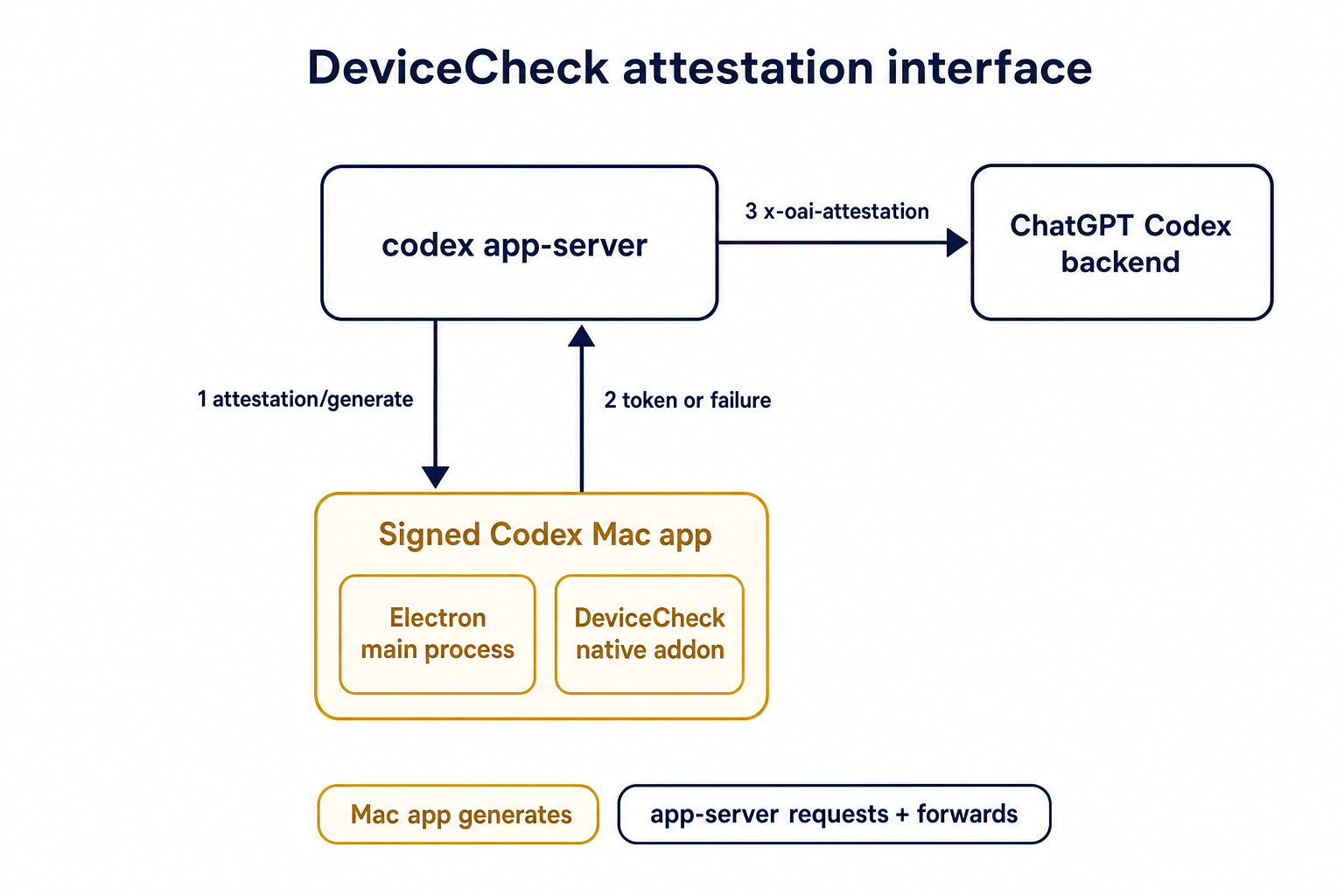
TL;DR: teaches `codex-rs` / app-server to request a desktop-provided
attestation token and attach it as `x-oai-attestation` on the scoped
ChatGPT Codex request paths.
## Details
This PR teaches the Codex app-server runtime how to request and attach
an attestation token. It does not generate DeviceCheck tokens directly;
instead, it relies on the connected desktop app to advertise that it can
generate attestation and then asks that app for a fresh header value
when needed.
The flow is:
1. The Codex desktop app connects to app-server.
2. During `initialize`, the app can advertise that it supports
`requestAttestation`.
3. Before app-server calls selected ChatGPT Codex endpoints, it sends
the internal server request `attestation/generate` to the app.
4. app-server receives a pre-encoded header value back.
5. app-server forwards that value as `x-oai-attestation` on the scoped
outbound requests.
The code in this repo is mostly protocol and runtime plumbing: it adds
the app-server request/response shape, introduces an attestation
provider in core, wires that provider into Responses / compaction /
realtime setup paths, and covers the intended scoping with tests. The
signed macOS DeviceCheck generation remains owned by the desktop app PR.
## Related PR
- Codex desktop app implementation:
https://github.com/openai/openai/pull/878649
## Validation
<details>
<summary>Tests run</summary>
```sh
cargo test -p codex-app-server-protocol
cargo test -p codex-core attestation --lib
cargo test -p codex-app-server --lib attestation
```
Also ran:
```sh
just fix -p codex-core
just fix -p codex-app-server
just fix -p codex-app-server-protocol
just fmt
just write-app-server-schema
```
</details>
<details>
<summary>E2E DeviceCheck validation</summary>
First validated the signed desktop app boundary directly: launched a
packaged signed `Codex.app`, sent `attestation/generate`, decoded the
returned `v1.` attestation header, and validated the extracted
DeviceCheck token with `personal/jm/verify_devicecheck_token.py` using
bundle ID `com.openai.codex`. Apple returned `status_code: 200` and
`is_ok: true`.
Then ran the fuller app + app-server flow. The packaged `Codex.app`
launched a current-branch app-server via `CODEX_CLI_PATH`, and a local
MITM proxy intercepted outbound `chatgpt.com` traffic. The app-server
requested `attestation/generate` from the real Electron app process, and
the intercepted `/backend-api/codex/responses` traffic included
`x-oai-attestation` on both routes:
```text
GET /backend-api/codex/responses Upgrade: websocket x-oai-attestation: present
POST /backend-api/codex/responses Upgrade: none x-oai-attestation: present
```
The captured header decoded to a DeviceCheck token that also validated
with Apple for `com.openai.codex` (`status_code: 200`, `is_ok: true`,
team `2DC432GLL2`).
</details>
---------
Co-authored-by: Codex <noreply@openai.com>
## Why

The earlier PRs add stdio transport support and the config-backed
environment provider, but the feature remains inert until normal Codex
entrypoints construct `EnvironmentManager` with enough context to
discover `CODEX_HOME/environments.toml`. This final stack PR activates
the provider while preserving the legacy `CODEX_EXEC_SERVER_URL`
fallback when no environments file exists.

**Stack position:** this is PR 5 of 5. It is the product wiring PR that
activates the configured environment provider added in PR 4.

## What Changed

- Thread `codex_home` into `EnvironmentManagerArgs`.
- Change `EnvironmentManager::new(...)` to load the provider from
`CODEX_HOME`.
- Preserve legacy behavior by falling back to
`DefaultEnvironmentProvider::from_env()` when `environments.toml` is
absent.
- Make `environments.toml`-backed managers start new threads with all
configured environments, default first, while keeping the legacy env-var
path single-default.
- Update the app-server, TUI, exec, MCP server, connector, prompt-debug,
and thread-manager-sample callsites to pass `codex_home` and handle
provider-loading errors.

## Self-Review Notes

- The multi-environment startup path is intentionally tied to the
`environments.toml` provider. Using `>1` configured environment as the
only signal would also expand the legacy `CODEX_EXEC_SERVER_URL`
provider because it keeps `local` addressable alongside `remote`.
- The startup environment list is still derived inside
`EnvironmentManager`; the provider only says whether its snapshot should
start new threads with all configured environments.
- The thread-manager sample was updated to pass the current
`ThreadManager::new(...)` installation id argument so the stack compiles
under Bazel.

## Stack

- 1. https://github.com/openai/codex/pull/20663 - Add stdio exec-server
listener
- 2. https://github.com/openai/codex/pull/20664 - Add stdio exec-server
client transport
- 3. https://github.com/openai/codex/pull/20665 - Make environment
providers own default selection
- 4. https://github.com/openai/codex/pull/20666 - Add CODEX_HOME
environments TOML provider
- **5. This PR:** https://github.com/openai/codex/pull/20667 - Load
configured environments from CODEX_HOME

Split from original draft: https://github.com/openai/codex/pull/20508

## Validation

- `just fmt`
- `git diff --check`
- `bazel build --config=remote --strategy=remote
--remote_download_toplevel
//codex-rs/thread-manager-sample:codex-thread-manager-sample`
- `bazel test --config=remote --strategy=remote
--remote_download_toplevel
//codex-rs/exec-server:exec-server-unit-tests`
- `bazel test --config=remote --strategy=remote
--remote_download_toplevel --test_sharding_strategy=disabled
--test_arg=default_thread_environment_selections_use_manager_default_id
//codex-rs/core:core-unit-tests`
- `bazel test --config=remote --strategy=remote
--remote_download_toplevel --test_sharding_strategy=disabled
--test_arg=start_thread_uses_all_default_environments_from_codex_home
//codex-rs/core:core-unit-tests`

## Documentation

This activates `CODEX_HOME/environments.toml`; user-facing documentation
should be added before this stack is treated as a documented public
workflow.

---------

Co-authored-by: Codex <noreply@openai.com>
## Why

`/fast` was wired as a one-off slash command even though model metadata
now exposes service tiers as catalog data. That meant adding another
tier, such as a slower/cheaper tier, would require more hardcoded TUI
plumbing instead of letting the model catalog drive the available
commands.

This change makes service-tier commands data-driven: each advertised
`service_tiers` entry becomes a `/name` command using the catalog
description, while the request path sends the tier `id` only when the
selected model supports it.

## What Changed

- Removed the hardcoded `/fast` slash-command variant and introduced
dynamic service-tier command items in the composer and command popup.
- Added toggle behavior for service-tier commands: invoking `/name`
selects that tier, and invoking it again clears the selection.
- Preserved the existing Fast-mode keybinding/status affordances by
resolving the current model tier whose name is `fast`, while still
sending the tier request value such as `priority`.
- Persisted service-tier selections as raw request strings so non-fast
tiers can round-trip through config.
- Updated the Bedrock catalog entry to advertise fast support through
`service_tiers` with `id: "priority"` and `name: "fast"`.
- Added defensive filtering in core so unsupported selected service
tiers are omitted from `/responses` requests.

## Validation

- Added/updated coverage for dynamic service-tier slash command lookup,
popup descriptions, composer dispatch, TUI fast toggling, and
unsupported-tier omission in core request construction.
- Local tests were not run per request.

---------

Co-authored-by: Codex <noreply@openai.com>
## Summary
- Remove `perCwdExtraUserRoots` / `SkillsListExtraRootsForCwd` from the
`skills/list` app-server API.
- Drop Rust app-server and `codex-core-skills` extra-root plumbing so
skill scans are keyed by the normal cwd/user/plugin roots only.
- Regenerate app-server schemas and update docs/tests that only existed
for the removed extra-roots behavior.

## Validation
- `just write-app-server-schema`
- `just fmt`
- `cargo test -p codex-app-server-protocol`
- `cargo test -p codex-core-skills`
- `just fix -p codex-app-server-protocol`
- `just fix -p codex-core-skills`
- `just fix -p codex-app-server`
- `just fix -p codex-tui`

## Notes
- `cargo test -p codex-app-server --test all skills_list` ran the edited
skills-list cases, but the full filtered run ended on existing
`skills_changed_notification_is_emitted_after_skill_change` timeout
after a websocket `401`.
- `cargo test -p codex-tui --lib` compiled the changed TUI callers, then
failed two unrelated status permission tests because local
`/etc/codex/requirements.toml` forbids `DangerFullAccess`.
- Source-truth check found the OpenAI monorepo still has
generated/app-server-kit mirror references to the removed field; those
should be cleaned up when generated app-server types are synced or in a
companion OpenAI cleanup.
## Why

We want terminal tool review analytics, but the reducer should not stamp
review timing from its own wall clock.

This PR plumbs review timing through the real protocol and app-server
seams so downstream analytics can consume the emitter's timestamps
directly. Guardian reviews keep their enriched `started_at` /
`completed_at` analytics fields by deriving those legacy second-based
values from the same protocol-native millisecond lifecycle timestamps,
rather than sampling a separate analytics clock.

## What changed

- add `started_at_ms` to user approval request payloads
- add `started_at_ms` / `completed_at_ms` to guardian review
notifications
- preserve Guardian review `started_at` / `completed_at` enrichment from
the protocol-native timing source
- stamp typed `ServerResponse` analytics facts with app-server-observed
`completed_at_ms`
- thread the new timing fields through core, protocol, app-server, TUI,
and analytics fixtures

## Verification

- `cargo test -p codex-app-server outgoing_message --manifest-path
codex-rs/Cargo.toml`
- `cargo test -p codex-app-server-protocol guardian --manifest-path
codex-rs/Cargo.toml`
- `cargo test -p codex-tui guardian --manifest-path codex-rs/Cargo.toml`
- `cargo test -p codex-analytics analytics_client_tests --manifest-path
codex-rs/Cargo.toml`

---
[//]: # (BEGIN SAPLING FOOTER)
Stack created with [Sapling](https://sapling-scm.com). Best reviewed
with [ReviewStack](https://reviewstack.dev/openai/codex/pull/21434).
* #18748
* __->__ #21434
* #18747
* #17090
* #17089
* #20514
Adds marketplaceKinds to plugin/list for local, workspace-directory, and
shared-with-me; omitted params keep default local plus gated global
behavior, while explicit kinds are exact.

Exposes shareContext on plugin summaries from local share mappings and
remote workspace/shared responses, including remotePluginId and nullable
creator metadata.

Adds shared-with-me listing through /ps/plugins/workspace/shared,
renames the workspace remote namespace to workspace-directory, and keeps
direct remote read/share/install/update/delete paths gated by plugins
rather than remote_plugin.
## Why

Message history was implemented inside `codex-core` and surfaced through
core protocol ops and `SessionConfiguredEvent` fields even though the
current consumer is TUI-local prompt recall. That made core own UI
history persistence and exposed `history_log_id` / `history_entry_count`
through surfaces that app-server and other clients do not need.

This change moves message history persistence out of core and keeps the
recall plumbing local to the TUI.

## What changed

- Added a new `codex-message-history` crate for appending, looking up,
trimming, and reading metadata from `history.jsonl`.
- Removed core protocol history ops/events: `AddToHistory`,
`GetHistoryEntryRequest`, and `GetHistoryEntryResponse`.
- Removed `history_log_id` and `history_entry_count` from
`SessionConfiguredEvent` and updated exec/MCP/test fixtures accordingly.
- Updated the TUI to dispatch local app events for message-history
append/lookup and keep its persistent-history metadata in TUI session
state.

## Validation

- `cargo test -p codex-message-history -p codex-protocol`
- `cargo test -p codex-exec event_processor_with_json_output`
- `cargo test -p codex-mcp-server outgoing_message`
- `cargo test -p codex-tui`
- `just fix -p codex-message-history -p codex-protocol -p codex-core -p
codex-tui -p codex-exec -p codex-mcp-server`
## Why

`session_id` and `thread_id` are separate identities after #20437, but
app-server only surfaced `sessionId` on the `thread/start`,
`thread/resume`, and `thread/fork` response envelopes. Other
thread-bearing surfaces such as `thread/list`, `thread/read`,
`thread/started`, `thread/rollback`, `thread/metadata/update`, and
`thread/unarchive` either lacked the grouping key or forced clients to
special-case those three responses.

Making `sessionId` part of the reusable `Thread` payload gives every v2
API surface one place to expose session-tree identity.

## Mental model
  1. thread.sessionId lives on `Thread`
2. It is a view/runtime identity for the current live session tree, not
durable stored lineage metadata
3. When app-server has a live loaded thread, it copies the real value
from core’s session_configured.session_id
4. When it only has stored/unloaded data, it falls back to
thread.sessionId = thread.id

## What changed

- Added `sessionId` to the v2
[`Thread`](8fc9e9b4cf/codex-rs/app-server-protocol/src/protocol/v2/thread_data.rs (L105-L109)).
- Removed the duplicate top-level `sessionId` fields from
`thread/start`, `thread/resume`, and `thread/fork`; clients should now
read `response.thread.sessionId`.
- Populated `thread.sessionId` when building live thread responses,
replaying loaded threads, and returning stored-thread summaries so the
field is present across start, resume, fork, list, read, rollback,
metadata-update, unarchive, and `thread/started` paths. See
[`load_thread_from_resume_source_or_send_internal`](8fc9e9b4cf/codex-rs/app-server/src/request_processors/thread_processor.rs (L2824-L2918))
and
[`thread_from_stored_thread`](8fc9e9b4cf/codex-rs/app-server/src/request_processors/thread_processor.rs (L3671-L3719)).
- Preserved the stored-thread fallback: if a thread has not been loaded
into a live session tree yet, `thread.sessionId` falls back to
`thread.id`; once the thread is live again, the field reports the active
session tree root.
- Regenerated the JSON/TypeScript schemas and updated the app-server
README examples to show
[`thread.sessionId`](8fc9e9b4cf/codex-rs/app-server/README.md (L306-L310))
on the thread object.
## Summary
- make `thread_source` an explicit optional thread-level field on
`thread/start`, `thread/fork`, and returned thread payloads
- persist `thread_source` in rollout/session metadata so resumed live
threads retain the original value
- replace the old best-effort `session_source` -> `thread_source`
mapping with an explicit caller-supplied analytics classification

## Why
Before this change, analytics `thread_source` was populated by a
best-effort mapping from `session_source`. `session_source` describes
the runtime/client surface, not the actual thread-level origin, so that
projection was not accurate enough to distinguish cases such as `user`,
`subagent`, `memory_consolidation`, and future thread origins reliably.

Making `thread_source` explicit keeps one thread-level analytics field
while letting callers provide the real classification directly instead
of recovering it indirectly from `session_source`.

## Impact
For new analytics events, `thread_source` now reflects the explicit
thread-level classification supplied by the caller rather than an
inferred value derived from `session_source`. Existing protocol fields
remain optional; callers that omit `threadSource` now produce `null`
instead of a best-effort inferred value.

## Validation
- `just write-app-server-schema`
- `cargo test -p codex-analytics -p codex-core -p
codex-app-server-protocol --no-run`
- `cargo test -p codex-app-server-protocol
generated_ts_optional_nullable_fields_only_in_params`
- `cargo test -p codex-analytics
thread_initialized_event_serializes_expected_shape`
- `cargo test -p codex-core
resume_stopped_thread_from_rollout_preserves_thread_source`
## Why

The resume/fork picker is becoming the main way users recover previous
work, but the old fixed table made sessions hard to scan once thread
names, branches, working directories, and timestamps all mattered. This
redesign makes the picker denser by default, easier to search, and safer
to inspect before resuming or forking.

<table>
<tr>
<td>
<img width="1660" height="1103" alt="CleanShot 2026-05-03 at 12 34 10"
src="https://github.com/user-attachments/assets/313ede1d-1da4-4863-acd2-56b3e27e9703"
/>
</td>
<td>
<img width="1662" height="1100" alt="CleanShot 2026-05-03 at 12 34 15"
src="https://github.com/user-attachments/assets/cfde7d5c-bab0-4994-a807-254e53f344ea"
/>
</td>
</tr>
<tr>
<td>
<img width="1664" height="1107" alt="CleanShot 2026-05-03 at 12 39 22"
src="https://github.com/user-attachments/assets/e1ee58ca-4dc5-4a35-ae0f-47562da3974c"
/>
</td>
<td>
<img width="1662" height="1100" alt="CleanShot 2026-05-03 at 12 35 09"
src="https://github.com/user-attachments/assets/9c888072-eedf-4f45-985c-0c14df28bcc7"
/>
</td>
</tr>
</table>

## What Changed

- Replaces the old session table with responsive session rows that
prioritize the session name or preview, then show timestamp, cwd, and
branch metadata.
- Makes dense view the default while keeping comfortable view available
through `Ctrl+O`.
- Persists the picker view preference in `[tui].session_picker_view`,
including active profile-scoped config.
- Adds sort/filter controls for updated time, created time, cwd, and all
sessions.
- Expands search matching across session name, preview, thread id,
branch, and cwd.
- Makes `Esc` safer in search mode: it clears an active query before
starting a new session.
- Adds lazy transcript inspection:
  - `Space` expands recent transcript context inline.
  - `Ctrl+T` opens a transcript overlay.
  - raw reasoning visibility follows `show_raw_agent_reasoning`.
- Keeps remote cwd filtering server-side for remote app-server sessions
so local path normalization does not incorrectly hide remote results.
- Updates snapshots and config schema for the new picker states and
config option.

## How to Test

1. Start Codex in a repo with several saved sessions.
2. Press `Ctrl+R` / resume picker entry point.
3. Confirm the picker opens in dense mode and shows session name or
preview, timestamp, cwd, and branch metadata.
4. Press `Ctrl+O` and confirm it switches between dense and comfortable
views.
5. Restart Codex and confirm the selected view persists.
6. Type a query that matches a branch, cwd, thread id, or session name;
confirm matching sessions appear.
7. Press `Esc` while the query is non-empty and confirm it clears search
instead of starting a new session.
8. Select a session and press `Space`; confirm recent transcript context
expands inline.
9. Press `Ctrl+T`; confirm the transcript overlay opens and respects
raw-reasoning visibility settings.

Targeted tests:
- `cargo test -p codex-tui resume_picker --no-fail-fast`
- `cargo test -p codex-core
runtime_config_resolves_session_picker_view_default_and_override`
- `cargo test -p codex-core profile_tui_rejects_unsupported_settings`
- `cargo check -p codex-thread-manager-sample`
- `cargo insta pending-snapshots`
## Why

`Turn.items` currently overloads an empty array to mean either that no
items exist or that the server intentionally did not load them for this
response. That ambiguity blocks future lazy-loading work where clients
need to distinguish unloaded, summary, and fully hydrated turn payloads.

## What changed

- add a new `TurnItemsView` enum with `notLoaded`, `summary`, and `full`
variants
- add required `itemsView` metadata to app-server `Turn` payloads
- mark reconstructed persisted history as `full` and live shell-style
turn payloads as `notLoaded`
- keep current `thread/turns/list` behavior unchanged and document that
it still returns `full` turns today
- regenerate the JSON and TypeScript protocol fixtures

## Verification

- `just write-app-server-schema`
- `cargo test -p codex-app-server-protocol`
- `cargo test -p codex-app-server thread_read_can_include_turns`
- `cargo test -p codex-app-server
thread_turns_list_can_page_backward_and_forward`
- `cargo test -p codex-app-server
thread_resume_rejects_history_when_thread_is_running`
- `just fix -p codex-app-server-protocol`
- `just fix -p codex-app-server`
- `just fmt`
# Why

We want shared hook trust that both the app and the TUI can build on,
but the metadata is only useful if runtime behavior agrees with it. This
PR adds a single backend trust model for hooks so unmanaged hooks cannot
run until the current definition has been reviewed, while managed hooks
remain runnable and non-configurable.

# What

- persist `trusted_hash` alongside hook state in `config.toml`
- expose `currentHash` and derived `trustStatus` through `hooks/list`
- derive trust from normalized hook definitions so equivalent hooks from
`config.toml` and `hooks.json` share the same trust identity
- gate unmanaged hooks on trust before they enter the runnable handler
set

# Reviewer Notes

- key file to review is `codex-rs/hooks/src/engine/discovery.rs`
- the only **core** change is schema related
## Why

Granular copy is particularly difficult with the current output. Part of
it was solved with the introduction of the `/copy` command but when you
only need to copy parts of a response, you still encounter some issues:

- When you copy a paragraph, the result is a sequence of separate lines
instead of one correctly joined paragraph.
- When a word wraps, part of it stays on the original line and the rest
appears at the start of the next line.
- When you copy a long command, extra line breaks are often inserted,
and command arguments can be split across multiple lines.


https://github.com/user-attachments/assets/0ef85c84-9363-4aad-b43a-15fce062a443

## Solution

Now that we own the scrollback and we re-create it when we resize, we
have the opportunity of toggling between the raw text and the rich text
we see today.

- Add TUI raw scrollback mode with `tui.raw_output_mode`, `/raw
[on|off]`, and the configurable `tui.keymap.global.toggle_raw_output`
action.
- Render transcript cells through rich/raw-aware paths so raw mode
preserves source text and lets the terminal soft-wrap selection-friendly
output.
- Bind raw-mode toggle to `alt-r` by default, with the keybinding path
toggling silently while `/raw` continues to emit confirmation messages.

## Related Issues

Likely addressed by raw mode:

- #12200: clean copy for multiline and soft-wrapped output. Raw mode
removes Codex-inserted wrapping/indentation and lets the terminal
soft-wrap logical lines.
- #9252: command suggestions gain unwanted leading spaces when copied.
Raw mode renders transcript text without the rich-mode left
padding/gutter.
- #8258: prompt output is hard to copy because of leading indentation.
Raw mode renders user/source-backed transcript text without that
decorative indentation.

Partially or conditionally addressed:

- #2880: copy/export message as Markdown. Raw mode exposes raw Markdown
for terminal selection, but this PR does not add a dedicated
export/copy-message command.
- #19820: mouse drag selection + copy in the TUI. Raw mode improves
terminal-native selection of output/history text, but this PR does not
implement in-TUI mouse selection, highlighting, auto-copy, or composer
selection.
- #18979: copied content is divided into two parts. This should improve
cases caused by Codex-inserted wraps/padding in rendered output; if the
report is about pasting into the composer/input path, that remains
outside this PR.

## Validation

- `just write-config-schema`
- `just fmt`
- `cargo test -p codex-config`
- `cargo test -p codex-tui`
- `just fix -p codex-tui`
- `just argument-comment-lint`
- `cargo test -p codex-tui
raw_output_mode_can_change_without_inserting_notice -- --nocapture`
- `cargo test -p codex-tui
raw_slash_command_toggles_and_accepts_on_off_args -- --nocapture`
- `cargo test -p codex-tui raw_output_toggle -- --nocapture`
- `git diff --check`
- `cargo insta pending-snapshots`
## Why

App-server clients sometimes need argv-based local process execution
while sandbox policy is controlled outside Codex. Those environments can
reject sandbox-disabling paths before a command ever starts, even when
the caller intentionally wants unsandboxed execution.

This PR adds a distinct `process/*` API for that use case instead of
extending `command/exec` with another sandbox-disabling shape. Keeping
the new surface separate also makes the future removal of `command/exec`
simpler: clients that need explicit process lifecycle control can move
to the newer handle-based API without depending on `command/exec`
business logic.

## What changed

- Added v2 process lifecycle methods: `process/spawn`,
`process/writeStdin`, `process/resizePty`, and `process/kill`.
- Added process notifications: `process/outputDelta` for streamed
stdout/stderr chunks and `process/exited` for final exit status and
buffered output.
- Made `process/spawn` intentionally unsandboxed and omitted
sandbox-selection fields such as `sandboxPolicy` and
`permissionProfile`.
- Added client-supplied, connection-scoped `processHandle` values for
follow-up control requests and notification routing.
- Supported cwd, environment overrides, PTY mode and size, stdin
streaming, stdout/stderr streaming, per-stream output caps, and timeout
controls.
- Killed active process sessions when the originating app-server
connection closes.
- Wired the implementation through the modular `request_processors/`
app-server layout, with process-handle request serialization for
follow-up control calls.
- Updated generated JSON/TypeScript schema fixtures and documented the
new API in `codex-rs/app-server/README.md`.
- Added v2 app-server integration coverage in
`codex-rs/app-server/tests/suite/v2/process_exec.rs` for spawn
acknowledgement before exit, buffered output caps, and process
termination.

## Verification

- `cargo test -p codex-app-server-protocol`
- `cargo test -p codex-app-server`

---------

Co-authored-by: Owen Lin <owen@openai.com>
## Why

Tool families already disagree on what their existing `duration` fields
mean, so lifecycle latency should live on the shared item envelope
instead of being inferred from per-tool execution fields. Carrying that
envelope through app-server notifications gives downstream consumers one
reusable timing signal without pretending every tool has the same
execution semantics.

## What changed

- Adds `started_at_ms` to core `ItemStartedEvent` values and
`completed_at_ms` to core `ItemCompletedEvent` values.
- Populates those timestamps in the shared session lifecycle emitters,
so protocol-native items get timing without each producer tracking its
own clock state.
- Exposes `startedAtMs` on app-server `item/started` notifications and
`completedAtMs` on `item/completed` notifications.
- Maps the lifecycle timestamps through the app-server boundary while
leaving legacy-converted notifications nullable when no lifecycle
timestamp exists.
- Regenerates the app-server JSON schema and TypeScript fixtures for the
notification-envelope change and updates downstream fixtures that
construct those notifications directly.
- Extends the existing web-search and image-generation integration flows
to assert the new lifecycle timestamps on the native item events.

## Verification

- `cargo check -p codex-protocol -p codex-core -p
codex-app-server-protocol -p codex-app-server -p codex-tui -p codex-exec
-p codex-app-server-client`
- `cargo test -p codex-core --test all web_search_item_is_emitted`
- `cargo test -p codex-core --test all
image_generation_call_event_is_emitted`
- `cargo test -p codex-app-server-protocol`

---
[//]: # (BEGIN SAPLING FOOTER)
Stack created with [Sapling](https://sapling-scm.com). Best reviewed
with [ReviewStack](https://reviewstack.dev/openai/codex/pull/20514).
* #18748
* #18747
* #17090
* #17089
* __->__ #20514
## Summary
- normalize terminal-emitted C0 control characters through configurable
editor keymaps, covering raw control-key fallbacks like
Shift+Enter-as-LF in terminals from #20555 and #20898, plus part of the
modified-Enter behavior in #20580
- add default-unbound keymap actions for toggling Fast mode and killing
the current composer line, giving #20698 users a configurable zsh-style
Ctrl+U option without changing the existing default Ctrl+U behavior
- wire the new actions through gated /keymap picker entries, schema
generation, and snapshot coverage
Fixes#20555.
Fixes#20898.
## Testing
- just write-config-schema
- just fmt
- cargo test -p codex-config
- cargo test -p codex-tui keymap::tests
- cargo test -p codex-tui bottom_pane::textarea::tests
- cargo test -p codex-tui keymap_setup::tests
- cargo insta pending-snapshots
- just fix -p codex-tui
- git diff --check
- just argument-comment-lint
## Why?

The Codex App already exposes branch and PR context in its
branch-details UI. This brings the same context into the CLI footer as
opt-in statusline items, so users can choose the extra signal without
making the default footer busier.

## What?

Add optional `pull-request-number` and `branch-changes` items to the
configurable TUI status line.

- `pull-request-number` shows the open PR for the current checkout and
renders as a clickable terminal hyperlink when OSC 8 links are
supported.
- `branch-changes` shows committed additions/deletions against the
repository default branch, or `No changes` when the branch has no
committed diff.

<img width="1257" height="261" alt="CleanShot 2026-05-03 at 20 44 15"
src="https://github.com/user-attachments/assets/10b4380b-c3e9-4729-9ee1-3f742068fa47"
/>

## Architecture

This follows the same client/app-server split as the Codex App: the TUI
owns presentation, caching, and optional rendering, while
workspace-sensitive `git` and `gh` discovery runs through app-server.

The new TUI-local `workspace_command` layer sends bounded,
non-interactive `command/exec` requests to the active app-server. That
makes the implementation remote-friendly: the TUI does not decide
whether commands run in an embedded local workspace or a remote
workspace, and it does not bypass app-server sandbox or permission
policy.

The branch summary logic stays internal to `codex-tui` because this PR
only needs TUI statusline behavior. The command boundary is still
isolated behind `WorkspaceCommandExecutor`, so the lookup code can be
lifted or reused later without changing statusline rendering.

## How?

- Add a TUI `WorkspaceCommandExecutor` abstraction backed by app-server
`command/exec`.
- Add branch summary probes for:
  - current branch name,
  - open PR metadata,
  - committed branch diff stats against the default branch.
- Prefer remote-tracking default branch refs for diff stats, avoiding
stale or absent local `main` branches.
- Resolve PRs with `gh pr view` first, then fall back to
commit-associated PR lookup across parent/fork repos.
- Add `/statusline` picker entries, preview values, rendering, and OSC 8
clickable PR links.
- Keep all probes best-effort so missing `git`, missing `gh`, auth
failures, or non-git directories hide optional items instead of
surfacing footer errors.

## Validation

- `cargo test -p codex-tui branch_summary -- --nocapture`
- Snapshot coverage for the `/statusline` preview/setup rendering paths
- Hyperlink rendering coverage for clickable PR statusline cells
## Why

SQLite state was still being opened from consumer paths, including lazy
`OnceCell`-backed thread-store call sites. That let one process
construct multiple state DB connections for the same Codex home, which
makes SQLite lock contention and `database is locked` failures much
easier to hit.

State DB lifetime should be chosen by main-like entrypoints and tests,
then passed through explicitly. Consumers should use the supplied
`Option<StateDbHandle>` or `StateDbHandle` and keep their existing
filesystem fallback or error behavior when no handle is available.

The startup path also needs to keep the rollout crate in charge of
SQLite state initialization. Opening `codex_state::StateRuntime`
directly bypasses rollout metadata backfill, so entrypoints should
initialize through `codex_rollout::state_db` and receive a handle only
after required rollout backfills have completed.

## What Changed

- Initialize the state DB in main-like entrypoints for CLI, TUI,
app-server, exec, MCP server, and the thread-manager sample.
- Pass `Option<StateDbHandle>` through `ThreadManager`,
`LocalThreadStore`, app-server processors, TUI app wiring, rollout
listing/recording, personality migration, shell snapshot cleanup,
session-name lookup, and memory/device-key consumers.
- Remove the lazy local state DB wrapper from the thread store so
non-test consumers use only the supplied handle or their existing
fallback path.
- Make `codex_rollout::state_db::init` the local state startup path: it
opens/migrates SQLite, runs rollout metadata backfill when needed, waits
for concurrent backfill workers up to a bounded timeout, verifies
completion, and then returns the initialized handle.
- Keep optional/non-owning SQLite helpers, such as remote TUI local
reads, as open-only paths that do not run startup backfill.
- Switch app-server startup from direct
`codex_state::StateRuntime::init` to the rollout state initializer so
app-server cannot skip rollout backfill.
- Collapse split rollout lookup/list APIs so callers use the normal
methods with an optional state handle instead of `_with_state_db`
variants.
- Restore `getConversationSummary(ThreadId)` to delegate through
`ThreadStore::read_thread` instead of a LocalThreadStore-specific
rollout path special case.
- Keep DB-backed rollout path lookup keyed on the DB row and file
existence, without imposing the filesystem filename convention on
existing DB rows.
- Verify readable DB-backed rollout paths against `session_meta.id`
before returning them, so a stale SQLite row that points at another
thread's JSONL falls back to filesystem search and read-repairs the DB
row.
- Keep `debug prompt-input` filesystem-only so a one-off debug command
does not initialize or backfill SQLite state just to print prompt input.
- Keep goal-session test Codex homes alive only in the goal-specific
helper, rather than leaking tempdirs from the shared session test
helper.
- Update tests and call sites to pass explicit state handles where DB
behavior is expected and explicit `None` where filesystem-only behavior
is intended.

## Validation

- `CARGO_TARGET_DIR=/tmp/codex-target-state-db cargo check -p
codex-rollout -p codex-thread-store -p codex-app-server -p codex-core -p
codex-tui -p codex-exec -p codex-cli --tests`
- `CARGO_TARGET_DIR=/tmp/codex-target-state-db cargo test -p
codex-rollout state_db_`
- `CARGO_TARGET_DIR=/tmp/codex-target-state-db cargo test -p
codex-rollout find_thread_path`
- `CARGO_TARGET_DIR=/tmp/codex-target-state-db cargo test -p
codex-rollout find_thread_path -- --nocapture`
- `CARGO_TARGET_DIR=/tmp/codex-target-state-db cargo test -p
codex-rollout try_init_ -- --nocapture`
- `CARGO_TARGET_DIR=/tmp/codex-target-state-db cargo test -p
codex-rollout`
- `CARGO_TARGET_DIR=/tmp/codex-target-state-db cargo clippy -p
codex-rollout --lib -- -D warnings`
- `CARGO_TARGET_DIR=/tmp/codex-target-state-db cargo test -p
codex-thread-store
read_thread_falls_back_when_sqlite_path_points_to_another_thread --
--nocapture`
- `CARGO_TARGET_DIR=/tmp/codex-target-state-db cargo test -p
codex-thread-store`
- `CARGO_TARGET_DIR=/tmp/codex-target-state-db cargo test -p codex-core
shell_snapshot`
- `CARGO_TARGET_DIR=/tmp/codex-target-state-db cargo test -p codex-core
--test all personality_migration`
- `CARGO_TARGET_DIR=/tmp/codex-target-state-db cargo test -p codex-core
--test all rollout_list_find`
- `RUST_MIN_STACK=8388608 CODEX_SKIP_VENDORED_BWRAP=1
CARGO_TARGET_DIR=/tmp/codex-target-state-db cargo test -p codex-core
--test all rollout_list_find::find_prefers_sqlite_path_by_id --
--nocapture`
- `RUST_MIN_STACK=8388608 CODEX_SKIP_VENDORED_BWRAP=1
CARGO_TARGET_DIR=/tmp/codex-target-state-db cargo test -p codex-core
--test all rollout_list_find -- --nocapture`
- `CARGO_TARGET_DIR=/tmp/codex-target-state-db cargo test -p codex-core
interrupt_accounts_active_goal_before_pausing`
- `CARGO_TARGET_DIR=/tmp/codex-target-state-db cargo test -p
codex-app-server get_auth_status -- --test-threads=1`
- `CODEX_SKIP_VENDORED_BWRAP=1
CARGO_TARGET_DIR=/tmp/codex-target-state-db cargo test -p
codex-app-server --lib`
- `CODEX_SKIP_VENDORED_BWRAP=1
CARGO_TARGET_DIR=/tmp/codex-target-state-db cargo check -p codex-rollout
-p codex-app-server --tests`
- `CARGO_TARGET_DIR=/tmp/codex-target-state-db just fix -p codex-rollout
-p codex-thread-store -p codex-core -p codex-app-server -p codex-tui -p
codex-exec -p codex-cli`
- `CODEX_SKIP_VENDORED_BWRAP=1
CARGO_TARGET_DIR=/tmp/codex-target-state-db just fix -p codex-rollout -p
codex-app-server`
- `CARGO_TARGET_DIR=/tmp/codex-target-state-db just fix -p
codex-rollout`
- `CODEX_SKIP_VENDORED_BWRAP=1
CARGO_TARGET_DIR=/tmp/codex-target-state-db just fix -p codex-core`
- `just argument-comment-lint -p codex-core`
- `just argument-comment-lint -p codex-rollout`

Focused coverage added in `codex-rollout`:

- `recorder::tests::state_db_init_backfills_before_returning` verifies
the rollout metadata row exists before startup init returns.
- `state_db::tests::try_init_waits_for_concurrent_startup_backfill`
verifies startup waits for another worker to finish backfill instead of
disabling the handle for the process.
-
`state_db::tests::try_init_times_out_waiting_for_stuck_startup_backfill`
verifies startup does not hang indefinitely on a stuck backfill lease.
-
`tests::find_thread_path_accepts_existing_state_db_path_without_canonical_filename`
verifies DB-backed lookup accepts valid existing rollout paths even when
the filename does not include the thread UUID.
-
`tests::find_thread_path_falls_back_when_db_path_points_to_another_thread`
verifies DB-backed lookup ignores a stale row whose existing path
belongs to another thread and read-repairs the row after filesystem
fallback.

Focused coverage updated in `codex-core`:

- `rollout_list_find::find_prefers_sqlite_path_by_id` now uses a
DB-preferred rollout file with matching `session_meta.id`, so it still
verifies that valid SQLite paths win without depending on stale/empty
rollout contents.

`cargo test -p codex-app-server thread_list_respects_search_term_filter
-- --test-threads=1 --nocapture` was attempted locally but timed out
waiting for the app-server test harness `initialize` response before
reaching the changed thread-list code path.

`bazel test //codex-rs/thread-store:thread-store-unit-tests
--test_output=errors` was attempted locally after the thread-store fix,
but this container failed before target analysis while fetching `v8+`
through BuildBuddy/direct GitHub. The equivalent local crate coverage,
including `cargo test -p codex-thread-store`, passes.

A plain local `cargo check -p codex-rollout -p codex-app-server --tests`
also requires system `libcap.pc` for `codex-linux-sandbox`; the
follow-up app-server check above used `CODEX_SKIP_VENDORED_BWRAP=1` in
this container.
## Why

The TUI currently exposes overlapping command names for the same
permissions flow: `/permissions` and the older `/approvals` alias. It
also uses `/autoreview` for the manual retry flow, even though the
action users take there is approving one denied auto-review request.

This change makes the command surface consistent with the hard rebrand:
- `/permissions` is the only command for permission settings.
- `/approve` is the command for approving a recent auto-review denial.

## What changed

- Removed the legacy `/approvals` slash command and its dispatch path.
- Kept `/permissions` as the single permissions command shown and
accepted by the TUI.
- Renamed the auto-review denial command from `/autoreview` to
`/approve`.
- Updated nearby comments so they refer to `/permissions` rather than
the retired `/approvals` name.

## Verification

- Updated the slash-command unit test to assert that `AutoReview` now
renders and parses as `approve`.
## Why

We constantly get bug reports about keys not being recognized by Codex
when the terminal is not handling the key press. Running `/keymap debug`
or `/keymap` and going to the Debug tab, we can allow the user to either
understand that the key being pressed is not being recognized or to
check what it's being recognized as and report or reassign that key.

| Menu | Inspector | Hint |
|---|---|---|
| <img width="1369" height="796" alt="CleanShot 2026-05-02 at 12 57 12"
src="https://github.com/user-attachments/assets/512b6faa-344e-4aee-9c00-b4bdc633a662"
/> | <img width="1261" height="754" alt="CleanShot 2026-05-02 at 12 56
36"
src="https://github.com/user-attachments/assets/a6ddae7d-e174-4ee4-893f-e6bec4fff4ab"
/> | <img width="1369" height="796" alt="CleanShot 2026-05-02 at 12 57
30"
src="https://github.com/user-attachments/assets/db507784-f40a-4cff-ac23-a61d9703769b"
/> |
## Summary
- add a Debug tab to `/keymap` and support `/keymap debug` for direct
access
- show what key Codex receives, the config key representation, raw event
details, and matching actions
- add a progressive missing-key hint that escalates after a few seconds
with no detected keypress

## Validation
- `just fmt`
- `cargo test -p codex-tui keymap_setup::tests::debug_view`
- `cargo test -p codex-tui keymap_setup::tests`
- `cargo test -p codex-tui slash_keymap`
- `cargo test -p codex-tui` (unit tests passed; integration test
`suite::model_availability_nux::resume_startup_does_not_consume_model_availability_nux_count`
failed locally by itself with `codex resume` exiting 1 and terminal
probe escape output)
- `just fix -p codex-tui`
- `just argument-comment-lint`
- `cargo insta pending-snapshots`
- `git diff --check`
## Why

Returning from a `/side` conversation restores the parent thread by
replaying its snapshot into the TUI. For very long parent threads,
replaying every transcript row can take noticeable time even though most
rows immediately scroll out of terminal history.

## What Changed

- Buffer thread-switch replay for parent restores when terminal resize
reflow is enabled.
- Reuse the existing resize-reflow tail renderer so only the retained
transcript tail is written back to scrollback when a row cap is
configured.
## Summary

Early adopters of the `/goal` feature have provided feedback that they
expect a goal they explicitly paused to remain paused when they resume a
thread. Previously, resuming a thread would reactivate a paused goal.

This PR keeps persisted goal status unchanged during thread resume. This
honors the user feedback while also simplifying the core goal logic.

Rather than have the core logic automatically resume a paused goal, that
responsibility is transferred to the client. The TUI now detects a
resumed thread with a paused goal and asks the user whether to `Resume
goal` or `Leave paused`. The prompt appears only for quiet resume flows,
so users who resume with an immediate prompt are not interrupted.

<img width="544" height="111" alt="image"
src="https://github.com/user-attachments/assets/0ac9de1c-6ee6-47ba-b223-c03c8eb4c192"
/>
This PR adds marketplace upgrade to the `/plugins` menu so users can
update configured marketplaces. It adds a `Ctrl+U` shortcut on eligible
marketplace tabs, a loading state, and the app-server request flow
needed to perform `marketplace/upgrade`. After a successful upgrade, the
TUI refreshes plugin data, plugin mentions, and user config so updated
marketplace contents show up across the menu and other plugin surfaces.
It also preserves the current marketplace tab on no-op and failure paths
and surfaces backend error details directly in the TUI.

- Add a `Ctrl+U` upgrade option for user-configured marketplace tabs in
`/plugins`
- Show the upgrade footer hint only on upgradeable marketplace tabs
- Show a loading state during `marketplace/upgrade`
- Surface already-up-to-date and per-marketplace failure results from
the backend
- Refresh plugin data, plugin mentions, and user config after successful
upgrades
- Add tests and snapshot updates for the shortcut flow, loading state,
and failure messaging

Steps to test:
1. Add a `/plugin` marketplace to Codex TUI.
2. Open `/plugins`, move to that marketplace tab, and confirm the footer
shows `Ctrl+U` to upgrade.
3. Press `Ctrl+U` and confirm the popup switches into an upgrade loading
state.
4. When the request finishes, confirm you see the expected result:
updated marketplace contents on success, an already-up-to-date message
on no-op, or backend error details on failure. On no-op or failure,
confirm the popup stays on the same marketplace tab.
## Why

Users have shared that the TUI can feel too visually flat because themes
mostly show up in code syntax highlighting. The configurable statusline
is a natural place to make the active theme more visible, while still
letting users keep the existing monotone statusline if they prefer it.

## What Changed

- Added a statusline styling helper that builds the rendered statusline
from `(StatusLineItem, text)` segments, preserving item identity while
keeping the plain text output unchanged.
- Derived foreground accent colors from the active syntax theme by
looking up TextMate scopes through the existing syntax highlighter, with
conservative ANSI fallbacks when a scope does not provide a foreground.
- Tuned theme-derived colors to keep the accents visible without making
the statusline feel overly bright.
- Added `[tui].status_line_use_colors`, defaulting to `true`, plus a
separated `/statusline` toggle so users can enable or disable
theme-derived statusline colors from the setup UI.
- Updated the live statusline and `/statusline` preview to use the same
styled builder, while keeping terminal-title preview text plain.
- Kept statusline separators and active-agent add-ons subdued while
removing blanket dimming from the whole passive statusline.

## Verification

- `cargo test -p codex-tui status_line`
- `cargo test -p codex-tui theme_picker`
- `cargo test -p codex-tui foreground_style_for_scopes`
- `cargo test -p codex-tui`
- `cargo test -p codex-config`
- `cargo test -p codex-core status_line_use_colors`
- `cargo insta pending-snapshots --manifest-path tui/Cargo.toml`

## Visual

<img width="369" height="23" alt="Screenshot 2026-04-30 at 6 16 08 PM"
src="https://github.com/user-attachments/assets/11d03efb-8e4f-4450-8f4d-00a9659ef4cd"
/>

<img width="385" height="23" alt="Screenshot 2026-04-30 at 6 16 02 PM"
src="https://github.com/user-attachments/assets/a3d89f36-bdc1-42e8-8e84-61350e3999e2"
/>
- Build one app-server process ThreadStore from startup config and share
it with ThreadManager and CodexMessageProcessor.
- Remove per-thread/fork store reconstruction so effective thread config
cannot switch the persistence backend.
- Add params to ThreadStore create/resume for specifying thread
metadata, since otherwise the metadata from store creation would be used
(incorrectly).
## Why

Codex now has configurable TUI keymaps, but the composer still behaves
like a plain text field. Users who prefer modal editing need a way to
keep Vim muscle memory while drafting prompts, and the keymap picker
needs to expose Vim-specific actions if those bindings are configurable
instead of hardcoded.

## What Changed

- Adds composer Vim mode with insert/normal state, common normal-mode
movement and editing commands, `d`/`y` operator-pending flows, and
mode-aware footer and cursor indicators.
- Adds `/vim`, an optional global `toggle_vim_mode` binding, and
`tui.vim_mode_default` so Vim mode can be toggled per session or enabled
as the default composer state.
- Extends runtime and config keymaps with `vim_normal` and
`vim_operator` contexts, exposes those contexts in `/keymap`, refreshes
the config schema, and validates Vim bindings separately.
- Integrates Vim normal mode with existing composer behavior: `/` opens
slash command entry, `!` enters shell mode, `j`/`k` navigate history at
history boundaries, successful submissions reset back to normal mode,
and paste burst handling remains insert-mode only.
- Teaches the TUI render path to apply and restore cursor style so Vim
insert mode can use a bar cursor without leaving the terminal in that
state after exit.

## Validation

- `cargo test -p codex-tui keymap -- --nocapture` on the keymap/Vim
coverage
- `cargo insta pending-snapshots`

## Docs

This introduces user-facing `/vim`, `tui.vim_mode_default`, and Vim
keymap contexts under `tui.keymap`, so the public CLI configuration and
slash-command docs should be updated before the feature ships.
## Why

`/status` was showing the configured `ModelProviderInfo.base_url` for
Amazon Bedrock, which can be stale or misleading because the actual
Bedrock Mantle endpoint is derived at runtime from the resolved AWS
region. This made sessions report the wrong provider endpoint even
though requests used the correct runtime URL.

## What changed

- Added `ModelProvider::runtime_base_url()` so provider implementations
can expose the request-time base URL through the shared runtime provider
abstraction.
- Moved Bedrock region-to-Mantle URL resolution into
`amazon_bedrock::mantle::runtime_base_url()`, keeping region resolution
private to the Mantle module.
- Overrode `runtime_base_url()` for Amazon Bedrock so it returns the
resolved Mantle endpoint instead of the configured default.
- Resolved and cached the runtime provider base URL during TUI startup,
then used that cached value when rendering `/status`.
- Added status coverage that verifies Bedrock displays the runtime URL
and ignores the configured Bedrock `base_url` when they differ.

## Verification
model provider is resolved correctly in local build:
<img width="696" height="245" alt="Screenshot 2026-04-29 at 5 01 36 PM"
src="https://github.com/user-attachments/assets/a13c10a5-3720-41ab-8ace-3c4bc573f971"
/>
## Why

`hooks/list` and `hooks/config/write` give us read/write access to hooks
and their state. This hooks up the TUI as a client so users can inspect
and manage that state directly.

## What

- add a two-page `/hooks` browser in the TUI: an event overview with
installed/active counts, followed by a per-event handler page with
toggle controls and detail rendering
- thread managed-state metadata through hook discovery and `hooks/list`
so the UI can label admin-managed hooks and suppress toggles for them
- persist hook toggles through the existing config-write path and add
snapshot coverage for the event list, handler list, managed-hook, and
empty states

## Stack

1. openai/codex#19705
2. openai/codex#19778
3. openai/codex#19840
4. This PR - openai/codex#19882

## Reviewer Notes

- Main UI logic is in
`codex-rs/tui/src/bottom_pane/hooks_browser_view.rs`; most of the diff
is the new view plus its snapshot coverage
- Request / write plumbing for opening the browser and persisting
toggles is in `codex-rs/tui/src/app/background_requests.rs` and
`codex-rs/tui/src/chatwidget/hooks.rs`
- Outside the TUI, the only behavioral change in this PR is threading
`is_managed` through hook discovery and `hooks/list` so managed hooks
render as non-toggleable
- The `codex-rs/tui/src/status/snapshots/` churn is unrelated merge
fallout from the stacked base branch's newer permission-label rendering

---------

Co-authored-by: Codex <noreply@openai.com>
## Why

With the local model layer and app-server routing in place from PR1,
this PR moves the active TUI runtime onto app-server notifications. The
affected pieces share the same event flow, so the command surface,
session state, bottom-pane prompts, chat rendering, history/status
views, and tests move together to keep the stacked branch buildable.

This PR also removes the obsolete compatibility surface that is no
longer used after the migration. The proposed protocol-boundary verifier
layer was dropped from the stack; enforcing that final boundary will be
simpler once `codex-tui` no longer needs any `codex_protocol`
references.

This PR is part 2 of a 2-PR stack:

1. Add TUI-owned replacement models and extract app-server event
routing.
2. Move the active TUI flow to app-server notifications and delete
obsolete adapter code.

## What changed

- Rewired app command and session handling to use app-server request and
notification shapes.
- Moved approval overlays, request-user-input flows, MCP elicitation,
realtime events, and review commands onto the app-server-facing model
surface.
- Updated chat rendering, history cells, status views, multi-agent UI,
replay state, and TUI tests to use app-server notifications plus the
local models introduced in PR1.
- Deleted `codex-rs/tui/src/app/app_server_adapter.rs` and the
superseded `chatwidget/tests/background_events.rs` fixture path.

## Verification

- `cargo check -p codex-tui --tests`
- Top of stack: `cargo test -p codex-tui`
## Why

This stack moves `codex-tui` away from the core protocol event surface
and toward app-server API shapes plus TUI-owned local models. This first
PR sets up the lower-risk foundation: it introduces the local model
surface and extracts app-server event routing into focused TUI modules
while preserving the existing behavior for the larger migration in PR2.

This PR is part 1 of a 2-PR stack:

1. Add TUI-owned replacement models and extract app-server event
routing.
2. Move the active TUI flow to app-server notifications and delete
obsolete adapter code.

## What changed

- Added TUI-owned approval, diff, session state, session resume, token
usage, and user-message models.
- Added `app/app_server_event_targets.rs` and `app/app_server_events.rs`
to hold app-server event targeting and dispatch logic outside `app.rs`.
- Updated app/status tests to use the local model layer and added
focused routing coverage.
- Boxed a few large async TUI test futures so this base layer remains
checkable without overflowing the default test stack.

## Verification

- `cargo check -p codex-tui --tests`
This PR adds marketplace removal to the /plugins menu, giving users a
way to remove user-configured plugin marketplaces. It adds a `Ctrl+R`
shortcut to remove selected marketplace tabs, a confirmation prompt,
loading and error states, and the app-server request flow needed to
perform marketplace/remove. After a successful removal, the TUI
refreshes config, plugin mentions, user config, and plugin data so the
removed marketplace disappears from the menu and other surfaces in the
TUI.

- Add `Ctrl+R` removal option for user-configured marketplace tabs
- Show marketplace removal confirmation, loading, and error states
- Route `marketplace/remove` through the TUI background request flow
- Refresh config, plugin mentions, and plugin data after successful
removal
- Adds reusable per-tab footer hints so removal guidance only appears on
applicable tabs
- Add test coverage for `Ctrl+R` behavior while plugin search is active

Steps to test:
- Add a marketplace using the TUI /plugins menu
- Use Ctrl+R to remove the marketplace
- Accept the confirmation prompt
- Confirm the marketplace is removed when the process completes.
## Summary

Codex is repurposing `session` to mean a thread group, so the realtime
provider session id should no longer use `session_id` / `sessionId` in
Codex-facing protocol payloads. This PR renames that provider-specific
field to `realtime_session_id` / `realtimeSessionId` and intentionally
breaks clients that still send the old field names.

## What Changed

- Renamed realtime provider session fields in `ConversationStartParams`,
`RealtimeConversationStartedEvent`, and `RealtimeEvent::SessionUpdated`.
- Renamed app-server v2 realtime request and notification fields to
`realtimeSessionId`.
- Removed legacy serde aliases for `session_id` / `sessionId`; clients
must send the new names.
- Propagated the rename through core realtime startup, app-server
adapters, codex-api websocket handling, and TUI realtime state.
- Regenerated app-server protocol schema/TypeScript outputs and updated
app-server README examples.
- Kept upstream Realtime API concepts unchanged: provider `session.id`
parsing and `x-session-id` headers still use the upstream wire names.

## Testing

- CI is running on the latest pushed commit.
- Earlier local verification on this PR:
  - `cargo test -p codex-protocol`
- `CODEX_SKIP_VENDORED_BWRAP=1 cargo test -p codex-core
realtime_conversation`
  - `cargo test -p codex-app-server-protocol`
- `CODEX_SKIP_VENDORED_BWRAP=1 cargo test -p codex-app-server
realtime_conversation`
- attempted `CODEX_SKIP_VENDORED_BWRAP=1 cargo test -p codex-tui` (local
linker bus error while linking the test binary)

---------

Co-authored-by: Codex <noreply@openai.com>
## Why
Fixes#20264.
Side conversations are an ephemeral layer on top of the main chat.
Pressing `Ctrl+D` from an empty side-chat composer should unwind back to
the parent thread, matching the existing side-return behavior, instead
of falling through to the global quit shortcut and exiting Codex.
## What changed
The side-return shortcut matcher now treats `Ctrl+D` the same way it
already treats `Esc` and `Ctrl+C`. Because app-level side-return
handling runs before the chat widget's global quit handling, this
returns from `/side` while preserving normal `Ctrl+D` quit behavior
outside side conversations.
The existing shortcut coverage was updated to include lowercase and
uppercase `Ctrl+D` key events.
## Verification
- `cargo test -p codex-tui
side_return_shortcuts_match_esc_ctrl_c_and_ctrl_d`
- `cargo test -p codex-tui` starts successfully and the new shortcut
test passes, but the broader suite later aborts in the unrelated
existing test
`app::tests::attach_live_thread_for_selection_rejects_unmaterialized_fallback_threads`
with a stack overflow.
## Why

This is part 3 of a 7-PR stack to remove direct
`codex_protocol::protocol` usage from `codex-tui` while keeping each
layer reviewable and shippable.

With `AppCommand` now explicit, the internal app event bus can carry TUI
commands directly instead of bouncing through core `Op` values.

## What changed

- Changed `AppEvent::CodexOp` and `AppEvent::SubmitThreadOp` to carry
`AppCommand`.
- Updated app-event senders and direct emitters to submit `AppCommand`
values.
- Adjusted tests to match `AppCommand` or convert back through
`into_core()` where they intentionally assert legacy payload equality.

## Verification

- `cargo test -p codex-tui --no-run`
## Why

Remote-control app-server enrollments have both an internal server id
and the environment id exposed to remote-control clients. App-server
clients need one current status snapshot that says whether remote
control is usable and which environment id, if any, is exposed.

A temporary websocket disconnect is not itself an identity change.
Account changes, stale enrollment invalidation, successful
re-enrollment, and missing ChatGPT auth are meaningful status changes.
Disabled remote control remains `disabled` regardless of auth or SQLite
state. SQLite startup failure disablement and enrollment persistence
failures are handled in #20068; this PR reports the resulting effective
status to clients.

## What changed

- Adds v2 `remoteControl/status/changed` carrying `state` and
`environmentId`.
- Adds `RemoteControlConnectionState` values: `disabled`, `connecting`,
`connected`, and `errored`.
- Exposes remote-control status updates through `RemoteControlHandle`
using a Tokio watch channel.
- Always sends the current remote-control status snapshot to newly
initialized app-server clients.
- Broadcasts status changes to initialized app-server clients when state
or environment id changes.
- Treats missing ChatGPT auth as an `errored` status while leaving it
retryable because auth can change at runtime.
- Clears `environmentId` when enrollment is cleared for account changes,
auth loss, stale backend invalidation, or disabled remote control.
- Updates app-server protocol schema fixtures, generated TypeScript,
app-server README, remote-control tests, and TUI exhaustive notification
matches.

## Stack

- Builds on #20068.

## Verification

- `just write-app-server-schema`
- `cargo test -p codex-app-server-protocol`
- `cargo test -p codex-app-server transport::remote_control --lib`
- `cargo check -p codex-tui`
- `just fix -p codex-app-server-protocol`
- `just fix -p codex-app-server`
- `just fix -p codex-tui`
This PR adds a new feature to the `/plugins` menu that gives users the
ability to add new plugin marketplaces. It introduces an Add Marketplace
tab to the right of installed marketplaces, a source prompt, loading and
error states, and the app-server request flow needed to perform the
install. After a successful `marketplace/add`, the popup refreshes back
into the newly added marketplace tab so the new plugins are immediately
visible.

- Add an Add Marketplace tab to the `/plugins` menu
- Prompt for marketplace source input from git repo, URL, or local path
- Show loading and error states during `marketplace/add`
- Refresh plugin data after success and switch into the newly added
marketplace tab
- Add tests and snapshot updates
## Why

The TUI currently handles keyboard shortcuts as hard-coded event matches
spread across app, composer, pager, list, approval, and navigation code.
That makes shortcuts hard to customize, makes displayed hints easy to
drift from actual behavior, and makes future keymap work riskier because
there is no central action inventory.

This PR adds the foundation for configurable, action-based keymaps
without adding the interactive remapping UI yet. Onboarding
intentionally stays on fixed startup shortcuts because users cannot
reasonably configure keymaps before completing onboarding.

This is PR1 in the keymap stack:

- PR1: #18593: configurable keymap foundation
- PR2: #18594: `/keymap` picker and guided remapping UI
- PR3: #18595: Vim composer mode and the remap option

## Design Notes

The new model resolves named actions into concrete runtime bindings once
from config, then passes those bindings to the UI surfaces that handle
input or render shortcut hints.

The main concepts are:

- **Context**: a scope where an action is active, such as `global`,
`chat`, `composer`, `editor`, `pager`, `list`, or `approval`.
- **Action**: a named operation inside a context, such as
`global.open_transcript`, `composer.submit`, or `pager.close`.
- **Binding**: one or more single-key shortcuts assigned to an action,
written as config strings such as `ctrl-t`, `alt-backspace`, or
`page-down`. Multi-step sequences such as `ctrl-x ctrl-s`, `g g`, or
leader-key flows are not part of this PR.
- **Resolution order**: context-specific config wins first, supported
global fallbacks come next, and built-in defaults fill in anything
unset.
- **Explicit unbinding**: an empty array removes an action binding in
that scope and does not fall through to a fallback binding.
- **Conflict validation**: a resolved keymap rejects duplicate active
bindings inside the same scope so one keypress cannot dispatch two
actions.

## What Changed

- Added `TuiKeymap` config support under `[tui.keymap]`, including typed
contexts/actions, key alias normalization, generated schema coverage,
and user-facing config errors.
- Added `RuntimeKeymap` resolution in `codex-rs/tui/src/keymap.rs`,
including fallback precedence, built-in defaults, explicit unbinding,
and per-context conflict validation.
- Rewired existing TUI handlers to consume resolved keymap actions
instead of directly matching hard-coded keys in each component.
- Updated key hint rendering and footer/pager/list surfaces so displayed
shortcuts follow the resolved keymap.
- Kept onboarding shortcuts fixed in
`codex-rs/tui/src/onboarding/keys.rs` instead of exposing them through
`[tui.keymap]`.

## Validation

The branch includes focused coverage for config parsing, key
normalization, runtime fallback resolution, explicit unbinding,
duplicate-key conflict validation, default keymap consistency,
onboarding startup key behavior, and UI hint snapshots affected by
resolved key bindings.
## Why

After thread sessions have a required `PermissionProfile`, the TUI no
longer needs to cache a separate legacy `SandboxPolicy` in
`ThreadSessionState`. Keeping the legacy field would reintroduce two
permission authorities in the session cache and make later
replay/switching logic easier to get wrong.

This PR keeps legacy app-server compatibility at the ingestion boundary:
old `sandbox` response values are still accepted, but they are
immediately converted to a cwd-anchored profile.

## What Changed

- Removes `ThreadSessionState.sandbox_policy`.
- Updates active-session permission syncing to write only the current
`PermissionProfile`.
- Updates thread-read/replay/test fixtures to use profiles as the cached
session permission source.
- Leaves legacy `sandbox` fields in app-server request/response protocol
paths unchanged; those are compatibility boundaries and are converted
before entering cached TUI state.

## Verification

- `cargo test -p codex-tui thread_session_state::tests --lib`
- `cargo test -p codex-tui
inactive_thread_started_notification_initializes_replay_session --lib`
- `cargo test -p codex-tui thread_events --lib`
- `just fix -p codex-tui`


---
[//]: # (BEGIN SAPLING FOOTER)
Stack created with [Sapling](https://sapling-scm.com). Best reviewed
with [ReviewStack](https://reviewstack.dev/openai/codex/pull/19776).
* #19900
* #19899
* __->__ #19776
## Why

`SessionConfiguredEvent` is the internal event that tells clients what
permissions are active for a session. Emitting both `sandbox_policy` and
`permission_profile` leaves two possible authorities and forces every
consumer to decide which one to honor. At this point in the migration,
the profile is expressive enough to represent managed, disabled, and
external sandbox enforcement, so the internal event can be profile-only.

The wire compatibility concern is older serialized events or rollout
data that only contain `sandbox_policy`; those still need to
deserialize.

## What Changed

- Removes `sandbox_policy` from `SessionConfiguredEvent` and makes
`permission_profile` required.
- Adds custom deserialization so old payloads with only `sandbox_policy`
are upgraded to a cwd-anchored `PermissionProfile`.
- Updates core event emission and TUI session handling to sync
permissions from the profile directly.
- Updates app-server response construction to derive the legacy
`sandbox` response field from the active thread snapshot instead of from
`SessionConfiguredEvent`.
- Updates yolo-mode display logic to treat both
`PermissionProfile::Disabled` and managed unrestricted filesystem plus
enabled network as full-access, while still preserving the distinction
between no sandbox and external sandboxing.

## Verification

- `cargo test -p codex-protocol session_configured_event --lib`
- `cargo test -p codex-protocol serialize_event --lib`
- `cargo test -p codex-exec session_configured --lib`
- `cargo test -p codex-app-server
thread_response_permission_profile_preserves_enforcement --lib`
- `cargo test -p codex-core
session_configured_reports_permission_profile_for_external_sandbox
--lib`
- `cargo test -p codex-tui session_configured --lib`
- `cargo test -p codex-tui
yolo_mode_includes_managed_full_access_profiles --lib`


---
[//]: # (BEGIN SAPLING FOOTER)
Stack created with [Sapling](https://sapling-scm.com). Best reviewed
with [ReviewStack](https://reviewstack.dev/openai/codex/pull/19774).
* #19900
* #19899
* #19776
* #19775
* __->__ #19774
## Why

`ThreadSessionState` is the TUI's cached view of an app-server session.
To make `PermissionProfile` the canonical runtime permissions model,
cached thread sessions need to always have a profile instead of treating
the profile as an optional supplement to a legacy `sandbox` response
field.

The main compatibility concern is older app-server v2 lifecycle
responses that only include `sandbox` and omit `permissionProfile`:

- `thread/start` -> `ThreadStartResponse.sandbox`
- `thread/resume` -> `ThreadResumeResponse.sandbox`
- `thread/fork` -> `ThreadForkResponse.sandbox`

Those responses must still hydrate correctly when the TUI is pointed at
an older app-server. This PR converts the legacy `sandbox` value into a
`PermissionProfile` immediately at response ingestion time, using the
response `cwd`, so cached sessions do not carry an optional profile that
can later reinterpret cwd-bound grants against a different thread cwd.

This fallback is intentionally boundary compatibility. The follow-up PRs
in this stack continue the cleanup by making `SessionConfiguredEvent`
profile-only, deriving sandbox projections from snapshots only when an
API still needs them, and then removing `sandbox_policy` from
`ThreadSessionState`.

## What Changed

- Makes `ThreadSessionState.permission_profile` required.
- Converts legacy app-server response `sandbox` values into a
`PermissionProfile` at ingestion time using the response cwd.
- Ensures `thread/read` hydration does not reuse a primary session
profile that may be anchored to a different cwd; it uses the active
widget permission settings for the read thread fallback instead of
reusing cached primary-session permissions.
- Keeps the app-server request path unchanged: embedded sessions send
profiles, while remote sessions continue using legacy sandbox overrides
for compatibility.

## Verification

- `cargo test -p codex-tui thread_read --lib`
- `cargo test -p codex-tui
permission_settings_sync_preserves_active_profile_only_rules --lib`
- `cargo test -p codex-tui
resume_response_restores_turns_from_thread_items --lib`
- `cargo test -p codex-tui thread_session_state::tests --lib`


---
[//]: # (BEGIN SAPLING FOOTER)
Stack created with [Sapling](https://sapling-scm.com). Best reviewed
with [ReviewStack](https://reviewstack.dev/openai/codex/pull/19773).
* #19900
* #19899
* #19776
* #19775
* #19774
* __->__ #19773

