## Why
PR #21843 removed the TCP websocket app-server listener, but that also
removed functionality that still needs to exist. Restoring it as-is
would reopen the old remote exposure problem, so this keeps the restored
listener while making remote and non-loopback usage require explicit
auth.

## What Changed
- Mostly reverts #21843 and reapplies the small merge-conflict
resolutions needed on top of current main.
- Restores ws://IP:PORT parsing, the app-server TCP websocket acceptor,
websocket auth CLI flags, and the associated tests.
- The only intentional behavior change from the restored code is that
non-loopback websocket listeners now fail startup unless --ws-auth
capability-token or --ws-auth signed-bearer-token is configured.
Loopback listeners remain available for local and SSH-forwarding
workflows.

## Reviewer Focus
Please focus review on the small auth-enforcement delta layered on top
of the revert:

- codex-rs/app-server-transport/src/transport/websocket.rs:
start_websocket_acceptor now rejects unauthenticated non-loopback
websocket binds before accepting connections.
- codex-rs/app-server-transport/src/transport/auth.rs: helper logic
classifies unauthenticated non-loopback listeners.
- codex-rs/app-server/tests/suite/v2/connection_handling_websocket.rs:
tests cover unauthenticated ws://0.0.0.0 startup rejection and
authenticated non-loopback capability-token startup.

Everything else is intended to be revert/merge-conflict restoration
rather than new product behavior.

## Verification

- Manually verified that TUI remoting is restored and that auth is
enforced for non-localhost urls.
- Adds localVersion to plugin summaries and remoteVersion to share
context, including generated API schemas.
- Hydrates local and remote plugin versions from manifests and remote
release metadata.
- Adds default-on plugin_sharing gate for shared-with-me listing and
plugin/share/save, with disabled-path errors
    and focused coverage.
- make ThreadStore::update_thread_metadata accept a broad range of
metadata patches
- keep ThreadStore::append_items as raw canonical history append (no
metadata side effects)
- in the local store, write these metadata updates to a combination of
sqlite and rollout jsonl files for backwards-compat. It special cases
which fields need to go into jsonl vs sqlite vs whatever, confining the
awkwardness to just this implementation
- in remote stores we can simply persist the metadata directly to a
database, no special casing required.
- move the "implicit metadata updates triggered by appending rollout
items" from the RolloutRecorder (which is local-threadstore-specific) to
the LiveThread layer above the ThreadStore, inside of a private helper
utility called ThreadMetadataSync. LiveThread calls ThreadStore
append_items and update_metadata separately.
- Add a generic update metadata method to ThreadManager that works on
both live threads and "cold" threads
- Call that ThreadManager method from app server code, so app server
doesn't need to worry about whether the thread is live or not
Makes plugin summaries use config-style plugin@marketplace IDs while
exposing backend remote IDs separately as remotePluginId.

Also fix the consistency issue of REMOTE_SHARED_WITH_ME_MARKETPLACE_NAME
# Why

Managed hook configs need a shared cross-platform shape without making
the existing `command` field polymorphic. The common case is still one
command string, with Windows needing a different entrypoint only when
the runtime is actually Windows.

Keeping `command` as the portable/default path and adding an optional
Windows override keeps the config easier to read, preserves the existing
scalar shape for non-Windows users, and avoids forcing every caller into
a `{ unix, windows }` object when only one platform needs special
handling.

# What

- Add optional `command_windows` / `commandWindows` alongside the
existing hook `command` field.
- Resolve `command_windows` only on Windows during hook discovery; other
platforms continue to use `command` unchanged.
- Keep trust hashing aligned to the effective command selected for the
current runtime.

# Docs

The Codex hooks/config reference should document `command_windows` as
the Windows-only override for command hooks.
## Summary

Remote clients can still receive large `thread/resume` histories when
prior turns include MCP tool call payloads or image-generation results.
This adds a temporary response-only redaction path for the known remote
client names.

Longer term we will move towards fully paginated APIs backed by SQLite.

## Changes

- Redact MCP tool call payload-bearing fields in `thread/resume`
responses for `codex_chatgpt_android_remote` and
`codex_chatgpt_ios_remote`.
- Drop `imageGeneration` items from those `thread/resume` responses.
- Keep redaction out of persisted rollout files, `thread/read`,
`thread/turns/list`, live notifications, and token usage replay.
- Cover the behavior with app-server helper tests and a v2 resume
integration test that checks both remote clients plus a non-target
control client.

## Testing

- `cargo test -p codex-app-server thread_resume_redaction`
- `cargo test -p codex-app-server
thread_resume_redacts_payloads_for_chatgpt_remote_clients`
This PR replaces the TUI’s file-only `@mention` popup with a unified
mentions experience. Typing `@...` now searches across filesystem
matches, installed plugins, and skills in one popup, with result types
clearly labeled and selectable from the same flow.

- Adds a unified `@mentions` popup that returns:
  - plugins
  - skills
  - files
  - directories

- Adds search modes so users can narrow the popup without changing their
query:
  - All Results _(default/same as Codex App)_
  - Filesystem Only
  - Plugins _(...and skills)_

- Preserves existing insertion behavior:
  - selected file paths are inserted into the prompt
  - paths with spaces are quoted
  - image file selections still attach as images when possible
  - selecting a plugin or skill inserts the corresponding `$name`
- the composer records the canonical mention binding, such as
`plugin://...` or the skill path

- Expanded `@mentions` rendering:
  - type tags for Plugin, Skill, File, and Dir
  - distinct plugin/filesystem colors
  - stable fixed-height layout (8 rows)
  - truncation behavior for narrow terminals

Note:
- The unified mentions popup does not display app connectors under
`@mention` results for Codex App parity. Connector mentions remain
available through the existing `$mention` path.


https://github.com/user-attachments/assets/f93781ed-57d3-4cb5-9972-675bc5f3ef3f
## Why

Users have requested the ability to edit a goal's objective after a goal
has been created. This PR exposes a new `/goal edit` command in the TUI
to address this request.

In the process of implementing this, I also noticed an existing bug in
the goal runtime. When a goal's objective is updated through the
`thread/goal/set` app server API, the goal runtime didn't emit a new
steering prompt to tell the agent about the new objective. This PR also
fixes this hole.

## What Changed

- Adds `/goal edit` in the TUI, opening an edit box prefilled with the
current goal objective.
- Keeps active and paused goals in their current state, resets completed
goals to active, keeps budget-limited goals budget-limited, and
preserves the existing token budget.
- Changes the existing `thread/goal/set` behavior so editing an
objective preserves goal accounting instead of resetting it. The older
reset-on-new-objective behavior was left over from before
`thread/goal/clear`; clients that need to reset accounting can now clear
the existing goal and create a new one.
- Reuses the existing goal set API path; this does not add or change
app-server protocol surface area.
- Adds a dedicated goal runtime steering prompt when an externally
persisted goal mutation changes the objective, so active turns receive
the updated objective.

## Validation

- Make sure `/goal edit` returns an error if no goal currently exists
- Make sure `/goal edit` displays an edit box that can be optionally
canceled with no side effects
- Make sure that an edited goal results in a steer so the agent starts
pursuing the new objective
- Make sure the new objective is reflected in the goal if you use
`/goal` to display the goal summary
- Make sure that `/goal edit` doesn't reset the token budget, time/token
accounting on the updated goal
## Why

The app-server no longer needs to expose a TCP websocket listener.
Keeping that transport also kept around a separate listener/auth surface
that is unnecessary now that local clients can use stdio or the
Unix-domain control socket, while remote connectivity is handled by
`remote_control`.

## What Changed

- Removed `ws://IP:PORT` parsing and the `AppServerTransport::WebSocket`
startup path.
- Deleted the app-server websocket listener auth module and removed
related CLI flags/dependencies.
- Kept websocket framing only where it is still needed: over the
Unix-domain control socket and in the outbound `remote_control`
connection.
- Updated app-server CLI/help text and `app-server/README.md` to
document only `stdio://`, `unix://`, `unix://PATH`, and `off` for local
transports.
- Converted affected app-server integration coverage from TCP websocket
listeners to UDS-backed websocket connections, and added a parse test
that rejects `ws://` listen URLs.
- Removed the now-unused workspace `constant_time_eq` dependency and
refreshed `Cargo.lock` after `cargo shear` caught the drift.
- Moved test app-server UDS socket paths to short Unix temp paths so
macOS Bazel test sandboxes do not exceed Unix socket path limits.

## Verification

- Added/updated tests around UDS websocket transport behavior and
`ws://` listen URL rejection.
- `cargo shear`
- `cargo metadata --no-deps --format-version 1`
- `cargo test -p codex-app-server unix_socket_transport`
- `cargo test -p codex-app-server unix_socket_disconnect`
- `just fix -p codex-app-server`
- `git diff --check`

Local full Rust test execution was blocked before compilation by an
external fetch failure for the pinned `nornagon/crossterm` git
dependency. `just bazel-lock-update` and `just bazel-lock-check` were
retried after the manifest cleanup but remain blocked by external
BuildBuddy/V8 fetch timeouts.
## Summary
- Populate `plugin/list` interface metadata for installed Git-sourced
marketplace plugins from the active cached plugin bundle.
- Preserve marketplace category precedence so list behavior matches
`plugin/read`.
- Keep existing fallback behavior when the cache or manifest is missing
or invalid.

## Test Plan
- `cd codex-rs && just fmt`
- `cd codex-rs && cargo test -p codex-core-plugins
list_marketplaces_installed_git_source_reads_metadata_from_cache_without_cloning`
- `cd codex-rs && cargo test -p codex-app-server
plugin_list_returns_installed_git_source_interface_from_cache`
- `cd codex-rs && just fix -p codex-core-plugins`
- `cd codex-rs && just fix -p codex-app-server`
- `git diff --check`

Server-truth check: OpenAI monorepo app-server generated types already
expose `PluginSummary.interface`, and the webview consumes it for plugin
cards. This PR keeps the protocol/schema unchanged and fills the
existing field from the cached installed bundle for Git-backed
cross-repo plugins.
Expose discoverability and full share principals in share context, carry
roles through save/updateTargets, hydrate local shared plugin reads, and
keep share URLs only under plugin.shareContext.
## Why

PR #21460 reverted the earlier move of skills change watching from
`codex-core` into app-server. This reapplies that boundary change so
app-server owns client-facing `skills/changed` notifications and core no
longer carries the watcher.

## What

- Restore the app-server `SkillsWatcher` and register it from thread
listener setup.
- Remove the core-owned skills watcher and its core live-reload
integration surface.
- Restore app-server coverage for `skills/changed` notifications after a
watched skill file changes.

## Validation

- `cargo test -p codex-app-server --test all
suite::v2::skills_list::skills_changed_notification_is_emitted_after_skill_change
-- --exact --nocapture`
- `cargo test -p codex-core --lib --no-run`
## Why

The app-server daemon work needs two app-server behaviors to be safe
when lifecycle management is driven by a helper process:

- a readiness probe must not become the process-wide client identity
just because it connects first
- a graceful reload signal needs to keep draining active turns even if
it is delivered more than once

## What changed

- Treat `codex_app_server_daemon` initialization as a probe-only client
for process-global originator and user-agent suffix state.
- Distinguish forceable shutdown signals from graceful-only ones, and
treat Unix `SIGHUP` as graceful-only while leaving `SIGTERM` and Ctrl-C
forceable.
- Add regression coverage for daemon probe initialization and repeated
`SIGHUP` delivery while a turn is still running.

## Testing

- `cargo test -p codex-app-server`
  - The new daemon-probe and repeated-`SIGHUP` coverage passed.
- The run still failed in the existing
`suite::conversation_summary::get_conversation_summary_by_relative_rollout_path_resolves_from_codex_home`
and
`suite::conversation_summary::get_conversation_summary_by_thread_id_reads_rollout`
tests because their initialize handshake timed out.
- `cargo test -p codex-app-server --test all
suite::conversation_summary::`
- Reproduced the same two existing initialize-timeout failures in
isolation.
## Summary
- make EnvironmentProvider::snapshot path-free and keep providers
focused on provider-owned remote environments
- let provider snapshots request local inclusion via include_local, with
environments.toml including local and CODEX_EXEC_SERVER_URL excluding
local
- move reserved local environment construction into EnvironmentManager
using ExecServerRuntimePaths

Follow-up to https://github.com/openai/codex/pull/20667

## Testing
- just fmt
- git diff --check
- devbox: bazel build --bes_backend= --bes_results_url=
//codex-rs/exec-server:exec-server
- devbox: bazel test --bes_backend= --bes_results_url=
//codex-rs/exec-server:exec-server-unit-tests

Co-authored-by: Codex <noreply@openai.com>
## Summary
TL;DR: teaches `codex-rs` / app-server to request a desktop-provided
attestation token and attach it as `x-oai-attestation` on the scoped
ChatGPT Codex request paths.
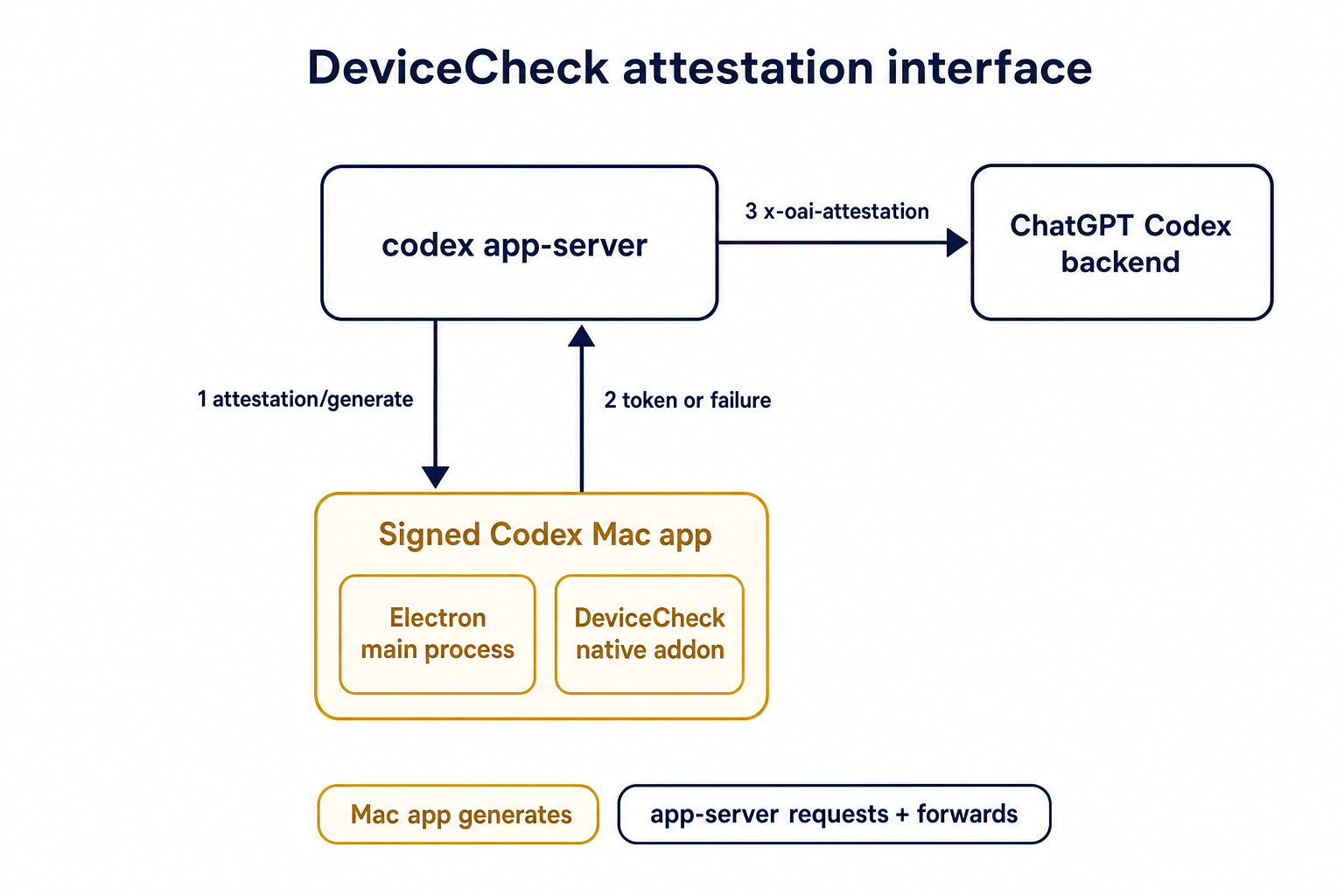
## Details
This PR teaches the Codex app-server runtime how to request and attach
an attestation token. It does not generate DeviceCheck tokens directly;
instead, it relies on the connected desktop app to advertise that it can
generate attestation and then asks that app for a fresh header value
when needed.
The flow is:
1. The Codex desktop app connects to app-server.
2. During `initialize`, the app can advertise that it supports
`requestAttestation`.
3. Before app-server calls selected ChatGPT Codex endpoints, it sends
the internal server request `attestation/generate` to the app.
4. app-server receives a pre-encoded header value back.
5. app-server forwards that value as `x-oai-attestation` on the scoped
outbound requests.
The code in this repo is mostly protocol and runtime plumbing: it adds
the app-server request/response shape, introduces an attestation
provider in core, wires that provider into Responses / compaction /
realtime setup paths, and covers the intended scoping with tests. The
signed macOS DeviceCheck generation remains owned by the desktop app PR.
## Related PR
- Codex desktop app implementation:
https://github.com/openai/openai/pull/878649
## Validation
<details>
<summary>Tests run</summary>
```sh
cargo test -p codex-app-server-protocol
cargo test -p codex-core attestation --lib
cargo test -p codex-app-server --lib attestation
```
Also ran:
```sh
just fix -p codex-core
just fix -p codex-app-server
just fix -p codex-app-server-protocol
just fmt
just write-app-server-schema
```
</details>
<details>
<summary>E2E DeviceCheck validation</summary>
First validated the signed desktop app boundary directly: launched a
packaged signed `Codex.app`, sent `attestation/generate`, decoded the
returned `v1.` attestation header, and validated the extracted
DeviceCheck token with `personal/jm/verify_devicecheck_token.py` using
bundle ID `com.openai.codex`. Apple returned `status_code: 200` and
`is_ok: true`.
Then ran the fuller app + app-server flow. The packaged `Codex.app`
launched a current-branch app-server via `CODEX_CLI_PATH`, and a local
MITM proxy intercepted outbound `chatgpt.com` traffic. The app-server
requested `attestation/generate` from the real Electron app process, and
the intercepted `/backend-api/codex/responses` traffic included
`x-oai-attestation` on both routes:
```text
GET /backend-api/codex/responses Upgrade: websocket x-oai-attestation: present
POST /backend-api/codex/responses Upgrade: none x-oai-attestation: present
```
The captured header decoded to a DeviceCheck token that also validated
with Apple for `com.openai.codex` (`status_code: 200`, `is_ok: true`,
team `2DC432GLL2`).
</details>
---------
Co-authored-by: Codex <noreply@openai.com>
## Why

`/fast` was wired as a one-off slash command even though model metadata
now exposes service tiers as catalog data. That meant adding another
tier, such as a slower/cheaper tier, would require more hardcoded TUI
plumbing instead of letting the model catalog drive the available
commands.

This change makes service-tier commands data-driven: each advertised
`service_tiers` entry becomes a `/name` command using the catalog
description, while the request path sends the tier `id` only when the
selected model supports it.

## What Changed

- Removed the hardcoded `/fast` slash-command variant and introduced
dynamic service-tier command items in the composer and command popup.
- Added toggle behavior for service-tier commands: invoking `/name`
selects that tier, and invoking it again clears the selection.
- Preserved the existing Fast-mode keybinding/status affordances by
resolving the current model tier whose name is `fast`, while still
sending the tier request value such as `priority`.
- Persisted service-tier selections as raw request strings so non-fast
tiers can round-trip through config.
- Updated the Bedrock catalog entry to advertise fast support through
`service_tiers` with `id: "priority"` and `name: "fast"`.
- Added defensive filtering in core so unsupported selected service
tiers are omitted from `/responses` requests.

## Validation

- Added/updated coverage for dynamic service-tier slash command lookup,
popup descriptions, composer dispatch, TUI fast toggling, and
unsupported-tier omission in core request construction.
- Local tests were not run per request.

---------

Co-authored-by: Codex <noreply@openai.com>
Requires discoverability on plugin/share/updateTargets so the server can
manage workspace link access consistently, including auto-adding the
workspace principal for UNLISTED.

Also rejects LISTED on share creation and blocks client-supplied
workspace principals while preserving response parsing for LISTED.
## Summary
- Remove `perCwdExtraUserRoots` / `SkillsListExtraRootsForCwd` from the
`skills/list` app-server API.
- Drop Rust app-server and `codex-core-skills` extra-root plumbing so
skill scans are keyed by the normal cwd/user/plugin roots only.
- Regenerate app-server schemas and update docs/tests that only existed
for the removed extra-roots behavior.

## Validation
- `just write-app-server-schema`
- `just fmt`
- `cargo test -p codex-app-server-protocol`
- `cargo test -p codex-core-skills`
- `just fix -p codex-app-server-protocol`
- `just fix -p codex-core-skills`
- `just fix -p codex-app-server`
- `just fix -p codex-tui`

## Notes
- `cargo test -p codex-app-server --test all skills_list` ran the edited
skills-list cases, but the full filtered run ended on existing
`skills_changed_notification_is_emitted_after_skill_change` timeout
after a websocket `401`.
- `cargo test -p codex-tui --lib` compiled the changed TUI callers, then
failed two unrelated status permission tests because local
`/etc/codex/requirements.toml` forbids `DangerFullAccess`.
- Source-truth check found the OpenAI monorepo still has
generated/app-server-kit mirror references to the removed field; those
should be cleaned up when generated app-server types are synced or in a
companion OpenAI cleanup.
Remove the remote thread-store backend and checked-in protobuf
artifacts. We've moved these into another crate that link against this
one.

Also remove the config settings for thread store backend selection,
since we'll instead pass an instantiated thread store into the core-api
crate's main entrypoint.
## Why
The goal of this PR is to align on app-server and `ThreadStore` API
updates for paginating through large threads.


#### app-server
##### `thread/turns/list`
- Updates `thread/turns/list` to support `itemsView?: "notLoaded" |
"summary" | "full" | null`, defaulting to `summary`.
- Implements the current `thread/turns/list` behavior over the existing
persisted rollout-history fallback:
  - `notLoaded` returns turn envelopes with empty `items`.
- `summary` returns the first user message and final assistant message
when available.
  - `full` preserves the existing full item behavior.

Note that this method still uses the naive approach of loading the
entire rollout file, and returns just the filtered slice of the data.
Real pagination will come later by leveraging SQLite.

##### `thread/turns/items/list`
- Adds the experimental `thread/turns/items/list` protocol, schema,
dispatcher, and processor stub. The app-server currently returns
JSON-RPC `-32601` with `thread/turns/items/list is not supported yet`.

#### ThreadStore
- Adds the experimental `thread/turns/items/list` protocol, schema,
dispatcher, and processor stub. The app-server currently returns
JSON-RPC `-32601` with `thread/turns/items/list is not supported yet`.
- Adds `ThreadStore` contract types and stubbed methods for listing
thread turns and listing items within a turn.
- Adds a typed `StoredTurnStatus` and `StoredTurnError` to avoid baking
app-server API enums or lossy string status values into the store-facing
turn contract.
- Adds a typed `StoredTurnStatus` and `StoredTurnError` to avoid baking
app-server API enums or lossy string status values into the store-facing
turn contract.

This also sketches the storage abstraction we expect to need once turns
are indexed/stored. In particular, `notLoaded` is useful only if
ThreadStore can eventually list turn metadata without loading every
persisted item for each turn.

## Validation

- Added/updated protocol serialization coverage for the new request and
response shapes.
- Added app-server integration coverage for `thread/turns/list` default
summary behavior and all three `itemsView` modes.
- Added app-server integration coverage that `thread/turns/items/list`
returns the expected unsupported JSON-RPC error when experimental APIs
are enabled.
- Added thread-store coverage that the default trait methods return
`ThreadStoreError::Unsupported`.

No developers.openai.com documentation update is needed for this
internal experimental app-server API surface.
## Summary

`cargo test` has entails both running standard Rust tests and doctests.
It turns out that the doctest discovery is fairly slow, and it's a cost
you pay even for crates that don't include any doctests.

This PR disables doctests with `doctest = false` for crates that lack
any doctests.

For the collection of crates below, this speeds up test execution by
>4x.

E.g., before this PR:

```
Benchmark 1: cargo test     -p codex-utils-absolute-path     -p codex-utils-cache     -p codex-utils-cli     -p codex-utils-home-dir     -p codex-utils-output-truncation     -p codex-utils-path     -p codex-utils-string     -p codex-utils-template     -p codex-utils-elapsed     -p codex-utils-json-to-toml
  Time (mean ± σ):      1.849 s ±  4.455 s    [User: 0.752 s, System: 1.367 s]
  Range (min … max):    0.418 s … 14.529 s    10 runs
```

And after:

```
Benchmark 1: cargo test     -p codex-utils-absolute-path     -p codex-utils-cache     -p codex-utils-cli     -p codex-utils-home-dir     -p codex-utils-output-truncation     -p codex-utils-path     -p codex-utils-string     -p codex-utils-template     -p codex-utils-elapsed     -p codex-utils-json-to-toml
  Time (mean ± σ):     428.6 ms ±   6.9 ms    [User: 187.7 ms, System: 219.7 ms]
  Range (min … max):   418.0 ms … 436.8 ms    10 runs
```

For a single crate, with >2x speedup, before:

```
Benchmark 1: cargo test -p codex-utils-string
  Time (mean ± σ):     491.1 ms ±   9.0 ms    [User: 229.8 ms, System: 234.9 ms]
  Range (min … max):   480.9 ms … 512.0 ms    10 runs
```

And after:

```
Benchmark 1: cargo test -p codex-utils-string
  Time (mean ± σ):     213.9 ms ±   4.3 ms    [User: 112.8 ms, System: 84.0 ms]
  Range (min … max):   206.8 ms … 221.0 ms    13 runs
```

Co-authored-by: Codex <noreply@openai.com>
## Summary

Fix `getConversationSummary` so thread-id summaries work for stored
threads that do not have a local rollout path, such as remote thread
stores.

The root cause was that `summary_from_stored_thread` returned `None`
when `StoredThread.rollout_path` was absent, and
`get_thread_summary_response_inner` treated that as an internal error.
This made conversation-id lookups depend on a local-only field even
though the thread store can address the thread by id.
Supersedes the abandoned #19859, rebuilt on latest `main`.

# Why

PR #19705 adds discovery for hooks bundled with plugins, but `/plugins`
still only shows skills, apps, and MCP servers. This follow-up makes
bundled hooks visible in the same plugin detail view so users can
inspect the full plugin surface in one place.

We also need `PluginHookSummary` to populate Plugin Hooks in the app;
`hooks/list` is not enough there because plugin detail needs to show
hooks for disabled plugins too.

# What

- extend `plugin/read` with `PluginHookSummary` entries for bundled
hooks
- summarize plugin hooks while loading plugin details
- render a `Hooks` row in the `/plugins` detail popup

<img width="3456" height="848" alt="CleanShot 2026-04-27 at 11 45 34@2x"
src="https://github.com/user-attachments/assets/fe3a38d6-a260-4351-8513-fb04c93d725b"
/>
## Why

Reverts #20689 to restore the previous optional state DB plumbing. The
conflict resolution keeps the newer installation ID and session/thread
identity changes that landed after #20689, while removing the mandatory
state DB and agent graph store dependency from ThreadManager
construction.

## What changed

- Restored `Option<StateDbHandle>` through app-server, MCP server,
prompt debug, and test entry points.
- Removed the `codex-core` dependency on `codex-agent-graph-store` and
reverted descendant lookup back to the existing state DB path when
available.
- Kept newer `installation_id` forwarding by passing it beside the
optional DB handle.
- Kept local thread-name updates working when the optional state DB
handle is absent.

## Validation

- `git diff --check`
- `cargo test -p codex-thread-store`
- `cargo test -p codex-state -p codex-rollout -p
codex-app-server-protocol`
- Attempted `env CARGO_INCREMENTAL=0 cargo test -p codex-core -p
codex-app-server -p codex-app-server-client -p codex-mcp-server -p
codex-thread-manager-sample -p codex-tui`; blocked locally by a rustc
ICE while compiling `v8 v146.4.0` with `rustc 1.93.0 (254b59607
2026-01-19)` on `aarch64-apple-darwin`.
## Summary
- process `skills/list` cwd entries with bounded concurrency of 5
- preserve the caller's requested cwd order in the response
- add coverage that verifies response ordering remains stable

## Why
Cold-start desktop traces showed that `skills/list` can dominate the
shared config queue when it scans many workspace roots serially. The
expensive work is largely independent per cwd, so the request was paying
the sum of all cwd costs instead of the cost of the slowest bounded
batch.

## Impact
This keeps current request semantics intact while reducing the
wall-clock time of large multi-root `skills/list` calls. That should
also reduce how long later config-family requests, such as
`plugin/list`, wait behind `skills/list` during startup.

## Validation
- `just fmt`
- `cargo test -p codex-app-server`
- `cargo test -p codex-app-server
skills_list_preserves_requested_cwd_order`
Adds marketplaceKinds to plugin/list for local, workspace-directory, and
shared-with-me; omitted params keep default local plus gated global
behavior, while explicit kinds are exact.

Exposes shareContext on plugin summaries from local share mappings and
remote workspace/shared responses, including remotePluginId and nullable
creator metadata.

Adds shared-with-me listing through /ps/plugins/workspace/shared,
renames the workspace remote namespace to workspace-directory, and keeps
direct remote read/share/install/update/delete paths gated by plugins
rather than remote_plugin.
## Why

Skills update notifications are app-server API behavior, but the watcher
lived in `codex-core` and surfaced through
`EventMsg::SkillsUpdateAvailable`. Moving the watcher out keeps core
focused on thread execution and lets app-server own both cache
invalidation and the `skills/changed` notification.

## What changed

- Added an app-server-owned skills watcher that watches local skill
roots, clears the shared skills cache, and emits `skills/changed`
directly.
- Registers skill watches from the common app-server thread listener
attach path, including direct starts, resumes, and app-server-observed
child or forked threads.
- Stores the `WatchRegistration` on `ThreadState`, so listener
replacement, thread teardown, idle unload, and app-server shutdown
deregister by dropping the RAII guard.
- Removed `EventMsg::SkillsUpdateAvailable`, the core watcher, and the
old core live-reload test.
- Extended the app-server skills change test to verify a cached skills
list is refreshed after a filesystem change without forcing reload.

## Validation

- `cargo check -p codex-core -p codex-app-server -p codex-mcp-server -p
codex-rollout -p codex-rollout-trace`
- `cargo test -p codex-app-server
skills_changed_notification_is_emitted_after_skill_change`
## Why

`session_id` and `thread_id` are separate identities after #20437, but
app-server only surfaced `sessionId` on the `thread/start`,
`thread/resume`, and `thread/fork` response envelopes. Other
thread-bearing surfaces such as `thread/list`, `thread/read`,
`thread/started`, `thread/rollback`, `thread/metadata/update`, and
`thread/unarchive` either lacked the grouping key or forced clients to
special-case those three responses.

Making `sessionId` part of the reusable `Thread` payload gives every v2
API surface one place to expose session-tree identity.

## Mental model
  1. thread.sessionId lives on `Thread`
2. It is a view/runtime identity for the current live session tree, not
durable stored lineage metadata
3. When app-server has a live loaded thread, it copies the real value
from core’s session_configured.session_id
4. When it only has stored/unloaded data, it falls back to
thread.sessionId = thread.id

## What changed

- Added `sessionId` to the v2
[`Thread`](8fc9e9b4cf/codex-rs/app-server-protocol/src/protocol/v2/thread_data.rs (L105-L109)).
- Removed the duplicate top-level `sessionId` fields from
`thread/start`, `thread/resume`, and `thread/fork`; clients should now
read `response.thread.sessionId`.
- Populated `thread.sessionId` when building live thread responses,
replaying loaded threads, and returning stored-thread summaries so the
field is present across start, resume, fork, list, read, rollback,
metadata-update, unarchive, and `thread/started` paths. See
[`load_thread_from_resume_source_or_send_internal`](8fc9e9b4cf/codex-rs/app-server/src/request_processors/thread_processor.rs (L2824-L2918))
and
[`thread_from_stored_thread`](8fc9e9b4cf/codex-rs/app-server/src/request_processors/thread_processor.rs (L3671-L3719)).
- Preserved the stored-thread fallback: if a thread has not been loaded
into a live session tree yet, `thread.sessionId` falls back to
`thread.id`; once the thread is live again, the field reports the active
session tree root.
- Regenerated the JSON/TypeScript schemas and updated the app-server
README examples to show
[`thread.sessionId`](8fc9e9b4cf/codex-rs/app-server/README.md (L306-L310))
on the thread object.
## Why

`thread/start` and `thread/resume` already return `sessionId`, but
`thread/fork` only returned the new thread. That left clients to infer
the forked thread's session identity from `thread.id`, which kept the
new `session_id` / `thread_id` split implicit at one lifecycle boundary.
Follow-up to #20437.

## What changed

- Add `sessionId` to `ThreadForkResponse`.
- Populate it from the forked session configuration.
- Regenerate the v2 JSON/TypeScript schema fixtures and update the
app-server docs/example.
- Extend the fork integration test to assert the returned `sessionId`.

## Verification

- Added coverage in `thread_fork_creates_new_thread_and_emits_started`
for the new response field.
## Summary

Related to
https://openai.slack.com/archives/C095U48JNL9/p1777537279707449
TLDR:
We update the meaning of session ids and thread ids:
* thread_id stays as now
* session_id become a shared id between every thread under a /root
thread (i.e. every sub-agent share the same session id)

This PR introduces an explicit `SessionId` and threads it through the
protocol/client boundary so `session_id` and `thread_id` can diverge
when they need to, while preserving compatibility for older serialized
`session_configured` events.

---------

Co-authored-by: Codex <noreply@openai.com>
## Why

Codex currently accepts dynamic tool names and namespaces that the
upstream Responses function-tool path does not actually support. In
practice, that means app-server can register a dynamic tool successfully
and only discover later that the LLM-facing tool contract will reject or
mishandle it.

This PR tightens the app-server-side dynamic tool contract to match the
Responses API before we stack dynamic tool hook support on top of it.

## What changed

- validate dynamic tool `name` against the Responses function-tool
identifier contract: `^[a-zA-Z0-9_-]+$`, length `1..128`
- validate dynamic tool `namespace` the same way, with the Responses
namespace length limit `1..64`
- reject namespaces that collide with the always-reserved Responses
runtime namespaces such as `functions`, `multi_tool_use`, `file_search`,
`web`, `browser`, `image_gen`, `computer`, `container`, `terminal`,
`python`, `python_user_visible`, `api_tool`, `tool_search`, and
`submodel_delegator`
- escape invalid identifiers in error messages so control characters do
not spill raw into logs or client-visible error text
- document the tightened dynamic tool identifier contract in
`codex-rs/app-server/README.md`
- add both unit coverage for the validator and an app-server integration
test that rejects a `thread/start` request with Responses-incompatible
dynamic tool identifiers

## Verification

- `cargo test -p codex-app-server validate_dynamic_tools_`
- `cargo test -p codex-app-server --test all
thread_start_rejects_dynamic_tools_not_supported_by_responses`
Extends `plugin/share/save` to accept optional discoverability and
shareTargets while uploading plugin contents, and adds
`plugin/share/updateTargets` for share-only target updates without
re-uploading.
## Summary
- make `thread_source` an explicit optional thread-level field on
`thread/start`, `thread/fork`, and returned thread payloads
- persist `thread_source` in rollout/session metadata so resumed live
threads retain the original value
- replace the old best-effort `session_source` -> `thread_source`
mapping with an explicit caller-supplied analytics classification

## Why
Before this change, analytics `thread_source` was populated by a
best-effort mapping from `session_source`. `session_source` describes
the runtime/client surface, not the actual thread-level origin, so that
projection was not accurate enough to distinguish cases such as `user`,
`subagent`, `memory_consolidation`, and future thread origins reliably.

Making `thread_source` explicit keeps one thread-level analytics field
while letting callers provide the real classification directly instead
of recovering it indirectly from `session_source`.

## Impact
For new analytics events, `thread_source` now reflects the explicit
thread-level classification supplied by the caller rather than an
inferred value derived from `session_source`. Existing protocol fields
remain optional; callers that omit `threadSource` now produce `null`
instead of a best-effort inferred value.

## Validation
- `just write-app-server-schema`
- `cargo test -p codex-analytics -p codex-core -p
codex-app-server-protocol --no-run`
- `cargo test -p codex-app-server-protocol
generated_ts_optional_nullable_fields_only_in_params`
- `cargo test -p codex-analytics
thread_initialized_event_serializes_expected_shape`
- `cargo test -p codex-core
resume_stopped_thread_from_rollout_preserves_thread_source`
## Summary
- Add plugin manifest keywords to core plugin marketplace/detail models
- Expose keywords on app-server v2 PluginSummary and generated
schema/types
- Populate keywords in plugin/list and plugin/read responses for local
plugins

Depends on https://github.com/openai/openai/pull/891087

## Validation
- just fmt
- just write-app-server-schema
- cargo test -p codex-app-server-protocol
- cargo test -p codex-core-plugins
- cargo test -p codex-app-server
plugin_list_keeps_valid_marketplaces_when_another_marketplace_fails_to_load
- cargo test -p codex-app-server
plugin_read_returns_plugin_details_with_bundle_contents
## Why

Thread names are app-server metadata now, backed by the thread store and
sqlite state database. Keeping a core `SetThreadName` op plus a rollout
`thread_name_updated` event made rename persistence live in the wrong
layer and required historical replay support for an event that new
app-server flows should not write.

## What changed

- Removed `Op::SetThreadName` and `EventMsg::ThreadNameUpdated` from the
core protocol and deleted the core handler path that appended rename
events to rollouts.
- Updated app-server `thread/name/set` so both loaded and unloaded
threads write through thread-store metadata and app-server emits
`thread/name/updated` notifications.
- Updated local thread-store name metadata updates to write sqlite title
metadata and the legacy thread-name index without appending rollout
events.
- Removed state extraction and rollout handling for the deleted
thread-name event.

## Validation

- `cargo test -p codex-app-server thread_name_updated_broadcasts`
- `cargo test -p codex-app-server
thread_name_set_is_reflected_in_read_list_and_resume`
- `cargo test -p codex-thread-store
update_thread_metadata_sets_name_on_active_rollout_and_indexes_name`
- `cargo test -p codex-state`
- `cargo check -p codex-mcp-server -p codex-rollout-trace`
- `just fix -p codex-app-server -p codex-thread-store -p codex-state -p
codex-mcp-server -p codex-rollout-trace`

## Docs

No external documentation update is expected for this internal ownership
change.
## Why

We want the agent graph store to be passed down the stack as a real
dependency, the same way we already treat the thread store.

This will let us inject the agent graph store as a real dependency and
support implementations other than the local SQLite-backed one. Right
now most code instantiates a state DB and an agent graph store
just-in-time. Ideally, we would not depend on the state DB directly but
only read through the higher-level interfaces.

This change makes the dependency boundaries explicit and moves state DB
initialization to process bootstrap instead of hiding it inside local
store implementations.

## What changed

- `ThreadManager` now requires a `StateDbHandle` and an
`AgentGraphStore` at construction time instead of treating them as
optional internals.
- The local store constructors no longer lazily initialize SQLite.
Callers now initialize the state DB once per process and use that shared
handle to build:
  - `LocalThreadStore`
  - `LocalAgentGraphStore`
- App bootstraps (`app-server`, `mcp-server`, `prompt_debug`, and the
thread-manager sample) now initialize the state DB up front and inject
the resulting handle down the stack.
- `app-server` now consistently uses its process-scoped state DB handle
instead of reopening SQLite or trying to recover it from loaded threads.
- Device-key storage now reuses the shared state DB handle instead of
maintaining its own lazy opener.
- The thread archive / descendant traversal paths now use the injected
`AgentGraphStore` instead of reaching through local
thread-store-specific state.

## Verification

- `cargo check -p codex-core -p codex-thread-store -p codex-app-server
-p codex-mcp-server -p codex-thread-manager-sample --tests`
- `cargo test -p codex-thread-store`
- `cargo test -p codex-core
thread_manager_accepts_separate_agent_graph_store_and_thread_store --
--nocapture`
- `cargo test -p codex-app-server
thread_archive_archives_spawned_descendants -- --nocapture`
## Why

`Turn.items` currently overloads an empty array to mean either that no
items exist or that the server intentionally did not load them for this
response. That ambiguity blocks future lazy-loading work where clients
need to distinguish unloaded, summary, and fully hydrated turn payloads.

## What changed

- add a new `TurnItemsView` enum with `notLoaded`, `summary`, and `full`
variants
- add required `itemsView` metadata to app-server `Turn` payloads
- mark reconstructed persisted history as `full` and live shell-style
turn payloads as `notLoaded`
- keep current `thread/turns/list` behavior unchanged and document that
it still returns `full` turns today
- regenerate the JSON and TypeScript protocol fixtures

## Verification

- `just write-app-server-schema`
- `cargo test -p codex-app-server-protocol`
- `cargo test -p codex-app-server thread_read_can_include_turns`
- `cargo test -p codex-app-server
thread_turns_list_can_page_backward_and_forward`
- `cargo test -p codex-app-server
thread_resume_rejects_history_when_thread_is_running`
- `just fix -p codex-app-server-protocol`
- `just fix -p codex-app-server`
- `just fmt`
# Why

We want shared hook trust that both the app and the TUI can build on,
but the metadata is only useful if runtime behavior agrees with it. This
PR adds a single backend trust model for hooks so unmanaged hooks cannot
run until the current definition has been reviewed, while managed hooks
remain runnable and non-configurable.

# What

- persist `trusted_hash` alongside hook state in `config.toml`
- expose `currentHash` and derived `trustStatus` through `hooks/list`
- derive trust from normalized hook definitions so equivalent hooks from
`config.toml` and `hooks.json` share the same trust identity
- gate unmanaged hooks on trust before they enter the runnable handler
set

# Reviewer Notes

- key file to review is `codex-rs/hooks/src/engine/discovery.rs`
- the only **core** change is schema related
## Why

Taking a step to removing the `persistExtendedHistory` field. It's not
scalable to be persisting so much data in the rollout file and returning
it in the thread history.

When a client explicitly sends `true`, the server now tells that client
the parameter is deprecated and ignored so the caller has a clear
migration signal via the `deprecationNotice` notification.

## What changed

- Keep the `persist_extended_history` / `persistExtendedHistory` field
in the v2 protocol for compatibility, but document it as deprecated and
ignored.
- Ignore the parameter in app-server `thread/start`, `thread/resume`,
and `thread/fork`; those paths always use limited history persistence
now.
- Stop treating `persistExtendedHistory` as a running-thread resume
override mismatch.
- Emit a connection-scoped `deprecationNotice` when a request explicitly
sets `persist_extended_history: true`.

## Verification

- Added `thread_start_deprecates_persist_extended_history_true` to cover
the deprecation notice.
- `cargo test -p codex-app-server`
- `cargo test -p codex-app-server-protocol`
## Why

The model list needs to carry display-ready service tier metadata so
clients can render tier choices with stable IDs, names, and
descriptions. A raw speed-tier string list is not enough for richer UI
copy or future tier labels.

## What changed

- Added `ModelServiceTier` to shared model metadata with string `id`,
`name`, and `description` fields.
- Added `service_tiers` to `ModelInfo` and `ModelPreset`, preserving
empty defaults for older cached model payloads.
- Exposed `serviceTiers` on app-server v2 `Model` responses and threaded
it through TUI app-server model conversion.
- Marked legacy `additional_speed_tiers` / `additionalSpeedTiers`
metadata as deprecated in source and generated schema output.
- Regenerated app-server protocol JSON schema and TypeScript fixtures,
including `ModelServiceTier.ts`.

## Verification

- Ran `just write-app-server-schema`.
- Did not run local tests per repo instruction; relying on PR CI.

---------

Co-authored-by: Codex <noreply@openai.com>
- Route `thread/metadata/update` through
`ThreadStore::update_thread_metadata`.
- Add `LocalThreadStore` git metadata patch support for set, partial
update, and clear semantics.
- Add some unit tests for the new thread store code
- Remove a lot of dead code/tests!
## Why

App-server clients sometimes need argv-based local process execution
while sandbox policy is controlled outside Codex. Those environments can
reject sandbox-disabling paths before a command ever starts, even when
the caller intentionally wants unsandboxed execution.

This PR adds a distinct `process/*` API for that use case instead of
extending `command/exec` with another sandbox-disabling shape. Keeping
the new surface separate also makes the future removal of `command/exec`
simpler: clients that need explicit process lifecycle control can move
to the newer handle-based API without depending on `command/exec`
business logic.

## What changed

- Added v2 process lifecycle methods: `process/spawn`,
`process/writeStdin`, `process/resizePty`, and `process/kill`.
- Added process notifications: `process/outputDelta` for streamed
stdout/stderr chunks and `process/exited` for final exit status and
buffered output.
- Made `process/spawn` intentionally unsandboxed and omitted
sandbox-selection fields such as `sandboxPolicy` and
`permissionProfile`.
- Added client-supplied, connection-scoped `processHandle` values for
follow-up control requests and notification routing.
- Supported cwd, environment overrides, PTY mode and size, stdin
streaming, stdout/stderr streaming, per-stream output caps, and timeout
controls.
- Killed active process sessions when the originating app-server
connection closes.
- Wired the implementation through the modular `request_processors/`
app-server layout, with process-handle request serialization for
follow-up control calls.
- Updated generated JSON/TypeScript schema fixtures and documented the
new API in `codex-rs/app-server/README.md`.
- Added v2 app-server integration coverage in
`codex-rs/app-server/tests/suite/v2/process_exec.rs` for spawn
acknowledgement before exit, buffered output caps, and process
termination.

## Verification

- `cargo test -p codex-app-server-protocol`
- `cargo test -p codex-app-server`

---------

Co-authored-by: Owen Lin <owen@openai.com>
## Summary

Remove the hardcoded remote plugin ID prefix allow-list from app-server
uninstall routing. IDs that do not parse as local `plugin@marketplace`
IDs now flow through the remote uninstall path, where the existing
remote ID safety validation still rejects empty IDs, spaces, slashes,
and other unsafe characters before URL/cache use.

## Why

Plugin-service owns the backend remote plugin ID contract. Codex should
not require remote IDs to start with the local hardcoded prefixes
`plugins~`, `plugins_`, `app_`, `asdk_app_`, or `connector_`, because
newer backend ID families could otherwise be rejected before
plugin-service sees the request.

## Validation

- `just fmt`
- `cargo test -p codex-app-server plugin_uninstall`
- `just fix -p codex-app-server`
- `git diff --check`

