## Why

Remote compaction v2 is the `/responses` implementation of
session-history compaction, but it still needs to preserve the
observable contract of the legacy `/responses/compact` path. In
particular, users and integrations that rely on `PreCompact` and
`PostCompact` hooks should not see different behavior when
`remote_compaction_v2` is enabled.

## What Changed

- Runs `PreCompact` before issuing the remote compaction v2 request,
including `Interrupted` analytics when a pre-hook stops execution.
- Runs `PostCompact` after a successful v2 compaction and aborts the
turn if the post-hook stops execution.
- Adds `compact_remote_parity` coverage that compares legacy and v2
compaction across manual transcript shapes, automatic pre-turn
compaction, automatic mid-turn compaction, hook payloads, replacement
history, follow-up request payloads, and API-key `service_tier=fast`
behavior.
- Registers the new parity suite under `core/tests/suite`.

Relevant code:

-
[`compact_remote_v2.rs`](af63745cb5/codex-rs/core/src/compact_remote_v2.rs)
-
[`compact_remote_parity.rs`](af63745cb5/codex-rs/core/tests/suite/compact_remote_parity.rs)

## Verification

- Added `core/tests/suite/compact_remote_parity.rs` to assert parity
between legacy remote compaction and remote compaction v2 for the
affected request, hook, rollout-history, and follow-up paths.
- Existing `compact_remote_v2` unit coverage still exercises v2
replacement-history retention and compaction-output collection.
## Why

Remote compaction v2 was still using `context_compaction` as both the
request trigger and the compacted output shape. The Responses API now
has the landed contract for this flow: Codex sends a dedicated `{
"type": "compaction_trigger" }` input item, and the backend returns the
standard `compaction` output item with encrypted content.

This aligns the v2 path with that wire contract while preserving the
existing local compacted-history post-processing behavior.

## What changed

- Add `ResponseItem::CompactionTrigger` and regenerate the app-server
protocol schema fixtures.
- Send `compaction_trigger` from `remote_compaction_v2` instead of a
payload-less `context_compaction`.
- Collect exactly one backend `compaction` output item, then reuse the
existing compacted-history rebuilding path.
- Treat the trigger item as a transient request marker rather than model
output or persisted rollout/memory content.

## Verification

- `cargo test -p codex-protocol compaction_trigger`
- `cargo test -p codex-core remote_compact_v2`
- `cargo test -p codex-core compact_remote_v2`
- `cargo test -p codex-core
responses_websocket_sends_response_processed_after_remote_compaction_v2`
- `just write-app-server-schema`
- `cargo test -p codex-app-server-protocol schema_fixtures`
## Why

This PR builds on [#22610](https://github.com/openai/codex/pull/22610)
and is the app-server side of the migration from mutable per-turn
`SandboxPolicy` replacement toward selecting immutable permission
profiles by id plus mutable runtime workspace roots.

Once permission profiles can carry their own immutable
`workspace_roots`, app-server no longer needs to mutate the selected
`PermissionProfile` just to represent thread-specific filesystem
context. The mutable part now lives on the thread as explicit
`runtimeWorkspaceRoots`, while `:workspace_roots` remains symbolic until
the sandbox is realized for a turn.

## What Changed

- Replaced the v2 permission-selection wrapper surface with plain
profile ids for `thread/start`, `thread/resume`, `thread/fork`, and
`turn/start`.
- Removed the API surface for profile modifications
(`PermissionProfileSelectionParams`,
`PermissionProfileModificationParams`,
`ActivePermissionProfileModification`).
- Added experimental `runtimeWorkspaceRoots` fields to the thread
lifecycle and turn-start APIs.
- Threaded runtime workspace roots through core session/thread
snapshots, turn overrides, app-server request handling, and command
execution permission resolution.
- Kept session permission state symbolic so later runtime root updates
and cwd-only implicit-root retargeting rebind `:workspace_roots`
correctly.
- Updated the embedded clients just enough to send and restore the new
thread state.
- Refreshed the generated schema/TypeScript artifacts and the app-server
README to match the new contract.

## Verification

Targeted coverage for this layer lives in:

- `codex-rs/app-server-protocol/src/protocol/v2/tests.rs`
- `codex-rs/app-server/tests/suite/v2/thread_start.rs`
- `codex-rs/app-server/tests/suite/v2/thread_resume.rs`
- `codex-rs/app-server/tests/suite/v2/turn_start.rs`
- `codex-rs/core/src/session/tests.rs`

The key regression checks exercise that:

- `runtimeWorkspaceRoots` resolve against the effective cwd on thread
start.
- Profile-declared workspace roots are excluded from the runtime
workspace roots returned by app-server.
- A turn-level runtime workspace-root update persists onto the thread
and is returned by `thread/resume`.
- A named permission profile selected on one turn remains symbolic so a
later runtime-root-only turn update changes the actual sandbox writes.
- A cwd-only turn update retargets the implicit runtime cwd root while
preserving additional runtime roots.
- The protocol fixtures and generated client artifacts stay in sync with
the string-based permission selection contract.


---
[//]: # (BEGIN SAPLING FOOTER)
Stack created with [Sapling](https://sapling-scm.com). Best reviewed
with [ReviewStack](https://reviewstack.dev/openai/codex/pull/22611).
* #22612
* __->__ #22611
## Summary
- add the missing response.created event to the mocked empty follow-up
response in the compact rollback test
- keep the fix scoped to the flaky mocked stream shape, without
increasing timeouts

## Recent flakes on main
- `snapshot_rollback_followup_turn_trims_context_updates` failed in
`rust-ci-full` on `main` in the Ubuntu remote test job on 2026-05-14:
https://github.com/openai/codex/actions/runs/25891434395/job/76095284830
- The same `compact_resume_fork` suite also failed recently on `main`
with `snapshot_rollback_past_compaction_replays_append_only_history`,
which has the same mocked Responses stream shape sensitivity this PR is
tightening:
https://github.com/openai/codex/actions/runs/25892437363/job/76098329098

## Verification
- env -u CODEX_SANDBOX_NETWORK_DISABLED cargo test -p codex-core --test
all snapshot_rollback_followup_turn_trims_context_updates -- --nocapture
- repeated the same focused test 3 consecutive times locally
- UV_CACHE_DIR=/private/tmp/uv-cache-codex-fmt just fmt
## Why
- Similar change as https://github.com/openai/codex/pull/21219
- Without change: MCP tool calls receive
`_meta["x-codex-turn-metadata"]` with various key values.
- Issue: MCP servers currently do not know if user input was requested
during the turn (Ex: Model decides to prompt the user for approval
mid-turn before making a possibly risky tool call). MCP servers may want
to know this when tracking latency metrics because these instances are
inflated.

## What Changed
- With change: MCP turn metadata now includes
`user_input_requested_during_turn` when a model-visible
`request_user_input` call happened earlier in the turn, propagated in
`_meta["x-codex-turn-metadata"]`.
- `mark_turn_user_input_requested()` is called when user input is
requested through either MCP elicitation (`mcp.rs`) or the
`request_user_input` tool (`mod.rs`).
- MCP tool call `_meta` is now built immediately before execution
(`mcp_tool_call.rs`) so user input requested earlier in the same turn,
including within the same tool call via elicitation, is reflected in the
metadata.
- Normal `/responses` turn metadata headers are unchanged.

## Verification
- `codex-rs/core/src/session/mcp_tests.rs`
- `codex-rs/core/src/tools/handlers/request_user_input_tests.rs`
- `codex-rs/core/src/turn_metadata_tests.rs`
- `codex-rs/core/tests/suite/search_tool.rs`
## Why

This is the configuration/model half of the alternative permissions
migration we discussed as a comparison point for
[#22401](https://github.com/openai/codex/pull/22401) and
[#22402](https://github.com/openai/codex/pull/22402).

The old `workspace-write` model mixes three concerns that we want to
keep separate:
- reusable profile rules that should stay immutable once selected
- user/runtime workspace roots from `cwd`, `--add-dir`, and legacy
workspace-write config
- internal Codex writable roots such as memories, which should not be
shown as user workspace roots

This PR gives permission profiles first-class `workspace_roots` so users
can opt multiple repositories into the same `:workspace_roots` rules
without using broad absolute-path write grants. It also starts
separating the raw selected profile from the effective runtime profile
by making `Permissions` expose explicit accessors instead of public
mutable fields.

A representative `config.toml` looks like this:

```toml
default_permissions = "dev"

[permissions.dev.workspace_roots]
"~/code/openai" = true
"~/code/developers-website" = true

[permissions.dev.filesystem.":workspace_roots"]
"." = "write"
".codex" = "read"
".git" = "read"
".vscode" = "read"
```

If Codex starts in `~/code/codex` with that profile selected, the
effective workspace-root set becomes:
- `~/code/codex` from the runtime `cwd`
- `~/code/openai` from the profile
- `~/code/developers-website` from the profile

The `:workspace_roots` rules are materialized across each root, so
`.git`, `.codex`, and `.vscode` stay scoped the same way everywhere.
Runtime additions such as `--add-dir` can still layer on later stack
entries without mutating the selected profile.

## Stack Shape

This PR intentionally stops before the profile-identity cleanup in
[#22683](https://github.com/openai/codex/pull/22683) so the base review
stays focused on config loading, workspace-root materialization, and
compatibility with legacy `workspace-write`.

The representation in this PR is therefore transitional: `Permissions`
carries enough state to distinguish the raw constrained profile from the
effective runtime profile, and there are still call sites that must keep
the active profile identity and constrained profile value in sync. The
follow-up PR replaces that with a single resolved profile state
(`ResolvedPermissionProfile` / `PermissionProfileState`) that keeps the
profile id, immutable `PermissionProfile`, and profile-declared
workspace roots together. That follow-up removes APIs such as
`set_constrained_permission_profile_with_active_profile()` where
separate arguments could drift out of sync.

Downstream PRs then build on this base to switch app-server turn updates
to profile ids plus runtime workspace roots and to finish the
user-visible summary behavior. Reviewers should judge this PR as the
workspace-roots foundation, not as the final in-memory shape of selected
permission profiles.

## Review Guide

Suggested review order:

1. Start with `codex-rs/core/src/config/mod.rs`.
This is the main shape change in the base slice. `Permissions` now
stores a private raw `Constrained<PermissionProfile>` plus runtime
`workspace_roots`. Callers use `permission_profile()` when they need the
raw constrained value and `effective_permission_profile()` when they
need a materialized runtime profile. As noted above,
[#22683](https://github.com/openai/codex/pull/22683) replaces this
transitional shape with a resolved profile state that keeps identity and
profile data together.

2. Review `codex-rs/config/src/permissions_toml.rs` and
`codex-rs/core/src/config/permissions.rs`.
These add `[permissions.<id>.workspace_roots]`, resolve enabled entries
relative to the policy cwd, and keep `:workspace_roots` deny-read glob
patterns symbolic until the actual roots are known.

3. Review `codex-rs/protocol/src/permissions.rs` and
`codex-rs/protocol/src/models.rs`.
These add the policy/profile materialization helpers that expand exact
`:workspace_roots` entries and scoped deny-read globs over every
workspace root. This is also where `ActivePermissionProfileModification`
is removed from the core model.

4. Review the legacy bridge in
`Config::load_from_base_config_with_overrides` and
`Config::set_legacy_sandbox_policy`.
This is where legacy `workspace-write` roots become runtime workspace
roots, while Codex internal writable roots stay internal and do not
appear as user-facing workspace roots.

5. Then skim downstream call sites.
The interesting pattern is raw-vs-effective access: state/proxy/bwrap
paths keep the raw constrained profile, while execution, summaries, and
user-visible status use the effective profile and workspace-root list.

## What Changed

- added `[permissions.<id>.workspace_roots]` to the config model and
schema
- added runtime `workspace_roots` state to `Config`/`Permissions` and
`ConfigOverrides`
- made `Permissions` profile fields private and replaced direct mutation
with accessors/setters
- added `PermissionProfile` and `FileSystemSandboxPolicy` helpers for
materializing `:workspace_roots` exact paths and deny-read globs across
all roots
- moved legacy additional writable roots into runtime workspace-root
state instead of active profile modifications
- removed `ActivePermissionProfileModification` and its app-server
protocol/schema export
- updated sandbox/status summary paths so internal writable roots are
not reported as user workspace roots

## Verification Strategy

The targeted tests cover the behavior at the layers where regressions
are most likely:
- `codex-rs/core/src/config/config_tests.rs` verifies config loading,
legacy workspace-root seeding, effective profile materialization, and
memory-root handling.
- `codex-rs/core/src/config/permissions_tests.rs` verifies profile
`workspace_roots` parsing and `:workspace_roots` scoped/glob
compilation.
- `codex-rs/protocol/src/permissions.rs` unit tests verify exact and
glob materialization over multiple workspace roots.
- `codex-rs/tui/src/status/tests.rs` and
`codex-rs/utils/sandbox-summary/src/sandbox_summary.rs` verify the
user-facing summaries show effective workspace roots and hide internal
writes.

I also ran `cargo check --tests` locally after the latest stack refresh
to catch cross-crate API breakage from the private-field/accessor
changes.


---
[//]: # (BEGIN SAPLING FOOTER)
Stack created with [Sapling](https://sapling-scm.com). Best reviewed
with [ReviewStack](https://reviewstack.dev/openai/codex/pull/22610).
* #22612
* #22611
* #22683
* __->__ #22610
## Summary

Remove the deprecated `experimental_instructions_file` config setting
from the typed config surface and the remaining deprecation-notice
plumbing. `model_instructions_file` remains the supported setting and
its loading path is unchanged.

The setting was deprecated when it was renamed to
`model_instructions_file` on January 20, 2026 in
https://github.com/openai/codex/pull/9555.

## Changes

- Remove `experimental_instructions_file` from `ConfigToml` and
`ConfigProfile`.
- Delete the custom config-layer scan and session deprecation notice for
the removed setting.
- Stop clearing the removed field from generated session config locks.
- Remove the obsolete deprecation-notice test case while keeping
`model_instructions_file` coverage intact.

## Validation

- `just write-config-schema`
- `just fmt`
- `cargo test -p codex-config`
- `cargo test -p codex-core model_instructions_file`
- `just fix -p codex-core`
- `git diff --check`

Co-authored-by: Codex <noreply@openai.com>
## Why

The Responses API test support already has structured SSE event
builders. Keeping separate JSON fixture loaders made small mock streams
harder to read and left an on-disk fixture for a single event.

## What changed

- Removed `load_sse_fixture` and `load_sse_fixture_with_id_from_str`
from `core_test_support`.
- Deleted the one `tests/fixtures/incomplete_sse.json` Responses API
fixture.
- Replaced the remaining call sites with `responses::sse(...)` and
existing event helpers.

## Validation

- `cargo test -p codex-core --test all
stream_no_completed::retries_on_early_close`
- `cargo test -p codex-core --test all
history_dedupes_streamed_and_final_messages_across_turns`
- `cargo test -p codex-core --test all review::`
## Summary
Removes the feature since this is effectively on by default in all cases
where we should use it, or can be configured via models.json.

## Testing
- [x] unit tests pass
## Why

Some core integration-test paths were creating Codex state under ambient
`~/.codex`. In environments where `HOME=/tmp`, that showed up as
`/tmp/.codex`, which is host-level shared state and makes these tests
environment/order sensitive.

The affected paths were:

- `core/tests/suite/live_cli.rs`: `run_live()` spawned the real CLI with
a temp cwd, but without an isolated home, so the child resolved Codex
home from ambient `HOME`.
- core / exec-server integration test binaries using
`configure_test_binary_dispatch(...)`: their startup ctor installs arg0
helper aliases like `apply_patch` and `codex-linux-sandbox`. Full
`arg0_dispatch()` also installs aliases from ambient Codex-home
resolution, so test-binary startup could create `CODEX_HOME/tmp/arg0`;
with `HOME=/tmp`, that became `/tmp/.codex/tmp/arg0/...`.

## What changed

- `live_cli` now gives the spawned CLI a temp `HOME` and temp
`CODEX_HOME`.
- arg0 alias setup now has an explicit-home form,
`prepend_path_entry_for_codex_aliases_in(...)`, so test helpers can
place alias state under a temp directory without relying on ambient
`CODEX_HOME`.
- helper re-entry behavior is preserved with
`dispatch_arg0_if_needed()`, so aliases like `apply_patch` and
`codex-linux-sandbox` still dispatch correctly before test alias
installation.
- core test support keeps the temp Codex home alive for the lifetime of
the test binary, matching the alias lifetime.

## Verification

Verified on `dev2` with `HOME=/tmp` that the focused core test-binary
startup path no longer recreates `/tmp/.codex`.

Also checked the exact `live_cli` test path under `HOME=/tmp`; on `dev2`
it still hits the existing remote-only `cargo_bin("codex-rs")`
resolution failure before spawning the child, but `/tmp/.codex` remains
absent after the run.
## Why
The Docker remote-env coverage was failing before it reached the
behavior those tests are meant to exercise. The remote-aware test
fixture only registered the remote environment, so tests that
intentionally select both `local` and `remote` could not start a turn.
After that was fixed, two tests exposed stale fixtures: the approval
test was auto-approving under workspace-write, and the remote
`view_image` test was writing invalid PNG bytes.

## What Changed
- Added `EnvironmentManager::create_for_tests_with_local(...)` so tests
can keep the provider default while also selecting `local` explicitly.
- Updated `build_remote_aware()` to use that test-only manager when a
remote exec-server URL is present.
- Changed the remote apply-patch approval helper to use
`SandboxPolicy::new_read_only_policy()` so the test actually exercises
approval caching per environment.
- Replaced the hardcoded remote `view_image` PNG blob with the existing
`png_bytes(...)` helper so the test uses a valid image fixture.

## Validation
Ran these isolated Docker remote-env tests on the devbox with
`$remote-tests` setup:
-
`suite::remote_env::apply_patch_freeform_routes_to_selected_remote_environment`
-
`suite::remote_env::apply_patch_approvals_are_remembered_per_environment`
-
`suite::remote_env::apply_patch_intercepted_exec_command_routes_to_selected_remote_environment`
-
`suite::remote_env::exec_command_routes_to_selected_remote_environment`
- `suite::view_image::view_image_routes_to_selected_remote_environment`

All five pass.
## Why
Some MCP OAuth providers require a pre-registered public client ID and
cannot rely on dynamic client registration. Codex already supports MCP
OAuth, but it had no way to supply that client ID from config into the
PKCE flow.

## What changed
- add `oauth.client_id` under `[mcp_servers.<server>]` config, including
config editing and schema generation
- thread the configured client ID through CLI, app-server, plugin login,
and MCP skill dependency OAuth entrypoints
- configure RMCP authorization with the explicit client when present,
while preserving the existing dynamic-registration path when it is
absent
- add focused coverage for config parsing/serialization and OAuth URL
generation

## Verification
- `cargo test -p codex-config -p codex-rmcp-client -p codex-mcp -p
codex-core-plugins`
- `cargo test -p codex-core blocking_replace_mcp_servers_round_trips
--lib`
- `cargo test -p codex-core
replace_mcp_servers_streamable_http_serializes_oauth_resource --lib`
- `cargo test -p codex-core config_schema_matches_fixture --lib`

## Notes
Broader local package runs still hit unrelated pre-existing stack
overflows in:
- `codex-app-server::in_process_start_clamps_zero_channel_capacity`
-
`codex-core::resume_agent_from_rollout_uses_edge_data_when_descendant_metadata_source_is_stale`
## Why
Some sandboxed integration tests enabled both ambient temp roots
(`TMPDIR` and literal `/tmp`) even though they were not testing
temp-root behavior. On Linux bwrap, making `/tmp` writable causes
protected metadata mount targets such as `/tmp/.git`, `/tmp/.agents`,
and `/tmp/.codex` to be synthesized. If a run is interrupted, those
top-level markers can be left behind and contaminate later tests.

## What changed
For the incidental integration tests that do not need ambient temp-root
access, set `exclude_tmpdir_env_var` and `exclude_slash_tmp` to `true`.
Dedicated protected-metadata coverage remains in the lower-level sandbox
tests that use isolated temp roots.

## Verification
Focused remote devbox repros passed with a watcher polling `/tmp/.git`,
`/tmp/.agents`, and `/tmp/.codex`; no leaked markers were observed.
## Why

`--profile-v2 <name>` gives launchers and runtime entry points a named
profile config without making each profile duplicate the base user
config. The base `$CODEX_HOME/config.toml` still loads first, then
`$CODEX_HOME/<name>.config.toml` layers above it and becomes the active
writable user config for that session.

That keeps shared defaults, plugin/MCP setup, and managed/user
constraints in one place while letting a named profile override only the
pieces that need to differ.

## What Changed

- Added the shared `--profile-v2 <name>` runtime option with validated
plain names, now represented by `ProfileV2Name`.
- Extended config layer state so the base user config and selected
profile config are both `User` layers; APIs expose the active user layer
and merged effective user config.
- Threaded profile selection through runtime entry points: `codex`,
`codex exec`, `codex review`, `codex resume`, `codex fork`, and `codex
debug prompt-input`.
- Made user-facing config writes go to the selected profile file when
active, including TUI/settings persistence, app-server config writes,
and MCP/app tool approval persistence.
- Made plugin, marketplace, MCP, hooks, and config reload paths read
from the merged user config so base and profile layers both participate.
- Updated app-server config layer schemas to mark profile-backed user
layers.

## Limits

`--profile-v2` is still rejected for config-management subcommands such
as feature, MCP, and marketplace edits. Those paths remain tied to the
base `config.toml` until they have explicit profile-selection semantics.

Some adjacent background writes may still update base or global state
rather than the selected profile:

- marketplace auto-upgrade metadata
- automatic MCP dependency installs from skills
- remote plugin sync or uninstall config edits
- personality migration marker/default writes

## Verification

Added targeted coverage for profile name validation, layer
ordering/merging, selected-profile writes, app-server config writes,
session hot reload, plugin config merging, hooks/config fixture updates,
and MCP/app approval persistence.

---------

Co-authored-by: Codex <noreply@openai.com>
# Why

`PreToolUse.additionalContext` became model-visible after #20692, but
the hook-output spilling path from #21069 never picked up that newer
lane. As a result, oversized `PreToolUse` context could bypass the
truncation/spill treatment that already applies to the other hook
outputs Codex forwards to the model.

# What

- Run `PreToolUseOutcome.additional_contexts` through
`maybe_spill_texts(...)`
- Add an integration test proving a large `PreToolUse.additionalContext`
is replaced with a truncated preview plus spill-file pointer, while the
full text is preserved on disk.
## Why

Recent session history showed no active use of the raw `shell`,
`local_shell`, or `container.exec` execution surfaces. Keeping those
handlers/specs wired into core leaves duplicate shell execution paths
alongside the supported `shell_command` and unified exec tools.

## What changed

- Removed the raw `shell` handler/spec and its `ShellToolCallParams`
protocol helper.
- Removed the legacy `local_shell` and `container.exec` handler/spec
plumbing while preserving persisted-history compatibility for old
response items.
- Normalized model/config `default` and `local` shell selections to
`shell_command`.
- Pruned tests that exercised removed raw-shell/local-shell/apply-patch
variants and kept coverage on `shell_command`, unified exec, and
freeform `apply_patch`.

## Verification

- `git diff --check`
- `cargo test -p codex-protocol`
- `cargo test -p codex-tools`
- `cargo test -p codex-core tools::handlers::shell`
- `cargo test -p codex-core tools::spec`
- `cargo test -p codex-core tools::router`
- `cargo test -p codex-core
active_call_preserves_triggering_command_context`
- `cargo test -p codex-core guardian_tests`
- `cargo test -p codex-core --test all shell_serialization`
- `cargo test -p codex-core --test all apply_patch_cli`
- `cargo test -p codex-core --test all shell_command_`
- `cargo test -p codex-core --test all local_shell`
- `cargo test -p codex-core --test all otel::`
- `cargo test -p codex-core --test all hooks::`
- `just fix -p codex-core`
- `just fix -p codex-tools`
## Why
Stop sending duplicate `session_id`/`thread_id` headers. We only want
the hyphenated forms as `_` is rejected by some proxies

Related discussion here:
https://openai.slack.com/archives/C095U48JNL9/p1778508316923179

## What
- Keep `session-id` and `thread-id`
- Remove the underscore aliases
## Why

Spawned agents can already override `model` and `reasoning_effort`, but
they have no equivalent way to opt into a model-supported service tier.
That makes it impossible to preserve or intentionally select tiered
execution behavior when delegating work to a sub-agent, even though the
model catalog already advertises supported `service_tiers`.

## What changed

- Add optional `service_tier` to both legacy and `MultiAgentV2`
`spawn_agent` tool inputs.
- Show each picker-visible model's supported service tier ids and
descriptions in the `spawn_agent` tool guidance.
- Resolve service tier selection after the child agent's effective model
is known.
- Inherit the parent tier when omitted and still supported by the final
child model; otherwise clear it.
- Reject explicit unsupported tier requests with a model-facing error.
- Keep explicit `service_tier` usable on full-history forks, while still
honoring the existing model/reasoning fork restrictions.
- Hide `service_tier` alongside other spawn metadata when
`hide_spawn_agent_metadata` is enabled.

## Verification

Added focused coverage for:

- v1/v2 `spawn_agent` schema exposure for `service_tier`
- tier descriptions in spawn guidance
- hidden-metadata suppression
- explicit supported tier selection
- explicit unknown and unsupported tier rejection
- inherited tier preservation or clearing based on child-model support
- full-history fork acceptance for explicit service tiers in both v1 and
v2

Local Rust tests were not run in this workspace per repo guidance; the
new coverage is included for CI.
## Why

`UnavailableDummyTools` kept synthetic placeholder tools alive for
historical tool calls whose backing MCP tool was no longer available.
That path adds stale model-visible tool specs and special routing at the
point where unavailable MCP calls should use ordinary current-tool
handling. This removes the runtime backfill instead of preserving a
second compatibility lane.

## Is it safe to remove?

The unavailable tools were added in #17853 after a CS issue when a
previously-called MCP tool failed to load and was omitted from the CS
spec. Now that we have tool search, I think this is resolved:
- API merges tools from previous TST output into effective tool set so
theyre always in CS spec
- if an MCP tool surfaced by TST later becomes unavailable, the model
can still call it and it will just return model-visible error
- both TST output and function call output are dropped on compaction so
model will not remember old calls to MCP post compaction

## What changed

- Delete unavailable-tool collection, placeholder handler, router/spec
plumbing, and obsolete placeholder coverage.
- Keep `features.unavailable_dummy_tools` as a removed no-op feature
tombstone so existing configs still parse cleanly.
- Add an integration-style `tool_search` regression test showing that a
deferred MCP tool surfaced through `tool_search` still routes through
MCP and returns a model-visible tool-call error rather than `unsupported
call`.

## Verification

- `cargo test -p codex-core tool_search`
## Why

`CODEX_RS_SSE_FIXTURE` let integration-style CLI, exec, and TUI tests
bypass the normal Responses transport by reading SSE from local files.
That kept test-only behavior wired through production client code. The
affected tests can stay hermetic by using the existing
`core_test_support::responses` mock server and passing `openai_base_url`
instead.

## What Changed

- Removed the `CODEX_RS_SSE_FIXTURE` flag,
`codex_api::stream_from_fixture`, the `env-flags` dependency, and the
checked-in SSE fixture files.
- Repointed the affected core, exec, and TUI tests at `MockServer` with
the existing SSE event constructors.
- Removed the Bazel test data plumbing for the deleted fixtures and
refreshed cargo/Bazel lock state.

## Verification

- `cargo build -p codex-cli`
- `cargo test -p codex-api`
- `cargo test -p codex-core --test all responses_api_stream_cli`
- `cargo test -p codex-core --test all
integration_creates_and_checks_session_file`
- `cargo test -p codex-exec --test all ephemeral`
- `cargo test -p codex-exec --test all resume`
- `cargo test -p codex-tui --test all
resume_startup_does_not_consume_model_availability_nux_count`
- `just bazel-lock-update`
- `just bazel-lock-check`
- `just fix -p codex-api -p codex-core -p codex-exec -p codex-tui`
- `git diff --check`
- make ThreadStore::update_thread_metadata accept a broad range of
metadata patches
- keep ThreadStore::append_items as raw canonical history append (no
metadata side effects)
- in the local store, write these metadata updates to a combination of
sqlite and rollout jsonl files for backwards-compat. It special cases
which fields need to go into jsonl vs sqlite vs whatever, confining the
awkwardness to just this implementation
- in remote stores we can simply persist the metadata directly to a
database, no special casing required.
- move the "implicit metadata updates triggered by appending rollout
items" from the RolloutRecorder (which is local-threadstore-specific) to
the LiveThread layer above the ThreadStore, inside of a private helper
utility called ThreadMetadataSync. LiveThread calls ThreadStore
append_items and update_metadata separately.
- Add a generic update metadata method to ThreadManager that works on
both live threads and "cold" threads
- Call that ThreadManager method from app server code, so app server
doesn't need to worry about whether the thread is live or not
## Why

`tool_search` already had solid end-to-end coverage for discovery and
follow-up execution, but it did not prove that distinct pieces of
indexed search text actually work in integration. In particular, we were
not exercising whether unique tool names, descriptions, namespaces,
underscore-expanded dynamic names, and schema-property terms were
sufficient to surface the expected deferred tools.

This change adds focused integration coverage for those term sources so
regressions in search text construction are caught by a real `TestCodex`
flow instead of only by lower-level unit tests.

## What changed

- added a small helper in `core/tests/suite/search_tool.rs` to assert
that a `tool_search_output` contains an expected namespace child tool
- added an MCP integration test that issues several `tool_search_call`s
and verifies distinct query terms match the expected app tools:
  - exact tool name: `calendar_timezone_option_99`
  - tool description phrase: `uploaded document`
  - top-level schema property: `starts_at`
- added a dynamic-tool integration test that verifies distinct query
terms match the expected deferred dynamic tool:
  - exact name: `quasar_ping_beacon`
  - underscore-expanded name: `quasar ping beacon`
  - description phrase: `saffron metronome`
  - namespace: `orbit_ops`
  - schema property: `chrono_spec`

## Validation

- `cargo test -p codex-core tool_search_matches_`

## Docs

No documentation update needed.
## Summary

This refactor makes tool handlers the owner of the specs they can
publish, so registry construction can register handlers once and
separately publish only the specs that should be model-visible.

The main motivation is deferred tools: MCP and dynamic tools still need
handlers registered up front, but deferred tools should be discoverable
through `tool_search` rather than emitted in the initial tool spec list.

## What changed

- `McpHandler` and `DynamicToolHandler` can return their own `ToolSpec`.
- `build_tool_registry_builder` now collects handlers, registers them
through the no-spec path, and publishes only non-deferred handler specs.
- Deferred MCP and dynamic tool names are combined into one
`all_deferred_tools` set that drives spec filtering, code-mode
deferred-tool signaling, and `tool_search` registration.
- `tool_search` registration now requires both deferred tools and
`namespace_tools`.
- Namespace specs are merged in `spec_plan`, preserving top-level spec
order, sorting tools within each namespace, and backfilling empty
namespace descriptions.
- Hosted web search and image-generation specs are included in the
collected spec vector before namespace merge/publication, and tool-name
tests that should not care about hosted relative order now compare sets.

## Testing

- `cargo test -p codex-core tools::spec::tests:: -- --nocapture`
- `cargo test -p codex-core tools::spec_plan::tests:: -- --nocapture`
- `cargo test -p codex-core
tools::router::tests::specs_filter_deferred_dynamic_tools --
--nocapture`
- `cargo test -p codex-core
suite::prompt_caching::prompt_tools_are_consistent_across_requests --
--nocapture`
- `just fmt`
- `just fix -p codex-core`
- `cargo test -p codex-core -- --skip
tools::handlers::multi_agents::tests::tool_handlers_cascade_close_and_resume_and_keep_explicitly_closed_subtrees_closed`
passed the library suite after skipping the known stack-overflowing unit
test.

Full `cargo test -p codex-core` currently hits a stack overflow in
`tools::handlers::multi_agents::tests::tool_handlers_cascade_close_and_resume_and_keep_explicitly_closed_subtrees_closed`;
the same focused test reproduces on `origin/main`.
## Summary
Adds include_collaboration_mode_instructions, which is a config
equivalent to include_permissions_instructions for collaboration modes.
Desired for situations where we want to disable this instruction from
entering the context

## Testing
- [x] Added unit test
## Why

The split filesystem policy stack already supports exact and glob
`access = none` read restrictions on macOS and Linux. Windows still
needed subprocess handling for those deny-read policies without claiming
enforcement from a backend that cannot provide it.

## Key finding

The unelevated restricted-token backend cannot safely enforce deny-read
overlays. Its `WRITE_RESTRICTED` token model is authoritative for write
checks, not read denials, so this PR intentionally fails that backend
closed when deny-read overrides are present instead of claiming
unsupported enforcement.

## What changed

This PR adds the Windows deny-read enforcement layer and makes the
backend split explicit:

- Resolves Windows deny-read filesystem policy entries into concrete ACL
targets.
- Preserves exact missing paths so they can be materialized and denied
before an enforceable sandboxed process starts.
- Snapshot-expands existing glob matches into ACL targets for Windows
subprocess enforcement.
- Honors `glob_scan_max_depth` when expanding Windows deny-read globs.
- Plans both the configured lexical path and the canonical target for
existing paths so reparse-point aliases are covered.
- Threads deny-read overrides through the elevated/logon-user Windows
sandbox backend and unified exec.
- Applies elevated deny-read ACLs synchronously before command launch
rather than delegating them to the background read-grant helper.
- Reconciles persistent deny-read ACEs per sandbox principal so policy
changes do not leave stale deny-read ACLs behind.
- Fails closed on the unelevated restricted-token backend when deny-read
overrides are present, because its `WRITE_RESTRICTED` token model is not
authoritative for read denials.

## Landed prerequisites

These prerequisite PRs are already on `main`:

1. #15979 `feat(permissions): add glob deny-read policy support`
2. #18096 `feat(sandbox): add glob deny-read platform enforcement`
3. #17740 `feat(config): support managed deny-read requirements`

This PR targets `main` directly and contains only the Windows deny-read
enforcement layer.

## Implementation notes

- Exact deny-read paths remain enforceable on the elevated path even
when they do not exist yet: Windows materializes the missing path before
applying the deny ACE, so the sandboxed command cannot create and read
it during the same run.
- Existing exact deny paths are preserved lexically until the ACL
planner, which then adds the canonical target as a second ACL target
when needed. That keeps both the configured alias and the resolved
object covered.
- Windows ACLs do not consume Codex glob syntax directly, so glob
deny-read entries are expanded to the concrete matches that exist before
process launch.
- Glob traversal deduplicates directory visits within each pattern walk
to avoid cycles, without collapsing distinct lexical roots that happen
to resolve to the same target.
- Persistent deny-read ACL state is keyed by sandbox principal SID, so
cleanup only removes ACEs owned by the same backend principal.
- Deny-read ACEs are fail-closed on the elevated path: setup aborts if
mandatory deny-read ACL application fails.
- Unelevated restricted-token sessions reject deny-read overrides early
instead of running with a silently unenforceable read policy.

## Verification

- `cargo test -p codex-core
windows_restricted_token_rejects_unreadable_split_carveouts`
- `just fmt`
- `just fix -p codex-core`
- `just fix -p codex-windows-sandbox`
- GitHub Actions rerun is in progress on the pushed head.

---------

Co-authored-by: Codex <noreply@openai.com>
## Why

Older sessions can contain model-warning records persisted as `user`
messages, including the unified exec process-limit warning, the
`apply_patch`-via-`exec_command` warning, and the model-mismatch
high-risk cyber fallback warning. Those warnings are no longer produced
as conversation history items, but when old sessions compact they should
still be recognized as injected context rather than preserved as real
user turns.

## What changed

- Removed `record_model_warning` and the production paths that emitted
these warning messages into conversation history.
- Added `LegacyUnifiedExecProcessLimitWarning`,
`LegacyApplyPatchExecCommandWarning`, and `LegacyModelMismatchWarning`
contextual fragments that are used only for matching old persisted
messages.
- Registered the legacy fragments with contextual user message detection
so compaction filters them through the existing fragment path.
- Added focused compaction coverage for old warning messages being
dropped during compacted-history processing.

## Testing

- `cargo test -p codex-core warning`
- `just fix -p codex-core`
## Why

`PreToolUse` already exposes `updatedInput` in its hook output schema,
but Codex currently rejects it instead of applying the rewrite. That
leaves hook authors unable to make the documented pre-execution
adjustment to a tool call before it runs.

## What

- Accept `updatedInput` from `PreToolUse` hooks when paired with
`permissionDecision: "allow"`.
- Apply the rewritten input before dispatch so the tool executes the
updated payload, not the original one.
- Preserve the stable hook-facing compatibility shapes that
participating tool handlers expose:
- Bash-like tools (`shell`, `container.exec`, `local_shell`,
`shell_command`, `exec_command`) use `{ "command": ... }`.
- `apply_patch` exposes its patch body through the same command-shaped
hook contract.
  - MCP tools expose their JSON argument object directly.
- Keep each participating tool handler responsible for translating
hook-facing `updatedInput` back into its concrete invocation shape.

## Verification

Direct Bash-like rewrite coverage:

- `pre_tool_use_rewrites_shell_before_execution`
- `pre_tool_use_rewrites_container_exec_before_execution`
- `pre_tool_use_rewrites_local_shell_before_execution`
- `pre_tool_use_rewrites_shell_command_before_execution`
- `pre_tool_use_rewrites_exec_command_before_execution`

These cases assert that each supported Bash-like surface runs only the
rewritten command while the hook still observes the original `{
"command": ... }` input.

`pre_tool_use_rewrites_apply_patch_before_execution`

- Model emits one patch.
- Hook swaps in a different patch.
- Asserts only the rewritten file is created, and the hook saw the
original patch.

`pre_tool_use_rewrites_code_mode_nested_exec_command_before_execution`

- Model runs one nested shell command from code mode.
- Hook rewrites it.
- Asserts only the rewritten command runs, and the hook saw the original
nested input.

`pre_tool_use_rewrites_mcp_tool_before_execution`

- Model calls the RMCP echo tool.
- Hook rewrites the MCP arguments.
- Asserts the MCP server receives and returns the rewritten message, not
the original one.
## Summary
- create a selected-cwd filesystem sandbox context for view_image
metadata and file reads in both local and remote environments
- add a local restricted-profile regression test for the previously
unsandboxed read path

## Validation
- just fmt
- bazel test --bes_backend= --bes_results_url= --test_output=errors
--test_filter=view_image::tests::handle_passes_sandbox_context_for_local_filesystem_reads
//codex-rs/core:core-unit-tests

---------

Co-authored-by: Codex <noreply@openai.com>
## Summary
- add multi-environment apply_patch routing for both freeform and
function-call tool flows
- parse and reconcile the optional environment selector in the main
apply_patch parser, then verify against the selected environment in the
handler
- carry environment_id through runtime and approval surfaces so
remote-targeted patches stay explicit end to end

## Testing
- just fmt
- remote exec-server e2e: `cargo test -p codex-core --test all
apply_patch_multi_environment_uses_remote_executor -- --nocapture` on
dev via `scripts/test-remote-env.sh`

---------

Co-authored-by: Codex <noreply@openai.com>
## Why

The permissions migration is making
`permissions.<profile>.network.enabled` the canonical sandbox network
bit, while proxy startup is a separate concern. Enabling network access
should not implicitly start the proxy, and users who are still on legacy
sandbox modes need a separate place to opt into proxy startup and
provide proxy-specific settings.

This follow-up to #19900 gives the network proxy its own feature surface
instead of overloading permission-profile network semantics.

## What changed

- Add an experimental `network_proxy` feature with a configurable
`[features.network_proxy]` table.
- Overlay `features.network_proxy` settings onto the configured proxy
state after permission-profile selection, so the proxy only starts when
the active `NetworkSandboxPolicy` already allows network access.
- Preserve `[experimental_network]` startup behavior independently of
the new feature flag.

## Behavior and examples

There are now three related knobs:

- `permissions.<profile>.network.enabled` controls whether the active
permission profile has network access at all.
- `features.network_proxy` enables proxy restrictions for an
already-network-enabled profile.
- Legacy `sandbox_mode` plus `[sandbox_workspace_write].network_access`
still control whether legacy `workspace-write` has network access at
all.

The rule is:

- network off + proxy flag on -> network stays off, proxy is a no-op
- network on + proxy flag off -> unrestricted direct network
- network on + proxy flag on -> network stays on, with proxy
restrictions applied

For permission profiles, the feature toggle adds proxy restrictions only
when network access is already enabled:

```toml
default_permissions = "workspace"

[permissions.workspace.filesystem]
":minimal" = "read"

[permissions.workspace.network]
enabled = true

[features]
network_proxy = true
```

If `network.enabled = false`, the same feature flag is a no-op: network
remains off and the proxy does not start.

For legacy sandbox config, `network_access` remains the master switch:

```toml
sandbox_mode = "workspace-write"

[sandbox_workspace_write]
network_access = true

[features]
network_proxy = true
```

That keeps legacy `workspace-write` network access on, but routes it
through the proxy policy. If `network_access = false`, the proxy feature
is a no-op and legacy `workspace-write` remains offline.

The same proxy opt-in can be supplied from the CLI:

```bash
codex -c 'features.network_proxy=true'
```

Additional proxy settings can be supplied when a table is needed:

```bash
codex \
  -c 'features.network_proxy.enabled=true' \
  -c 'features.network_proxy.enable_socks5=false'
```

The intended behavior matrix is:

| Config surface | Network setting | `features.network_proxy` | Direct
sandbox network | Proxy |
| --- | --- | --- | --- | --- |
| Permission profile | `network.enabled = false` | off | restricted |
off |
| Permission profile | `network.enabled = false` | on | restricted | off
|
| Permission profile | `network.enabled = true` | off | enabled | off |
| Permission profile | `network.enabled = true` | on | enabled | on |
| Legacy `workspace-write` | `network_access = false` | off | restricted
| off |
| Legacy `workspace-write` | `network_access = false` | on | restricted
| off |
| Legacy `workspace-write` | `network_access = true` | off | enabled |
off |
| Legacy `workspace-write` | `network_access = true` | on | enabled | on
|

`[experimental_network]` requirements remain separate from the user
feature toggle and still start the proxy on their own.

Relevant code:
-
[`features/src/feature_configs.rs`](https://github.com/openai/codex/blob/43785aff47/codex-rs/features/src/feature_configs.rs#L58-L117)
defines the feature-specific proxy config.
-
[`core/src/config/mod.rs`](https://github.com/openai/codex/blob/43785aff47/codex-rs/core/src/config/mod.rs#L1959-L1964)
reads the feature table, and [later applies it only when network access
is already
enabled](https://github.com/openai/codex/blob/43785aff47/codex-rs/core/src/config/mod.rs#L2448-L2458).

## Verification

Added focused coverage for:
- keeping the proxy off when `features.network_proxy` is enabled but
sandbox network access is disabled
- the full permission-profile and legacy `workspace-write` matrix above
- preserving `[experimental_network]` startup without the feature
- reusing profile-supplied proxy settings when the feature is enabled

Ran:
- `cargo test -p codex-features`
- `cargo test -p codex-core network_proxy_feature`
- `cargo test -p codex-core
experimental_network_requirements_enable_proxy_without_feature`
## Summary
Restricts behavior of `is_known_safe_command` only to modes where it is
explicitly part of the documented behavior:
- when `environment_lacks_sandbox_protections`
- in `AskForApproval::UnlessTrusted`

Notably, as a result of this, escalations for commands that pass
`is_known_safe_commands` are no longer auto-approved in
AskForApproval::OnRequest or AskForApproval::Granular.

## Testing
- [x] Updated unit tests
- [x] Updated approvals scenario tests.

---------

Co-authored-by: Codex <noreply@openai.com>
## Why
Dogfooder feedback exposed two correctness gaps in normal-loop overflow
recovery:

1. a sampling request that hit `ContextWindowExceeded` could keep
re-entering auto-compaction indefinitely if the compacted retry still
did not fit, and
2. local compact-history rebuilds flattened user messages down to text,
so an overflowing `[image, "what is this?"]` turn could be retried
without the image after compaction.

That means recovery could either fail to terminate cleanly or proceed
with a materially weakened version of the user request.

## What changed
- Move normal-loop `ContextWindowExceeded` handling into the sampling
retry loop, so successful rescue compaction consumes the provider retry
budget instead of creating an unbounded outer-turn loop.
- Keep compacted user-history rebuilds structured:
`collect_user_messages` now carries user `UserInput` content rather than
flattened strings, and `build_compacted_history` reconstructs full user
messages from that structured representation.
- Preserve image inputs while retaining the existing text-budget
truncation behavior for compacted user history.
- Preserve existing compaction-task failure handling and client-session
reset behavior while bounding repeated overflow retries.
- Add focused regression coverage for:
  - recovery after a normal-loop overflow,
  - retry-budget exhaustion after repeated overflow,
  - local recovery preserving image + text input,
  - remote recovery preserving image + text input,
  - remote compaction v2 preserving image + text input, and
  - compaction failure still terminating cleanly.

The main behavior changes are in `codex-rs/core/src/session/turn.rs` and
`codex-rs/core/src/compact.rs`.

## Verification
- Not run locally; relying on PR CI for this update.

---------

Co-authored-by: Codex <noreply@openai.com>
## Why

[#21736](https://github.com/openai/codex/pull/21736) introduces the
typed extension API, but the runtime does not yet carry a registry
through thread/session startup or give contributors host-owned stores to
read from. This PR wires that host-side path so later feature migrations
can move product-specific behavior behind typed contributions without
adding another bespoke seam directly to `codex-core`.

## What changed

- Thread `ExtensionRegistry<Config>` through `ThreadManager`,
`CodexSpawnArgs`, `Session`, and sub-agent spawn paths.
- Wire `ThreadStartContributor` and `ContextContributor`
- Expose the small supporting surface needed by non-core callers that
construct threads directly, including `empty_extension_registry()`
through `codex-core-api`.

This PR lands the host plumbing only: the app-server registry is still
empty, and concrete feature migrations are intended to follow
separately.
## Why

[PR #1705](https://github.com/openai/codex/pull/1705) moved
`apply_patch` execution under the configured sandbox and called out the
need for integration coverage. We already covered textual `../` escapes,
but did not have coverage for link aliases that live inside a writable
workspace while pointing at, or aliasing, files visible outside it.

This PR locks in the current sandbox boundary without changing
production write semantics. Symlink escapes into a read-only outside
root should fail and leave the outside file unchanged. Existing hard
links are characterized separately: if a user-created hard link already
exists inside the writable root, sandboxed writes preserve normal
hard-link semantics rather than replacing the link and silently breaking
that relationship.

## What Changed

- Added
`apply_patch_cli_does_not_write_through_symlink_escape_outside_workspace`
to verify `apply_patch` cannot update a symlink that targets a file
outside the writable workspace.
- Added `apply_patch_cli_preserves_existing_hard_link_outside_workspace`
to verify `apply_patch` intentionally writes through an existing hard
link and does not unlink or replace it.
- Added `file_system_sandboxed_write_preserves_existing_hard_link` to
verify sandboxed `fs/writeFile` preserves an existing hard link and
writes the shared inode.

## Testing

- `cargo test -p codex-exec-server file_system_sandboxed_write`
- `cargo test -p codex-core
apply_patch_cli_does_not_write_through_symlink_escape_outside_workspace`
- `cargo test -p codex-core
apply_patch_cli_preserves_existing_hard_link_outside_workspace`
- `just fix -p codex-exec-server -p codex-core`
- `just fix -p codex-core`


---
[//]: # (BEGIN SAPLING FOOTER)
Stack created with [Sapling](https://sapling-scm.com). Best reviewed
with [ReviewStack](https://reviewstack.dev/openai/codex/pull/21819).
* #21845
* __->__ #21819
## Why

PR #21460 reverted the earlier move of skills change watching from
`codex-core` into app-server. This reapplies that boundary change so
app-server owns client-facing `skills/changed` notifications and core no
longer carries the watcher.

## What

- Restore the app-server `SkillsWatcher` and register it from thread
listener setup.
- Remove the core-owned skills watcher and its core live-reload
integration surface.
- Restore app-server coverage for `skills/changed` notifications after a
watched skill file changes.

## Validation

- `cargo test -p codex-app-server --test all
suite::v2::skills_list::skills_changed_notification_is_emitted_after_skill_change
-- --exact --nocapture`
- `cargo test -p codex-core --lib --no-run`
## Summary
In https://github.com/openai/codex/pull/21584, we disabled doctests for
crates that lack any doctests. We can enforce that property via `cargo
shear --deny-warnings`: crates that lack doctests will be flagged if
doctests are enabled, and crates with doctests will be flagged if
doctests are disabled.
A few additional notes:
- By adding `--deny-warnings`, `cargo shear` also flagged a number of
modules that were not reachable at all. Some of those have been removed.
- This PR removes a usage of `windows_modules!` (since `cargo shear` and
`rustfmt` couldn't see through it) in favor of simple `#[cfg(target_os =
"windows")]` macros. As a consequence, many of these files exhibit churn
in this PR, since they weren't being formatted by `rustfmt` at all on
main.
- Again, to make the code more analyzable, this PR also removes some
usages of `#[path = "cwd_junction.rs"]` in favor of a more standard
module structure. The bin sidecar structure is still retained, but,
e.g., `windows-sandbox-rs/src/bin/command_runner.rs` was moved to
`windows-sandbox-rs/src/bin/command_runner/main.rs`, and so on.
---------
Co-authored-by: Codex <noreply@openai.com>
## Why

`apply_patch` is now a freeform/custom tool. Keeping the old
JSON/function-style registration and parsing path left another way for
models and tests to invoke `apply_patch`, which made the tool surface
harder to reason about.

## What changed

- Removed the `ApplyPatchToolType::Function` variant, JSON `apply_patch`
spec, and handler support for function payloads.
- Kept `apply_patch_tool_type = freeform` as the supported model
metadata path, including Bedrock catalog metadata.
- Migrated `apply_patch` tests and SSE fixtures to custom/freeform tool
calls.

## Verification

- `cargo test -p codex-tools -p codex-protocol -p codex-model-provider`
- `cargo test -p codex-core tools::handlers::apply_patch --lib`
- `cargo test -p codex-core --test all
apply_patch_tool_executes_and_emits_patch_events`
- `cargo test -p codex-core --test all
apply_patch_reports_parse_diagnostics`
- `cargo test -p codex-exec test_apply_patch_tool`
- `just fix -p codex-core`
- `just fix -p codex-tools -p codex-protocol -p codex-model-provider -p
codex-exec`
## Summary
TL;DR: teaches `codex-rs` / app-server to request a desktop-provided
attestation token and attach it as `x-oai-attestation` on the scoped
ChatGPT Codex request paths.
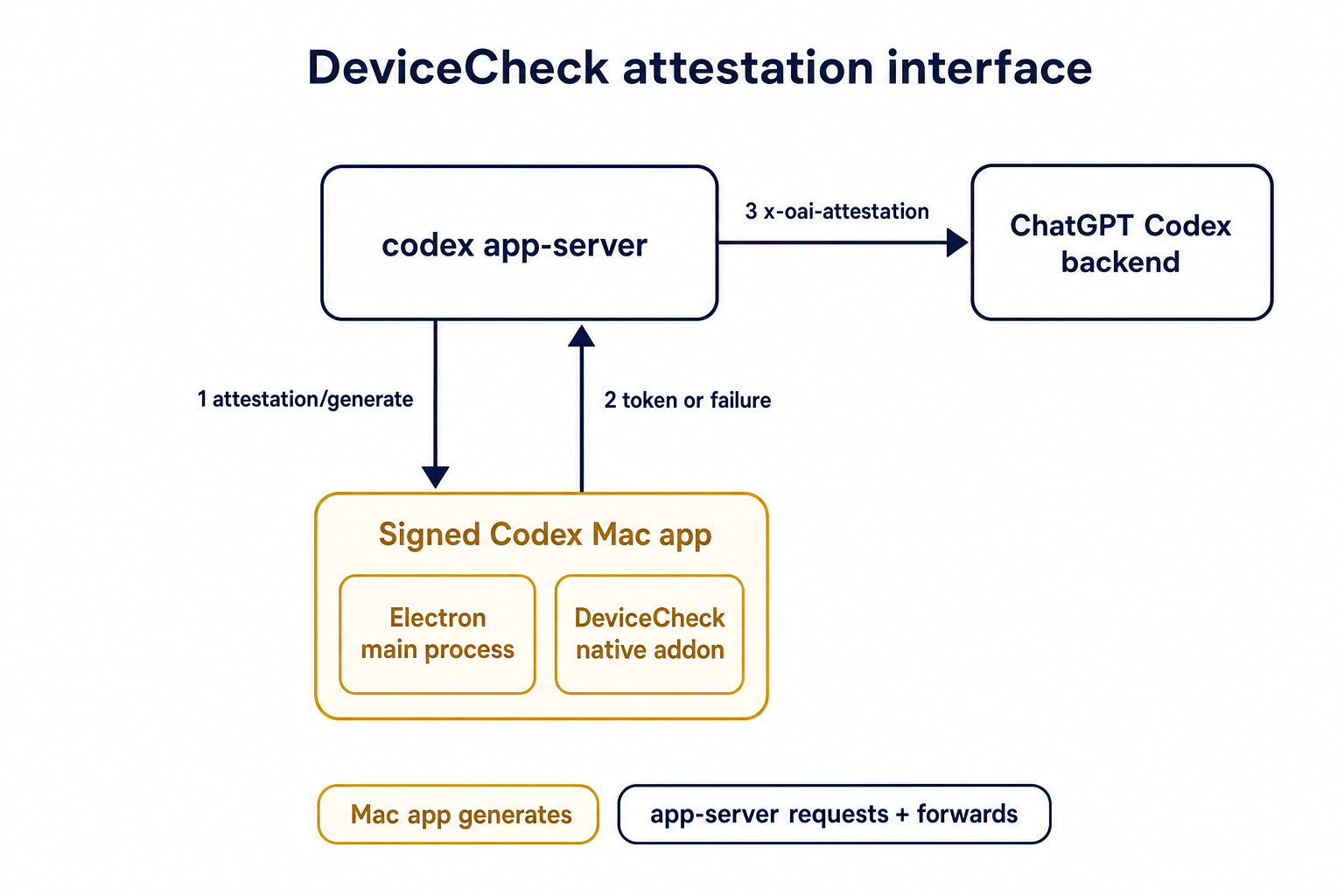
## Details
This PR teaches the Codex app-server runtime how to request and attach
an attestation token. It does not generate DeviceCheck tokens directly;
instead, it relies on the connected desktop app to advertise that it can
generate attestation and then asks that app for a fresh header value
when needed.
The flow is:
1. The Codex desktop app connects to app-server.
2. During `initialize`, the app can advertise that it supports
`requestAttestation`.
3. Before app-server calls selected ChatGPT Codex endpoints, it sends
the internal server request `attestation/generate` to the app.
4. app-server receives a pre-encoded header value back.
5. app-server forwards that value as `x-oai-attestation` on the scoped
outbound requests.
The code in this repo is mostly protocol and runtime plumbing: it adds
the app-server request/response shape, introduces an attestation
provider in core, wires that provider into Responses / compaction /
realtime setup paths, and covers the intended scoping with tests. The
signed macOS DeviceCheck generation remains owned by the desktop app PR.
## Related PR
- Codex desktop app implementation:
https://github.com/openai/openai/pull/878649
## Validation
<details>
<summary>Tests run</summary>
```sh
cargo test -p codex-app-server-protocol
cargo test -p codex-core attestation --lib
cargo test -p codex-app-server --lib attestation
```
Also ran:
```sh
just fix -p codex-core
just fix -p codex-app-server
just fix -p codex-app-server-protocol
just fmt
just write-app-server-schema
```
</details>
<details>
<summary>E2E DeviceCheck validation</summary>
First validated the signed desktop app boundary directly: launched a
packaged signed `Codex.app`, sent `attestation/generate`, decoded the
returned `v1.` attestation header, and validated the extracted
DeviceCheck token with `personal/jm/verify_devicecheck_token.py` using
bundle ID `com.openai.codex`. Apple returned `status_code: 200` and
`is_ok: true`.
Then ran the fuller app + app-server flow. The packaged `Codex.app`
launched a current-branch app-server via `CODEX_CLI_PATH`, and a local
MITM proxy intercepted outbound `chatgpt.com` traffic. The app-server
requested `attestation/generate` from the real Electron app process, and
the intercepted `/backend-api/codex/responses` traffic included
`x-oai-attestation` on both routes:
```text
GET /backend-api/codex/responses Upgrade: websocket x-oai-attestation: present
POST /backend-api/codex/responses Upgrade: none x-oai-attestation: present
```
The captured header decoded to a DeviceCheck token that also validated
with Apple for `com.openai.codex` (`status_code: 200`, `is_ok: true`,
team `2DC432GLL2`).
</details>
---------
Co-authored-by: Codex <noreply@openai.com>
## Why

`/fast` was wired as a one-off slash command even though model metadata
now exposes service tiers as catalog data. That meant adding another
tier, such as a slower/cheaper tier, would require more hardcoded TUI
plumbing instead of letting the model catalog drive the available
commands.

This change makes service-tier commands data-driven: each advertised
`service_tiers` entry becomes a `/name` command using the catalog
description, while the request path sends the tier `id` only when the
selected model supports it.

## What Changed

- Removed the hardcoded `/fast` slash-command variant and introduced
dynamic service-tier command items in the composer and command popup.
- Added toggle behavior for service-tier commands: invoking `/name`
selects that tier, and invoking it again clears the selection.
- Preserved the existing Fast-mode keybinding/status affordances by
resolving the current model tier whose name is `fast`, while still
sending the tier request value such as `priority`.
- Persisted service-tier selections as raw request strings so non-fast
tiers can round-trip through config.
- Updated the Bedrock catalog entry to advertise fast support through
`service_tiers` with `id: "priority"` and `name: "fast"`.
- Added defensive filtering in core so unsupported selected service
tiers are omitted from `/responses` requests.

## Validation

- Added/updated coverage for dynamic service-tier slash command lookup,
popup descriptions, composer dispatch, TUI fast toggling, and
unsupported-tier omission in core request construction.
- Local tests were not run per request.

---------

Co-authored-by: Codex <noreply@openai.com>
## Why
Some consumers expect conventional hyphenated HTTP headers. Codex
already sends the session and thread IDs on outbound Responses requests,
but it only uses the underscore spellings today, which makes those IDs
harder to consume in systems that normalize or reject underscore header
names.

Full context here:
https://openai.slack.com/archives/C08KCGLSPSQ/p1778248578422369

## What changed
- `build_session_headers` now emits both `session_id` and `session-id`
when a session ID is present.
- It does the same for `thread_id` and `thread-id`.
- Added regression coverage in `codex-api/tests/clients.rs` and
`core/tests/suite/client.rs` so both the lower-level client tests and
the end-to-end request tests assert the two header spellings are
present.

## Test plan
- Added header assertions in `codex-api/tests/clients.rs`.
- Added request-header assertions in `core/tests/suite/client.rs` for
both the `/v1/responses` and `/api/codex/responses` request paths.
## Summary
- enable `apply_patch_freeform` by default in the feature registry

## Why
- make the freeform `apply_patch` tool available by default when model
metadata does not explicitly opt into another mode

## Validation
- `just fmt`
- did not run tests

---------

Co-authored-by: Codex <noreply@openai.com>
## Summary

API-key-auth remote compaction requests should not inherit
`service_tier` from normal `/responses` turns. This path needs to match
API auth expectations, while ChatGPT-auth remote compaction should keep
reusing the shared request fields that still apply there.

This change keeps the decision inline in
`codex-rs/core/src/compact_remote.rs` only. Under API key auth, the
classic remote `/responses/compact` path now omits `service_tier`; under
ChatGPT auth, it keeps reusing the configured tier.
`codex-rs/core/src/compact_remote_v2.rs` is unchanged. The remote
compaction parity coverage and snapshots were updated to assert the
API-key omission and preserve the ChatGPT-auth behavior.

## Testing

- Updated remote compaction parity coverage in
`codex-rs/core/tests/suite/compact_remote.rs` and the corresponding
snapshots.
## Why

Remote compaction v2 consumes a normal Responses stream, but that
compaction-specific stream consumer dropped the `response.completed` id.
As a result, the `responses_websocket_response_processed` lifecycle
notification was emitted for normal turn sampling but not after a v2
remote compaction response was fully processed.

## What changed

- Return the completed response id alongside the v2 `context_compaction`
output item.
- After v2 compacted history is installed, send `response.processed`
through the same websocket session when the feature is enabled.
- Add websocket regression coverage for a remote compaction v2 request
followed by `response.processed`.

## Verification

- `cargo test -p codex-core --test all
responses_websocket_sends_response_processed_after_remote_compaction_v2
-- --nocapture`
- `cargo test -p codex-core
collect_context_compaction_output_accepts_additional_output_items --
--nocapture`
## Why

After stdio transports and provider-owned defaults exist, Codex needs a
config-backed provider that can describe more than the single legacy
`CODEX_EXEC_SERVER_URL` remote. This PR adds that provider without
activating it in product entrypoints yet, keeping parser/validation
review separate from runtime wiring.

**Stack position:** this is PR 4 of 5. It builds on PR 3's
provider/default model and adds the `environments.toml` provider used by
PR 5.

## What Changed

- Add `environment_toml.rs` as the TOML-specific home for parsing,
validation, and provider construction.
- Keep the TOML schema/provider structs private; the public constructor
added here is `EnvironmentManager::from_codex_home(...)`.
- Add `TomlEnvironmentProvider`, including validation for:
  - reserved ids such as `local` and `none`
  - duplicate ids
  - unknown explicit defaults
  - empty programs or URLs
  - exactly one of `url` or `program` per configured environment
- Support websocket environments with `url = "ws://..."` / `wss://...`.
- Support stdio-command environments with `program = "..."`.
- Add helpers to load `environments.toml` from `CODEX_HOME`, but do not
wire entrypoints to call them yet.
- Add the `toml` dependency for parsing.

## Stack

- 1. https://github.com/openai/codex/pull/20663 - Add stdio exec-server
listener
- 2. https://github.com/openai/codex/pull/20664 - Add stdio exec-server
client transport
- 3. https://github.com/openai/codex/pull/20665 - Make environment
providers own default selection
- **4. This PR:** https://github.com/openai/codex/pull/20666 - Add
CODEX_HOME environments TOML provider
- 5. https://github.com/openai/codex/pull/20667 - Load configured
environments from CODEX_HOME

Split from original draft: https://github.com/openai/codex/pull/20508

## Validation

Not run locally; this was split out of the original draft stack.

## Documentation

This introduces the config shape for `environments.toml`; user-facing
documentation should be added before this stack is treated as a
documented public workflow.

---------

Co-authored-by: Codex <noreply@openai.com>
Route view_image through selected environments so image reads use the selected turn environment and cwd, with schema exposure limited to multi-environment toolsets.\n\nCo-authored-by: Codex <noreply@openai.com>
## Summary

`cargo test` has entails both running standard Rust tests and doctests.
It turns out that the doctest discovery is fairly slow, and it's a cost
you pay even for crates that don't include any doctests.

This PR disables doctests with `doctest = false` for crates that lack
any doctests.

For the collection of crates below, this speeds up test execution by
>4x.

E.g., before this PR:

```
Benchmark 1: cargo test     -p codex-utils-absolute-path     -p codex-utils-cache     -p codex-utils-cli     -p codex-utils-home-dir     -p codex-utils-output-truncation     -p codex-utils-path     -p codex-utils-string     -p codex-utils-template     -p codex-utils-elapsed     -p codex-utils-json-to-toml
  Time (mean ± σ):      1.849 s ±  4.455 s    [User: 0.752 s, System: 1.367 s]
  Range (min … max):    0.418 s … 14.529 s    10 runs
```

And after:

```
Benchmark 1: cargo test     -p codex-utils-absolute-path     -p codex-utils-cache     -p codex-utils-cli     -p codex-utils-home-dir     -p codex-utils-output-truncation     -p codex-utils-path     -p codex-utils-string     -p codex-utils-template     -p codex-utils-elapsed     -p codex-utils-json-to-toml
  Time (mean ± σ):     428.6 ms ±   6.9 ms    [User: 187.7 ms, System: 219.7 ms]
  Range (min … max):   418.0 ms … 436.8 ms    10 runs
```

For a single crate, with >2x speedup, before:

```
Benchmark 1: cargo test -p codex-utils-string
  Time (mean ± σ):     491.1 ms ±   9.0 ms    [User: 229.8 ms, System: 234.9 ms]
  Range (min … max):   480.9 ms … 512.0 ms    10 runs
```

And after:

```
Benchmark 1: cargo test -p codex-utils-string
  Time (mean ± σ):     213.9 ms ±   4.3 ms    [User: 112.8 ms, System: 84.0 ms]
  Range (min … max):   206.8 ms … 221.0 ms    13 runs
```

Co-authored-by: Codex <noreply@openai.com>

