## Summary
TL;DR: teaches `codex-rs` / app-server to request a desktop-provided
attestation token and attach it as `x-oai-attestation` on the scoped
ChatGPT Codex request paths.
## Details
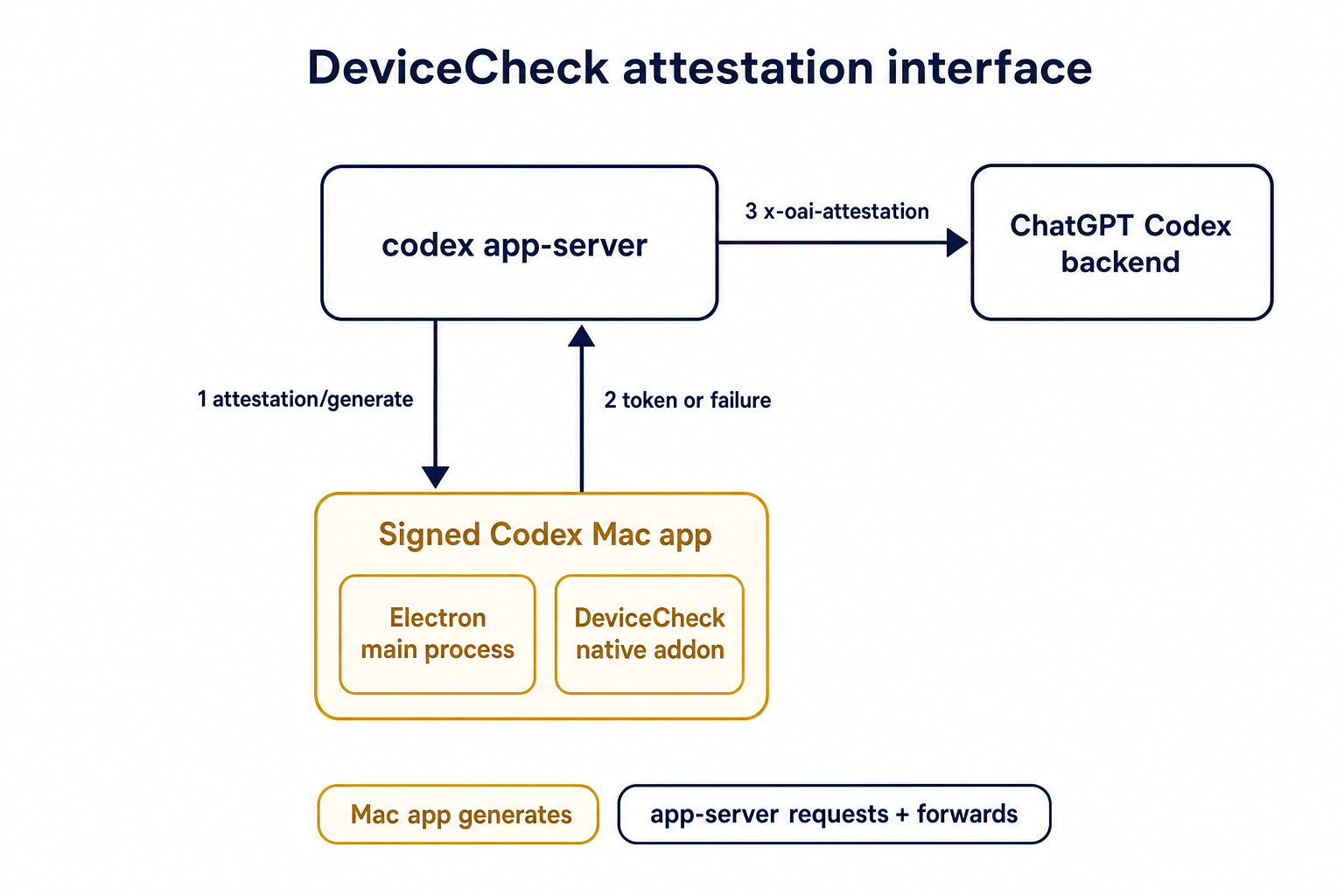
This PR teaches the Codex app-server runtime how to request and attach
an attestation token. It does not generate DeviceCheck tokens directly;
instead, it relies on the connected desktop app to advertise that it can
generate attestation and then asks that app for a fresh header value
when needed.
The flow is:
1. The Codex desktop app connects to app-server.
2. During `initialize`, the app can advertise that it supports
`requestAttestation`.
3. Before app-server calls selected ChatGPT Codex endpoints, it sends
the internal server request `attestation/generate` to the app.
4. app-server receives a pre-encoded header value back.
5. app-server forwards that value as `x-oai-attestation` on the scoped
outbound requests.
The code in this repo is mostly protocol and runtime plumbing: it adds
the app-server request/response shape, introduces an attestation
provider in core, wires that provider into Responses / compaction /
realtime setup paths, and covers the intended scoping with tests. The
signed macOS DeviceCheck generation remains owned by the desktop app PR.
## Related PR
- Codex desktop app implementation:
https://github.com/openai/openai/pull/878649
## Validation
<details>
<summary>Tests run</summary>
```sh
cargo test -p codex-app-server-protocol
cargo test -p codex-core attestation --lib
cargo test -p codex-app-server --lib attestation
```
Also ran:
```sh
just fix -p codex-core
just fix -p codex-app-server
just fix -p codex-app-server-protocol
just fmt
just write-app-server-schema
```
</details>
<details>
<summary>E2E DeviceCheck validation</summary>
First validated the signed desktop app boundary directly: launched a
packaged signed `Codex.app`, sent `attestation/generate`, decoded the
returned `v1.` attestation header, and validated the extracted
DeviceCheck token with `personal/jm/verify_devicecheck_token.py` using
bundle ID `com.openai.codex`. Apple returned `status_code: 200` and
`is_ok: true`.
Then ran the fuller app + app-server flow. The packaged `Codex.app`
launched a current-branch app-server via `CODEX_CLI_PATH`, and a local
MITM proxy intercepted outbound `chatgpt.com` traffic. The app-server
requested `attestation/generate` from the real Electron app process, and
the intercepted `/backend-api/codex/responses` traffic included
`x-oai-attestation` on both routes:
```text
GET /backend-api/codex/responses Upgrade: websocket x-oai-attestation: present
POST /backend-api/codex/responses Upgrade: none x-oai-attestation: present
```
The captured header decoded to a DeviceCheck token that also validated
with Apple for `com.openai.codex` (`status_code: 200`, `is_ok: true`,
team `2DC432GLL2`).
</details>
---------
Co-authored-by: Codex <noreply@openai.com>
## Summary

Related to
https://openai.slack.com/archives/C095U48JNL9/p1777537279707449
TLDR:
We update the meaning of session ids and thread ids:
* thread_id stays as now
* session_id become a shared id between every thread under a /root
thread (i.e. every sub-agent share the same session id)

This PR introduces an explicit `SessionId` and threads it through the
protocol/client boundary so `session_id` and `thread_id` can diverge
when they need to, while preserving compatibility for older serialized
`session_configured` events.

---------

Co-authored-by: Codex <noreply@openai.com>
## Summary
- make `thread_source` an explicit optional thread-level field on
`thread/start`, `thread/fork`, and returned thread payloads
- persist `thread_source` in rollout/session metadata so resumed live
threads retain the original value
- replace the old best-effort `session_source` -> `thread_source`
mapping with an explicit caller-supplied analytics classification

## Why
Before this change, analytics `thread_source` was populated by a
best-effort mapping from `session_source`. `session_source` describes
the runtime/client surface, not the actual thread-level origin, so that
projection was not accurate enough to distinguish cases such as `user`,
`subagent`, `memory_consolidation`, and future thread origins reliably.

Making `thread_source` explicit keeps one thread-level analytics field
while letting callers provide the real classification directly instead
of recovering it indirectly from `session_source`.

## Impact
For new analytics events, `thread_source` now reflects the explicit
thread-level classification supplied by the caller rather than an
inferred value derived from `session_source`. Existing protocol fields
remain optional; callers that omit `threadSource` now produce `null`
instead of a best-effort inferred value.

## Validation
- `just write-app-server-schema`
- `cargo test -p codex-analytics -p codex-core -p
codex-app-server-protocol --no-run`
- `cargo test -p codex-app-server-protocol
generated_ts_optional_nullable_fields_only_in_params`
- `cargo test -p codex-analytics
thread_initialized_event_serializes_expected_shape`
- `cargo test -p codex-core
resume_stopped_thread_from_rollout_preserves_thread_source`
## Summary

Ad-hoc memory notes are written under `memories/extensions/ad_hoc/`, but
the consolidation agent only knows how to interpret an extension when
the extension folder has an `instructions.md`. Seed those instructions
from the memories write pipeline so an enabled memories startup creates
the expected ad-hoc extension layout automatically.

This also moves extension-specific write behavior behind a dedicated
`memories/write/src/extensions/` module. `ad_hoc` owns the seeded
instructions template, while the existing resource-retention cleanup
lives in its own `prune` module so future memory extensions can add
their own write-side setup without growing a flat helper file.

## Changes

- Seed `memories/extensions/ad_hoc/instructions.md` during eligible
memory startup without overwriting an existing file.
- Store the ad-hoc instructions template under
`memories/write/templates/extensions/ad_hoc/`, keeping ownership in
`codex-memories-write`.
- Split memory extension support into `extensions::ad_hoc` and
`extensions::prune`.
- Keep the existing old-resource pruning behavior unchanged.

## Verification

- `cargo test -p codex-memories-write`
- `bazel build //codex-rs/memories/write:write`

---------

Co-authored-by: chatgpt-codex-connector[bot] <199175422+chatgpt-codex-connector[bot]@users.noreply.github.com>
- Build one app-server process ThreadStore from startup config and share
it with ThreadManager and CodexMessageProcessor.
- Remove per-thread/fork store reconstruction so effective thread config
cannot switch the persistence backend.
- Add params to ThreadStore create/resume for specifying thread
metadata, since otherwise the metadata from store creation would be used
(incorrectly).
Summary:
- Add codex-thread-manager-sample, a one-shot binary that starts a
ThreadManager thread, submits a prompt, and prints the final assistant
output.
- Pass ThreadStore into ThreadManager::new and expose
thread_store_from_config for existing callsites.
- Build the sample Config directly with only --model and prompt inputs.

Verification:
- just fmt
- cargo check -p codex-thread-manager-sample -p codex-app-server -p
codex-mcp-server
- git diff --check

Tests: Not run per request.
## Why

Memory startup runs in the background after an eligible turn, but it can
consume Codex backend quota at exactly the wrong time: when the user is
already near a rate-limit boundary. This PR adds a guard so the memory
pipeline backs off when the Codex rate-limit snapshot says the remaining
budget is too low.

## What Changed

- Added `memories.min_rate_limit_remaining_percent` with a default of
`25`, clamped to `0..=100`, and regenerated `core/config.schema.json`.
- Added `codex-rs/memories/write/src/guard.rs`, which fetches Codex
backend rate limits before memory startup and skips phase 1 / phase 2
when the Codex limit is reached or either tracked window is above the
configured usage ceiling.
- Keeps startup best-effort: non-Codex auth or rate-limit fetch/client
failures preserve the existing memory startup behavior.
- Records a `codex.memory.startup` counter with
`status=skipped_rate_limit` when startup is skipped.
- Added config parsing/clamping coverage and guard unit tests.

## Verification

- Added `codex-rs/memories/write/src/guard_tests.rs` for threshold,
primary/secondary window, and reached-limit behavior.
- Added config tests for TOML parsing and clamping.
## Why

Memory startup was tied to thread lifecycle events such as create, load,
and fork. That can run memory work before a thread receives real user
input, and it makes startup cost scale with thread management instead of
actual turns. Moving the trigger to `thread/sendInput` keeps memory
startup aligned with the first real user turn and lets it use the
current thread config at turn time.

The idea is to prevent ghost cost due to pre-warm triggered by the app

Turn-based startup can also make global phase-2 consolidation easier to
request repeatedly, so this adds a success cooldown and tightens the
default startup scan window.

## What Changed

- Start `codex_memories_write::start_memories_startup_task` after a
non-empty `thread/sendInput` turn is submitted, instead of from thread
create/load/fork paths:
d4a6885b78/codex-rs/app-server/src/codex_message_processor.rs (L6477-L6487)
- Expose `CodexThread::config()` so app-server can pass the live config
into memory startup at turn time.
- Add a six-hour successful-run cooldown for global phase-2
consolidation via `SkippedCooldown`:
d4a6885b78/codex-rs/state/src/runtime/memories.rs (L963-L966)
- Reduce memory startup defaults to at most 2 rollouts over 10 days:
d4a6885b78/codex-rs/config/src/types.rs (L31-L34)

## Verification

Updated the memory runtime coverage around phase-2 reclaim behavior,
including `phase2_global_lock_respects_success_cooldown`.

---------

Co-authored-by: Codex <noreply@openai.com>
## Why

Phase 2 still needs to choose the most relevant stage-1 memory outputs
by usage and recency, but exposing that ranking as the rendered
`raw_memories.md` order creates unnecessary large diff. Usage-count or
timestamp changes can reshuffle otherwise unchanged memories, making the
workspace diff noisy and giving the consolidation prompt a misleading
recency signal from file position.
This fix will reduce token consumption

## What Changed

- Keep the existing top-N Phase 2 selection ranking by `usage_count`,
`last_usage`, `source_updated_at`, and `thread_id`.
- Return the selected rows in stable ascending `thread_id` order before
syncing Phase 2 filesystem inputs.
- Update the memory README, raw memories header, and consolidation
prompt so they describe the stable order and tell the prompt to use
metadata and workspace diffs instead of file order as the recency
signal.
- Adjust the memory runtime tests to use deterministic thread IDs and
assert the stable return order separately from the ranked selection
semantics.

## Test Coverage

- Existing memory runtime tests in
`codex-rs/state/src/runtime/memories.rs` now cover the stable returned
ordering for Phase 2 inputs.

---------

Co-authored-by: Codex <noreply@openai.com>
Keep extracting memories out of core and moving the write trigger in the
app-server
This is temporary and it should move at the client level as a follow-up
This makes core fully independant from `codex-memories-write`

---------

Co-authored-by: Codex <noreply@openai.com>

