## Summary
TL;DR: teaches `codex-rs` / app-server to request a desktop-provided
attestation token and attach it as `x-oai-attestation` on the scoped
ChatGPT Codex request paths.
## Details
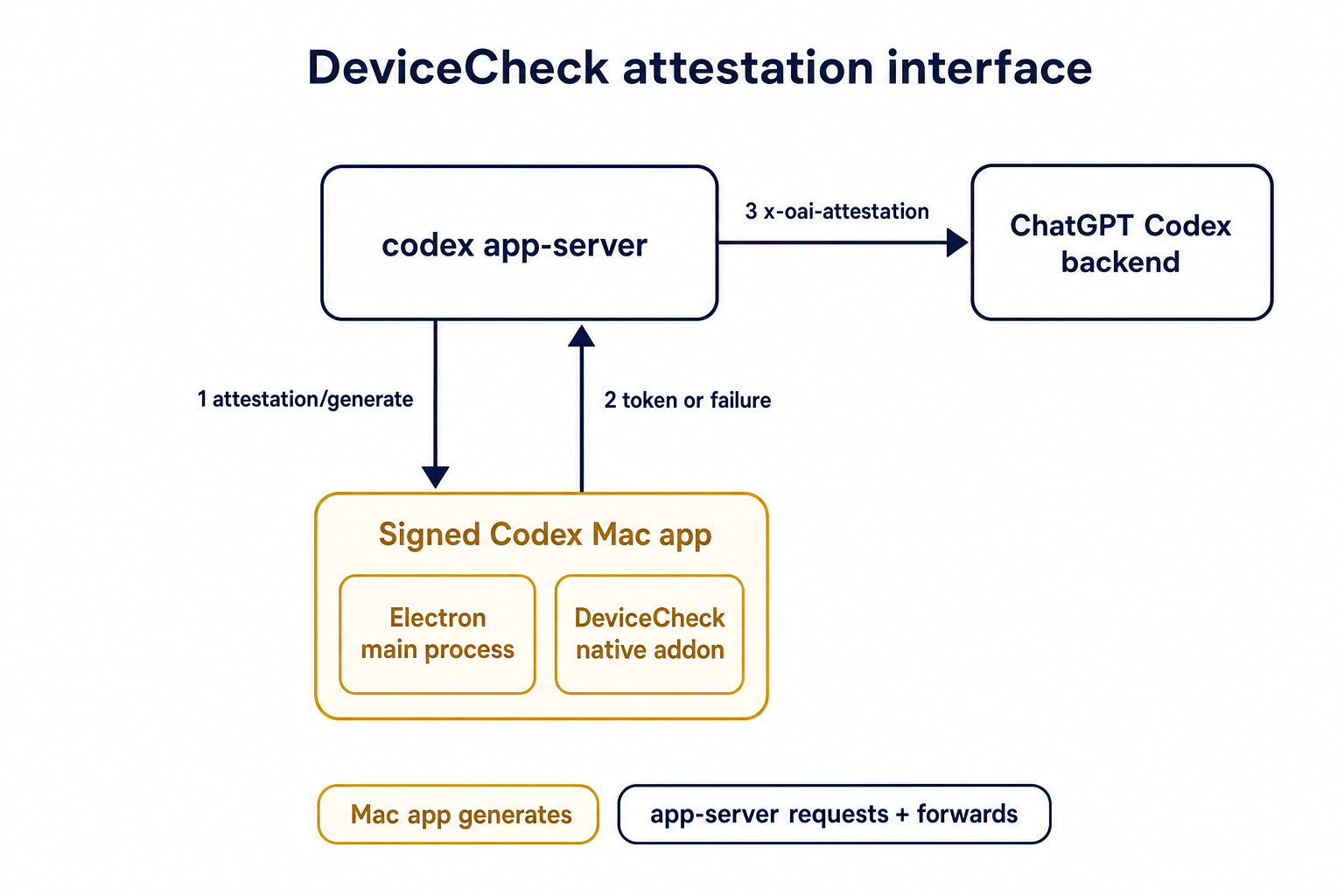
This PR teaches the Codex app-server runtime how to request and attach
an attestation token. It does not generate DeviceCheck tokens directly;
instead, it relies on the connected desktop app to advertise that it can
generate attestation and then asks that app for a fresh header value
when needed.
The flow is:
1. The Codex desktop app connects to app-server.
2. During `initialize`, the app can advertise that it supports
`requestAttestation`.
3. Before app-server calls selected ChatGPT Codex endpoints, it sends
the internal server request `attestation/generate` to the app.
4. app-server receives a pre-encoded header value back.
5. app-server forwards that value as `x-oai-attestation` on the scoped
outbound requests.
The code in this repo is mostly protocol and runtime plumbing: it adds
the app-server request/response shape, introduces an attestation
provider in core, wires that provider into Responses / compaction /
realtime setup paths, and covers the intended scoping with tests. The
signed macOS DeviceCheck generation remains owned by the desktop app PR.
## Related PR
- Codex desktop app implementation:
https://github.com/openai/openai/pull/878649
## Validation
<details>
<summary>Tests run</summary>
```sh
cargo test -p codex-app-server-protocol
cargo test -p codex-core attestation --lib
cargo test -p codex-app-server --lib attestation
```
Also ran:
```sh
just fix -p codex-core
just fix -p codex-app-server
just fix -p codex-app-server-protocol
just fmt
just write-app-server-schema
```
</details>
<details>
<summary>E2E DeviceCheck validation</summary>
First validated the signed desktop app boundary directly: launched a
packaged signed `Codex.app`, sent `attestation/generate`, decoded the
returned `v1.` attestation header, and validated the extracted
DeviceCheck token with `personal/jm/verify_devicecheck_token.py` using
bundle ID `com.openai.codex`. Apple returned `status_code: 200` and
`is_ok: true`.
Then ran the fuller app + app-server flow. The packaged `Codex.app`
launched a current-branch app-server via `CODEX_CLI_PATH`, and a local
MITM proxy intercepted outbound `chatgpt.com` traffic. The app-server
requested `attestation/generate` from the real Electron app process, and
the intercepted `/backend-api/codex/responses` traffic included
`x-oai-attestation` on both routes:
```text
GET /backend-api/codex/responses Upgrade: websocket x-oai-attestation: present
POST /backend-api/codex/responses Upgrade: none x-oai-attestation: present
```
The captured header decoded to a DeviceCheck token that also validated
with Apple for `com.openai.codex` (`status_code: 200`, `is_ok: true`,
team `2DC432GLL2`).
</details>
---------
Co-authored-by: Codex <noreply@openai.com>
## Why

The earlier PRs add stdio transport support and the config-backed
environment provider, but the feature remains inert until normal Codex
entrypoints construct `EnvironmentManager` with enough context to
discover `CODEX_HOME/environments.toml`. This final stack PR activates
the provider while preserving the legacy `CODEX_EXEC_SERVER_URL`
fallback when no environments file exists.

**Stack position:** this is PR 5 of 5. It is the product wiring PR that
activates the configured environment provider added in PR 4.

## What Changed

- Thread `codex_home` into `EnvironmentManagerArgs`.
- Change `EnvironmentManager::new(...)` to load the provider from
`CODEX_HOME`.
- Preserve legacy behavior by falling back to
`DefaultEnvironmentProvider::from_env()` when `environments.toml` is
absent.
- Make `environments.toml`-backed managers start new threads with all
configured environments, default first, while keeping the legacy env-var
path single-default.
- Update the app-server, TUI, exec, MCP server, connector, prompt-debug,
and thread-manager-sample callsites to pass `codex_home` and handle
provider-loading errors.

## Self-Review Notes

- The multi-environment startup path is intentionally tied to the
`environments.toml` provider. Using `>1` configured environment as the
only signal would also expand the legacy `CODEX_EXEC_SERVER_URL`
provider because it keeps `local` addressable alongside `remote`.
- The startup environment list is still derived inside
`EnvironmentManager`; the provider only says whether its snapshot should
start new threads with all configured environments.
- The thread-manager sample was updated to pass the current
`ThreadManager::new(...)` installation id argument so the stack compiles
under Bazel.

## Stack

- 1. https://github.com/openai/codex/pull/20663 - Add stdio exec-server
listener
- 2. https://github.com/openai/codex/pull/20664 - Add stdio exec-server
client transport
- 3. https://github.com/openai/codex/pull/20665 - Make environment
providers own default selection
- 4. https://github.com/openai/codex/pull/20666 - Add CODEX_HOME
environments TOML provider
- **5. This PR:** https://github.com/openai/codex/pull/20667 - Load
configured environments from CODEX_HOME

Split from original draft: https://github.com/openai/codex/pull/20508

## Validation

- `just fmt`
- `git diff --check`
- `bazel build --config=remote --strategy=remote
--remote_download_toplevel
//codex-rs/thread-manager-sample:codex-thread-manager-sample`
- `bazel test --config=remote --strategy=remote
--remote_download_toplevel
//codex-rs/exec-server:exec-server-unit-tests`
- `bazel test --config=remote --strategy=remote
--remote_download_toplevel --test_sharding_strategy=disabled
--test_arg=default_thread_environment_selections_use_manager_default_id
//codex-rs/core:core-unit-tests`
- `bazel test --config=remote --strategy=remote
--remote_download_toplevel --test_sharding_strategy=disabled
--test_arg=start_thread_uses_all_default_environments_from_codex_home
//codex-rs/core:core-unit-tests`

## Documentation

This activates `CODEX_HOME/environments.toml`; user-facing documentation
should be added before this stack is treated as a documented public
workflow.

---------

Co-authored-by: Codex <noreply@openai.com>
## Why

We want terminal tool review analytics, but the reducer should not stamp
review timing from its own wall clock.

This PR plumbs review timing through the real protocol and app-server
seams so downstream analytics can consume the emitter's timestamps
directly. Guardian reviews keep their enriched `started_at` /
`completed_at` analytics fields by deriving those legacy second-based
values from the same protocol-native millisecond lifecycle timestamps,
rather than sampling a separate analytics clock.

## What changed

- add `started_at_ms` to user approval request payloads
- add `started_at_ms` / `completed_at_ms` to guardian review
notifications
- preserve Guardian review `started_at` / `completed_at` enrichment from
the protocol-native timing source
- stamp typed `ServerResponse` analytics facts with app-server-observed
`completed_at_ms`
- thread the new timing fields through core, protocol, app-server, TUI,
and analytics fixtures

## Verification

- `cargo test -p codex-app-server outgoing_message --manifest-path
codex-rs/Cargo.toml`
- `cargo test -p codex-app-server-protocol guardian --manifest-path
codex-rs/Cargo.toml`
- `cargo test -p codex-tui guardian --manifest-path codex-rs/Cargo.toml`
- `cargo test -p codex-analytics analytics_client_tests --manifest-path
codex-rs/Cargo.toml`

---
[//]: # (BEGIN SAPLING FOOTER)
Stack created with [Sapling](https://sapling-scm.com). Best reviewed
with [ReviewStack](https://reviewstack.dev/openai/codex/pull/21434).
* #18748
* __->__ #21434
* #18747
* #17090
* #17089
* #20514
## Why

Reverts #20689 to restore the previous optional state DB plumbing. The
conflict resolution keeps the newer installation ID and session/thread
identity changes that landed after #20689, while removing the mandatory
state DB and agent graph store dependency from ThreadManager
construction.

## What changed

- Restored `Option<StateDbHandle>` through app-server, MCP server,
prompt debug, and test entry points.
- Removed the `codex-core` dependency on `codex-agent-graph-store` and
reverted descendant lookup back to the existing state DB path when
available.
- Kept newer `installation_id` forwarding by passing it beside the
optional DB handle.
- Kept local thread-name updates working when the optional state DB
handle is absent.

## Validation

- `git diff --check`
- `cargo test -p codex-thread-store`
- `cargo test -p codex-state -p codex-rollout -p
codex-app-server-protocol`
- Attempted `env CARGO_INCREMENTAL=0 cargo test -p codex-core -p
codex-app-server -p codex-app-server-client -p codex-mcp-server -p
codex-thread-manager-sample -p codex-tui`; blocked locally by a rustc
ICE while compiling `v8 v146.4.0` with `rustc 1.93.0 (254b59607
2026-01-19)` on `aarch64-apple-darwin`.
## Why

Skills update notifications are app-server API behavior, but the watcher
lived in `codex-core` and surfaced through
`EventMsg::SkillsUpdateAvailable`. Moving the watcher out keeps core
focused on thread execution and lets app-server own both cache
invalidation and the `skills/changed` notification.

## What changed

- Added an app-server-owned skills watcher that watches local skill
roots, clears the shared skills cache, and emits `skills/changed`
directly.
- Registers skill watches from the common app-server thread listener
attach path, including direct starts, resumes, and app-server-observed
child or forked threads.
- Stores the `WatchRegistration` on `ThreadState`, so listener
replacement, thread teardown, idle unload, and app-server shutdown
deregister by dropping the RAII guard.
- Removed `EventMsg::SkillsUpdateAvailable`, the core watcher, and the
old core live-reload test.
- Extended the app-server skills change test to verify a cached skills
list is refreshed after a filesystem change without forcing reload.

## Validation

- `cargo check -p codex-core -p codex-app-server -p codex-mcp-server -p
codex-rollout -p codex-rollout-trace`
- `cargo test -p codex-app-server
skills_changed_notification_is_emitted_after_skill_change`
## Why

The core `Op::ListMcpTools` request path is no longer needed. Keeping it
around left a dead request/response surface alongside the app-server MCP
inventory APIs that own current server status listing.

## What Changed

- Removed `Op::ListMcpTools`, `EventMsg::McpListToolsResponse`, and the
core handler that built the MCP snapshot response.
- Removed the now-unused `codex-mcp` snapshot wrapper/export and passive
event handling arms in rollout and MCP-server consumers.
- Updated tests that used the old op as a synchronization hook to wait
on existing startup/skills events, and deleted the plugin test that only
exercised the removed listing op.

## Validation

- `cargo test -p codex-protocol`
- `cargo test -p codex-mcp`
- `cargo test -p codex-rollout -p codex-rollout-trace -p
codex-mcp-server`
- `cargo test -p codex-core --test all
pending_input::queued_inter_agent_mail`
- `cargo test -p codex-core --test all
rmcp_client::stdio_mcp_tool_call_includes_sandbox_state_meta`
- `cargo test -p codex-core --test all
rmcp_client::stdio_image_responses`
- `just fix -p codex-core -p codex-protocol -p codex-mcp -p
codex-rollout -p codex-rollout-trace -p codex-mcp-server`
## Why

Message history was implemented inside `codex-core` and surfaced through
core protocol ops and `SessionConfiguredEvent` fields even though the
current consumer is TUI-local prompt recall. That made core own UI
history persistence and exposed `history_log_id` / `history_entry_count`
through surfaces that app-server and other clients do not need.

This change moves message history persistence out of core and keeps the
recall plumbing local to the TUI.

## What changed

- Added a new `codex-message-history` crate for appending, looking up,
trimming, and reading metadata from `history.jsonl`.
- Removed core protocol history ops/events: `AddToHistory`,
`GetHistoryEntryRequest`, and `GetHistoryEntryResponse`.
- Removed `history_log_id` and `history_entry_count` from
`SessionConfiguredEvent` and updated exec/MCP/test fixtures accordingly.
- Updated the TUI to dispatch local app events for message-history
append/lookup and keep its persistent-history metadata in TUI session
state.

## Validation

- `cargo test -p codex-message-history -p codex-protocol`
- `cargo test -p codex-exec event_processor_with_json_output`
- `cargo test -p codex-mcp-server outgoing_message`
- `cargo test -p codex-tui`
- `just fix -p codex-message-history -p codex-protocol -p codex-core -p
codex-tui -p codex-exec -p codex-mcp-server`
## Summary

- resolve or inject the installation ID before core startup and pass it
through `ThreadManager`, `CodexSpawnArgs`, and `Session` as a plain
`String`
- keep child sessions on the parent installation ID instead of
rediscovering it inside core
- propagate installation ID startup failures in `mcp-server` instead of
panicking

## Why

Core was still touching the filesystem on the session startup path to
discover `installation_id`. This moves that work to the outer host
boundary so core no longer depends on `codex_home` reads during session
construction.

---------

Co-authored-by: Codex <noreply@openai.com>
## Summary

Related to
https://openai.slack.com/archives/C095U48JNL9/p1777537279707449
TLDR:
We update the meaning of session ids and thread ids:
* thread_id stays as now
* session_id become a shared id between every thread under a /root
thread (i.e. every sub-agent share the same session id)

This PR introduces an explicit `SessionId` and threads it through the
protocol/client boundary so `session_id` and `thread_id` can diverge
when they need to, while preserving compatibility for older serialized
`session_configured` events.

---------

Co-authored-by: Codex <noreply@openai.com>
## Summary
- make `thread_source` an explicit optional thread-level field on
`thread/start`, `thread/fork`, and returned thread payloads
- persist `thread_source` in rollout/session metadata so resumed live
threads retain the original value
- replace the old best-effort `session_source` -> `thread_source`
mapping with an explicit caller-supplied analytics classification

## Why
Before this change, analytics `thread_source` was populated by a
best-effort mapping from `session_source`. `session_source` describes
the runtime/client surface, not the actual thread-level origin, so that
projection was not accurate enough to distinguish cases such as `user`,
`subagent`, `memory_consolidation`, and future thread origins reliably.

Making `thread_source` explicit keeps one thread-level analytics field
while letting callers provide the real classification directly instead
of recovering it indirectly from `session_source`.

## Impact
For new analytics events, `thread_source` now reflects the explicit
thread-level classification supplied by the caller rather than an
inferred value derived from `session_source`. Existing protocol fields
remain optional; callers that omit `threadSource` now produce `null`
instead of a best-effort inferred value.

## Validation
- `just write-app-server-schema`
- `cargo test -p codex-analytics -p codex-core -p
codex-app-server-protocol --no-run`
- `cargo test -p codex-app-server-protocol
generated_ts_optional_nullable_fields_only_in_params`
- `cargo test -p codex-analytics
thread_initialized_event_serializes_expected_shape`
- `cargo test -p codex-core
resume_stopped_thread_from_rollout_preserves_thread_source`
## Why

`skills/list` is already exposed through app-server v2 and covered by
the app-server test suite. Keeping the separate core `Op::ListSkills`
path leaves a duplicate legacy protocol surface that no longer needs to
be maintained.

## What Changed

- Removed `Op::ListSkills` and `EventMsg::ListSkillsResponse` from the
core protocol.
- Deleted the corresponding core session handler and stale core
integration tests.
- Removed rollout/MCP ignore branches and protocol v1 docs references
for the deleted event/op.
- Left app-server `skills/list` and its existing coverage intact.

## Validation

- `cargo test -p codex-protocol`
- `cargo test -p codex-core --test all suite::skills`
- `cargo check -p codex-mcp-server -p codex-rollout -p
codex-rollout-trace`
- `just fix -p codex-core`
## Why

Thread names are app-server metadata now, backed by the thread store and
sqlite state database. Keeping a core `SetThreadName` op plus a rollout
`thread_name_updated` event made rename persistence live in the wrong
layer and required historical replay support for an event that new
app-server flows should not write.

## What changed

- Removed `Op::SetThreadName` and `EventMsg::ThreadNameUpdated` from the
core protocol and deleted the core handler path that appended rename
events to rollouts.
- Updated app-server `thread/name/set` so both loaded and unloaded
threads write through thread-store metadata and app-server emits
`thread/name/updated` notifications.
- Updated local thread-store name metadata updates to write sqlite title
metadata and the legacy thread-name index without appending rollout
events.
- Removed state extraction and rollout handling for the deleted
thread-name event.

## Validation

- `cargo test -p codex-app-server thread_name_updated_broadcasts`
- `cargo test -p codex-app-server
thread_name_set_is_reflected_in_read_list_and_resume`
- `cargo test -p codex-thread-store
update_thread_metadata_sets_name_on_active_rollout_and_indexes_name`
- `cargo test -p codex-state`
- `cargo check -p codex-mcp-server -p codex-rollout-trace`
- `just fix -p codex-app-server -p codex-thread-store -p codex-state -p
codex-mcp-server -p codex-rollout-trace`

## Docs

No external documentation update is expected for this internal ownership
change.
## Why

We want the agent graph store to be passed down the stack as a real
dependency, the same way we already treat the thread store.

This will let us inject the agent graph store as a real dependency and
support implementations other than the local SQLite-backed one. Right
now most code instantiates a state DB and an agent graph store
just-in-time. Ideally, we would not depend on the state DB directly but
only read through the higher-level interfaces.

This change makes the dependency boundaries explicit and moves state DB
initialization to process bootstrap instead of hiding it inside local
store implementations.

## What changed

- `ThreadManager` now requires a `StateDbHandle` and an
`AgentGraphStore` at construction time instead of treating them as
optional internals.
- The local store constructors no longer lazily initialize SQLite.
Callers now initialize the state DB once per process and use that shared
handle to build:
  - `LocalThreadStore`
  - `LocalAgentGraphStore`
- App bootstraps (`app-server`, `mcp-server`, `prompt_debug`, and the
thread-manager sample) now initialize the state DB up front and inject
the resulting handle down the stack.
- `app-server` now consistently uses its process-scoped state DB handle
instead of reopening SQLite or trying to recover it from loaded threads.
- Device-key storage now reuses the shared state DB handle instead of
maintaining its own lazy opener.
- The thread archive / descendant traversal paths now use the injected
`AgentGraphStore` instead of reaching through local
thread-store-specific state.

## Verification

- `cargo check -p codex-core -p codex-thread-store -p codex-app-server
-p codex-mcp-server -p codex-thread-manager-sample --tests`
- `cargo test -p codex-thread-store`
- `cargo test -p codex-core
thread_manager_accepts_separate_agent_graph_store_and_thread_store --
--nocapture`
- `cargo test -p codex-app-server
thread_archive_archives_spawned_descendants -- --nocapture`
## Why

SQLite state was still being opened from consumer paths, including lazy
`OnceCell`-backed thread-store call sites. That let one process
construct multiple state DB connections for the same Codex home, which
makes SQLite lock contention and `database is locked` failures much
easier to hit.

State DB lifetime should be chosen by main-like entrypoints and tests,
then passed through explicitly. Consumers should use the supplied
`Option<StateDbHandle>` or `StateDbHandle` and keep their existing
filesystem fallback or error behavior when no handle is available.

The startup path also needs to keep the rollout crate in charge of
SQLite state initialization. Opening `codex_state::StateRuntime`
directly bypasses rollout metadata backfill, so entrypoints should
initialize through `codex_rollout::state_db` and receive a handle only
after required rollout backfills have completed.

## What Changed

- Initialize the state DB in main-like entrypoints for CLI, TUI,
app-server, exec, MCP server, and the thread-manager sample.
- Pass `Option<StateDbHandle>` through `ThreadManager`,
`LocalThreadStore`, app-server processors, TUI app wiring, rollout
listing/recording, personality migration, shell snapshot cleanup,
session-name lookup, and memory/device-key consumers.
- Remove the lazy local state DB wrapper from the thread store so
non-test consumers use only the supplied handle or their existing
fallback path.
- Make `codex_rollout::state_db::init` the local state startup path: it
opens/migrates SQLite, runs rollout metadata backfill when needed, waits
for concurrent backfill workers up to a bounded timeout, verifies
completion, and then returns the initialized handle.
- Keep optional/non-owning SQLite helpers, such as remote TUI local
reads, as open-only paths that do not run startup backfill.
- Switch app-server startup from direct
`codex_state::StateRuntime::init` to the rollout state initializer so
app-server cannot skip rollout backfill.
- Collapse split rollout lookup/list APIs so callers use the normal
methods with an optional state handle instead of `_with_state_db`
variants.
- Restore `getConversationSummary(ThreadId)` to delegate through
`ThreadStore::read_thread` instead of a LocalThreadStore-specific
rollout path special case.
- Keep DB-backed rollout path lookup keyed on the DB row and file
existence, without imposing the filesystem filename convention on
existing DB rows.
- Verify readable DB-backed rollout paths against `session_meta.id`
before returning them, so a stale SQLite row that points at another
thread's JSONL falls back to filesystem search and read-repairs the DB
row.
- Keep `debug prompt-input` filesystem-only so a one-off debug command
does not initialize or backfill SQLite state just to print prompt input.
- Keep goal-session test Codex homes alive only in the goal-specific
helper, rather than leaking tempdirs from the shared session test
helper.
- Update tests and call sites to pass explicit state handles where DB
behavior is expected and explicit `None` where filesystem-only behavior
is intended.

## Validation

- `CARGO_TARGET_DIR=/tmp/codex-target-state-db cargo check -p
codex-rollout -p codex-thread-store -p codex-app-server -p codex-core -p
codex-tui -p codex-exec -p codex-cli --tests`
- `CARGO_TARGET_DIR=/tmp/codex-target-state-db cargo test -p
codex-rollout state_db_`
- `CARGO_TARGET_DIR=/tmp/codex-target-state-db cargo test -p
codex-rollout find_thread_path`
- `CARGO_TARGET_DIR=/tmp/codex-target-state-db cargo test -p
codex-rollout find_thread_path -- --nocapture`
- `CARGO_TARGET_DIR=/tmp/codex-target-state-db cargo test -p
codex-rollout try_init_ -- --nocapture`
- `CARGO_TARGET_DIR=/tmp/codex-target-state-db cargo test -p
codex-rollout`
- `CARGO_TARGET_DIR=/tmp/codex-target-state-db cargo clippy -p
codex-rollout --lib -- -D warnings`
- `CARGO_TARGET_DIR=/tmp/codex-target-state-db cargo test -p
codex-thread-store
read_thread_falls_back_when_sqlite_path_points_to_another_thread --
--nocapture`
- `CARGO_TARGET_DIR=/tmp/codex-target-state-db cargo test -p
codex-thread-store`
- `CARGO_TARGET_DIR=/tmp/codex-target-state-db cargo test -p codex-core
shell_snapshot`
- `CARGO_TARGET_DIR=/tmp/codex-target-state-db cargo test -p codex-core
--test all personality_migration`
- `CARGO_TARGET_DIR=/tmp/codex-target-state-db cargo test -p codex-core
--test all rollout_list_find`
- `RUST_MIN_STACK=8388608 CODEX_SKIP_VENDORED_BWRAP=1
CARGO_TARGET_DIR=/tmp/codex-target-state-db cargo test -p codex-core
--test all rollout_list_find::find_prefers_sqlite_path_by_id --
--nocapture`
- `RUST_MIN_STACK=8388608 CODEX_SKIP_VENDORED_BWRAP=1
CARGO_TARGET_DIR=/tmp/codex-target-state-db cargo test -p codex-core
--test all rollout_list_find -- --nocapture`
- `CARGO_TARGET_DIR=/tmp/codex-target-state-db cargo test -p codex-core
interrupt_accounts_active_goal_before_pausing`
- `CARGO_TARGET_DIR=/tmp/codex-target-state-db cargo test -p
codex-app-server get_auth_status -- --test-threads=1`
- `CODEX_SKIP_VENDORED_BWRAP=1
CARGO_TARGET_DIR=/tmp/codex-target-state-db cargo test -p
codex-app-server --lib`
- `CODEX_SKIP_VENDORED_BWRAP=1
CARGO_TARGET_DIR=/tmp/codex-target-state-db cargo check -p codex-rollout
-p codex-app-server --tests`
- `CARGO_TARGET_DIR=/tmp/codex-target-state-db just fix -p codex-rollout
-p codex-thread-store -p codex-core -p codex-app-server -p codex-tui -p
codex-exec -p codex-cli`
- `CODEX_SKIP_VENDORED_BWRAP=1
CARGO_TARGET_DIR=/tmp/codex-target-state-db just fix -p codex-rollout -p
codex-app-server`
- `CARGO_TARGET_DIR=/tmp/codex-target-state-db just fix -p
codex-rollout`
- `CODEX_SKIP_VENDORED_BWRAP=1
CARGO_TARGET_DIR=/tmp/codex-target-state-db just fix -p codex-core`
- `just argument-comment-lint -p codex-core`
- `just argument-comment-lint -p codex-rollout`

Focused coverage added in `codex-rollout`:

- `recorder::tests::state_db_init_backfills_before_returning` verifies
the rollout metadata row exists before startup init returns.
- `state_db::tests::try_init_waits_for_concurrent_startup_backfill`
verifies startup waits for another worker to finish backfill instead of
disabling the handle for the process.
-
`state_db::tests::try_init_times_out_waiting_for_stuck_startup_backfill`
verifies startup does not hang indefinitely on a stuck backfill lease.
-
`tests::find_thread_path_accepts_existing_state_db_path_without_canonical_filename`
verifies DB-backed lookup accepts valid existing rollout paths even when
the filename does not include the thread UUID.
-
`tests::find_thread_path_falls_back_when_db_path_points_to_another_thread`
verifies DB-backed lookup ignores a stale row whose existing path
belongs to another thread and read-repairs the row after filesystem
fallback.

Focused coverage updated in `codex-core`:

- `rollout_list_find::find_prefers_sqlite_path_by_id` now uses a
DB-preferred rollout file with matching `session_meta.id`, so it still
verifies that valid SQLite paths win without depending on stale/empty
rollout contents.

`cargo test -p codex-app-server thread_list_respects_search_term_filter
-- --test-threads=1 --nocapture` was attempted locally but timed out
waiting for the app-server test harness `initialize` response before
reaching the changed thread-list code path.

`bazel test //codex-rs/thread-store:thread-store-unit-tests
--test_output=errors` was attempted locally after the thread-store fix,
but this container failed before target analysis while fetching `v8+`
through BuildBuddy/direct GitHub. The equivalent local crate coverage,
including `cargo test -p codex-thread-store`, passes.

A plain local `cargo check -p codex-rollout -p codex-app-server --tests`
also requires system `libcap.pc` for `codex-linux-sandbox`; the
follow-up app-server check above used `CODEX_SKIP_VENDORED_BWRAP=1` in
this container.
## Why

Image-view results should be represented as a core-produced turn item
instead of being reconstructed by app-server. At the same time, existing
rollout/history paths still understand the legacy `ViewImageToolCall`
event, so this keeps that event as compatibility output generated from
the new item lifecycle.

## What changed

- Added `TurnItem::ImageView` to `codex-protocol`.
- Emitted image-view item start/completion directly from the core
`view_image` handler.
- Kept `ViewImageToolCall` as a legacy event and generate it from
completed `TurnItem::ImageView` items.
- Kept `thread_history.rs` on the legacy `ViewImageToolCall` replay
path, with `ImageView` item lifecycle events ignored there.
- Updated app-server protocol conversion, rollout persistence, and
affected exhaustive event matches for the new item plus legacy fan-out
shape.

## Verification

- `cargo test -p codex-protocol -p codex-app-server-protocol -p
codex-rollout -p codex-rollout-trace -p codex-mcp-server -p
codex-app-server --lib`
- `cargo test -p codex-core --test all
view_image_tool_attaches_local_image`
- `just fix -p codex-protocol -p codex-core -p codex-app-server-protocol
-p codex-app-server -p codex-rollout -p codex-rollout-trace -p
codex-mcp-server`
- `git diff --check`
- Build one app-server process ThreadStore from startup config and share
it with ThreadManager and CodexMessageProcessor.
- Remove per-thread/fork store reconstruction so effective thread config
cannot switch the persistence backend.
- Add params to ThreadStore create/resume for specifying thread
metadata, since otherwise the metadata from store creation would be used
(incorrectly).
## Why

Several legacy `EventMsg` variants were still emitted or mapped even
though clients either ignored them or had moved to item/lifecycle
events. `Op::Undo` had also degraded to an unavailable shim, so this
removes that dead task path instead of preserving a command that cannot
do useful work.

`McpStartupComplete`, `WebSearchBegin`, and `ImageGenerationBegin` are
intentionally kept because useful consumers still depend on them: MCP
startup completion drives readiness behavior, and the begin events let
app-server/core consumers surface in-progress web-search and
image-generation items before the final payload arrives.

## What Changed

- Removed weak legacy event variants and payloads from `codex-protocol`,
including legacy agent deltas, background events, and undo lifecycle
events.
- Kept/restored `EventMsg::McpStartupComplete`,
`EventMsg::WebSearchBegin`, and `EventMsg::ImageGenerationBegin` with
serializer and emission coverage.
- Updated core, rollout, MCP server, app-server thread history,
review/delegate filtering, and tests to rely on the useful replacement
events that remain.
- Removed `Op::Undo`, `UndoTask`, the undo test module, and stale TUI
slash-command comments.
- Stopped agent job/background progress and compaction retry notices
from emitting `BackgroundEvent` payloads.

## Verification

- `cargo check -p codex-protocol -p codex-app-server-protocol -p
codex-core -p codex-rollout -p codex-rollout-trace -p codex-mcp-server`
- `cargo test -p codex-protocol -p codex-app-server-protocol -p
codex-rollout -p codex-rollout-trace -p codex-mcp-server`
- `cargo test -p codex-core --test all suite::items`
- `just fix -p codex-protocol -p codex-app-server-protocol -p codex-core
-p codex-rollout -p codex-rollout-trace -p codex-mcp-server`
- Earlier coverage on this PR also included `codex-mcp`, `codex-tui`,
core library tests, MCP/plugin/delegate/review/agent job tests, and MCP
startup TUI tests.
Summary:
- Add codex-thread-manager-sample, a one-shot binary that starts a
ThreadManager thread, submits a prompt, and prints the final assistant
output.
- Pass ThreadStore into ThreadManager::new and expose
thread_store_from_config for existing callsites.
- Build the sample Config directly with only --model and prompt inputs.

Verification:
- just fmt
- cargo check -p codex-thread-manager-sample -p codex-app-server -p
codex-mcp-server
- git diff --check

Tests: Not run per request.
## Summary
- Change `EnvironmentProvider` to return concrete `Environment`
instances instead of `EnvironmentConfigurations`.
- Make `DefaultEnvironmentProvider` provide the provider-visible `local`
environment plus optional `remote` environment from
`CODEX_EXEC_SERVER_URL`.
- Keep `EnvironmentManager` as the concrete cache while exposing its own
explicit local environment for `local_environment()` fallback paths.

## Validation
- `just fmt`
- `git diff --check`

---------

Co-authored-by: Codex <noreply@openai.com>
## Why

`SessionConfiguredEvent` is the internal event that tells clients what
permissions are active for a session. Emitting both `sandbox_policy` and
`permission_profile` leaves two possible authorities and forces every
consumer to decide which one to honor. At this point in the migration,
the profile is expressive enough to represent managed, disabled, and
external sandbox enforcement, so the internal event can be profile-only.

The wire compatibility concern is older serialized events or rollout
data that only contain `sandbox_policy`; those still need to
deserialize.

## What Changed

- Removes `sandbox_policy` from `SessionConfiguredEvent` and makes
`permission_profile` required.
- Adds custom deserialization so old payloads with only `sandbox_policy`
are upgraded to a cwd-anchored `PermissionProfile`.
- Updates core event emission and TUI session handling to sync
permissions from the profile directly.
- Updates app-server response construction to derive the legacy
`sandbox` response field from the active thread snapshot instead of from
`SessionConfiguredEvent`.
- Updates yolo-mode display logic to treat both
`PermissionProfile::Disabled` and managed unrestricted filesystem plus
enabled network as full-access, while still preserving the distinction
between no sandbox and external sandboxing.

## Verification

- `cargo test -p codex-protocol session_configured_event --lib`
- `cargo test -p codex-protocol serialize_event --lib`
- `cargo test -p codex-exec session_configured --lib`
- `cargo test -p codex-app-server
thread_response_permission_profile_preserves_enforcement --lib`
- `cargo test -p codex-core
session_configured_reports_permission_profile_for_external_sandbox
--lib`
- `cargo test -p codex-tui session_configured --lib`
- `cargo test -p codex-tui
yolo_mode_includes_managed_full_access_profiles --lib`


---
[//]: # (BEGIN SAPLING FOOTER)
Stack created with [Sapling](https://sapling-scm.com). Best reviewed
with [ReviewStack](https://reviewstack.dev/openai/codex/pull/19774).
* #19900
* #19899
* #19776
* #19775
* __->__ #19774
## Summary

Auth loading used to expose synchronous construction helpers in several
places even though some auth sources now need async work. This PR makes
the auth-loading surface async and updates the callers to await it.

This is intentionally only plumbing. It does not change how
AgentIdentity tokens are decoded, how task runtime ids are allocated, or
how JWT signatures are verified.

## Stack

1. **This PR:** [refactor: make auth loading
async](https://github.com/openai/codex/pull/19762)
2. [refactor: load AgentIdentity runtime
eagerly](https://github.com/openai/codex/pull/19763)
3. [feat: verify AgentIdentity JWTs with
JWKS](https://github.com/openai/codex/pull/19764)

## Important call sites

| Area | Change |
| --- | --- |
| `codex-login` auth loading | `CodexAuth` and `AuthManager`
construction paths now await auth loading. |
| app-server startup | Auth manager construction is awaited during
initialization. |
| CLI/TUI/exec/MCP/chatgpt callers | Existing auth-loading calls now
await the same behavior. |
| cloud requirements storage loader | The loader becomes async so it can
share the same auth construction path. |
| auth tests | Tests that load auth now run in async contexts. |

## Testing

Tests: targeted Rust auth test compilation, formatter, scoped Clippy
fix, and Bazel lock check.
Adds the app-server v2 goal API on top of the persisted goal state from
PR 1.

## Why

Clients need a stable app-server surface for reading and controlling
materialized thread goals before the model tools and TUI can use them.
Goal changes also need to be observable by app-server clients, including
clients that resume an existing thread.

## What changed

- Added v2 `thread/goal/get`, `thread/goal/set`, and `thread/goal/clear`
RPCs for materialized threads.
- Added `thread/goal/updated` and `thread/goal/cleared` notifications so
clients can keep local goal state in sync.
- Added resume/snapshot wiring so reconnecting clients see the current
goal state for a thread.
- Added app-server handlers that reconcile persisted rollout state
before direct goal mutations.
- Updated the app-server README plus generated JSON and TypeScript
schema fixtures for the new API surface.

## Verification

- Added app-server v2 coverage for goal get/set/clear behavior,
notification emission, resume snapshots, and non-local thread-store
interactions.
## Why

Clients that observe `SessionConfigured` need the same canonical
permission view that app-server thread responses provide. Reporting the
profile in protocol events lets clients keep their local state
synchronized without reinterpreting legacy sandbox fields.

## What changed

This adds `permission_profile` to `SessionConfigured` and propagates it
through core, exec JSON output, MCP server messages, and TUI
history/widget handling.

## Verification

- `cargo test -p codex-tui permissions -- --nocapture`
- `cargo test -p codex-core --test all permissions_messages --
--nocapture`


---
[//]: # (BEGIN SAPLING FOOTER)
Stack created with [Sapling](https://sapling-scm.com). Best reviewed
with [ReviewStack](https://reviewstack.dev/openai/codex/pull/18282).
* #18288
* #18287
* #18286
* #18285
* #18284
* #18283
* __->__ #18282
## Summary
Short circuit the convo if auto-review hits too many denials

## Testing
- [x] Added unit tests

---------

Co-authored-by: Codex <noreply@openai.com>
## Summary
- add experimental turn/start.environments params for per-turn
environment id + cwd selections
- pass selections through core protocol ops and resolve them with
EnvironmentManager before TurnContext creation
- treat omitted selections as default behavior, empty selections as no
environment, and non-empty selections as first environment/cwd as the
turn primary

## Testing
- ran `just fmt`
- ran `just write-app-server-schema`
- not run: unit tests for this stacked PR

---------

Co-authored-by: Codex <noreply@openai.com>
Adds new events for streaming apply_patch changes from responses api.
This is to enable clients to show progress during file writes.

Caveat: This does not work with apply_patch in function call mode, since
that required adding streaming json parsing.
## Summary
- Replace the manual `/notify-owner` flow with an inline confirmation
prompt when a usage-based workspace member hits a credits-depleted
limit.
- Fetch the current workspace role from the live ChatGPT
`accounts/check/v4-2023-04-27` endpoint so owner/member behavior matches
the desktop and web clients.
- Keep owner, member, and spend-cap messaging distinct so we only offer
the owner nudge when the workspace is actually out of credits.

## What Changed
- `backend-client`
- Added a typed fetch for the current account role from
`accounts/check`.
  - Mapped backend role values into a Rust workspace-role enum.
- `app-server` and protocol
  - Added `workspaceRole` to `account/read` and `account/updated`.
- Derived `isWorkspaceOwner` from the live role, with a fallback to the
cached token claim when the role fetch is unavailable.
- `tui`
  - Removed the explicit `/notify-owner` slash command.
- When a member is blocked because the workspace is out of credits, the
error now prompts:
- `Your workspace is out of credits. Request more from your workspace
owner? [y/N]`
  - Choosing `y` sends the existing owner-notification request.
- Choosing `n`, pressing `Esc`, or accepting the default selection
dismisses the prompt without sending anything.
- Selection popups now honor explicit item shortcuts, which is how the
`y` / `n` interaction is wired.

## Reviewer Notes
- The main behavior change is scoped to usage-based workspace members
whose workspace credits are depleted.
- Spend-cap reached should not show the owner-notification prompt.
- Owners and admins should continue to see `/usage` guidance instead of
the member prompt.
- The live role fetch is best-effort; if it fails, we fall back to the
existing token-derived ownership signal.

## Testing
- Manual verification
  - Workspace owner does not see the member prompt.
- Workspace member with depleted credits sees the confirmation prompt
and can send the nudge with `y`.
- Workspace member with spend cap reached does not see the
owner-notification prompt.

### Workspace member out of usage

https://github.com/user-attachments/assets/341ac396-eff4-4a7f-bf0c-60660becbea1

### Workspace owner
<img width="1728" height="1086" alt="Screenshot 2026-04-09 at 11 48
22 AM"
src="https://github.com/user-attachments/assets/06262a45-e3fc-4cc4-8326-1cbedad46ed6"
/>
## Summary
App-server v2 already receives turn-scoped `clientMetadata`, but the
Rust app-server was dropping it before the outbound Responses request.
This change keeps the fix lightweight by threading that metadata through
the existing turn-metadata path rather than inventing a new transport.

## What we're trying to do and why
We want turn-scoped metadata from the app-server protocol layer,
especially fields like Hermes/GAAS run IDs, to survive all the way to
the actual Responses API request so it is visible in downstream
websocket request logging and analytics.

The specific bug was:
- app-server protocol uses camelCase `clientMetadata`
- Responses transport already has an existing turn metadata carrier:
`x-codex-turn-metadata`
- websocket transport already rewrites that header into
`request.request_body.client_metadata["x-codex-turn-metadata"]`
- but the Rust app-server never parsed or stored `clientMetadata`, so
nothing from the app-server request was making it into that existing
path

This PR fixes that without adding a new header or a second metadata
channel.

## How we did it
### Protocol surface
- Add optional `clientMetadata` to v2 `TurnStartParams` and
`TurnSteerParams`
- Regenerate the JSON schema / TypeScript fixtures
- Update app-server docs to describe the field and its behavior

### Runtime plumbing
- Add a dedicated core op for app-server user input carrying turn-scoped
metadata: `Op::UserInputWithClientMetadata`
- Wire `turn/start` and `turn/steer` through that op / signature path
instead of dropping the metadata at the message-processor boundary
- Store the metadata in `TurnMetadataState`

### Transport behavior
- Reuse the existing serialized `x-codex-turn-metadata` payload
- Merge the new app-server `clientMetadata` into that JSON additively
- Do **not** replace built-in reserved fields already present in the
turn metadata payload
- Keep websocket behavior unchanged at the outer shape level: it still
sends only `client_metadata["x-codex-turn-metadata"]`, but that JSON
string now contains the merged fields
- Keep HTTP fallback behavior unchanged except that the existing
`x-codex-turn-metadata` header now includes the merged fields too

### Request shape before / after
Before, a websocket `response.create` looked like:
```json
{
  "type": "response.create",
  "client_metadata": {
    "x-codex-turn-metadata": "{\"session_id\":\"...\",\"turn_id\":\"...\"}"
  }
}
```
Even if the app-server caller supplied `clientMetadata`, it was not
represented there.

After, the same request shape is preserved, but the serialized payload
now includes the new turn-scoped fields:
```json
{
  "type": "response.create",
  "client_metadata": {
    "x-codex-turn-metadata": "{\"session_id\":\"...\",\"turn_id\":\"...\",\"fiber_run_id\":\"fiber-start-123\",\"origin\":\"gaas\"}"
  }
}
```

## Validation
### Targeted tests added / updated
- protocol round-trip coverage for `clientMetadata` on `turn/start` and
`turn/steer`
- protocol round-trip coverage for `Op::UserInputWithClientMetadata`
- `TurnMetadataState` merge test proving client metadata is added
without overwriting reserved built-in fields
- websocket request-shape test proving outbound `response.create`
contains merged metadata inside
`client_metadata["x-codex-turn-metadata"]`
- app-server integration tests proving:
- `turn/start` forwards `clientMetadata` into the outbound Responses
request path
  - websocket warmup + real turn request both behave correctly
  - `turn/steer` updates the follow-up request metadata

### Commands run
- `just write-app-server-schema`
- `cargo test -p codex-app-server-protocol`
- `cargo test -p codex-protocol`
- `cargo test -p codex-core
turn_metadata_state_merges_client_metadata_without_replacing_reserved_fields
--lib`
- `cargo test -p codex-core --test all
responses_websocket_preserves_custom_turn_metadata_fields`
- `cargo test -p codex-app-server --test all client_metadata`
- `cargo test -p codex-app-server --test all
turn_start_forwards_client_metadata_to_responses_websocket_request_body_v2
-- --nocapture`
- `just fmt`
- `just fix -p codex-core -p codex-protocol -p codex-app-server-protocol
-p codex-app-server`
- `just fix -p codex-exec -p codex-tui-app-server`
- `just argument-comment-lint`

### Full suite note
`cargo test` in `codex-rs` still fails in:
-
`suite::v2::turn_interrupt::turn_interrupt_resolves_pending_command_approval_request`

I verified that same failure on a clean detached `HEAD` worktree with an
isolated `CARGO_TARGET_DIR`, so it is not caused by this patch.
Adds WebRTC startup to the experimental app-server
`thread/realtime/start` method with an optional transport enum. The
websocket path remains the default; WebRTC offers create the realtime
session through the shared start flow and emit the answer SDP via
`thread/realtime/sdp`.

---------

Co-authored-by: Codex <noreply@openai.com>
Addresses #16951

Problem: codex mcp-server did not apply the configured residency
requirement, so requests from non-US regions could miss the `residency`
header and fail with a 401.

Solution: Set the default client residency requirement after loading
config in the MCP server startup path, matching the existing exec and
TUI behavior.
Extract a shared helper that builds AuthManager from Config and applies
the forced ChatGPT workspace override in one place.

Create the shared AuthManager at MessageProcessor call sites so that
upcoming new transport's initialization can reuse the same handle, and
keep only external auth refresher wiring inside `MessageProcessor`.

Remove the now-unused `AuthManager::shared_with_external_auth` helper.
Stacked on #16508.

This removes the temporary `codex-core` / `codex-login` re-export shims
from the ownership split and rewrites callsites to import directly from
`codex-model-provider-info`, `codex-models-manager`, `codex-api`,
`codex-protocol`, `codex-feedback`, and `codex-response-debug-context`.

No behavior change intended; this is the mechanical import cleanup layer
split out from the ownership move.

---------

Co-authored-by: Codex <noreply@openai.com>
## Why

This finishes the config-type move out of `codex-core` by removing the
temporary compatibility shim in `codex_core::config::types`. Callers now
depend on `codex-config` directly, which keeps these config model types
owned by the config crate instead of re-expanding `codex-core` as a
transitive API surface.

## What Changed

- Removed the `codex-rs/core/src/config/types.rs` re-export shim and the
`core::config::ApprovalsReviewer` re-export.
- Updated `codex-core`, `codex-cli`, `codex-tui`, `codex-app-server`,
`codex-mcp-server`, and `codex-linux-sandbox` call sites to import
`codex_config::types` directly.
- Added explicit `codex-config` dependencies to downstream crates that
previously relied on the `codex-core` re-export.
- Regenerated `codex-rs/core/config.schema.json` after updating the
config docs path reference.
## Why

`codex-core` was re-exporting APIs owned by sibling `codex-*` crates,
which made downstream crates depend on `codex-core` as a proxy module
instead of the actual owner crate.

Removing those forwards makes crate boundaries explicit and lets leaf
crates drop unnecessary `codex-core` dependencies. In this PR, this
reduces the dependency on `codex-core` to `codex-login` in the following
files:

```
codex-rs/backend-client/Cargo.toml
codex-rs/mcp-server/tests/common/Cargo.toml
```

## What

- Remove `codex-rs/core/src/lib.rs` re-exports for symbols owned by
`codex-login`, `codex-mcp`, `codex-rollout`, `codex-analytics`,
`codex-protocol`, `codex-shell-command`, `codex-sandboxing`,
`codex-tools`, and `codex-utils-path`.
- Delete the `default_client` forwarding shim in `codex-rs/core`.
- Update in-crate and downstream callsites to import directly from the
owning `codex-*` crate.
- Add direct Cargo dependencies where callsites now target the owner
crate, and remove `codex-core` from `codex-rs/backend-client`.
## Summary
- remove protocol and core support for discovering and listing custom
prompts
- simplify the TUI slash-command flow and command popup to built-in
commands only
- delete obsolete custom prompt tests, helpers, and docs references
- clean up downstream event handling for the removed protocol events
## Why

`argument-comment-lint` was green in CI even though the repo still had
many uncommented literal arguments. The main gap was target coverage:
the repo wrapper did not force Cargo to inspect test-only call sites, so
examples like the `latest_session_lookup_params(true, ...)` tests in
`codex-rs/tui_app_server/src/lib.rs` never entered the blocking CI path.

This change cleans up the existing backlog, makes the default repo lint
path cover all Cargo targets, and starts rolling that stricter CI
enforcement out on the platform where it is currently validated.

## What changed

- mechanically fixed existing `argument-comment-lint` violations across
the `codex-rs` workspace, including tests, examples, and benches
- updated `tools/argument-comment-lint/run-prebuilt-linter.sh` and
`tools/argument-comment-lint/run.sh` so non-`--fix` runs default to
`--all-targets` unless the caller explicitly narrows the target set
- fixed both wrappers so forwarded cargo arguments after `--` are
preserved with a single separator
- documented the new default behavior in
`tools/argument-comment-lint/README.md`
- updated `rust-ci` so the macOS lint lane keeps the plain wrapper
invocation and therefore enforces `--all-targets`, while Linux and
Windows temporarily pass `-- --lib --bins`

That temporary CI split keeps the stricter all-targets check where it is
already cleaned up, while leaving room to finish the remaining Linux-
and Windows-specific target-gated cleanup before enabling
`--all-targets` on those runners. The Linux and Windows failures on the
intermediate revision were caused by the wrapper forwarding bug, not by
additional lint findings in those lanes.

## Validation

- `bash -n tools/argument-comment-lint/run.sh`
- `bash -n tools/argument-comment-lint/run-prebuilt-linter.sh`
- shell-level wrapper forwarding check for `-- --lib --bins`
- shell-level wrapper forwarding check for `-- --tests`
- `just argument-comment-lint`
- `cargo test` in `tools/argument-comment-lint`
- `cargo test -p codex-terminal-detection`

## Follow-up

- Clean up remaining Linux-only target-gated callsites, then switch the
Linux lint lane back to the plain wrapper invocation.
- Clean up remaining Windows-only target-gated callsites, then switch
the Windows lint lane back to the plain wrapper invocation.
## Why

This is effectively a follow-up to
[#15812](https://github.com/openai/codex/pull/15812). That change
removed the special skill-script exec path, but `skill_metadata` was
still being threaded through command-approval payloads even though the
approval flow no longer uses it to render prompts or resolve decisions.

Keeping it around added extra protocol, schema, and client surface area
without changing behavior.

Removing it keeps the command-approval contract smaller and avoids
carrying a dead field through app-server, TUI, and MCP boundaries.

## What changed

- removed `ExecApprovalRequestSkillMetadata` and the corresponding
`skillMetadata` field from core approval events and the v2 app-server
protocol
- removed the generated JSON and TypeScript schema output for that field
- updated app-server, MCP server, TUI, and TUI app-server approval
plumbing to stop forwarding the field
- cleaned up tests that previously constructed or asserted
`skillMetadata`

## Testing

- `cargo test -p codex-app-server-protocol`
- `cargo test -p codex-protocol`
- `cargo test -p codex-app-server-test-client`
- `cargo test -p codex-mcp-server`
- `just argument-comment-lint`

