## Why

Extensions can observe thread and turn lifecycle events today, but there
was no single host-owned hook for changes to the effective thread
configuration. That makes features that need to react to model,
permission, or tool-suggest updates either depend on individual mutation
paths or risk going stale after runtime config refreshes.

This adds a typed config-change contributor so extension-owned state can
stay synchronized with the effective thread config while the host
remains responsible for deciding when config changed.

## What Changed

- Added `ConfigContributor<C>` to `codex_extension_api`, with
before/after immutable snapshots of the effective config plus
session/thread extension stores.
- Added registry builder/accessor support through `config_contributor`
and `config_contributors`.
- Emits config-change callbacks after committed updates from session
settings, per-turn setting updates, and `refresh_runtime_config`.
- Builds effective config snapshots only when config contributors are
registered, and suppresses no-op callbacks when the before/after
snapshots are equal.
- Added a core session regression test that verifies contributors
observe both model changes and user-layer runtime config changes,
including access to session and thread extension stores.

## Validation

Added `config_change_contributor_observes_effective_config_changes` in
`codex-rs/core/src/session/tests.rs` to cover the new contributor path.
## Summary
- add a scoped level_id to ExtensionData and expose it through
level_id()
- remove thread_id/turn_id parameters from extension contributor inputs
where the scoped ExtensionData already carries that identity
- move turn-scoped extension data onto TurnContext so token usage and
lifecycle contributors can share the same turn store

## Testing
- cargo check -p codex-extension-api -p codex-core --tests
- cargo test -p codex-extension-api
- cargo test -p codex-guardian
- cargo test -p codex-core --lib
record_token_usage_info_notifies_extension_contributors
- cargo test -p codex-core --lib
submission_loop_channel_close_emits_thread_stop_lifecycle
- cargo test -p codex-core --lib
submission_loop_channel_close_aborts_active_turn_before_thread_stop_lifecycle
- just fix -p codex-extension-api
- just fix -p codex-guardian
- just fix -p codex-core
- just fmt

## Note
- Attempted cargo test -p codex-core; it aborted in
agent::control::tests::spawn_agent_fork_last_n_turns_keeps_only_recent_turns
with the existing stack overflow before the full suite completed.
## Why

Extensions need a stable place to observe token accounting after Codex
folds model-provider usage into the session's cached `TokenUsageInfo`.
Without a contributor hook, extension-owned features that need last-turn
or cumulative token usage have to duplicate session plumbing or infer
state from client-facing `TokenCount` notifications.

## What changed

- Added `TokenUsageContributor` to `codex-extension-api`, passing
session/thread `ExtensionData`, `ThreadId`, turn id, and the current
`TokenUsageInfo`.
- Added registry builder/storage support for token-usage contributors.
- Invoked registered contributors from
`Session::record_token_usage_info` after the session token cache is
updated and before the client `TokenCount` notification is emitted.

## Testing

- Added `record_token_usage_info_notifies_extension_contributors`,
covering cumulative token usage updates and access to both extension
stores.
## Why

The thread lifecycle contributor hooks from #22476 should observe every
session teardown. The explicit `Op::Shutdown` path already emitted
`on_thread_stop`, but when `submission_loop` exited because its
submission channel closed, it only tore down runtime services. That
meant extensions could miss the thread-stop lifecycle signal on implicit
runtime shutdown.

## What Changed

- Split shared runtime teardown into `shutdown_runtime_services(...)`.
- Split thread-stop lifecycle emission into
`emit_thread_stop_lifecycle(...)`.
- Reused those helpers from both explicit shutdown and the channel-close
shutdown path.
- Tracked whether `Op::Shutdown` was received so the explicit path does
not double-emit lifecycle events after it exits the loop.
- Added a regression test that closes the submission channel and asserts
`ThreadLifecycleContributor::on_thread_stop` runs once with the expected
thread/session stores.

## Testing

- `cargo test -p codex-core
submission_loop_channel_close_emits_thread_stop_lifecycle`
## Why

Extensions that need thread-scoped state currently only get a start-time
callback. That is enough for seeding stores, but it leaves the host
without a shared extension seam for later thread rehydrate and flush
work as thread ownership evolves. This PR turns that start-only seam
into a host-owned thread lifecycle contributor contract so
extension-private state can stay behind the extension API instead of
leaking extra orchestration through core.

## What changed

- Replaced `ThreadStartContributor` with `ThreadLifecycleContributor`
and added typed lifecycle inputs for thread start, resume, and stop. The
contract lives in
[`contributors/thread_lifecycle.rs`](d0e9211f70/codex-rs/ext/extension-api/src/contributors/thread_lifecycle.rs (L1-L64)).
- Kept the existing start-time behavior intact by routing session
construction through `on_thread_start`.
- Invoked `on_thread_stop` during session shutdown before thread-scoped
extension state is dropped, while isolating contributor failures behind
warning logs.
- Migrated `git-attribution` and `guardian` onto the lifecycle
registration path.
- Renamed the extension registry plumbing from start-specific
contributors to lifecycle-specific contributors.

## Notes

`on_thread_resume` is introduced at the API boundary here so extensions
can target the final lifecycle shape; host resume dispatch can be wired
where that runtime path is finalized.
## Why

Extension tools were split across two public runtime contracts:
`codex-tool-api` exposed `ToolBundle` plus its own call/spec/error
types, while core native tools used `codex_tools::ToolExecutor`. That
made contributed tool specs and execution behavior easy to drift apart
and added another crate boundary for what should be one executable-tool
seam.

This PR makes `ToolExecutor` the single runtime contract and keeps
extension-specific pinning in `codex-extension-api`.

## Remaining todo

https://github.com/openai/codex/pull/22369/changes#diff-b935ea8245c3ce568a30cff660175fa6390b66b872ae409e1e2e965738250741R5
Either generic `Invocation` or sub-extract the `ToolCall` and clean
`ToolInvocation`

## What changed

- Removed the `codex-tool-api` workspace crate and its dependencies from
core and `codex-extension-api`.
- Made `codex_tools::ToolExecutor` object-safe with `async_trait` so
extension contributors can return a dyn executor.
- Added the extension-facing aliases under
`ext/extension-api/src/contributors/tools.rs`, including
`ExtensionToolExecutor = dyn ToolExecutor<ToolCall, Output =
ExtensionToolOutput>`.
- Changed `ToolContributor::tools` to return extension executors
directly instead of `ToolBundle`s.
- Updated core’s extension tool handler/registry/router path to adapt
those extension executors into the existing native `ToolInvocation`
runtime path.
- Added focused coverage for extension tools being registered,
model-visible, dispatchable, and not replacing built-in tools.

## Verification

- `cargo test -p codex-tools`
- `cargo test -p codex-extension-api`
## Why

Codex still models model-visible tools and executable behavior largely
inside `codex-core`, which makes it harder to evolve the tool system
toward a single reusable abstraction for built-ins, MCP-backed tools,
dynamic tools, and later tools injected from outside core.

This PR takes the next incremental step in that direction by moving the
common execution-facing pieces out of core and separating them from
core-only orchestration. The intent is to let shared tool abstractions
improve in one place, while `codex-core` keeps the parts that are still
inherently host-specific today, such as `ToolInvocation`, dispatch
wiring, and hook integration.

This PR is mostly moving things around. The only interesting piece is
this abstraction:
https://github.com/openai/codex/pull/22359/changes#diff-81af519002548ba51ed102bdaaf77e081d40a1e73a6e5f9b104bbbc96a6f1b3dR13

## What changed

- Added `codex_tools::ToolExecutor<Invocation>` as the shared execution
trait for model-visible tools.
- Moved the reusable execution support types from `codex-core` into
`codex-tools`:
  - `FunctionCallError`
  - `ToolPayload`
  - `ToolOutput`
- Refactored core tool implementations so that execution behavior lives
on `ToolExecutor<ToolInvocation>`, while `ToolHandler` remains the
core-local extension point for hook payloads, telemetry tags, diff
consumers, and other orchestration concerns.
- Kept the registry and dispatch flow behaviorally unchanged while
making the shared/extracted boundary explicit across built-in, MCP,
dynamic, extension-backed, shell, and multi-agent tool handlers.

## Verification

- `cargo test -p codex-tools`
- `just fix -p codex-tools`
- `just fix -p codex-core`
- `cargo test -p codex-core` progressed through the updated tool
surfaces and then hit the existing unrelated multi-agent stack overflow
in
`tools::handlers::multi_agents::tests::tool_handlers_cascade_close_and_resume_and_keep_explicitly_closed_subtrees_closed`.
# Why

Hook trust happens through the TUI in `/hooks` so it can block
non-interactive use cases. This flag will allow users that are using
codex headlessly to bypass hooks when they want to.

# What

This adds one invocation-scoped escape hatch.

- the CLI flag sets a runtime-only `bypass_hook_trust` override; there
is no durable `config.toml` setting
- hook discovery still respects normal enablement, so explicitly
disabled hooks remain disabled
- we show a `--dangerously-bypass-hook-trust is enabled. Enabled hooks
may run without review for this invocation.` message on startup so
accidental use is visible in both interactive and exec flows

This keeps “enabled” and “trusted” as separate concepts in the normal
path, while giving CI/E2E callers a stable way to opt into the
exceptional path when they already control the hook set.
## Why

`UnavailableDummyTools` kept synthetic placeholder tools alive for
historical tool calls whose backing MCP tool was no longer available.
That path adds stale model-visible tool specs and special routing at the
point where unavailable MCP calls should use ordinary current-tool
handling. This removes the runtime backfill instead of preserving a
second compatibility lane.

## Is it safe to remove?

The unavailable tools were added in #17853 after a CS issue when a
previously-called MCP tool failed to load and was omitted from the CS
spec. Now that we have tool search, I think this is resolved:
- API merges tools from previous TST output into effective tool set so
theyre always in CS spec
- if an MCP tool surfaced by TST later becomes unavailable, the model
can still call it and it will just return model-visible error
- both TST output and function call output are dropped on compaction so
model will not remember old calls to MCP post compaction

## What changed

- Delete unavailable-tool collection, placeholder handler, router/spec
plumbing, and obsolete placeholder coverage.
- Keep `features.unavailable_dummy_tools` as a removed no-op feature
tombstone so existing configs still parse cleanly.
- Add an integration-style `tool_search` regression test showing that a
deferred MCP tool surfaced through `tool_search` still routes through
MCP and returns a model-visible tool-call error rather than `unsupported
call`.

## Verification

- `cargo test -p codex-core tool_search`
## Why

hook semantics treat `session_id` as shared across a root session and
its subagents. Codex hooks were still emitting the current thread ID,
which made spawned agents look like independent sessions and made it
harder for hook integrations to correlate work across a root thread and
its spawned helpers

This change makes hooks use Codex's existing shared session identity so
hook `session_id` matches the root-thread session across spawned
subagents.

## What Changed

- switch hook payloads to use the existing shared session identity from
core instead of the current thread ID
- cover all hook surfaces that expose `session_id`, including
`SessionStart`, tool hooks, compact hooks, prompt-submit hooks, stop
hooks, and legacy after-agent dispatch
- make ThreadStore::update_thread_metadata accept a broad range of
metadata patches
- keep ThreadStore::append_items as raw canonical history append (no
metadata side effects)
- in the local store, write these metadata updates to a combination of
sqlite and rollout jsonl files for backwards-compat. It special cases
which fields need to go into jsonl vs sqlite vs whatever, confining the
awkwardness to just this implementation
- in remote stores we can simply persist the metadata directly to a
database, no special casing required.
- move the "implicit metadata updates triggered by appending rollout
items" from the RolloutRecorder (which is local-threadstore-specific) to
the LiveThread layer above the ThreadStore, inside of a private helper
utility called ThreadMetadataSync. LiveThread calls ThreadStore
append_items and update_metadata separately.
- Add a generic update metadata method to ThreadManager that works on
both live threads and "cold" threads
- Call that ThreadManager method from app server code, so app server
doesn't need to worry about whether the thread is live or not
## Summary
Adds include_collaboration_mode_instructions, which is a config
equivalent to include_permissions_instructions for collaboration modes.
Desired for situations where we want to disable this instruction from
entering the context

## Testing
- [x] Added unit test
## Why

Tool dispatch had two serialization mechanisms:

- `supports_parallel_tool_calls` decides whether a tool participates in
the shared parallel-execution lock.
- `is_mutating` separately gated some calls inside dispatch.

That second hook no longer carried its weight. The remaining
parallel-support flag is already the per-tool concurrency policy, so
keeping a second mutating gate made dispatch harder to follow and left
behind extra session plumbing that only existed for that path.

## What changed

- Removed `is_mutating` from tool handlers and deleted the
`tool_call_gate` path that existed only to support it.
- Simplified dispatch and routing to rely on the existing per-tool
`supports_parallel_tool_calls` boolean.
- Dropped the now-unused handler overrides and related session/test
scaffolding.
- Kept the router/parallel tests focused on the surviving per-tool
behavior.
- Removed the unused `codex-utils-readiness` dependency from
`codex-core` as a follow-up fix for `cargo shear`.

## Testing

- `cargo test -p codex-core
parallel_support_does_not_match_namespaced_local_tool_names`
- `cargo test -p codex-core mcp_parallel_support_uses_handler_data`
- `cargo test -p codex-core
tools_without_handlers_do_not_support_parallel`
Part 1 of guardian as extension. This bind all the logic to spawn
another agent from an extension and it adds `ThreadId` in the start
thread collaborator
## Why

Older sessions can contain model-warning records persisted as `user`
messages, including the unified exec process-limit warning, the
`apply_patch`-via-`exec_command` warning, and the model-mismatch
high-risk cyber fallback warning. Those warnings are no longer produced
as conversation history items, but when old sessions compact they should
still be recognized as injected context rather than preserved as real
user turns.

## What changed

- Removed `record_model_warning` and the production paths that emitted
these warning messages into conversation history.
- Added `LegacyUnifiedExecProcessLimitWarning`,
`LegacyApplyPatchExecCommandWarning`, and `LegacyModelMismatchWarning`
contextual fragments that are used only for matching old persisted
messages.
- Registered the legacy fragments with contextual user message detection
so compaction filters them through the existing fragment path.
- Added focused compaction coverage for old warning messages being
dropped during compacted-history processing.

## Testing

- `cargo test -p codex-core warning`
- `just fix -p codex-core`
## Why
The MCP tool path had accumulated a few core-owned special cases: a
dedicated payload variant, resolver plumbing, a legacy `AfterToolUse`
translation path, and a side channel for parallel-call metadata. That
made `ToolRegistry` and the spec builder know more about MCP than they
needed to.

This change moves MCP-specific execution details back onto `ToolInfo`
and `McpHandler` so `codex-core` can treat MCP calls like normal
function calls while still preserving MCP-specific dispatch and
telemetry behavior where it belongs.

## What changed
- removed `resolve_mcp_tool_info`, `ToolPayload::Mcp`, `ToolKind`, and
the remaining registry-side MCP resolver path
- stored MCP routing metadata directly on `McpHandler` and `ToolInfo`,
including `supports_parallel_tool_calls`
- deleted the legacy `AfterToolUse` consumer in `core`, which removes
the need for handler-specific `after_tool_use_payload` implementations
- switched tool-result telemetry to handler-provided tags and kept
MCP-specific dispatch payload construction inside the handler
- simplified tool spec planning/building by passing `ToolInfo` directly
and dropping the direct/deferred MCP wrapper structs and the
parallel-server side table

## Testing
- `cargo check -p codex-core -p codex-mcp -p codex-otel`
- `cargo test -p codex-core
mcp_parallel_support_uses_exact_payload_server`
- `cargo test -p codex-core
direct_mcp_tools_register_namespaced_handlers`
- `cargo test -p codex-core
search_tool_description_lists_each_mcp_source_once`
- `cargo test -p codex-mcp
list_all_tools_uses_startup_snapshot_while_client_is_pending`
- `just fix -p codex-core -p codex-mcp -p codex-otel`
# Why

Managed hook configs need a shared cross-platform shape without making
the existing `command` field polymorphic. The common case is still one
command string, with Windows needing a different entrypoint only when
the runtime is actually Windows.

Keeping `command` as the portable/default path and adding an optional
Windows override keeps the config easier to read, preserves the existing
scalar shape for non-Windows users, and avoids forcing every caller into
a `{ unix, windows }` object when only one platform needs special
handling.

# What

- Add optional `command_windows` / `commandWindows` alongside the
existing hook `command` field.
- Resolve `command_windows` only on Windows during hook discovery; other
platforms continue to use `command` unchanged.
- Keep trust hashing aligned to the effective command selected for the
current runtime.

# Docs

The Codex hooks/config reference should document `command_windows` as
the Windows-only override for command hooks.
## Why

We've added support for auth elicitation behind the auth_elicitation
flag, but servers need to explicitly check the capability before it
decides to send elicitations in order to be backward compatible. This PR
adds the capability advertising conditioned on the flag.

## What changed

- Build `client_elicitation_capability` from the `AuthElicitation`
feature state.
- Thread that capability through MCP config, session startup, and
`McpConnectionManager` so RMCP initialization advertises the correct
elicitation support.
- Advertise both `form` and `url` elicitation when the feature is
enabled, and preserve the empty default capability when it is disabled.
- Add coverage for the feature-derived config shape and the advertised
initialization payload.

## Testing

- `cargo test -p codex-mcp`
- `cargo test -p codex-core
to_mcp_config_preserves_auth_elicitation_feature_from_config`
- `cargo test -p codex-core` *(currently fails outside this change in
`tools::handlers::multi_agents::tests::tool_handlers_cascade_close_and_resume_and_keep_explicitly_closed_subtrees_closed`
with a stack overflow after unrelated tests have started running)*
## Why

Users have requested the ability to edit a goal's objective after a goal
has been created. This PR exposes a new `/goal edit` command in the TUI
to address this request.

In the process of implementing this, I also noticed an existing bug in
the goal runtime. When a goal's objective is updated through the
`thread/goal/set` app server API, the goal runtime didn't emit a new
steering prompt to tell the agent about the new objective. This PR also
fixes this hole.

## What Changed

- Adds `/goal edit` in the TUI, opening an edit box prefilled with the
current goal objective.
- Keeps active and paused goals in their current state, resets completed
goals to active, keeps budget-limited goals budget-limited, and
preserves the existing token budget.
- Changes the existing `thread/goal/set` behavior so editing an
objective preserves goal accounting instead of resetting it. The older
reset-on-new-objective behavior was left over from before
`thread/goal/clear`; clients that need to reset accounting can now clear
the existing goal and create a new one.
- Reuses the existing goal set API path; this does not add or change
app-server protocol surface area.
- Adds a dedicated goal runtime steering prompt when an externally
persisted goal mutation changes the objective, so active turns receive
the updated objective.

## Validation

- Make sure `/goal edit` returns an error if no goal currently exists
- Make sure `/goal edit` displays an edit box that can be optionally
canceled with no side effects
- Make sure that an edited goal results in a steer so the agent starts
pursuing the new objective
- Make sure the new objective is reflected in the goal if you use
`/goal` to display the goal summary
- Make sure that `/goal edit` doesn't reset the token budget, time/token
accounting on the updated goal
## Summary

This PR updates the goal continuation prompt to address feedback from
early adopters. There are two primary changes:

1. Goal continuation and budget-limit steering prompts now use hidden
user-context messages instead of hidden developer messages.
2. The goal continuation prompt is refined to improve the model's
ability to fully complete the active goal rather than stop at a smaller
or merely passing subset.

The user-message transition is important for two reasons. First, it
eliminates an issue where older steering messages could be responded to
again after a new turn. Second, it works better with compaction because
user messages are treated differently from developer messages during
compaction.

The prompt refinements make persistence explicit, ground work in current
evidence, encourage `update_plan` for multi-step progress visibility,
and require stronger completion audits before calling `update_goal`. It
also removes the elapsed-time reporting in the prompt; I saw evidence
that this was causing the model to shortcut work as it became nervous
about time.

These changes were tested with evals. Chriss4123 has also been running
independent evals in
[#19910](https://github.com/openai/codex/issues/19910), and many of the
improvements in this PR were suggested by him.

## Verification

- Tested with evals.
- Added and updated focused `codex-core` coverage for hidden goal user
context, continuation and budget-limit request shape, prompt rendering,
and objective delimiter escaping.
## Why
Dogfooder feedback exposed two correctness gaps in normal-loop overflow
recovery:

1. a sampling request that hit `ContextWindowExceeded` could keep
re-entering auto-compaction indefinitely if the compacted retry still
did not fit, and
2. local compact-history rebuilds flattened user messages down to text,
so an overflowing `[image, "what is this?"]` turn could be retried
without the image after compaction.

That means recovery could either fail to terminate cleanly or proceed
with a materially weakened version of the user request.

## What changed
- Move normal-loop `ContextWindowExceeded` handling into the sampling
retry loop, so successful rescue compaction consumes the provider retry
budget instead of creating an unbounded outer-turn loop.
- Keep compacted user-history rebuilds structured:
`collect_user_messages` now carries user `UserInput` content rather than
flattened strings, and `build_compacted_history` reconstructs full user
messages from that structured representation.
- Preserve image inputs while retaining the existing text-budget
truncation behavior for compacted user history.
- Preserve existing compaction-task failure handling and client-session
reset behavior while bounding repeated overflow retries.
- Add focused regression coverage for:
  - recovery after a normal-loop overflow,
  - retry-budget exhaustion after repeated overflow,
  - local recovery preserving image + text input,
  - remote recovery preserving image + text input,
  - remote compaction v2 preserving image + text input, and
  - compaction failure still terminating cleanly.

The main behavior changes are in `codex-rs/core/src/session/turn.rs` and
`codex-rs/core/src/compact.rs`.

## Verification
- Not run locally; relying on PR CI for this update.

---------

Co-authored-by: Codex <noreply@openai.com>
## Why

This is the next narrow step toward moving concrete tool families out of
core. After #22138 introduced `codex-tool-api`, we still needed a real
end-to-end seam that lets an extension own an executable tool definition
once and have core install it without the temporary `extension-api`
wrapper or a dependency on `codex-tools`.

`codex-tool-api` is the small extension-facing execution contract, while
`codex-tools` still has a different job: host-side shared tool metadata
and planning logic that is not “run this contributed tool”, like spec
shaping, namespaces, discovery, code-mode augmentation, and
MCP/dynamic-to-Responses API conversion

## What changed

- Moved the shared leaf tool-spec and JSON Schema types into
`codex-tool-api`, so the executable contract now lives with
[`ToolBundle`](c538758095/codex-rs/tool-api/src/bundle.rs (L19-L70)).
- Replaced the temporary extension-side tool wrapper with direct
`ToolBundle` use in `codex-extension-api`.
- Taught core to collect contributed bundles, include them in spec
planning, register them through
[`ToolRegistryBuilder::register_tool_bundle`](c538758095/codex-rs/core/src/tools/registry.rs (L653-L667)),
and dispatch them through the existing router/runtime path.
- Added focused coverage for contributed tools becoming model-visible
and dispatchable, plus spec-planning coverage for contributed function
and freeform tools.

## Verification

- Added `extension_tool_bundles_are_model_visible_and_dispatchable` in
`core/src/tools/router_tests.rs`.
- Added spec-plan coverage in `core/src/tools/spec_plan_tests.rs` for
contributed extension bundles.

## Related

- Follow-up to #22138
## Why

Git commit attribution is prompt policy, not session orchestration.
After #21737 adds the extension-registry seam, this moves that
prompt-only behavior out of `codex-core` so `Session` can consume
extension-contributed prompt fragments instead of owning a one-off
policy path itself.

Before this PR, `Session` injected the trailer instruction directly from
`codex-core` ([session
assembly](a57a747eb6/codex-rs/core/src/session/mod.rs (L2733-L2739)),
[helper
module](a57a747eb6/codex-rs/core/src/commit_attribution.rs (L1-L33))).
This branch moves that same responsibility into
[`codex-git-attribution`](b5029a6736/codex-rs/ext/git-attribution/src/lib.rs (L14-L100)).

## What changed

- Added the `codex-git-attribution` extension crate.
- Snapshot `CodexGitCommit` plus `commit_attribution` at thread start,
then contribute the developer-policy fragment through the extension
registry.
- Register the extension in app-server thread extensions.
- Remove the old `codex-core` helper module and direct `Session`
injection path.

This keeps the existing behavior intact: the prompt is only contributed
when `CodexGitCommit` is enabled, blank attribution still disables the
trailer, and the default remains `Codex <noreply@openai.com>`.

## Stack

- Stacked on #21737.
## Why

[#21736](https://github.com/openai/codex/pull/21736) introduces the
typed extension API, but the runtime does not yet carry a registry
through thread/session startup or give contributors host-owned stores to
read from. This PR wires that host-side path so later feature migrations
can move product-specific behavior behind typed contributions without
adding another bespoke seam directly to `codex-core`.

## What changed

- Thread `ExtensionRegistry<Config>` through `ThreadManager`,
`CodexSpawnArgs`, `Session`, and sub-agent spawn paths.
- Wire `ThreadStartContributor` and `ContextContributor`
- Expose the small supporting surface needed by non-core callers that
construct threads directly, including `empty_extension_registry()`
through `codex-core-api`.

This PR lands the host plumbing only: the app-server registry is still
empty, and concrete feature migrations are intended to follow
separately.
## Why

The model-visible `<network>` context currently repeats indentation and
a pair of XML tags for every allowed or denied domain. Large domain sets
spend a surprising amount of prompt budget on that scaffolding instead
of the actual policy values.

## What changed

- Render allowed domains as one comma-separated `<allowed>` value
instead of one element per domain.
- Render denied domains the same way.
- Keep the full allow/deny domain sets model-visible while updating the
serialization and settings-update coverage for the denser shape.

## Example

Before:
```xml
<network enabled="true">
  <allowed>api.example.test</allowed>
  <allowed>cdn.example.test</allowed>
  <denied>blocked.example.test</denied>
</network>
```

After:
```xml
<network enabled="true"><allowed>api.example.test,cdn.example.test</allowed><denied>blocked.example.test</denied></network>
```

## Validation

- `cargo test -p codex-core environment_context`
- `cargo test -p codex-core
build_settings_update_items_emits_environment_item_for_network_changes`
- Ran a local `codex` session with a real network context containing 121
allowed domains and 42 denied domains, then inspected the raw prompt
with `raw_token_viewer_cli.py`. With the same domain set, the rendered
`<network>` section shrank from 7,175 characters across 161 lines to
3,666 characters on one line, and the containing environment-context
block fell from 6,428 tokens to 5,379 tokens.
## Why

PR #21460 reverted the earlier move of skills change watching from
`codex-core` into app-server. This reapplies that boundary change so
app-server owns client-facing `skills/changed` notifications and core no
longer carries the watcher.

## What

- Restore the app-server `SkillsWatcher` and register it from thread
listener setup.
- Remove the core-owned skills watcher and its core live-reload
integration surface.
- Restore app-server coverage for `skills/changed` notifications after a
watched skill file changes.

## Validation

- `cargo test -p codex-app-server --test all
suite::v2::skills_list::skills_changed_notification_is_emitted_after_skill_change
-- --exact --nocapture`
- `cargo test -p codex-core --lib --no-run`
## Summary
TL;DR: teaches `codex-rs` / app-server to request a desktop-provided
attestation token and attach it as `x-oai-attestation` on the scoped
ChatGPT Codex request paths.
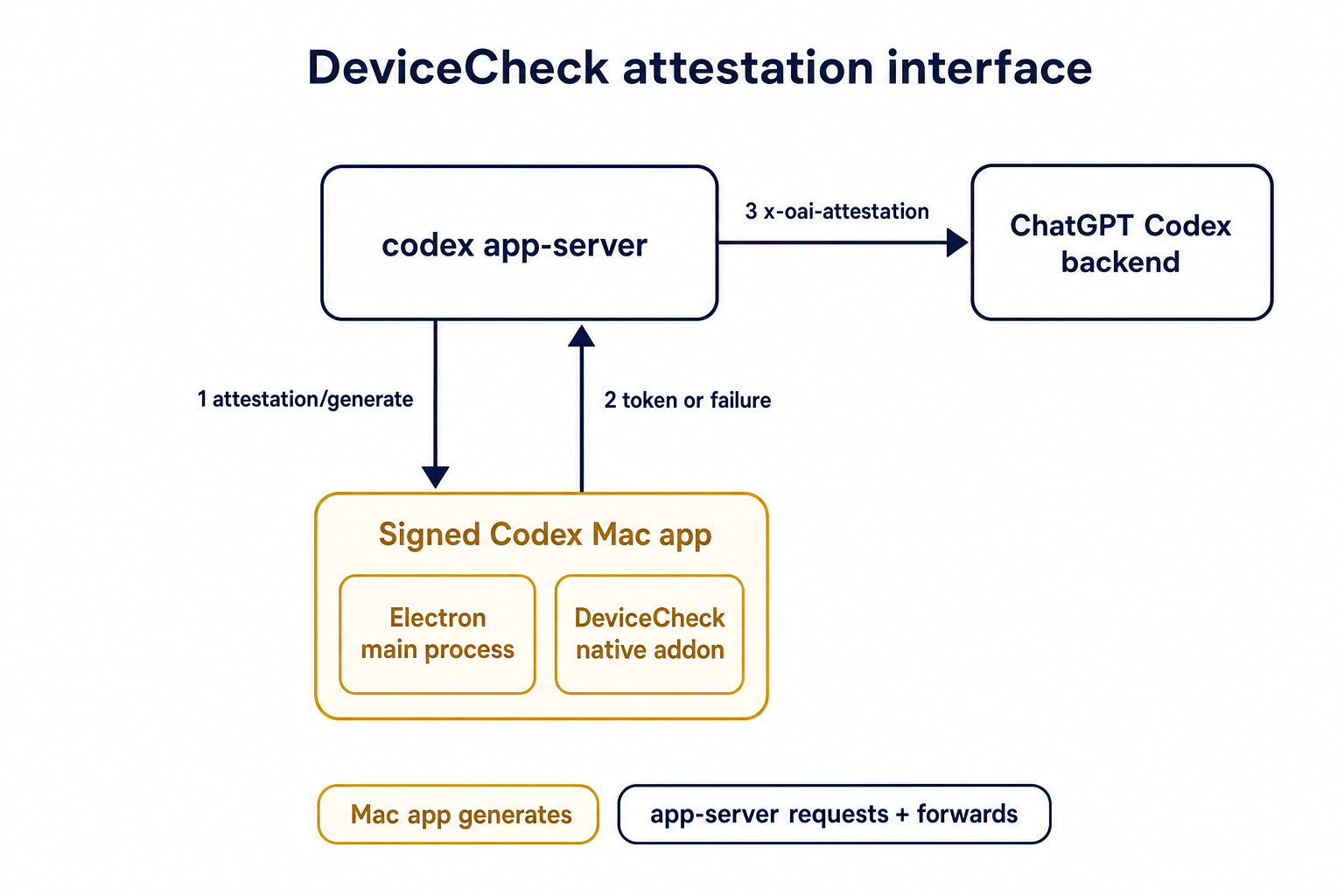
## Details
This PR teaches the Codex app-server runtime how to request and attach
an attestation token. It does not generate DeviceCheck tokens directly;
instead, it relies on the connected desktop app to advertise that it can
generate attestation and then asks that app for a fresh header value
when needed.
The flow is:
1. The Codex desktop app connects to app-server.
2. During `initialize`, the app can advertise that it supports
`requestAttestation`.
3. Before app-server calls selected ChatGPT Codex endpoints, it sends
the internal server request `attestation/generate` to the app.
4. app-server receives a pre-encoded header value back.
5. app-server forwards that value as `x-oai-attestation` on the scoped
outbound requests.
The code in this repo is mostly protocol and runtime plumbing: it adds
the app-server request/response shape, introduces an attestation
provider in core, wires that provider into Responses / compaction /
realtime setup paths, and covers the intended scoping with tests. The
signed macOS DeviceCheck generation remains owned by the desktop app PR.
## Related PR
- Codex desktop app implementation:
https://github.com/openai/openai/pull/878649
## Validation
<details>
<summary>Tests run</summary>
```sh
cargo test -p codex-app-server-protocol
cargo test -p codex-core attestation --lib
cargo test -p codex-app-server --lib attestation
```
Also ran:
```sh
just fix -p codex-core
just fix -p codex-app-server
just fix -p codex-app-server-protocol
just fmt
just write-app-server-schema
```
</details>
<details>
<summary>E2E DeviceCheck validation</summary>
First validated the signed desktop app boundary directly: launched a
packaged signed `Codex.app`, sent `attestation/generate`, decoded the
returned `v1.` attestation header, and validated the extracted
DeviceCheck token with `personal/jm/verify_devicecheck_token.py` using
bundle ID `com.openai.codex`. Apple returned `status_code: 200` and
`is_ok: true`.
Then ran the fuller app + app-server flow. The packaged `Codex.app`
launched a current-branch app-server via `CODEX_CLI_PATH`, and a local
MITM proxy intercepted outbound `chatgpt.com` traffic. The app-server
requested `attestation/generate` from the real Electron app process, and
the intercepted `/backend-api/codex/responses` traffic included
`x-oai-attestation` on both routes:
```text
GET /backend-api/codex/responses Upgrade: websocket x-oai-attestation: present
POST /backend-api/codex/responses Upgrade: none x-oai-attestation: present
```
The captured header decoded to a DeviceCheck token that also validated
with Apple for `com.openai.codex` (`status_code: 200`, `is_ok: true`,
team `2DC432GLL2`).
</details>
---------
Co-authored-by: Codex <noreply@openai.com>
## Why

`ToolName::display()` made it too easy to flatten tool identity and
accidentally compare rendered strings. Tool identity should stay
structural until a legacy string boundary actually requires the
flattened spelling.

## What

- Removes `ToolName::display()` and relies on the existing `Display`
impl for messages and errors.
- Adds structural ordering for `ToolName` and uses it for
sorting/deduping deferred tools.
- Carries `ToolName` through tool/sandbox plumbing, flattening only at
legacy boundaries such as hook payloads, telemetry tags, and Responses
tool names.
- Updates MCP normalization tests to assert `ToolName` structure instead
of rendered strings.

## Testing

- `cargo test -p codex-mcp test_normalize_tools`
- `cargo test -p codex-core unavailable_tool`
- `just fix -p codex-protocol`
- `just fix -p codex-mcp`
- `just fix -p codex-core`
## Why

`/fast` was wired as a one-off slash command even though model metadata
now exposes service tiers as catalog data. That meant adding another
tier, such as a slower/cheaper tier, would require more hardcoded TUI
plumbing instead of letting the model catalog drive the available
commands.

This change makes service-tier commands data-driven: each advertised
`service_tiers` entry becomes a `/name` command using the catalog
description, while the request path sends the tier `id` only when the
selected model supports it.

## What Changed

- Removed the hardcoded `/fast` slash-command variant and introduced
dynamic service-tier command items in the composer and command popup.
- Added toggle behavior for service-tier commands: invoking `/name`
selects that tier, and invoking it again clears the selection.
- Preserved the existing Fast-mode keybinding/status affordances by
resolving the current model tier whose name is `fast`, while still
sending the tier request value such as `priority`.
- Persisted service-tier selections as raw request strings so non-fast
tiers can round-trip through config.
- Updated the Bedrock catalog entry to advertise fast support through
`service_tiers` with `id: "priority"` and `name: "fast"`.
- Added defensive filtering in core so unsupported selected service
tiers are omitted from `/responses` requests.

## Validation

- Added/updated coverage for dynamic service-tier slash command lookup,
popup descriptions, composer dispatch, TUI fast toggling, and
unsupported-tier omission in core request construction.
- Local tests were not run per request.

---------

Co-authored-by: Codex <noreply@openai.com>
## Why

`service_tier` in `config.toml` and profile config was still modeled as
an enum, which blocked newer or experimental service tier IDs even
though the runtime paths already carry string IDs.

This change makes the TOML-facing config accept string service tier IDs
directly while keeping the legacy `fast` alias behavior by normalizing
it to the request value `priority`.

## What Changed

- change the TOML-facing `service_tier` fields in global and profile
config to `Option<String>`
- keep config-load normalization so legacy `fast` still resolves to
`priority`
- persist resolved service tier strings directly in config locks so
arbitrary IDs round-trip cleanly
- regenerate the config schema and add config coverage for arbitrary
string IDs plus legacy `fast` normalization

## Verification

- added config tests for arbitrary string service tiers and legacy
`fast` normalization
- ran `just write-config-schema`
- CI

---------

Co-authored-by: Codex <noreply@openai.com>
## Why

We want terminal tool review analytics, but the reducer should not stamp
review timing from its own wall clock.

This PR plumbs review timing through the real protocol and app-server
seams so downstream analytics can consume the emitter's timestamps
directly. Guardian reviews keep their enriched `started_at` /
`completed_at` analytics fields by deriving those legacy second-based
values from the same protocol-native millisecond lifecycle timestamps,
rather than sampling a separate analytics clock.

## What changed

- add `started_at_ms` to user approval request payloads
- add `started_at_ms` / `completed_at_ms` to guardian review
notifications
- preserve Guardian review `started_at` / `completed_at` enrichment from
the protocol-native timing source
- stamp typed `ServerResponse` analytics facts with app-server-observed
`completed_at_ms`
- thread the new timing fields through core, protocol, app-server, TUI,
and analytics fixtures

## Verification

- `cargo test -p codex-app-server outgoing_message --manifest-path
codex-rs/Cargo.toml`
- `cargo test -p codex-app-server-protocol guardian --manifest-path
codex-rs/Cargo.toml`
- `cargo test -p codex-tui guardian --manifest-path codex-rs/Cargo.toml`
- `cargo test -p codex-analytics analytics_client_tests --manifest-path
codex-rs/Cargo.toml`

---
[//]: # (BEGIN SAPLING FOOTER)
Stack created with [Sapling](https://sapling-scm.com). Best reviewed
with [ReviewStack](https://reviewstack.dev/openai/codex/pull/21434).
* #18748
* __->__ #21434
* #18747
* #17090
* #17089
* #20514
- Route live thread renames through `ThreadStore` metadata updates.
- Read resumed thread names from store metadata with legacy local
fallback preserved in the store.
## Why

This is the next stacked step after deleting the tool-handler kind
indirection. Specs should come from the registered handlers themselves
so registry construction has a single source of truth for handler
behavior and exposed tool definitions.

## What changed

- Added `ToolHandler::spec()` plus handler-provided parallel/code-mode
metadata, and made `ToolRegistryBuilder::register_handler` automatically
collect specs from registered handlers.
- Moved builtin tool spec construction into the corresponding handlers
and their adjacent `_spec` modules, including shell, unified exec, apply
patch, view image, request plugin install, tool search, MCP resource,
goals, planning, permissions, agent jobs, and multi-agent tools.
- Reworked configurable handlers to receive their tool-building options
through constructors, with non-optional handler options where the
handler is always spec-backed. Shell fallback handlers keep an explicit
no-spec mode because they are also registered as hidden dispatch
aliases.
- Kept `CodeModeExecuteHandler` on the explicit configured wrapper so
the code-mode exec spec can still be built from the nested registry.

## Verification

- `cargo check -p codex-core`
- `cargo test -p codex-core tools::spec_plan::tests`
- `cargo test -p codex-core tools::spec::tests`
- `cargo test -p codex-core tools::handlers::multi_agents_spec::tests`
- `RUST_MIN_STACK=16777216 cargo test -p codex-core
tools::handlers::multi_agents::tests`
- `cargo test -p codex-core tools::handlers::apply_patch::tests`
- `cargo test -p codex-core tools::handlers::unified_exec::tests`
- `just fix -p codex-core`
- `git diff --check`
## Why

App-server config writes were leaving existing threads partially stale.
After a config mutation, the app-server told each live thread to run
`Op::ReloadUserConfig`, but that path only re-read the user
`config.toml` layer. Settings that came from the app-server's
materialized config snapshot did not propagate to existing threads until
restart.

This change prevent a FS access from `core` for CCA.

## What changed

- add `CodexThread::refresh_runtime_config()` and
`Session::refresh_runtime_config()` so the app-server can push a freshly
rebuilt config snapshot into a live thread
- rebuild the latest config with each thread's `cwd` after config
mutations, then refresh the thread from that snapshot instead of asking
it to reload only `config.toml`
- keep session-static settings unchanged during refresh, while updating
runtime-refreshable state such as the config layer stack,
`tool_suggest`, and derived hook/plugin/skill state
- keep `reload_user_config_layer()` as the file-backed fallback for
legacy local reload flows, but route the shared refresh logic through
the new runtime refresh path

## Testing

- add a session test that verifies `refresh_runtime_config()` rebuilds
hooks from refreshed config
- add a session test that verifies runtime-refreshable fields update
while session-static settings like `model` and `notify` stay unchanged

---------

Co-authored-by: Codex <noreply@openai.com>
## Summary

This PR removes the synthetic `HashMap<String, ToolInfo>` keys from MCP
tool discovery. `McpConnectionManager::list_all_tools()` now returns
normalized `Vec<ToolInfo>`, and downstream code derives identity from
`ToolInfo::canonical_tool_name()`.

The motivation is to keep model-visible tool identity on
`ToolName`/`ToolInfo` instead of parallel string map keys, so future
namespace changes do not have to preserve otherwise-unused lookup keys.

## Changes

- Rename the MCP normalization path from `qualify_tools` to
`normalize_tools_for_model` and return tool values directly.
- Flow MCP tool lists through connectors, plugin injection, router/spec
building, code mode, and tool search as vectors/slices.
- Keep direct/deferred subtraction local to `mcp_tool_exposure`, using
`ToolName` values.
- Update tests to compare `ToolName` instances where MCP identity
matters.

## Validation

- `cargo test -p codex-mcp test_normalize_tools`
- `cargo test -p codex-core mcp_tool_exposure`
- `cargo test -p codex-core
direct_mcp_tools_register_namespaced_handlers`
- `cargo test -p codex-core
search_tool_registers_namespaced_mcp_tool_aliases`
- `just fix -p codex-mcp`
- `just fix -p codex-core`
## Summary
- replace filesystem-based turn diff tracking with an operation-backed
accumulator
- preserve enough verified apply_patch state to render move-overwrite
cases correctly
- keep the turn/diff/updated contract intact while removing remote-only
turn-diff test skips

This takes the assumption that no 3P services rely on the output format
of `apply_patch`

## Why
For the CCA file system isolation push

---------

Co-authored-by: Codex <noreply@openai.com>
## DISCLAIMER
This is experimental and no production service must rely on this

## Why

Built-in MCPs are product-owned runtime capabilities, but they were
previously flattened into the same config-backed stdio path as
user-configured servers. That made them depend on a hidden `codex
builtin-mcp` re-exec path, exposed them through config-oriented CLI
flows, and erased distinctions the runtime needs to preserve—most
notably whether an MCP call should count as external context for
memory-mode pollution.

## What changed

- Model product-owned built-ins separately from config-backed MCP
servers via `BuiltinMcpServer` and `EffectiveMcpServer`.
- Launch built-ins in process through a reusable async transport instead
of the hidden `builtin-mcp` stdio subcommand.
- Keep config-oriented CLI operations such as `codex mcp
list/get/login/logout` scoped to configured servers, while merging
built-ins only into the effective runtime server set.
- Retain server metadata after launch so parallel-tool support and
context classification come from the live server set; built-in
`memories` is now classified as local Codex state rather than external
context.

## Test plan

- `cargo test -p codex-mcp`
- `cargo test -p codex-core --test suite
builtin_memories_mcp_call_does_not_mark_thread_memory_mode_polluted_when_configured`

---------

Co-authored-by: Codex <noreply@openai.com>
## Why

Reverts #20689 to restore the previous optional state DB plumbing. The
conflict resolution keeps the newer installation ID and session/thread
identity changes that landed after #20689, while removing the mandatory
state DB and agent graph store dependency from ThreadManager
construction.

## What changed

- Restored `Option<StateDbHandle>` through app-server, MCP server,
prompt debug, and test entry points.
- Removed the `codex-core` dependency on `codex-agent-graph-store` and
reverted descendant lookup back to the existing state DB path when
available.
- Kept newer `installation_id` forwarding by passing it beside the
optional DB handle.
- Kept local thread-name updates working when the optional state DB
handle is absent.

## Validation

- `git diff --check`
- `cargo test -p codex-thread-store`
- `cargo test -p codex-state -p codex-rollout -p
codex-app-server-protocol`
- Attempted `env CARGO_INCREMENTAL=0 cargo test -p codex-core -p
codex-app-server -p codex-app-server-client -p codex-mcp-server -p
codex-thread-manager-sample -p codex-tui`; blocked locally by a rustc
ICE while compiling `v8 v146.4.0` with `rustc 1.93.0 (254b59607
2026-01-19)` on `aarch64-apple-darwin`.
## Why

Skills update notifications are app-server API behavior, but the watcher
lived in `codex-core` and surfaced through
`EventMsg::SkillsUpdateAvailable`. Moving the watcher out keeps core
focused on thread execution and lets app-server own both cache
invalidation and the `skills/changed` notification.

## What changed

- Added an app-server-owned skills watcher that watches local skill
roots, clears the shared skills cache, and emits `skills/changed`
directly.
- Registers skill watches from the common app-server thread listener
attach path, including direct starts, resumes, and app-server-observed
child or forked threads.
- Stores the `WatchRegistration` on `ThreadState`, so listener
replacement, thread teardown, idle unload, and app-server shutdown
deregister by dropping the RAII guard.
- Removed `EventMsg::SkillsUpdateAvailable`, the core watcher, and the
old core live-reload test.
- Extended the app-server skills change test to verify a cached skills
list is refreshed after a filesystem change without forcing reload.

## Validation

- `cargo check -p codex-core -p codex-app-server -p codex-mcp-server -p
codex-rollout -p codex-rollout-trace`
- `cargo test -p codex-app-server
skills_changed_notification_is_emitted_after_skill_change`
## Summary
- make resolved turn environment shell metadata optional instead of
hard-coding bash
- render environment context shells from explicit environment metadata
when present, falling back to the existing session shell
- update environment context tests for inherited PowerShell-style
fallback and explicit per-environment shell override

## Testing
- Not run (not requested; formatted with `just fmt`).

Co-authored-by: Codex <noreply@openai.com>
# Motivation

Browser Use origin-access prompts are MCP elicitations, not direct
tool-call approval prompts, so they were bypassing the Guardian approval
path. We need a generic opt-in that lets eligible MCP elicitations use
Guardian when the current turn already routes approvals there.

# Description

Add a generic elicitation reviewer hook in codex-mcp and wire codex-core
to pass a Guardian reviewer callback when creating the MCP connection
manager. The reviewer validates explicit mcp_tool_call opt-in metadata,
builds a Guardian MCP tool-call review request from
server/tool/connector metadata and tool params, and maps Guardian
approval, denial, timeout, and cancellation decisions back to MCP
elicitation responses.

The new option to trigger this in the `_meta` object is:
```
"codex_request_type": "approval_request",
```

# Testing

- RUST_MIN_STACK=8388608 NEXTEST_STATUS_LEVEL=leak cargo nextest run
--no-fail-fast --cargo-profile ci-test --test-threads 2
- cargo clippy --tests -- -D warnings
- cargo fmt -- --config imports_granularity=Item --check
- cargo shear
- pnpm run format
- python3 .github/scripts/verify_cargo_workspace_manifests.py
- python3 .github/scripts/verify_tui_core_boundary.py
- python3 .github/scripts/verify_bazel_clippy_lints.py
- git diff --check
## Why

The core `Op::ListMcpTools` request path is no longer needed. Keeping it
around left a dead request/response surface alongside the app-server MCP
inventory APIs that own current server status listing.

## What Changed

- Removed `Op::ListMcpTools`, `EventMsg::McpListToolsResponse`, and the
core handler that built the MCP snapshot response.
- Removed the now-unused `codex-mcp` snapshot wrapper/export and passive
event handling arms in rollout and MCP-server consumers.
- Updated tests that used the old op as a synchronization hook to wait
on existing startup/skills events, and deleted the plugin test that only
exercised the removed listing op.

## Validation

- `cargo test -p codex-protocol`
- `cargo test -p codex-mcp`
- `cargo test -p codex-rollout -p codex-rollout-trace -p
codex-mcp-server`
- `cargo test -p codex-core --test all
pending_input::queued_inter_agent_mail`
- `cargo test -p codex-core --test all
rmcp_client::stdio_mcp_tool_call_includes_sandbox_state_meta`
- `cargo test -p codex-core --test all
rmcp_client::stdio_image_responses`
- `just fix -p codex-core -p codex-protocol -p codex-mcp -p
codex-rollout -p codex-rollout-trace -p codex-mcp-server`
## Summary

- Add a `response.processed` websocket request payload and sender for
Responses API websockets.
- Send `response.processed` from `try_run_sampling_request` after a
response completes, local turn processing succeeds, and the
session-owned feature flag is enabled.
- Add websocket coverage for both enabled and disabled feature-flag
behavior.

## Validation

- `just fmt`
- `cargo test -p codex-core response_processed`
- `cargo test -p codex-api responses_websocket`
- `cargo test -p codex-features
responses_websocket_response_processed_is_under_development`
- `git diff --check`
- `just fix -p codex-api -p codex-core -p codex-features`
- `git diff --check origin/main...HEAD`
## Why

Message history was implemented inside `codex-core` and surfaced through
core protocol ops and `SessionConfiguredEvent` fields even though the
current consumer is TUI-local prompt recall. That made core own UI
history persistence and exposed `history_log_id` / `history_entry_count`
through surfaces that app-server and other clients do not need.

This change moves message history persistence out of core and keeps the
recall plumbing local to the TUI.

## What changed

- Added a new `codex-message-history` crate for appending, looking up,
trimming, and reading metadata from `history.jsonl`.
- Removed core protocol history ops/events: `AddToHistory`,
`GetHistoryEntryRequest`, and `GetHistoryEntryResponse`.
- Removed `history_log_id` and `history_entry_count` from
`SessionConfiguredEvent` and updated exec/MCP/test fixtures accordingly.
- Updated the TUI to dispatch local app events for message-history
append/lookup and keep its persistent-history metadata in TUI session
state.

## Validation

- `cargo test -p codex-message-history -p codex-protocol`
- `cargo test -p codex-exec event_processor_with_json_output`
- `cargo test -p codex-mcp-server outgoing_message`
- `cargo test -p codex-tui`
- `just fix -p codex-message-history -p codex-protocol -p codex-core -p
codex-tui -p codex-exec -p codex-mcp-server`
## Summary

- resolve or inject the installation ID before core startup and pass it
through `ThreadManager`, `CodexSpawnArgs`, and `Session` as a plain
`String`
- keep child sessions on the parent installation ID instead of
rediscovering it inside core
- propagate installation ID startup failures in `mcp-server` instead of
panicking

## Why

Core was still touching the filesystem on the session startup path to
discover `installation_id`. This moves that work to the outer host
boundary so core no longer depends on `codex_home` reads during session
construction.

---------

Co-authored-by: Codex <noreply@openai.com>

