## Why

`codex-core` was re-exporting APIs owned by sibling `codex-*` crates,
which made downstream crates depend on `codex-core` as a proxy module
instead of the actual owner crate.

Removing those forwards makes crate boundaries explicit and lets leaf
crates drop unnecessary `codex-core` dependencies. In this PR, this
reduces the dependency on `codex-core` to `codex-login` in the following
files:

```
codex-rs/backend-client/Cargo.toml
codex-rs/mcp-server/tests/common/Cargo.toml
```

## What

- Remove `codex-rs/core/src/lib.rs` re-exports for symbols owned by
`codex-login`, `codex-mcp`, `codex-rollout`, `codex-analytics`,
`codex-protocol`, `codex-shell-command`, `codex-sandboxing`,
`codex-tools`, and `codex-utils-path`.
- Delete the `default_client` forwarding shim in `codex-rs/core`.
- Update in-crate and downstream callsites to import directly from the
owning `codex-*` crate.
- Add direct Cargo dependencies where callsites now target the owner
crate, and remove `codex-core` from `codex-rs/backend-client`.
## Summary
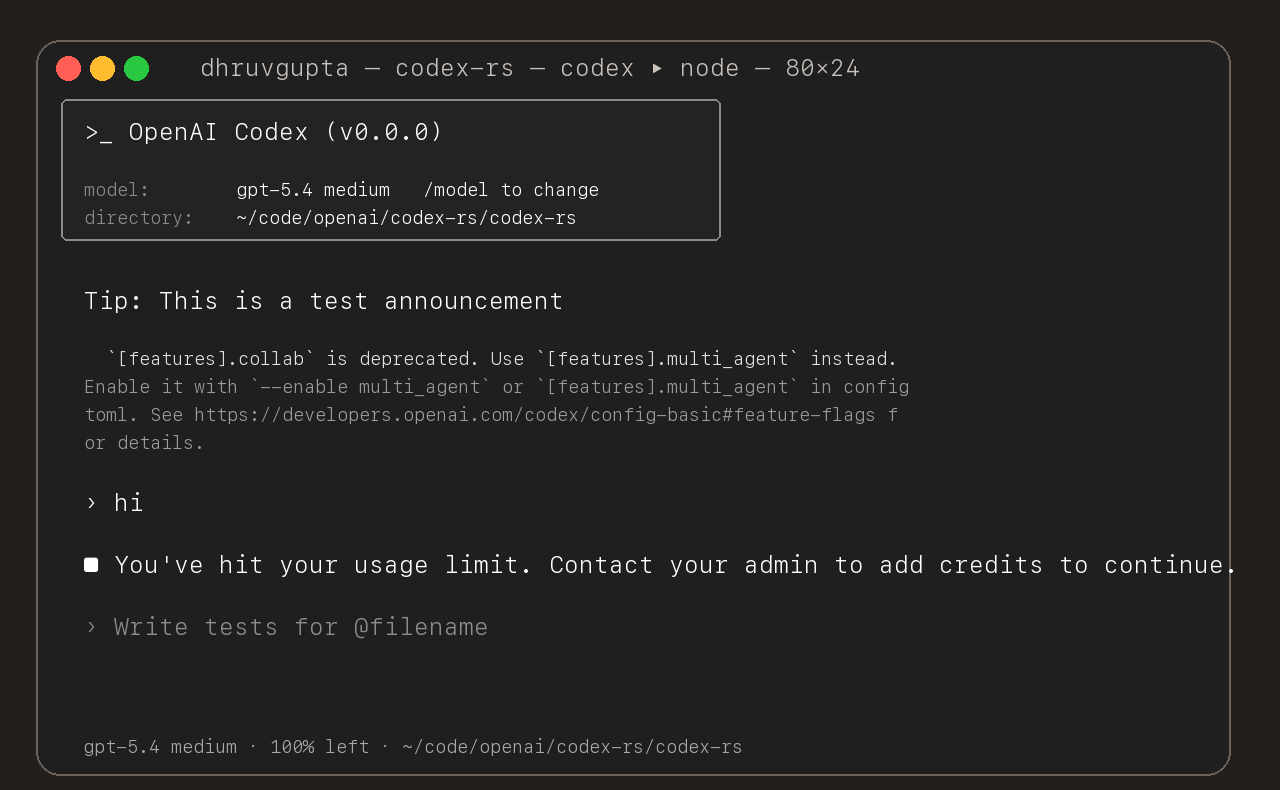
- update the self-serve business usage-based limit message to direct
users to their admin for additional credits
- add a focused unit test for the self_serve_business_usage_based plan
branch
Added also:
If you are at a rate limit but you still have credits, codex cli would
tell you to switch the model. We shouldnt do this if you have credits so
fixed this.
## Test
- launched the source-built CLI and verified the updated message is
shown for the self-serve business usage-based plan
Refactors cloud requirements error handling to carry structured error
metadata and surfaces that metadata through JSON-RPC config-load
failures, including:
* adds typed CloudRequirementsLoadErrorCode values plus optional
statusCode
* marks thread/start, thread/resume, and thread/fork config failures
with structured cloud-requirements error data
Currently we emit `thread/status/changed` with `Idle` status right
before sending `thread/started` event (which also has `Idle` status in
it).
It feels that there is no point in that as client has no way to know
prior state of the thread as it didn't exist yet, so silence these kinds
of notifications.
Add service name to the app-server so that the app can use it's own
service name

This is on thread level because later we might plan the app-server to
become a singleton on the computer
Exposes through the app server updated names set for a thread. This
enables other surfaces to use the core as the source of truth for thread
naming. `threadName` is gathered using the helper functions used to
interact with `session_index.jsonl`, and is hydrated in:
- `thread/list`
- `thread/read`
- `thread/resume`
- `thread/unarchive`
- `thread/rollback`

We don't do this for `thread/start` and `thread/fork`.
Motivation
- Today, a newly connected client has no direct way to determine the
current runtime status of threads from read/list responses alone.
- This forces clients to infer state from transient events, which can
lead to stale or inconsistent UI when reconnecting or attaching late.

Changes
- Add `status` to `thread/read` responses.
- Add `statuses` to `thread/list` responses.
- Emit `thread/status/changed` notifications with `threadId` and the new
status.
- Track runtime status for all loaded threads and default unknown
threads to `idle`.
- Update protocol/docs/tests/schema fixtures for the revised API.

Testing
- Validated protocol API changes with automated protocol tests and
regenerated schema/type fixtures.
- Validated app-server behavior with unit and integration test suites,
including status transitions and notifications.
- Defer rollout persistence for fresh threads (`InitialHistory::New`):
keep rollout events in memory and only materialize rollout file + state
DB row on first `EventMsg::UserMessage`.
- Keep precomputed rollout path available before materialization.
- Change `thread/start` to build thread response from live config
snapshot and optional precomputed path.
- Improve pre-materialization behavior in app-server/TUI: clearer
invalid-request errors for file-backed ops and a friendlier `/fork` “not
ready yet” UX.
- Update tests to match deferred semantics across
start/read/archive/unarchive/fork/resume/review flows.
- Improved resilience of user_shell test, which should be unrelated to
this change but must be affected by timing changes

For Reviewers:
* The primary change is in recorder.rs
* Most of the other changes were to fix up broken assumptions in
existing tests

Testing:
* Manually tested CLI
* Exercised app server paths by manually running IDE Extension with
rebuilt CLI binary
* Only user-visible change is that `/fork` in TUI generates visible
error if used prior to first turn
Summary
- add a `required` flag for MCP servers everywhere config/CLI data is
touched so mandatory helpers can be round-tripped
- have `codex exec` and `codex app-server` thread start/resume fail fast
when required MCPs fail to initialize
This PR adds support for chained (layered) config.toml file merging for
clients that use the app server interface. This feature already exists
for the TUI, but it does not work for GUI clients.

It does the following:
* Changes code paths for new thread, resume thread, and fork thread to
use the effective config based on the cwd.
* Updates the `config/read` API to accept an optional `cwd` parameter.
If specified, the API returns the effective config based on that cwd
path. Also optionally includes all layers including project config
files. If cwd is not specified, the API falls back on its older behavior
where it considers only the global (non-project) config files when
computing the effective config.

The changes in codex_message_processor.rs look deceptively large. They
mostly just involve moving existing blocks of code to a later point in
some functions so it can use the cwd to calculate the config.

This PR builds upon #9509 and should be reviewed and merged after that
PR.

Tested:
* Verified change with (dependent, as-yet-uncommitted) changes to IDE
Extension and confirmed correct behavior

The full fix requires additional changes in the IDE Extension code base,
but they depend on this PR.
This adds the following fields to `ThreadStartResponse` and
`ThreadResumeResponse`:

```rust
    pub model: String,
    pub model_provider: String,
    pub cwd: PathBuf,
    pub approval_policy: AskForApproval,
    pub sandbox: SandboxPolicy,
    pub reasoning_effort: Option<ReasoningEffort>,
```

This is important because these fields are optional in
`ThreadStartParams` and `ThreadResumeParams`, so the caller needs to be
able to determine what values were ultimately used to start/resume the
conversation. (Though note that any of these could be changed later
between turns in the conversation.)

Though to get this information reliably, it must be read from the
internal `SessionConfiguredEvent` that is created in response to the
start of a conversation. Because `SessionConfiguredEvent` (as defined in
`codex-rs/protocol/src/protocol.rs`) did not have all of these fields, a
number of them had to be added as part of this PR.

Because `SessionConfiguredEvent` is referenced in many tests, test
instances of `SessionConfiguredEvent` had to be updated, as well, which
is why this PR touches so many files.
## Summary
- update documentation, example configs, and automation defaults to
reference gpt-5.1 / gpt-5.1-codex
- bump the CLI and core configuration defaults, model presets, and error
messaging to the new models while keeping the model-family/tool coverage
for legacy slugs
- refresh tests, fixtures, and TUI snapshots so they expect the upgraded
defaults

## Testing
- `cargo test -p codex-core
config::tests::test_precedence_fixture_with_gpt5_profile`


------
[Codex
Task](https://chatgpt.com/codex/tasks/task_i_6916c5b3c2b08321ace04ee38604fc6b)
Add the following fields to Thread:

```
    pub preview: String,
    pub model_provider: String,
    pub created_at: i64,
```

Will prob need another PR once this lands:
https://github.com/openai/codex/pull/6337
Implements:
```
thread/list
thread/start
thread/resume
thread/archive
```

along with their integration tests. These are relatively light wrappers
around the existing core logic, and changes to core logic are minimal.

However, an improvement made for developer ergonomics:
- `thread/start` and `thread/resume` automatically attaches a
conversation listener internally, so clients don't have to make a
separate `AddConversationListener` call like they do today.

For consistency, also updated `model/list` and `feedback/upload` (naming
conventions, list API params).

