## Why
[Recent PR](https://github.com/openai/codex/pull/22709) removed
`trace_id` from `TurnContextItem`.

## What changed
- Add to `TurnStartedEvent` so rollout consumers can correlate turns
with telemetry traces.
- Note that the branch name is out of date because I originally re-added
to `TurnContextItem`, but we decided to move it to `TurnStartedEvent`.

## Verification
- `cargo test -p codex-protocol`
- `cargo test -p codex-core --lib
regular_turn_emits_turn_started_without_waiting_for_startup_prewarm`
- `cargo test -p codex-core --test all
emits_warning_when_resumed_model_differs`
- `cargo test -p codex-rollout`
- `cargo test -p codex-state`
Add new enterprise requirement gate.

Validation:
- `cargo test -p codex-config --lib`
- `cargo test -p codex-app-server-protocol --lib`
- `cargo test -p codex-tui --lib debug_config`
- `cargo test -p codex-app-server --lib` *(fails: stack overflow in
`in_process::tests::in_process_start_initializes_and_handles_typed_v2_request`;
reproduces when run alone)*
## Why

Legacy `[profiles.<name>]` config tables and the legacy `profile`
selector are being retired in favor of profile files selected with
`--profile <name>`. After #23886 removed the CLI-side legacy profile
plumbing, the app-server config surface still exposed those fields and
still carried conversion code for the old protocol shape.

## What changed

- Remove `profile`, `profiles`, and `ProfileV2` from the app-server
config protocol/schema output so `config/read` no longer returns legacy
profile config.
- Drop the old v1 `UserSavedConfig` profile conversion path from
`config`.
- Reject new app-server config writes under `profiles.*` with the same
migration direction used for `profile`, while still allowing callers to
clear existing legacy profile tables.
- Refresh app-server config coverage and the experimental API README
example around the remaining `Config` nesting path.

## Verification

- Added config-manager coverage that `config/read` omits legacy profile
config, `profiles.*` writes are rejected, and existing legacy profile
tables can still be cleared.
- Updated the v2 config RPC test to cover the rejected `profiles.*`
batch-write path.
`#[serde(default)]` wasn't sufficient for our generated TS types to
reflect that clients didn't have to set them. We also need
`skip_serializing_if = "std::ops::Not::not"`. This is already a rule in
our agents.md file.
## Summary
- add experimental `thread/search` for local rollout-backed thread
search using `rg` over JSONL rollouts
- return search-specific result rows with optional previews instead of
storing preview data on `StoredThread` or ordinary `Thread` responses
- keep `thread/list` separate from full-content search and document the
new app-server surface

## Testing
- `cargo test -p codex-app-server-protocol`
- `cargo test -p codex-app-server
thread_search_returns_content_and_title_matches -- --nocapture`
## Why

Cloud-managed `requirements.toml` should be able to define the managed
permission profiles a client may select and constrain that selectable
set without requiring local user config to recreate the profile catalog.

This keeps requirements focused on restrictions. The selected default
remains a config or session choice, while requirements contribute the
managed profile bodies and `allowed_permissions` allowlist that the
config-loading boundary validates before a resolved runtime
`PermissionProfile` is installed.

## What changed

- Add `requirements.toml` support for a managed permission-profile
catalog plus its allowlist:

```toml
allowed_permissions = ["review", "build"]

[permissions.review]
extends = ":read-only"

[permissions.build]
extends = ":workspace"
```

- Merge requirements-defined profile bodies into the effective
permission catalog and reject profile ids that collide with
config-defined profiles.
- Validate that every `allowed_permissions` entry resolves to a built-in
or catalog profile before selection uses it.
- Preserve allowed configured named-profile selections. When a
configured named profile is disallowed, fall back to the first allowed
requirements profile with a startup warning.
- Keep built-in selections and the stock trust-based `:read-only` /
`:workspace` fallback path intact when no permission profile is
explicitly selected.
- Centralize the managed catalog and allowlist selection path in
`EffectivePermissionSelection` so the requirements boundary is visible
in config loading.
- Surface `allowedPermissions` through `configRequirements/read`, and
update the generated app-server schema fixtures plus the app-server
README.

## Validation

- `cargo test -p codex-config`
- `cargo test -p codex-core system_requirements_`
- `cargo test -p codex-core system_allowed_permissions_`
- `cargo test -p codex-app-server-protocol`
- `just write-app-server-schema`

## Related work

- Uses merged permission-profile inheritance support from #22270 and
#23705.
- Kept separate from the in-flight permission profile listing API in
#23412.
Add owning plugin id to MCP tool call items so we can better filter them
at plugin level.

## Summary
- add optional `plugin_id` to MCP tool-call items and legacy begin/end
events
- propagate plugin metadata into emitted core items and app-server v2
`ThreadItem::McpToolCall`
- preserve plugin ids through app-server replay/redaction paths and
regenerate v2 schema fixtures

## Testing
- `just write-app-server-schema`
- `just fmt`
- `just fix -p codex-core`
- `cargo test -p codex-protocol -p codex-app-server-protocol`
- `cargo test -p codex-app-server-protocol`
- `cargo test -p codex-core mcp_tool_call_item_includes_plugin_id --lib`
- `cargo check -p codex-tui --tests`
- `cargo check -p codex-app-server --tests`
- `git diff --check`

## Notes
- `just fix -p codex-core` completed with two non-fatal
`too_many_arguments` warnings on the touched MCP notification helpers.
- A broader `cargo test -p codex-core` run passed core unit tests, then
hit shell/sandbox/snapshot failures in the integration target.
- A broader app-server downstream run hit the existing
`in_process::tests::in_process_start_clamps_zero_channel_capacity` stack
overflow; `cargo test -p codex-exec` also hit the existing sandbox
expectation mismatch in
`thread_lifecycle_params_include_legacy_sandbox_when_no_active_profile`.
## Why

Model catalog responses can now advertise a nullable
`default_service_tier` for each model. Codex needs to preserve three
distinct states all the way from config/app-server inputs to inference:

- no explicit service tier, so the client may apply the current model
catalog default when FastMode is enabled
- explicit `default`, meaning the user intentionally wants standard
routing
- explicit catalog tier ids such as `priority`, `flex`, or future tiers

Keeping those states distinct prevents the UI from showing one tier
while core sends another, especially after model switches or app-server
`thread/start` / `turn/start` updates.

## What Changed

- Plumbed `default_service_tier` through model catalog protocol types,
app-server model responses, generated schemas, model cache fixtures, and
provider/model-manager conversions.
- Added the request-only `default` service tier sentinel and normalized
legacy config spelling so `fast` in `config.toml` still materializes as
the runtime/request id `priority`.
- Moved catalog default resolution to the TUI/client side, including
recomputing the effective service tier when model/FastMode-dependent
surfaces change.
- Updated app-server thread lifecycle config construction so
`serviceTier: null` preserves explicit standard-routing intent by
mapping to `default` instead of internal `None`.
- Kept core responsible for validating explicit tiers against the
current model and stripping `default` before `/v1/responses`, without
applying catalog defaults itself.

## Validation

- `CARGO_INCREMENTAL=0 cargo build -p codex-cli`
- `CARGO_INCREMENTAL=0 cargo test -p codex-app-server model_list`
- `cargo test -p codex-tui service_tier`
- `cargo test -p codex-protocol service_tier_for_request`
- `cargo test -p codex-core get_service_tier`
- `RUST_MIN_STACK=8388608 CARGO_INCREMENTAL=0 cargo test -p codex-core
service_tier`
## Why

The `goals` feature is ready to be available without requiring users to
opt into experimental features. Keeping it behind the beta flag leaves
persisted thread goals and automatic goal continuation disabled by
default.

This PR also marks the goal-related app server APIs and events as no
longer experimental.

## What changed

- Mark `goals` as `Stage::Stable`.
- Enable `goals` by default in `codex-rs/features/src/lib.rs`.
# What

<img width="1792" height="1024" alt="image"
src="https://github.com/user-attachments/assets/8f81d232-5813-4994-a61d-e42a05a93a3e"
/>

`SubagentStop` runs when a thread-spawned subagent turn is about to
finish. Thread-spawned subagents use `SubagentStop` instead of the
normal root-agent `Stop` hook.

Configured handlers match on `agent_type`. Hook input includes the
normal stop fields plus:

- `agent_id`: the child thread id.
- `agent_type`: the resolved subagent type.
- `agent_transcript_path`: the child subagent transcript path.
- `transcript_path`: the parent thread transcript path.
- `last_assistant_message`: the final assistant message from the child
turn, when available.
- `stop_hook_active`: `true` when the child is already continuing
because an earlier stop-like hook blocked completion.

`SubagentStop` shares the same completion-control semantics as `Stop`,
scoped to the child turn:

- No decision allows the child turn to finish.
- `decision: "block"` with a non-empty `reason` records that reason as
hook feedback and continues the child with that prompt.
- `continue: false` stops the child turn. If `stopReason` is present,
Codex surfaces it as the stop reason.

# Lifecycle Scope

Only thread-spawned subagents run `SubagentStop`.

Internal/system subagents such as Review, Compact, MemoryConsolidation,
and Other do not run normal `Stop` hooks and do not run `SubagentStop`.
This avoids exposing synthetic matcher labels for internal
implementation paths.

# Stack

1. #22782: add `SubagentStart`.
2. This PR: add `SubagentStop`.
3. #22882: add subagent identity to normal hook inputs.
## Stack

This is the foundation PR for the permission-profile inheritance stack.

- This PR adds config-level `extends` resolution and merge semantics.
- Follow-up: #23705 applies resolved profiles at runtime and updates the
active-profile protocol surfaces.

## Why

Permission profiles are starting to carry enough policy that
copy-pasting near-identical definitions becomes hard to review and easy
to drift. Before the runtime can consume inherited profiles, the config
layer needs one explicit resolver that can merge parent chains and
reject unsafe or invalid inheritance shapes.

## What changed

- Add `extends` to permission-profile TOML and resolve parent chains in
inheritance order.
- Merge inherited profile TOML with the existing config merge behavior
while preserving the permission-specific normalization needed for
network domain keys.
- Keep parent descriptions out of resolved child profiles and record
inherited profile names separately for downstream consumers.
- Reject undefined parents, unsupported built-in parents, and
inheritance cycles with targeted errors.
- Cover resolver behavior with TOML fixture tests and refresh the
generated config schema.

## Validation

- `cargo test -p codex-config`
- `cargo test -p codex-core permissions_profiles_`
## Why

App-server clients need a way to update a thread's next-turn settings
without starting a turn, adding transcript content, or waiting for turn
lifecycle events. This gives settings UI a direct path for durable
thread settings while clients observe the eventual effective state
through a notification.

This is a simplified rework of PR
https://github.com/openai/codex/pull/22509. In particular, it changes
the `thread/settings/update` api to return immediately rather than
waiting and returning the effective (updated) thread settings. This
makes the new api consistent with `turn/start` and greatly reduces the
complexity of the implementation relative to the earlier attempt.

## What Changed

- Adds experimental `thread/settings/update` with partial-update request
fields and an empty acknowledgment response.
- Adds experimental `thread/settings/updated`, carrying full effective
`ThreadSettings` and scoped by `threadId` to subscribed clients for the
affected thread.
- Shares durable settings validation with `turn/start`, including
`sandboxPolicy` plus `permissions` rejection and `serviceTier: null`
clearing.
- Emits the same settings notification when `turn/start` overrides
change the stored effective thread settings.
- Regenerates app-server protocol schema fixtures and updates
`app-server/README.md`.
- Adds an explicit vertical marketplace kind for plugin/list that
fail-open fetches collection=vertical only when full remote plugins are
disabled.

- Renames the global remote marketplace/cache identity to
openai-curated-remote and materializes remote installs with backend
release versions and app manifests.
## Why

Clients need a typed permission-profile catalog instead of
reconstructing that state from config internals.

## What changed

- Added `permissionProfile/list` to the app-server v2 protocol with
cursor pagination and optional `cwd`.
- The list response includes built-in permission profiles plus
config-defined `[permissions.<id>]` profiles from the effective config
for the request context.
- Permission profiles keep optional `description` metadata for display
purposes.
- App-server docs and schema fixtures are updated for the new RPC.
## Summary
- Coerce `path: ""` to `None` at the v2 protocol params deserialization
boundary for `thread/resume` and `thread/fork`.
- Restore the pre-ThreadStore running-thread resume behavior: if
`threadId` is already running, rejoin it by id and treat a non-empty
`path` only as a consistency check; otherwise cold resume keeps `history
> path > threadId` precedence.
- Add protocol, resume, and fork regression coverage for empty path
payloads; refresh app-server schema fixtures for the clarified params
docs.

## Tests
- `just fmt`
- `just write-app-server-schema`
- `cargo test -p codex-app-server-protocol
thread_path_params_deserialize_empty_path_as_none`
- `cargo test -p codex-app-server-protocol --test schema_fixtures`
- `cargo test -p codex-app-server empty_path`
- `RUST_MIN_STACK=8388608 cargo test -p codex-app-server --test all
thread_resume_rejects_mismatched_path_for_running_thread_id`
- `RUST_MIN_STACK=8388608 cargo test -p codex-app-server --test all
thread_resume_uses_path_over_non_running_thread_id`
# What

`SubagentStart` runs once when Codex creates a thread-spawned subagent,
before that child sends its first model request. Thread-spawned
subagents use `SubagentStart` instead of the normal root-agent
`SessionStart` hook.

Configured handlers match on the subagent `agent_type`, using the same
value passed to `spawn_agent`. When no agent type is specified, Codex
uses the default agent type.

Hook input includes the normal session-start fields plus:

- `agent_id`: the child thread id.
- `agent_type`: the resolved subagent type.

`SubagentStart` may return `hookSpecificOutput.additionalContext`. That
context is added to the child conversation before the first model
request.

# Lifecycle Scope

Only thread-spawned subagents run `SubagentStart`.

Internal/system subagents such as Review, Compact, MemoryConsolidation,
and Other do not run normal `SessionStart` hooks and do not run
`SubagentStart`. This avoids exposing synthetic matcher labels for
internal implementation paths.

Also the `SessionStart` hook no longer fires for subagents, this matches
behavior with other coding agents' implementation

# Stack

1. This PR: add `SubagentStart`.
2. #22873: add `SubagentStop`.
3. #22882: add subagent identity to normal hook inputs.
## Why
Filesystem permission profiles used `none` for deny-read entries, which
is less direct than the action the entry actually represents. This
change makes `deny` the canonical filesystem permission spelling while
preserving compatibility for older configs that still send `none`.

## What changed
- rename `FileSystemAccessMode::None` to `Deny`
- serialize and generate schemas with `deny` as the canonical value
- retain `none` only as a legacy input alias for temporary config
compatibility
- update filesystem glob diagnostics and regression coverage to use the
canonical spelling
- refresh config and app-server schema fixtures to match the new wire
shape

## Validation
- `cargo test -p codex-protocol`
- `cargo test -p codex-app-server-protocol`
- `cargo test -p codex-core config_toml_deserializes_permission_profiles
--lib`
- `cargo test -p codex-core
read_write_glob_patterns_still_reject_non_subpath_globs --lib`

Earlier in the session, a broad `cargo test -p codex-core` run reached
unrelated pre-existing failures in timing/snapshot/git-info tests under
this environment; the targeted surfaces touched by this PR passed
cleanly.
## Why

`model_auto_compact_token_limit` has only been able to budget the full
active context. That makes it hard to set a small "growth since
compaction" budget for sessions that preserve a large carried window
prefix: the preserved prefix can consume the whole budget and force
immediate repeated compaction.

This PR adds an opt-in `body_after_prefix` scope so callers can apply
`model_auto_compact_token_limit` to sampled output and later growth
after the current carried prefix, while still forcing compaction before
the full model context window is exhausted.

## What changed

- Adds `AutoCompactTokenLimitScope` with the existing `total` behavior
as the default and a new `body_after_prefix` mode:
[`config_types.rs`](973806b1cb/codex-rs/protocol/src/config_types.rs (L24-L37)).
- Threads `model_auto_compact_token_limit_scope` through config loading,
`Config`, `core-api`, and app-server v2 schema/TypeScript generation.
- Records the first observed input-token count for a `body_after_prefix`
compaction window and uses it as the baseline when deciding whether the
scoped auto-compaction budget is exhausted:
[`turn.rs`](973806b1cb/codex-rs/core/src/session/turn.rs (L743-L781)).
- Keeps a hard context-window cap in `body_after_prefix`, so scoped
budgeting cannot let the active context overrun the usable window.

## Verification

Added compact-suite coverage for the two key behaviors:
`body_after_prefix` does not re-compact just because the carried prefix
is larger than the scoped budget, and it still compacts when the total
active context reaches the configured context window:
[`compact.rs`](973806b1cb/codex-rs/core/tests/suite/compact.rs (L3003-L3128)).
## Why

The v2 app-server permission profile fields are experimental, but the
previous migration kept a legacy object payload for profile selection.
That made clients aware of server-owned `activePermissionProfile`
metadata such as `extends`, and it kept a
`legacy_additional_writable_roots` path even though
`runtimeWorkspaceRoots` now owns runtime workspace-root selection.

This PR makes the client contract match the intended model: clients
select a permission profile by id, and the server resolves and reports
active profile provenance in response payloads.

Follow-up to #22611.

## What Changed

- Changed `thread/start`, `thread/resume`, `thread/fork`, and
`turn/start` permission profile selection to plain profile id strings.
- Changed `command/exec.permissionProfile` to a plain profile id string
for the same client/server ownership split.
- Removed `PermissionProfileSelectionParams` and the legacy `{ type:
"profile", modifications: [...] }` compatibility deserializer.
- Updated app-server, TUI, and `codex exec` call sites to send only ids,
while keeping `activePermissionProfile` as server response metadata.
- Updated app-server docs and schema fixtures for the revised
`command/exec.permissionProfile` shape.

## Verification

- `cargo test -p codex-app-server-protocol`
- `RUST_MIN_STACK=8388608 cargo test -p codex-app-server`
- `cargo test -p codex-exec`
- `RUST_MIN_STACK=8388608 cargo test -p codex-tui`

---
[//]: # (BEGIN SAPLING FOOTER)
Stack created with [Sapling](https://sapling-scm.com). Best reviewed
with [ReviewStack](https://reviewstack.dev/openai/codex/pull/23360).
* #23368
* __->__ #23360
## Why

`experimentalFeature/list` reports effective feature enablement, but
currently does not resolve it against a working directory where
project-local config.toml files can exist and toggle on/off features
when merged into the effective config after resolving the various config
layers. That means we effectively (and incorrectly) ignore features set
in project-local config.

To address that, this PR exposes an optional `thread_id` param which
allows us to load the thread's `cwd.

## Testing

- `cargo test -p codex-app-server-protocol`
- `cargo test -p codex-app-server experimental_feature_list`
Addresses #22833, #22245, #23067

## Why
`/goal` can keep synthesizing turns even when the next turn cannot make
meaningful progress. Hard usage exhaustion can replay failing turns, and
repeated permission or external-resource blockers can keep burning
tokens while waiting for user or system intervention.

## What changed
- Add resumable `blocked` and `usageLimited` goal states. As with
`paused`, goal continuation stops with these states.
- Move to `usageLimited` after usage-limit failures.
- Allow the built-in `update_goal` tool to set `blocked` only under
explicit repeated-impasse guidance. Updated goal continuation prompt to
specify that agent should use `blocked` only when it has made at least
three attempts to get past an impasse.

Most of the files touched by this PR are because of the small app server
protocol update.

## Validation

I manually reproduced a number of situations where an agent can run into
a true impasse and verified that it properly enters `blocked` state. I
then resumed and verified that it once again entered `blocked` state
several turns later if the impasse still exists.

I also manually reproduced the usage-limit condition by creating a
simulated responses API endpoint that returns 429 errors with the
appropriate error message. Verified that the goal runtime properly moves
the goal into `usageLimited` state and TUI UI updates appropriately.
Verified that `/goal resume` resumes (and immediately goes back into
`ussageLImited` state if appropriate).


## Follow-up PRs

Small changes will be needed to the GUI clients to properly handle the
two new states.
## Summary
- add app-server `plugin/installed` for mention-oriented plugin loading
- return installed plugins plus explicitly requested install-suggestion
rows
- keep remote handling on installed-state data instead of the broad
catalog listing path

## Why
The `@` mention surface only needs plugins that are usable now, plus a
small product-approved set of install suggestions. It does not need the
full catalog-shaped `plugin/list` payload that the Plugins page uses.

## Validation
- `just write-app-server-schema`
- `just fmt`
- `cargo test -p codex-app-server-protocol`
- `cargo test -p codex-core-plugins`
- `cargo test -p codex-app-server --test all plugin_installed_`

## Notes
- The package-wide `cargo test -p codex-app-server` run still hits an
existing unrelated stack overflow in
`in_process::tests::in_process_start_clamps_zero_channel_capacity`.
- Companion webview PR: https://github.com/openai/openai/pull/915672
## Why

The app server API should expose permission profile identity, not the
lower-level runtime permission model. `PermissionProfile` is the
compiled sandbox/network representation that the server uses internally;
exposing it through app-server-protocol forces clients to understand
details that should remain implementation-level.

The API boundary should prefer `ActivePermissionProfile`: a stable
profile id, plus future parent-profile metadata, that clients can pass
back when they want to select the same active permissions. This also
avoids schema generation collisions between the app-server v2 API type
space and the core protocol model.

Incidentally, while PR makes a number of changes to `command/exec`, note
that we are hoping to deprecate this API in favor of `process/spawn`, so
we don't need to be too finicky about these changes.

## What Changed

- Removed `PermissionProfile` from the app-server-protocol API surface,
including generated schema and TypeScript exports.
- Changed `CommandExecParams.permissionProfile` to
`ActivePermissionProfile`.
- Resolve command exec profile ids through `ConfigManager` for the
command cwd, matching turn override selection semantics.
- Updated downstream TUI tests/helpers to use core permission types
directly instead of app-server-protocol `PermissionProfile` shims.
## Summary

- Add optional image detail to user image inputs across core, app-server
v2, thread history/event mapping, and the generated app-server
schemas/types.
- Preserve requested detail when serializing Responses image inputs:
omitted detail stays on the existing `high` default, while explicit
`original` keeps local images on the original-resolution path.
- Support `high`/`original` consistently for tool image outputs,
including MCP `codex/imageDetail`, code-mode image helpers, and
`view_image`.
## Why
To help improve `codex remote-control` CLI UX which I plan to do in a
followup, this PR adds `server-name` to the various remote control APIs:
- `remoteControl/enable`
- `remoteControl/disable`
- `remoteControl/status/changed`

Also, add a `remoteControl/status/read` API. This will be helpful in the
Codex App.
## Why

The app-server thread lifecycle API should no longer expose the full
`PermissionProfile` value. After the permissions-profile migration,
clients should round-trip only the active profile identity through
`activePermissionProfile` and `permissions` when that identity is known.

The full profile is server-side config. Treating a response-derived
legacy sandbox projection as a new local profile can lose named-profile
restrictions and accidentally widen permissions on the next turn. The
legacy `sandbox` response field remains only as the
compatibility/display fallback.

## What Changed

- Removed `permissionProfile` from `ThreadStartResponse`,
`ThreadResumeResponse`, and `ThreadForkResponse`.
- Stopped populating that field in app-server thread start/resume/fork
responses.
- Updated embedded exec/TUI response mapping to derive display
permission state from local config or the legacy sandbox fallback
instead of a response profile value.
- Added a TUI turn override shape that distinguishes preserving server
permissions, selecting an active profile id, and sending a legacy
sandbox for an explicit local override.
- Preserved remote app-server permissions across turns by sending
`permissions` only when an `activePermissionProfile` id is known, and
otherwise sending no sandbox override unless the user selected a local
override.
- Kept embedded `thread/resume` hydration server-authored when
`activePermissionProfile` is absent, which matches the live-thread
attach path where the server ignores requested overrides.
- Updated the app-server README to remove the obsolete lifecycle
response `permissionProfile` reference. The remaining
`permissionProfile` README references are request-side permission
overrides.
- Regenerated app-server JSON schema and TypeScript fixtures.
- Kept the generated typed response enum exempt from
`large_enum_variant`, matching the existing payload enum exemption after
the lifecycle response variants shrank.

## How To Review

Start with `codex-rs/app-server-protocol/src/protocol/v2/thread.rs` to
confirm the response shape, then check the response construction in
`codex-rs/app-server/src/request_processors`. The generated schema and
TypeScript fixture changes are mechanical follow-through from the
protocol removal.

The TUI behavior is the delicate part: review
`codex-rs/tui/src/app_server_session.rs` for response hydration and
turn-start override projection, then
`codex-rs/tui/src/app/thread_routing.rs` for the decision about whether
the next turn should preserve the server snapshot, send an active
profile id, or send a legacy sandbox for an explicit local override.

## Verification

- `just write-app-server-schema`
- `cargo test -p codex-app-server-protocol
thread_lifecycle_responses_default_missing_optional_fields`
- `cargo test -p codex-exec
session_configured_from_thread_response_uses_permission_profile_from_config`
- `cargo test -p codex-tui --lib thread_response`
- `cargo test -p codex-tui turn_permissions_`
- `cargo test -p codex-tui
resume_response_restores_turns_from_thread_items`
- `cargo test -p codex-analytics
track_response_only_enqueues_analytics_relevant_responses`
- `just fix -p codex-analytics`
- `just fix -p codex-app-server-protocol`
- `just fix -p codex-tui`
- `just argument-comment-lint`

---
[//]: # (BEGIN SAPLING FOOTER)
Stack created with [Sapling](https://sapling-scm.com). Best reviewed
with [ReviewStack](https://reviewstack.dev/openai/codex/pull/22792).
* #22795
* __->__ #22792
## Why

This PR builds on [#22610](https://github.com/openai/codex/pull/22610)
and is the app-server side of the migration from mutable per-turn
`SandboxPolicy` replacement toward selecting immutable permission
profiles by id plus mutable runtime workspace roots.

Once permission profiles can carry their own immutable
`workspace_roots`, app-server no longer needs to mutate the selected
`PermissionProfile` just to represent thread-specific filesystem
context. The mutable part now lives on the thread as explicit
`runtimeWorkspaceRoots`, while `:workspace_roots` remains symbolic until
the sandbox is realized for a turn.

## What Changed

- Replaced the v2 permission-selection wrapper surface with plain
profile ids for `thread/start`, `thread/resume`, `thread/fork`, and
`turn/start`.
- Removed the API surface for profile modifications
(`PermissionProfileSelectionParams`,
`PermissionProfileModificationParams`,
`ActivePermissionProfileModification`).
- Added experimental `runtimeWorkspaceRoots` fields to the thread
lifecycle and turn-start APIs.
- Threaded runtime workspace roots through core session/thread
snapshots, turn overrides, app-server request handling, and command
execution permission resolution.
- Kept session permission state symbolic so later runtime root updates
and cwd-only implicit-root retargeting rebind `:workspace_roots`
correctly.
- Updated the embedded clients just enough to send and restore the new
thread state.
- Refreshed the generated schema/TypeScript artifacts and the app-server
README to match the new contract.

## Verification

Targeted coverage for this layer lives in:

- `codex-rs/app-server-protocol/src/protocol/v2/tests.rs`
- `codex-rs/app-server/tests/suite/v2/thread_start.rs`
- `codex-rs/app-server/tests/suite/v2/thread_resume.rs`
- `codex-rs/app-server/tests/suite/v2/turn_start.rs`
- `codex-rs/core/src/session/tests.rs`

The key regression checks exercise that:

- `runtimeWorkspaceRoots` resolve against the effective cwd on thread
start.
- Profile-declared workspace roots are excluded from the runtime
workspace roots returned by app-server.
- A turn-level runtime workspace-root update persists onto the thread
and is returned by `thread/resume`.
- A named permission profile selected on one turn remains symbolic so a
later runtime-root-only turn update changes the actual sandbox writes.
- A cwd-only turn update retargets the implicit runtime cwd root while
preserving additional runtime roots.
- The protocol fixtures and generated client artifacts stay in sync with
the string-based permission selection contract.


---
[//]: # (BEGIN SAPLING FOOTER)
Stack created with [Sapling](https://sapling-scm.com). Best reviewed
with [ReviewStack](https://reviewstack.dev/openai/codex/pull/22611).
* #22612
* __->__ #22611
## Summary
- reserve an explicit opaque `desktop` namespace in `ConfigToml`
- expose `desktop` directly in the app-server v2 `config/read` response
- keep `config/value/write` and `config/batchWrite` as the only mutation
seam for paths like `desktop.someKey`
- regenerate the config/app-server schema outputs and document the new
contract

## Why
The desktop settings work wants one durable, user-editable home for
app-owned preferences in `~/.codex/config.toml`, without forcing Rust to
model every individual desktop setting key.

This PR is only the enabling Rust/app-server layer. It gives the
Electron app a first-class config namespace it can read and write
through the existing config APIs, while leaving the actual desktop
migration to the app PR.

## Behavior and design notes
- **Opaque but explicit:** `desktop` is first-class at the typed config
root, while its children remain app-owned and open-ended.
- **Strict validation still works:** arbitrary nested `desktop.*` keys
are accepted instead of being rejected as unknown config.
- **Existing config APIs stay the seam:** `config/read` returns the bag,
and dotted writes such as `desktop.someKey` continue to flow through
`config/value/write` / `config/batchWrite` rather than a bespoke RPC.
- **No new consumer behavior:** Core/TUI do not start depending on
desktop preferences. This only preserves and exposes the namespace for
callers that intentionally use it.
- **Same persistence machinery:** hand-edited `config.toml` keeps using
the existing TOML edit/write path; this PR does not introduce a second
serializer or side channel.
- **TOML-friendly values:** the namespace is intended for ordinary
JSON-shaped setting values that map cleanly into TOML: strings, numbers,
booleans, arrays, and nested object/table values. This PR does not add
special handling for TOML-only edge cases such as datetimes.

## Layering semantics
Reads keep using the ordinary effective config pipeline, so `desktop`
participates in the same layered `config/read` behavior as the rest of
`ConfigToml`. Writes still target user config through the existing
config service.

## Why this is the shape
The alternative would be teaching Rust about each desktop setting as it
is added. That would make ordinary app preferences into a cross-repo
change, which is exactly the coupling we want to avoid.

This keeps the contract small:
1. Rust owns one opaque `desktop` namespace in `config.toml`.
2. The desktop app owns the schema and meaning of individual keys inside
it.
3. The existing config APIs remain the transport and mutation surface.

That is the piece the desktop settings PR needs in order to move forward
cleanly.

## Verification
- `cargo test -p codex-config strict_config_accepts_opaque_desktop_keys`
- `cargo test -p codex-core
desktop_toml_round_trips_opaque_nested_values`
- `cargo test -p codex-core config_schema_matches_fixture`
- `cargo test -p codex-app-server-protocol`
- `cargo test -p codex-app-server --test all desktop_settings`
## Why

This is the configuration/model half of the alternative permissions
migration we discussed as a comparison point for
[#22401](https://github.com/openai/codex/pull/22401) and
[#22402](https://github.com/openai/codex/pull/22402).

The old `workspace-write` model mixes three concerns that we want to
keep separate:
- reusable profile rules that should stay immutable once selected
- user/runtime workspace roots from `cwd`, `--add-dir`, and legacy
workspace-write config
- internal Codex writable roots such as memories, which should not be
shown as user workspace roots

This PR gives permission profiles first-class `workspace_roots` so users
can opt multiple repositories into the same `:workspace_roots` rules
without using broad absolute-path write grants. It also starts
separating the raw selected profile from the effective runtime profile
by making `Permissions` expose explicit accessors instead of public
mutable fields.

A representative `config.toml` looks like this:

```toml
default_permissions = "dev"

[permissions.dev.workspace_roots]
"~/code/openai" = true
"~/code/developers-website" = true

[permissions.dev.filesystem.":workspace_roots"]
"." = "write"
".codex" = "read"
".git" = "read"
".vscode" = "read"
```

If Codex starts in `~/code/codex` with that profile selected, the
effective workspace-root set becomes:
- `~/code/codex` from the runtime `cwd`
- `~/code/openai` from the profile
- `~/code/developers-website` from the profile

The `:workspace_roots` rules are materialized across each root, so
`.git`, `.codex`, and `.vscode` stay scoped the same way everywhere.
Runtime additions such as `--add-dir` can still layer on later stack
entries without mutating the selected profile.

## Stack Shape

This PR intentionally stops before the profile-identity cleanup in
[#22683](https://github.com/openai/codex/pull/22683) so the base review
stays focused on config loading, workspace-root materialization, and
compatibility with legacy `workspace-write`.

The representation in this PR is therefore transitional: `Permissions`
carries enough state to distinguish the raw constrained profile from the
effective runtime profile, and there are still call sites that must keep
the active profile identity and constrained profile value in sync. The
follow-up PR replaces that with a single resolved profile state
(`ResolvedPermissionProfile` / `PermissionProfileState`) that keeps the
profile id, immutable `PermissionProfile`, and profile-declared
workspace roots together. That follow-up removes APIs such as
`set_constrained_permission_profile_with_active_profile()` where
separate arguments could drift out of sync.

Downstream PRs then build on this base to switch app-server turn updates
to profile ids plus runtime workspace roots and to finish the
user-visible summary behavior. Reviewers should judge this PR as the
workspace-roots foundation, not as the final in-memory shape of selected
permission profiles.

## Review Guide

Suggested review order:

1. Start with `codex-rs/core/src/config/mod.rs`.
This is the main shape change in the base slice. `Permissions` now
stores a private raw `Constrained<PermissionProfile>` plus runtime
`workspace_roots`. Callers use `permission_profile()` when they need the
raw constrained value and `effective_permission_profile()` when they
need a materialized runtime profile. As noted above,
[#22683](https://github.com/openai/codex/pull/22683) replaces this
transitional shape with a resolved profile state that keeps identity and
profile data together.

2. Review `codex-rs/config/src/permissions_toml.rs` and
`codex-rs/core/src/config/permissions.rs`.
These add `[permissions.<id>.workspace_roots]`, resolve enabled entries
relative to the policy cwd, and keep `:workspace_roots` deny-read glob
patterns symbolic until the actual roots are known.

3. Review `codex-rs/protocol/src/permissions.rs` and
`codex-rs/protocol/src/models.rs`.
These add the policy/profile materialization helpers that expand exact
`:workspace_roots` entries and scoped deny-read globs over every
workspace root. This is also where `ActivePermissionProfileModification`
is removed from the core model.

4. Review the legacy bridge in
`Config::load_from_base_config_with_overrides` and
`Config::set_legacy_sandbox_policy`.
This is where legacy `workspace-write` roots become runtime workspace
roots, while Codex internal writable roots stay internal and do not
appear as user-facing workspace roots.

5. Then skim downstream call sites.
The interesting pattern is raw-vs-effective access: state/proxy/bwrap
paths keep the raw constrained profile, while execution, summaries, and
user-visible status use the effective profile and workspace-root list.

## What Changed

- added `[permissions.<id>.workspace_roots]` to the config model and
schema
- added runtime `workspace_roots` state to `Config`/`Permissions` and
`ConfigOverrides`
- made `Permissions` profile fields private and replaced direct mutation
with accessors/setters
- added `PermissionProfile` and `FileSystemSandboxPolicy` helpers for
materializing `:workspace_roots` exact paths and deny-read globs across
all roots
- moved legacy additional writable roots into runtime workspace-root
state instead of active profile modifications
- removed `ActivePermissionProfileModification` and its app-server
protocol/schema export
- updated sandbox/status summary paths so internal writable roots are
not reported as user workspace roots

## Verification Strategy

The targeted tests cover the behavior at the layers where regressions
are most likely:
- `codex-rs/core/src/config/config_tests.rs` verifies config loading,
legacy workspace-root seeding, effective profile materialization, and
memory-root handling.
- `codex-rs/core/src/config/permissions_tests.rs` verifies profile
`workspace_roots` parsing and `:workspace_roots` scoped/glob
compilation.
- `codex-rs/protocol/src/permissions.rs` unit tests verify exact and
glob materialization over multiple workspace roots.
- `codex-rs/tui/src/status/tests.rs` and
`codex-rs/utils/sandbox-summary/src/sandbox_summary.rs` verify the
user-facing summaries show effective workspace roots and hide internal
writes.

I also ran `cargo check --tests` locally after the latest stack refresh
to catch cross-crate API breakage from the private-field/accessor
changes.


---
[//]: # (BEGIN SAPLING FOOTER)
Stack created with [Sapling](https://sapling-scm.com). Best reviewed
with [ReviewStack](https://reviewstack.dev/openai/codex/pull/22610).
* #22612
* #22611
* #22683
* __->__ #22610
## Summary
- remove the app-server `plugin-read` serialization queue from
`plugin/list` and `plugin/read`
- allow plugin read/list requests to start immediately instead of
waiting behind other plugin read/list requests

## Test plan
- `just fmt`
- `cargo test -p codex-app-server-protocol`
## Summary

This change lets `forced_chatgpt_workspace_id` accept multiple workspace
IDs instead of a single value.

It keeps the existing config key name, adds backward-compatible parsing
for a single string in `config.toml`, and normalizes the setting into an
allowed workspace list across login enforcement, app-server config
surfaces, and local ChatGPT auth helpers.

## Why

Workspace-restricted deployments may need to allow more than one ChatGPT
workspace without dropping the guardrail entirely.

## Server-side impact

Codex's local server and app-server protocol needed changes because they
previously assumed a single workspace ID. The local login flow now
matches the auth backend interface by sending the allowed workspace list
as a single comma-separated `allowed_workspace_id` query parameter.

## Validation

This was tested with:

- A single workspace config
- With multi-workspace configs
- With multiple workspaces in the config
- The user only being a part of a subset of them

All were successful.

Automated coverage:

- `cargo test -p codex-login`
- `cargo test -p codex-app-server-protocol`
- `cargo test -p codex-tui local_chatgpt_auth`
- `cargo test --locked -p codex-app-server
login_account_chatgpt_includes_forced_workspace_allowlist_query_param`
## Why

`--profile-v2 <name>` gives launchers and runtime entry points a named
profile config without making each profile duplicate the base user
config. The base `$CODEX_HOME/config.toml` still loads first, then
`$CODEX_HOME/<name>.config.toml` layers above it and becomes the active
writable user config for that session.

That keeps shared defaults, plugin/MCP setup, and managed/user
constraints in one place while letting a named profile override only the
pieces that need to differ.

## What Changed

- Added the shared `--profile-v2 <name>` runtime option with validated
plain names, now represented by `ProfileV2Name`.
- Extended config layer state so the base user config and selected
profile config are both `User` layers; APIs expose the active user layer
and merged effective user config.
- Threaded profile selection through runtime entry points: `codex`,
`codex exec`, `codex review`, `codex resume`, `codex fork`, and `codex
debug prompt-input`.
- Made user-facing config writes go to the selected profile file when
active, including TUI/settings persistence, app-server config writes,
and MCP/app tool approval persistence.
- Made plugin, marketplace, MCP, hooks, and config reload paths read
from the merged user config so base and profile layers both participate.
- Updated app-server config layer schemas to mark profile-backed user
layers.

## Limits

`--profile-v2` is still rejected for config-management subcommands such
as feature, MCP, and marketplace edits. Those paths remain tied to the
base `config.toml` until they have explicit profile-selection semantics.

Some adjacent background writes may still update base or global state
rather than the selected profile:

- marketplace auto-upgrade metadata
- automatic MCP dependency installs from skills
- remote plugin sync or uninstall config edits
- personality migration marker/default writes

## Verification

Added targeted coverage for profile name validation, layer
ordering/merging, selected-profile writes, app-server config writes,
session hot reload, plugin config merging, hooks/config fixture updates,
and MCP/app approval persistence.

---------

Co-authored-by: Codex <noreply@openai.com>
## Why
reapplies https://github.com/openai/codex/pull/22386 which was
previously reverted

Also, introduce `remoteControl/enable` and `remoteControl/disable`
app-server APIs to toggle on/off remote control at runtime for a given
running app-server instance.

## What Changed

- Adds experimental v2 RPCs:
  - `remoteControl/enable`
  - `remoteControl/disable`
- Adds `RemoteControlRequestProcessor` and routes the new RPCs through
it instead of `ConfigRequestProcessor`.
- Adds named `RemoteControlHandle::enable`, `disable`, and `status`
methods.
- Makes `remoteControl/enable` return an error when sqlite state DB is
unavailable, while keeping enrollment/websocket failures as async status
updates.
- Adds `AppServerRuntimeOptions.remote_control_enabled` and hidden
`--remote-control` flags for `codex app-server` and `codex-app-server`.
- Updates managed daemon startup to use `codex app-server
--remote-control --listen unix://`.
- Marks `Feature::RemoteControl` as removed and ignores
`[features].remote_control`.
- Updates app-server README entries for the new remote-control methods.
## Summary
It appears this config flag has been broken/a noop for quite some time:
since https://github.com/openai/codex/pull/8850. Let's simplify and get
rid of this.

## Testing
- [x] Updated unit tests
## Summary
- move `plugin/list` from the shared `config` read queue onto a
dedicated `plugin-list` shared-read queue
- move `plugin/read` onto that same dedicated shared-read queue as well
- keep the existing scheduler behavior unchanged
- allow plugin list/read operations to proceed independently of
config-family writes, accepting temporary stale or transient read errors
during concurrent mutations

## Validation
- `just fmt`
- `cargo test -p codex-app-server-protocol`
Adds plugin/share/checkout to turn a shared remote plugin into a local
working copy under ~/plugins/<name>.

Registers the copy in the managed personal marketplace and records the
remote-to-local mapping for later share/save flows.

---------

Co-authored-by: Codex <noreply@openai.com>
## Why

Enterprise-managed hook policy needs a narrow way to require Codex to
ignore user-controlled lifecycle hooks without adopting the broader
trust-precedence model from earlier hook work. This keeps the policy
anchored in `requirements.toml`, so admins can opt into managed hooks
only while normal `config.toml` files cannot enable the restriction
themselves.

## What changed

- Added `allow_managed_hooks_only` to the requirements data flow and
preserved explicit `false` values.
- Also adds it to /debug-config
- Marked MDM, system, and legacy managed config layers as managed for
hook discovery.
- Updated hook discovery so `allow_managed_hooks_only = true`:
  - keeps managed requirements hooks and managed config-layer hooks,
- skips user/project/session `hooks.json` and `[hooks]` entries with
concise startup warnings,
  - skips current unmanaged plugin hooks,
- ignores any `allow_managed_hooks_only` key placed in ordinary
`config.toml` layers.
- Adds localVersion to plugin summaries and remoteVersion to share
context, including generated API schemas.
- Hydrates local and remote plugin versions from manifests and remote
release metadata.
- Adds default-on plugin_sharing gate for shared-with-me listing and
plugin/share/save, with disabled-path errors
    and focused coverage.
Makes plugin summaries use config-style plugin@marketplace IDs while
exposing backend remote IDs separately as remotePluginId.

Also fix the consistency issue of REMOTE_SHARED_WITH_ME_MARKETPLACE_NAME
# Why

Managed hook configs need a shared cross-platform shape without making
the existing `command` field polymorphic. The common case is still one
command string, with Windows needing a different entrypoint only when
the runtime is actually Windows.

Keeping `command` as the portable/default path and adding an optional
Windows override keeps the config easier to read, preserves the existing
scalar shape for non-Windows users, and avoids forcing every caller into
a `{ unix, windows }` object when only one platform needs special
handling.

# What

- Add optional `command_windows` / `commandWindows` alongside the
existing hook `command` field.
- Resolve `command_windows` only on Windows during hook discovery; other
platforms continue to use `command` unchanged.
- Keep trust hashing aligned to the effective command selected for the
current runtime.

# Docs

The Codex hooks/config reference should document `command_windows` as
the Windows-only override for command hooks.
Expose discoverability and full share principals in share context, carry
roles through save/updateTargets, hydrate local shared plugin reads, and
keep share URLs only under plugin.shareContext.
## Summary

Support registry-backed remote executors end to end so downstream
services can resolve an executor id into an exec-server URL and make
that environment available to Codex without relying on the legacy cloud
environments flow.

## What changed

- switch remote executor registration to the executor registry bootstrap
contract
- allow named remote environments to be inserted into
`EnvironmentManager` at runtime
- add the experimental app-server RPC `environment/add` so initialized
experimental clients can register those remote environments for later
`thread/start` and `turn/start` selection

## Validation

Ran focused validation locally:
- `cargo test -p codex-exec-server environment_manager_`
- `cargo test -p codex-exec-server
register_executor_posts_with_bearer_token_header`
- `cargo test -p codex-app-server-protocol`
## Summary
TL;DR: teaches `codex-rs` / app-server to request a desktop-provided
attestation token and attach it as `x-oai-attestation` on the scoped
ChatGPT Codex request paths.
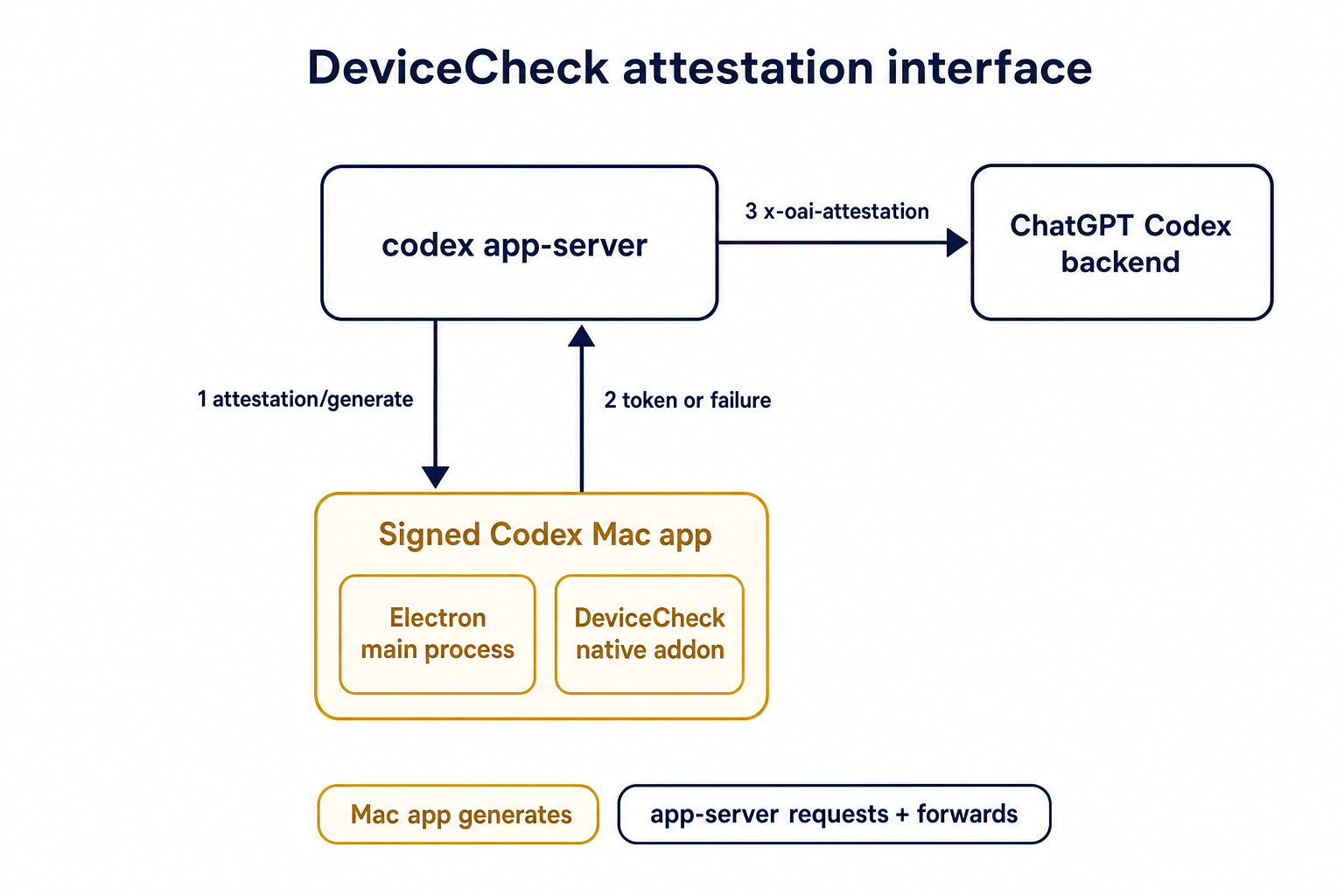
## Details
This PR teaches the Codex app-server runtime how to request and attach
an attestation token. It does not generate DeviceCheck tokens directly;
instead, it relies on the connected desktop app to advertise that it can
generate attestation and then asks that app for a fresh header value
when needed.
The flow is:
1. The Codex desktop app connects to app-server.
2. During `initialize`, the app can advertise that it supports
`requestAttestation`.
3. Before app-server calls selected ChatGPT Codex endpoints, it sends
the internal server request `attestation/generate` to the app.
4. app-server receives a pre-encoded header value back.
5. app-server forwards that value as `x-oai-attestation` on the scoped
outbound requests.
The code in this repo is mostly protocol and runtime plumbing: it adds
the app-server request/response shape, introduces an attestation
provider in core, wires that provider into Responses / compaction /
realtime setup paths, and covers the intended scoping with tests. The
signed macOS DeviceCheck generation remains owned by the desktop app PR.
## Related PR
- Codex desktop app implementation:
https://github.com/openai/openai/pull/878649
## Validation
<details>
<summary>Tests run</summary>
```sh
cargo test -p codex-app-server-protocol
cargo test -p codex-core attestation --lib
cargo test -p codex-app-server --lib attestation
```
Also ran:
```sh
just fix -p codex-core
just fix -p codex-app-server
just fix -p codex-app-server-protocol
just fmt
just write-app-server-schema
```
</details>
<details>
<summary>E2E DeviceCheck validation</summary>
First validated the signed desktop app boundary directly: launched a
packaged signed `Codex.app`, sent `attestation/generate`, decoded the
returned `v1.` attestation header, and validated the extracted
DeviceCheck token with `personal/jm/verify_devicecheck_token.py` using
bundle ID `com.openai.codex`. Apple returned `status_code: 200` and
`is_ok: true`.
Then ran the fuller app + app-server flow. The packaged `Codex.app`
launched a current-branch app-server via `CODEX_CLI_PATH`, and a local
MITM proxy intercepted outbound `chatgpt.com` traffic. The app-server
requested `attestation/generate` from the real Electron app process, and
the intercepted `/backend-api/codex/responses` traffic included
`x-oai-attestation` on both routes:
```text
GET /backend-api/codex/responses Upgrade: websocket x-oai-attestation: present
POST /backend-api/codex/responses Upgrade: none x-oai-attestation: present
```
The captured header decoded to a DeviceCheck token that also validated
with Apple for `com.openai.codex` (`status_code: 200`, `is_ok: true`,
team `2DC432GLL2`).
</details>
---------
Co-authored-by: Codex <noreply@openai.com>
* Pass installation ID for storage on enrollments server for
deduping/grouping multiple appservers per installation
* Pass installation ID in remoteControl/status/changed events
Requires discoverability on plugin/share/updateTargets so the server can
manage workspace link access consistently, including auto-adding the
workspace principal for UNLISTED.

Also rejects LISTED on share creation and blocks client-supplied
workspace principals while preserving response parsing for LISTED.
## Summary
- Remove `perCwdExtraUserRoots` / `SkillsListExtraRootsForCwd` from the
`skills/list` app-server API.
- Drop Rust app-server and `codex-core-skills` extra-root plumbing so
skill scans are keyed by the normal cwd/user/plugin roots only.
- Regenerate app-server schemas and update docs/tests that only existed
for the removed extra-roots behavior.

## Validation
- `just write-app-server-schema`
- `just fmt`
- `cargo test -p codex-app-server-protocol`
- `cargo test -p codex-core-skills`
- `just fix -p codex-app-server-protocol`
- `just fix -p codex-core-skills`
- `just fix -p codex-app-server`
- `just fix -p codex-tui`

## Notes
- `cargo test -p codex-app-server --test all skills_list` ran the edited
skills-list cases, but the full filtered run ended on existing
`skills_changed_notification_is_emitted_after_skill_change` timeout
after a websocket `401`.
- `cargo test -p codex-tui --lib` compiled the changed TUI callers, then
failed two unrelated status permission tests because local
`/etc/codex/requirements.toml` forbids `DangerFullAccess`.
- Source-truth check found the OpenAI monorepo still has
generated/app-server-kit mirror references to the removed field; those
should be cleaned up when generated app-server types are synced or in a
companion OpenAI cleanup.
## Why

We want terminal tool review analytics, but the reducer should not stamp
review timing from its own wall clock.

This PR plumbs review timing through the real protocol and app-server
seams so downstream analytics can consume the emitter's timestamps
directly. Guardian reviews keep their enriched `started_at` /
`completed_at` analytics fields by deriving those legacy second-based
values from the same protocol-native millisecond lifecycle timestamps,
rather than sampling a separate analytics clock.

## What changed

- add `started_at_ms` to user approval request payloads
- add `started_at_ms` / `completed_at_ms` to guardian review
notifications
- preserve Guardian review `started_at` / `completed_at` enrichment from
the protocol-native timing source
- stamp typed `ServerResponse` analytics facts with app-server-observed
`completed_at_ms`
- thread the new timing fields through core, protocol, app-server, TUI,
and analytics fixtures

## Verification

- `cargo test -p codex-app-server outgoing_message --manifest-path
codex-rs/Cargo.toml`
- `cargo test -p codex-app-server-protocol guardian --manifest-path
codex-rs/Cargo.toml`
- `cargo test -p codex-tui guardian --manifest-path codex-rs/Cargo.toml`
- `cargo test -p codex-analytics analytics_client_tests --manifest-path
codex-rs/Cargo.toml`

---
[//]: # (BEGIN SAPLING FOOTER)
Stack created with [Sapling](https://sapling-scm.com). Best reviewed
with [ReviewStack](https://reviewstack.dev/openai/codex/pull/21434).
* #18748
* __->__ #21434
* #18747
* #17090
* #17089
* #20514
## Why
The goal of this PR is to align on app-server and `ThreadStore` API
updates for paginating through large threads.


#### app-server
##### `thread/turns/list`
- Updates `thread/turns/list` to support `itemsView?: "notLoaded" |
"summary" | "full" | null`, defaulting to `summary`.
- Implements the current `thread/turns/list` behavior over the existing
persisted rollout-history fallback:
  - `notLoaded` returns turn envelopes with empty `items`.
- `summary` returns the first user message and final assistant message
when available.
  - `full` preserves the existing full item behavior.

Note that this method still uses the naive approach of loading the
entire rollout file, and returns just the filtered slice of the data.
Real pagination will come later by leveraging SQLite.

##### `thread/turns/items/list`
- Adds the experimental `thread/turns/items/list` protocol, schema,
dispatcher, and processor stub. The app-server currently returns
JSON-RPC `-32601` with `thread/turns/items/list is not supported yet`.

#### ThreadStore
- Adds the experimental `thread/turns/items/list` protocol, schema,
dispatcher, and processor stub. The app-server currently returns
JSON-RPC `-32601` with `thread/turns/items/list is not supported yet`.
- Adds `ThreadStore` contract types and stubbed methods for listing
thread turns and listing items within a turn.
- Adds a typed `StoredTurnStatus` and `StoredTurnError` to avoid baking
app-server API enums or lossy string status values into the store-facing
turn contract.
- Adds a typed `StoredTurnStatus` and `StoredTurnError` to avoid baking
app-server API enums or lossy string status values into the store-facing
turn contract.

This also sketches the storage abstraction we expect to need once turns
are indexed/stored. In particular, `notLoaded` is useful only if
ThreadStore can eventually list turn metadata without loading every
persisted item for each turn.

## Validation

- Added/updated protocol serialization coverage for the new request and
response shapes.
- Added app-server integration coverage for `thread/turns/list` default
summary behavior and all three `itemsView` modes.
- Added app-server integration coverage that `thread/turns/items/list`
returns the expected unsupported JSON-RPC error when experimental APIs
are enabled.
- Added thread-store coverage that the default trait methods return
`ThreadStoreError::Unsupported`.

No developers.openai.com documentation update is needed for this
internal experimental app-server API surface.

