## Summary

Remote clients can still receive large `thread/resume` histories when
prior turns include MCP tool call payloads or image-generation results.
This adds a temporary response-only redaction path for the known remote
client names.

Longer term we will move towards fully paginated APIs backed by SQLite.

## Changes

- Redact MCP tool call payload-bearing fields in `thread/resume`
responses for `codex_chatgpt_android_remote` and
`codex_chatgpt_ios_remote`.
- Drop `imageGeneration` items from those `thread/resume` responses.
- Keep redaction out of persisted rollout files, `thread/read`,
`thread/turns/list`, live notifications, and token usage replay.
- Cover the behavior with app-server helper tests and a v2 resume
integration test that checks both remote clients plus a non-target
control client.

## Testing

- `cargo test -p codex-app-server thread_resume_redaction`
- `cargo test -p codex-app-server
thread_resume_redacts_payloads_for_chatgpt_remote_clients`
## Summary
- add SQLite init, backfill-gate, and fallback telemetry without
introducing a cross-cutting state-db access wrapper
- install one process-scoped telemetry sink after OTEL startup and let
low-level state/rollout paths emit through it directly
- add process-start metrics for the process owners that initialize
SQLite

---------

Co-authored-by: Owen Lin <owen@openai.com>
## Why

PR #21460 reverted the earlier move of skills change watching from
`codex-core` into app-server. This reapplies that boundary change so
app-server owns client-facing `skills/changed` notifications and core no
longer carries the watcher.

## What

- Restore the app-server `SkillsWatcher` and register it from thread
listener setup.
- Remove the core-owned skills watcher and its core live-reload
integration surface.
- Restore app-server coverage for `skills/changed` notifications after a
watched skill file changes.

## Validation

- `cargo test -p codex-app-server --test all
suite::v2::skills_list::skills_changed_notification_is_emitted_after_skill_change
-- --exact --nocapture`
- `cargo test -p codex-core --lib --no-run`
## Summary

Support registry-backed remote executors end to end so downstream
services can resolve an executor id into an exec-server URL and make
that environment available to Codex without relying on the legacy cloud
environments flow.

## What changed

- switch remote executor registration to the executor registry bootstrap
contract
- allow named remote environments to be inserted into
`EnvironmentManager` at runtime
- add the experimental app-server RPC `environment/add` so initialized
experimental clients can register those remote environments for later
`thread/start` and `turn/start` selection

## Validation

Ran focused validation locally:
- `cargo test -p codex-exec-server environment_manager_`
- `cargo test -p codex-exec-server
register_executor_posts_with_bearer_token_header`
- `cargo test -p codex-app-server-protocol`
## Summary
TL;DR: teaches `codex-rs` / app-server to request a desktop-provided
attestation token and attach it as `x-oai-attestation` on the scoped
ChatGPT Codex request paths.
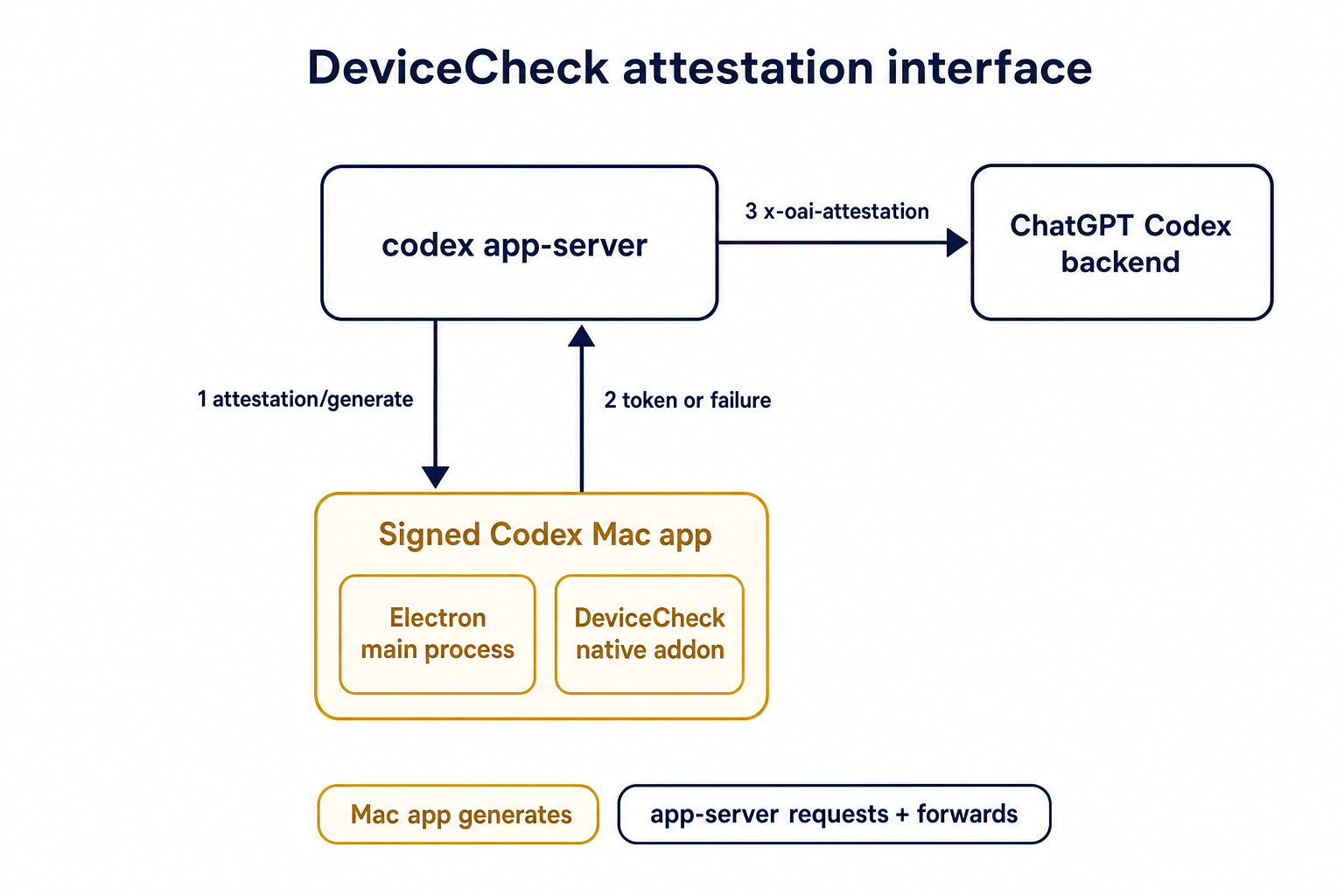
## Details
This PR teaches the Codex app-server runtime how to request and attach
an attestation token. It does not generate DeviceCheck tokens directly;
instead, it relies on the connected desktop app to advertise that it can
generate attestation and then asks that app for a fresh header value
when needed.
The flow is:
1. The Codex desktop app connects to app-server.
2. During `initialize`, the app can advertise that it supports
`requestAttestation`.
3. Before app-server calls selected ChatGPT Codex endpoints, it sends
the internal server request `attestation/generate` to the app.
4. app-server receives a pre-encoded header value back.
5. app-server forwards that value as `x-oai-attestation` on the scoped
outbound requests.
The code in this repo is mostly protocol and runtime plumbing: it adds
the app-server request/response shape, introduces an attestation
provider in core, wires that provider into Responses / compaction /
realtime setup paths, and covers the intended scoping with tests. The
signed macOS DeviceCheck generation remains owned by the desktop app PR.
## Related PR
- Codex desktop app implementation:
https://github.com/openai/openai/pull/878649
## Validation
<details>
<summary>Tests run</summary>
```sh
cargo test -p codex-app-server-protocol
cargo test -p codex-core attestation --lib
cargo test -p codex-app-server --lib attestation
```
Also ran:
```sh
just fix -p codex-core
just fix -p codex-app-server
just fix -p codex-app-server-protocol
just fmt
just write-app-server-schema
```
</details>
<details>
<summary>E2E DeviceCheck validation</summary>
First validated the signed desktop app boundary directly: launched a
packaged signed `Codex.app`, sent `attestation/generate`, decoded the
returned `v1.` attestation header, and validated the extracted
DeviceCheck token with `personal/jm/verify_devicecheck_token.py` using
bundle ID `com.openai.codex`. Apple returned `status_code: 200` and
`is_ok: true`.
Then ran the fuller app + app-server flow. The packaged `Codex.app`
launched a current-branch app-server via `CODEX_CLI_PATH`, and a local
MITM proxy intercepted outbound `chatgpt.com` traffic. The app-server
requested `attestation/generate` from the real Electron app process, and
the intercepted `/backend-api/codex/responses` traffic included
`x-oai-attestation` on both routes:
```text
GET /backend-api/codex/responses Upgrade: websocket x-oai-attestation: present
POST /backend-api/codex/responses Upgrade: none x-oai-attestation: present
```
The captured header decoded to a DeviceCheck token that also validated
with Apple for `com.openai.codex` (`status_code: 200`, `is_ok: true`,
team `2DC432GLL2`).
</details>
---------
Co-authored-by: Codex <noreply@openai.com>
Requires discoverability on plugin/share/updateTargets so the server can
manage workspace link access consistently, including auto-adding the
workspace principal for UNLISTED.

Also rejects LISTED on share creation and blocks client-supplied
workspace principals while preserving response parsing for LISTED.
## Why
The goal of this PR is to align on app-server and `ThreadStore` API
updates for paginating through large threads.


#### app-server
##### `thread/turns/list`
- Updates `thread/turns/list` to support `itemsView?: "notLoaded" |
"summary" | "full" | null`, defaulting to `summary`.
- Implements the current `thread/turns/list` behavior over the existing
persisted rollout-history fallback:
  - `notLoaded` returns turn envelopes with empty `items`.
- `summary` returns the first user message and final assistant message
when available.
  - `full` preserves the existing full item behavior.

Note that this method still uses the naive approach of loading the
entire rollout file, and returns just the filtered slice of the data.
Real pagination will come later by leveraging SQLite.

##### `thread/turns/items/list`
- Adds the experimental `thread/turns/items/list` protocol, schema,
dispatcher, and processor stub. The app-server currently returns
JSON-RPC `-32601` with `thread/turns/items/list is not supported yet`.

#### ThreadStore
- Adds the experimental `thread/turns/items/list` protocol, schema,
dispatcher, and processor stub. The app-server currently returns
JSON-RPC `-32601` with `thread/turns/items/list is not supported yet`.
- Adds `ThreadStore` contract types and stubbed methods for listing
thread turns and listing items within a turn.
- Adds a typed `StoredTurnStatus` and `StoredTurnError` to avoid baking
app-server API enums or lossy string status values into the store-facing
turn contract.
- Adds a typed `StoredTurnStatus` and `StoredTurnError` to avoid baking
app-server API enums or lossy string status values into the store-facing
turn contract.

This also sketches the storage abstraction we expect to need once turns
are indexed/stored. In particular, `notLoaded` is useful only if
ThreadStore can eventually list turn metadata without loading every
persisted item for each turn.

## Validation

- Added/updated protocol serialization coverage for the new request and
response shapes.
- Added app-server integration coverage for `thread/turns/list` default
summary behavior and all three `itemsView` modes.
- Added app-server integration coverage that `thread/turns/items/list`
returns the expected unsupported JSON-RPC error when experimental APIs
are enabled.
- Added thread-store coverage that the default trait methods return
`ThreadStoreError::Unsupported`.

No developers.openai.com documentation update is needed for this
internal experimental app-server API surface.
## Summary

Fix `getConversationSummary` so thread-id summaries work for stored
threads that do not have a local rollout path, such as remote thread
stores.

The root cause was that `summary_from_stored_thread` returned `None`
when `StoredThread.rollout_path` was absent, and
`get_thread_summary_response_inner` treated that as an internal error.
This made conversation-id lookups depend on a local-only field even
though the thread store can address the thread by id.
- Route live thread renames through `ThreadStore` metadata updates.
- Read resumed thread names from store metadata with legacy local
fallback preserved in the store.
Adds marketplaceKinds to plugin/list for local, workspace-directory, and
shared-with-me; omitted params keep default local plus gated global
behavior, while explicit kinds are exact.

Exposes shareContext on plugin summaries from local share mappings and
remote workspace/shared responses, including remotePluginId and nullable
creator metadata.

Adds shared-with-me listing through /ps/plugins/workspace/shared,
renames the workspace remote namespace to workspace-directory, and keeps
direct remote read/share/install/update/delete paths gated by plugins
rather than remote_plugin.
## Why

Skills update notifications are app-server API behavior, but the watcher
lived in `codex-core` and surfaced through
`EventMsg::SkillsUpdateAvailable`. Moving the watcher out keeps core
focused on thread execution and lets app-server own both cache
invalidation and the `skills/changed` notification.

## What changed

- Added an app-server-owned skills watcher that watches local skill
roots, clears the shared skills cache, and emits `skills/changed`
directly.
- Registers skill watches from the common app-server thread listener
attach path, including direct starts, resumes, and app-server-observed
child or forked threads.
- Stores the `WatchRegistration` on `ThreadState`, so listener
replacement, thread teardown, idle unload, and app-server shutdown
deregister by dropping the RAII guard.
- Removed `EventMsg::SkillsUpdateAvailable`, the core watcher, and the
old core live-reload test.
- Extended the app-server skills change test to verify a cached skills
list is refreshed after a filesystem change without forcing reload.

## Validation

- `cargo check -p codex-core -p codex-app-server -p codex-mcp-server -p
codex-rollout -p codex-rollout-trace`
- `cargo test -p codex-app-server
skills_changed_notification_is_emitted_after_skill_change`
# Overview
MCP refreshes were rebuilding active threads from fresh disk-backed
config only, which dropped thread-start session overlays such as
app-injected MCP servers. This keeps refreshes current with disk config
while preserving the thread-local config that only the active thread
knows about.

# Changes
- Rebuild refreshed config per active thread using that thread's current
`cwd`, rather than fanning out one app-server config to every thread.
- Preserve each thread's `SessionFlags` layer while replacing reloadable
config layers with freshly loaded config, then derive the MCP refresh
payload from the rebuilt result.
- Move MCP refresh orchestration into app-server so manual refreshes
fail loudly while background refreshes remain best-effort, and route
plugin-triggered refreshes through the same per-thread reload path.
- Add regression coverage for session overlays, fresh project config,
plugin-derived MCP config, current requirements, and strict vs
best-effort refresh behavior.

# Verification
- Passed focused Rust coverage for the thread-config rebuild behavior
and deferred MCP refresh flow, plus `cargo test -p codex-app-server
--lib`.
- Verified end to end in the Codex dev app against the locally built
CLI: registered an MCP via thread config, verified that it could be used
successfully before refresh, manually triggered MCP refresh, and
verified that it continued to be available afterward.
Extends `plugin/share/save` to accept optional discoverability and
shareTargets while uploading plugin contents, and adds
`plugin/share/updateTargets` for share-only target updates without
re-uploading.
## Why

`Turn.items` currently overloads an empty array to mean either that no
items exist or that the server intentionally did not load them for this
response. That ambiguity blocks future lazy-loading work where clients
need to distinguish unloaded, summary, and fully hydrated turn payloads.

## What changed

- add a new `TurnItemsView` enum with `notLoaded`, `summary`, and `full`
variants
- add required `itemsView` metadata to app-server `Turn` payloads
- mark reconstructed persisted history as `full` and live shell-style
turn payloads as `notLoaded`
- keep current `thread/turns/list` behavior unchanged and document that
it still returns `full` turns today
- regenerate the JSON and TypeScript protocol fixtures

## Verification

- `just write-app-server-schema`
- `cargo test -p codex-app-server-protocol`
- `cargo test -p codex-app-server thread_read_can_include_turns`
- `cargo test -p codex-app-server
thread_turns_list_can_page_backward_and_forward`
- `cargo test -p codex-app-server
thread_resume_rejects_history_when_thread_is_running`
- `just fix -p codex-app-server-protocol`
- `just fix -p codex-app-server`
- `just fmt`
## Why

App-server had repeated hand-built JSON-RPC error objects for standard
error shapes. Using the shared helpers keeps the common
`invalid_request`, `invalid_params`, and `internal_error` construction
in one place and reduces the chance of new call sites drifting from the
common error payload shape.

## What changed

- Replaced manual standard JSON-RPC error object creation with
`internal_error(...)`, `invalid_request(...)`, and `invalid_params(...)`
across app-server request processors and runtime paths.
- Removed local duplicate helper definitions from search and review
request handling.
- Preserved existing structured `data` payloads by creating the shared
helper error first and then attaching the existing metadata.
- Left custom non-standard errors and raw error-code assertions intact.

## Validation

- `cargo test -p codex-app-server`
## Why

Taking a step to removing the `persistExtendedHistory` field. It's not
scalable to be persisting so much data in the rollout file and returning
it in the thread history.

When a client explicitly sends `true`, the server now tells that client
the parameter is deprecated and ignored so the caller has a clear
migration signal via the `deprecationNotice` notification.

## What changed

- Keep the `persist_extended_history` / `persistExtendedHistory` field
in the v2 protocol for compatibility, but document it as deprecated and
ignored.
- Ignore the parameter in app-server `thread/start`, `thread/resume`,
and `thread/fork`; those paths always use limited history persistence
now.
- Stop treating `persistExtendedHistory` as a running-thread resume
override mismatch.
- Emit a connection-scoped `deprecationNotice` when a request explicitly
sets `persist_extended_history: true`.

## Verification

- Added `thread_start_deprecates_persist_extended_history_true` to cover
the deprecation notice.
- `cargo test -p codex-app-server`
- `cargo test -p codex-app-server-protocol`
## Why

The desktop app on Windows needs a read-only way to tell, before the
next tool call, whether the local Windows sandbox setup is in a state
that should block the user and ask for setup again.

The main case we want to cover is the elevated sandbox setup version
bump. Today, if the app is configured for elevated Windows sandboxing
and the installed setup is stale, the next sandboxed shell/exec path can
end up triggering the elevated setup flow directly. That means the user
can see an unexpected UAC prompt with no UI explanation.

This change adds a small app-server preflight so the desktop app can ask
“is Windows sandbox ready, not configured, or update-required?” during
startup and show the appropriate blocking UI before the user hits a tool
call.

## What changed

- Added a new read-only app-server RPC: `windowsSandbox/readiness`
- Added a new protocol enum and response type:
  - `WindowsSandboxReadiness`
  - `WindowsSandboxReadinessResponse`
- Added core readiness logic in `core/src/windows_sandbox.rs`:
  - `ready`
  - `notConfigured`
  - `updateRequired`
- Wired the new request through `codex_message_processor`
- Regenerated the vendored app-server schema fixtures

## Readiness semantics

This is intentionally a coarse startup/version-bump readiness check, not
a full predictor of every runtime repair case.

For now, readiness is determined from:
- the configured Windows sandbox level
- `sandbox_setup_is_complete()` for elevated mode

That means:
- `disabled` maps to `notConfigured`
- `restricted token` maps to `ready`
- `elevated` maps to `ready` or `updateRequired` depending on
`sandbox_setup_is_complete()`

This is deliberate for the first UI integration because the common case
we want to catch is “the app updated, the elevated setup version bumped,
and the user should see an update-required blocker instead of a surprise
UAC prompt”.

It does not attempt to model every case where the deeper runtime path
might decide to repair or re-run setup.

## Testing

- Ran `cargo fmt --all -- app-server-protocol/src/protocol/common.rs
app-server-protocol/src/protocol/v2.rs
app-server/src/codex_message_processor.rs core/src/windows_sandbox.rs
core/src/windows_sandbox_tests.rs`
- Added unit tests for the pure readiness mapping in
`core/src/windows_sandbox_tests.rs`
- Regenerated vendored schema fixtures with `cargo run -p
codex-app-server-protocol --bin write_schema_fixtures -- --schema-root
app-server-protocol/schema`
- Did not run the full cargo test suite
## Why

Adding goal metrics makes it possible to track how often goals are
created, completed, and stopped by budget limits, plus the final token
and wall-clock usage for terminal outcomes.

## What Changed

- Added OpenTelemetry metric constants for goal lifecycle tracking:
- `codex.goal.created`: increments each time a new persisted goal is
created or an existing goal is replaced with a new objective.
- `codex.goal.completed`: increments when a goal transitions to
`complete`.
- `codex.goal.budget_limited`: increments when a goal transitions to
`budget_limited` because its token budget has been reached.
- `codex.goal.token_count`: records the final persisted token count when
a goal transitions to `complete` or `budget_limited`.
- `codex.goal.duration_s`: records the final persisted elapsed
wall-clock time, in seconds, when a goal transitions to `complete` or
`budget_limited`.
- Emitted creation metrics when a goal is created or replaced.
- Emitted terminal outcome counters and final usage histograms when a
goal transitions to `complete` or `budget_limited`, avoiding
double-counting later in-flight accounting for already budget-limited
goals.
- Added focused `codex-core` tests for create/complete metrics and
one-time budget-limit metrics.
Migrate token usage replay, rollback responses, and detached review
setup (a special case of forking) to be served from ThreadStore reads
rather direct rollout files.

- replay restored token usage from already-loaded `RolloutItem` history
instead of reopening `Thread.path`
- rebuild rollback responses from loaded `ThreadStore` snapshots and
history
- start detached reviews from store-backed parent history and stored
review-thread metadata
- remove obsolete app-server rollout-summary helper code that became
dead after the store-backed migration
- preserve response/notification ordering for resume, fork, rollback,
and detached review flows
- add integration test coverage for the affected paths
- Route `thread/metadata/update` through
`ThreadStore::update_thread_metadata`.
- Add `LocalThreadStore` git metadata patch support for set, partial
update, and clear semantics.
- Add some unit tests for the new thread store code
- Remove a lot of dead code/tests!
## Why

App-server clients sometimes need argv-based local process execution
while sandbox policy is controlled outside Codex. Those environments can
reject sandbox-disabling paths before a command ever starts, even when
the caller intentionally wants unsandboxed execution.

This PR adds a distinct `process/*` API for that use case instead of
extending `command/exec` with another sandbox-disabling shape. Keeping
the new surface separate also makes the future removal of `command/exec`
simpler: clients that need explicit process lifecycle control can move
to the newer handle-based API without depending on `command/exec`
business logic.

## What changed

- Added v2 process lifecycle methods: `process/spawn`,
`process/writeStdin`, `process/resizePty`, and `process/kill`.
- Added process notifications: `process/outputDelta` for streamed
stdout/stderr chunks and `process/exited` for final exit status and
buffered output.
- Made `process/spawn` intentionally unsandboxed and omitted
sandbox-selection fields such as `sandboxPolicy` and
`permissionProfile`.
- Added client-supplied, connection-scoped `processHandle` values for
follow-up control requests and notification routing.
- Supported cwd, environment overrides, PTY mode and size, stdin
streaming, stdout/stderr streaming, per-stream output caps, and timeout
controls.
- Killed active process sessions when the originating app-server
connection closes.
- Wired the implementation through the modular `request_processors/`
app-server layout, with process-handle request serialization for
follow-up control calls.
- Updated generated JSON/TypeScript schema fixtures and documented the
new API in `codex-rs/app-server/README.md`.
- Added v2 app-server integration coverage in
`codex-rs/app-server/tests/suite/v2/process_exec.rs` for spawn
acknowledgement before exit, buffered output caps, and process
termination.

## Verification

- `cargo test -p codex-app-server-protocol`
- `cargo test -p codex-app-server`

---------

Co-authored-by: Owen Lin <owen@openai.com>
## Why

SQLite state was still being opened from consumer paths, including lazy
`OnceCell`-backed thread-store call sites. That let one process
construct multiple state DB connections for the same Codex home, which
makes SQLite lock contention and `database is locked` failures much
easier to hit.

State DB lifetime should be chosen by main-like entrypoints and tests,
then passed through explicitly. Consumers should use the supplied
`Option<StateDbHandle>` or `StateDbHandle` and keep their existing
filesystem fallback or error behavior when no handle is available.

The startup path also needs to keep the rollout crate in charge of
SQLite state initialization. Opening `codex_state::StateRuntime`
directly bypasses rollout metadata backfill, so entrypoints should
initialize through `codex_rollout::state_db` and receive a handle only
after required rollout backfills have completed.

## What Changed

- Initialize the state DB in main-like entrypoints for CLI, TUI,
app-server, exec, MCP server, and the thread-manager sample.
- Pass `Option<StateDbHandle>` through `ThreadManager`,
`LocalThreadStore`, app-server processors, TUI app wiring, rollout
listing/recording, personality migration, shell snapshot cleanup,
session-name lookup, and memory/device-key consumers.
- Remove the lazy local state DB wrapper from the thread store so
non-test consumers use only the supplied handle or their existing
fallback path.
- Make `codex_rollout::state_db::init` the local state startup path: it
opens/migrates SQLite, runs rollout metadata backfill when needed, waits
for concurrent backfill workers up to a bounded timeout, verifies
completion, and then returns the initialized handle.
- Keep optional/non-owning SQLite helpers, such as remote TUI local
reads, as open-only paths that do not run startup backfill.
- Switch app-server startup from direct
`codex_state::StateRuntime::init` to the rollout state initializer so
app-server cannot skip rollout backfill.
- Collapse split rollout lookup/list APIs so callers use the normal
methods with an optional state handle instead of `_with_state_db`
variants.
- Restore `getConversationSummary(ThreadId)` to delegate through
`ThreadStore::read_thread` instead of a LocalThreadStore-specific
rollout path special case.
- Keep DB-backed rollout path lookup keyed on the DB row and file
existence, without imposing the filesystem filename convention on
existing DB rows.
- Verify readable DB-backed rollout paths against `session_meta.id`
before returning them, so a stale SQLite row that points at another
thread's JSONL falls back to filesystem search and read-repairs the DB
row.
- Keep `debug prompt-input` filesystem-only so a one-off debug command
does not initialize or backfill SQLite state just to print prompt input.
- Keep goal-session test Codex homes alive only in the goal-specific
helper, rather than leaking tempdirs from the shared session test
helper.
- Update tests and call sites to pass explicit state handles where DB
behavior is expected and explicit `None` where filesystem-only behavior
is intended.

## Validation

- `CARGO_TARGET_DIR=/tmp/codex-target-state-db cargo check -p
codex-rollout -p codex-thread-store -p codex-app-server -p codex-core -p
codex-tui -p codex-exec -p codex-cli --tests`
- `CARGO_TARGET_DIR=/tmp/codex-target-state-db cargo test -p
codex-rollout state_db_`
- `CARGO_TARGET_DIR=/tmp/codex-target-state-db cargo test -p
codex-rollout find_thread_path`
- `CARGO_TARGET_DIR=/tmp/codex-target-state-db cargo test -p
codex-rollout find_thread_path -- --nocapture`
- `CARGO_TARGET_DIR=/tmp/codex-target-state-db cargo test -p
codex-rollout try_init_ -- --nocapture`
- `CARGO_TARGET_DIR=/tmp/codex-target-state-db cargo test -p
codex-rollout`
- `CARGO_TARGET_DIR=/tmp/codex-target-state-db cargo clippy -p
codex-rollout --lib -- -D warnings`
- `CARGO_TARGET_DIR=/tmp/codex-target-state-db cargo test -p
codex-thread-store
read_thread_falls_back_when_sqlite_path_points_to_another_thread --
--nocapture`
- `CARGO_TARGET_DIR=/tmp/codex-target-state-db cargo test -p
codex-thread-store`
- `CARGO_TARGET_DIR=/tmp/codex-target-state-db cargo test -p codex-core
shell_snapshot`
- `CARGO_TARGET_DIR=/tmp/codex-target-state-db cargo test -p codex-core
--test all personality_migration`
- `CARGO_TARGET_DIR=/tmp/codex-target-state-db cargo test -p codex-core
--test all rollout_list_find`
- `RUST_MIN_STACK=8388608 CODEX_SKIP_VENDORED_BWRAP=1
CARGO_TARGET_DIR=/tmp/codex-target-state-db cargo test -p codex-core
--test all rollout_list_find::find_prefers_sqlite_path_by_id --
--nocapture`
- `RUST_MIN_STACK=8388608 CODEX_SKIP_VENDORED_BWRAP=1
CARGO_TARGET_DIR=/tmp/codex-target-state-db cargo test -p codex-core
--test all rollout_list_find -- --nocapture`
- `CARGO_TARGET_DIR=/tmp/codex-target-state-db cargo test -p codex-core
interrupt_accounts_active_goal_before_pausing`
- `CARGO_TARGET_DIR=/tmp/codex-target-state-db cargo test -p
codex-app-server get_auth_status -- --test-threads=1`
- `CODEX_SKIP_VENDORED_BWRAP=1
CARGO_TARGET_DIR=/tmp/codex-target-state-db cargo test -p
codex-app-server --lib`
- `CODEX_SKIP_VENDORED_BWRAP=1
CARGO_TARGET_DIR=/tmp/codex-target-state-db cargo check -p codex-rollout
-p codex-app-server --tests`
- `CARGO_TARGET_DIR=/tmp/codex-target-state-db just fix -p codex-rollout
-p codex-thread-store -p codex-core -p codex-app-server -p codex-tui -p
codex-exec -p codex-cli`
- `CODEX_SKIP_VENDORED_BWRAP=1
CARGO_TARGET_DIR=/tmp/codex-target-state-db just fix -p codex-rollout -p
codex-app-server`
- `CARGO_TARGET_DIR=/tmp/codex-target-state-db just fix -p
codex-rollout`
- `CODEX_SKIP_VENDORED_BWRAP=1
CARGO_TARGET_DIR=/tmp/codex-target-state-db just fix -p codex-core`
- `just argument-comment-lint -p codex-core`
- `just argument-comment-lint -p codex-rollout`

Focused coverage added in `codex-rollout`:

- `recorder::tests::state_db_init_backfills_before_returning` verifies
the rollout metadata row exists before startup init returns.
- `state_db::tests::try_init_waits_for_concurrent_startup_backfill`
verifies startup waits for another worker to finish backfill instead of
disabling the handle for the process.
-
`state_db::tests::try_init_times_out_waiting_for_stuck_startup_backfill`
verifies startup does not hang indefinitely on a stuck backfill lease.
-
`tests::find_thread_path_accepts_existing_state_db_path_without_canonical_filename`
verifies DB-backed lookup accepts valid existing rollout paths even when
the filename does not include the thread UUID.
-
`tests::find_thread_path_falls_back_when_db_path_points_to_another_thread`
verifies DB-backed lookup ignores a stale row whose existing path
belongs to another thread and read-repairs the row after filesystem
fallback.

Focused coverage updated in `codex-core`:

- `rollout_list_find::find_prefers_sqlite_path_by_id` now uses a
DB-preferred rollout file with matching `session_meta.id`, so it still
verifies that valid SQLite paths win without depending on stale/empty
rollout contents.

`cargo test -p codex-app-server thread_list_respects_search_term_filter
-- --test-threads=1 --nocapture` was attempted locally but timed out
waiting for the app-server test harness `initialize` response before
reaching the changed thread-list code path.

`bazel test //codex-rs/thread-store:thread-store-unit-tests
--test_output=errors` was attempted locally after the thread-store fix,
but this container failed before target analysis while fetching `v8+`
through BuildBuddy/direct GitHub. The equivalent local crate coverage,
including `cargo test -p codex-thread-store`, passes.

A plain local `cargo check -p codex-rollout -p codex-app-server --tests`
also requires system `libcap.pc` for `codex-linux-sandbox`; the
follow-up app-server check above used `CODEX_SKIP_VENDORED_BWRAP=1` in
this container.
## Why

Whenever we return a thread's history (turns and items) over app-server,
always return the limited form as specified by the rollout policy
`EventPersistenceMode::Limited`, even if the thread was previously
started with `EventPersistenceMode::Extended`.

We're finding it is quite unscalable to be returning the extended
history, so let's apply the same filtering logic of the rollout policy
when we load and return the thread's history.

## What Changed

- Reuse the rollout persistence policy when reconstructing app-server
`ThreadItem` history so only `EventPersistenceMode::Limited` rollout
items are replayed into API turns.
- Route `thread/read`, `thread/resume`, `thread/fork`,
`thread/turns/list`, and rollback responses through the same filtered
app-server history projection.
- Keep live active turns intact when composing a response for a
currently running thread.
- Update command execution coverage so persisted extended command events
are excluded from returned history for `thread/read`, `thread/fork`, and
`thread/turns/list`.

## Test Plan

- `cargo test -p codex-app-server limited`
- `cargo test -p codex-app-server thread_shell_command`
- `cargo test -p codex-app-server thread_read`
- `cargo test -p codex-app-server thread_rollback`
- `cargo test -p codex-app-server thread_fork`
- `cargo test -p codex-app-server-protocol`
## Why

The app-server request path had grown around a large
`CodexMessageProcessor` plus separate API wrapper/helper modules. That
made the dependency graph hard to see and forced unrelated request
families to share broad processor state.

This PR makes the split mechanical and command-prefix oriented so
request families own only the dependencies they use.

## What changed

- Replaced `CodexMessageProcessor` with command-prefix request
processors under `app-server/src/request_processors/`.
- Removed the old config, device-key, external-agent-config, and fs API
wrapper files by moving their API handling into processors.
- Split apps, plugins, marketplace, catalog, account, MCP, command exec,
fs, git, feedback, thread, turn, thread goals, and Windows sandbox
handling into dedicated processors.
- Kept shared lifecycle, summary conversion, token usage replay, and
shared error mapping only where multiple processors use them; single-use
helpers were inlined into their owning processor.
- Removed the fallback processor path and moved processor tests to
`_tests` files.

## Validation

- `cargo test -p codex-app-server`
- `cargo check -p codex-app-server`
- `just fix -p codex-app-server`

