## Summary

Remote clients can still receive large `thread/resume` histories when
prior turns include MCP tool call payloads or image-generation results.
This adds a temporary response-only redaction path for the known remote
client names.

Longer term we will move towards fully paginated APIs backed by SQLite.

## Changes

- Redact MCP tool call payload-bearing fields in `thread/resume`
responses for `codex_chatgpt_android_remote` and
`codex_chatgpt_ios_remote`.
- Drop `imageGeneration` items from those `thread/resume` responses.
- Keep redaction out of persisted rollout files, `thread/read`,
`thread/turns/list`, live notifications, and token usage replay.
- Cover the behavior with app-server helper tests and a v2 resume
integration test that checks both remote clients plus a non-target
control client.

## Testing

- `cargo test -p codex-app-server thread_resume_redaction`
- `cargo test -p codex-app-server
thread_resume_redacts_payloads_for_chatgpt_remote_clients`
## Why

The app-server watcher relocation leaves the generic filesystem watcher
as the last watcher-specific implementation still living inside
`codex-core`. Moving that code to a small crate keeps `codex-core`
focused on thread execution and lets app-server depend on the watcher
without reaching back into core for filesystem watching primitives.

This PR is stacked on #21287.

## What changed

- Added a new `codex-file-watcher` crate containing the existing watcher
implementation and its unit tests.
- Updated app-server `fs_watch`, `skills_watcher`, and listener state to
import watcher types from `codex-file-watcher`.
- Removed the `file_watcher` module and `notify` dependency from
`codex-core`.
- Updated Cargo workspace metadata and `Cargo.lock` for the new internal
crate.

## Validation

- `cargo check -p codex-file-watcher -p codex-core -p codex-app-server`
- `cargo test -p codex-file-watcher`
- `cargo test -p codex-app-server
skills_changed_notification_is_emitted_after_skill_change`
- `just bazel-lock-update`
- `just bazel-lock-check`
- `just fix -p codex-file-watcher`
- `just fix -p codex-core`
- `just fix -p codex-app-server`
## Why

PR #21460 reverted the earlier move of skills change watching from
`codex-core` into app-server. This reapplies that boundary change so
app-server owns client-facing `skills/changed` notifications and core no
longer carries the watcher.

## What

- Restore the app-server `SkillsWatcher` and register it from thread
listener setup.
- Remove the core-owned skills watcher and its core live-reload
integration surface.
- Restore app-server coverage for `skills/changed` notifications after a
watched skill file changes.

## Validation

- `cargo test -p codex-app-server --test all
suite::v2::skills_list::skills_changed_notification_is_emitted_after_skill_change
-- --exact --nocapture`
- `cargo test -p codex-core --lib --no-run`
## Summary
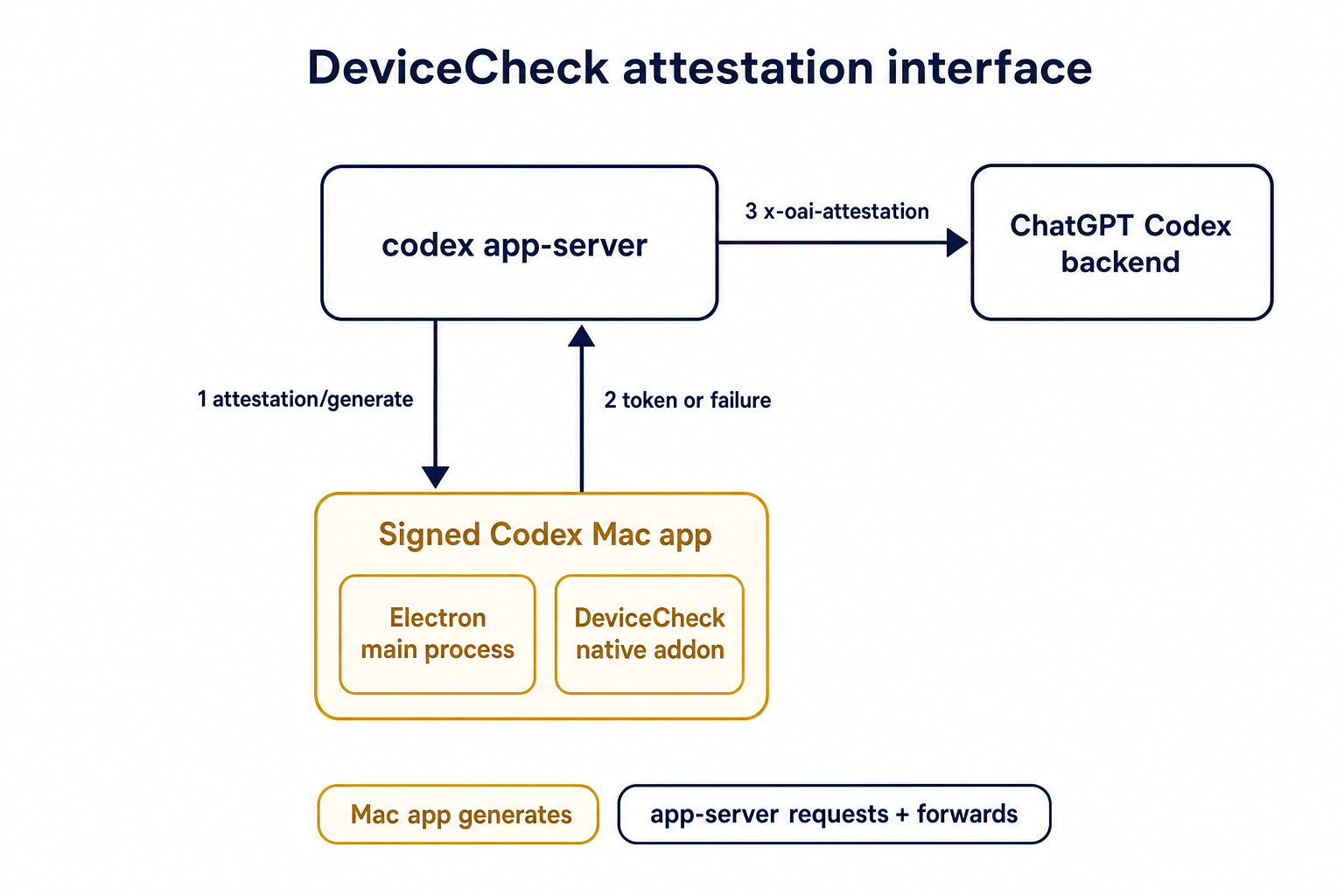
TL;DR: teaches `codex-rs` / app-server to request a desktop-provided
attestation token and attach it as `x-oai-attestation` on the scoped
ChatGPT Codex request paths.
## Details
This PR teaches the Codex app-server runtime how to request and attach
an attestation token. It does not generate DeviceCheck tokens directly;
instead, it relies on the connected desktop app to advertise that it can
generate attestation and then asks that app for a fresh header value
when needed.
The flow is:
1. The Codex desktop app connects to app-server.
2. During `initialize`, the app can advertise that it supports
`requestAttestation`.
3. Before app-server calls selected ChatGPT Codex endpoints, it sends
the internal server request `attestation/generate` to the app.
4. app-server receives a pre-encoded header value back.
5. app-server forwards that value as `x-oai-attestation` on the scoped
outbound requests.
The code in this repo is mostly protocol and runtime plumbing: it adds
the app-server request/response shape, introduces an attestation
provider in core, wires that provider into Responses / compaction /
realtime setup paths, and covers the intended scoping with tests. The
signed macOS DeviceCheck generation remains owned by the desktop app PR.
## Related PR
- Codex desktop app implementation:
https://github.com/openai/openai/pull/878649
## Validation
<details>
<summary>Tests run</summary>
```sh
cargo test -p codex-app-server-protocol
cargo test -p codex-core attestation --lib
cargo test -p codex-app-server --lib attestation
```
Also ran:
```sh
just fix -p codex-core
just fix -p codex-app-server
just fix -p codex-app-server-protocol
just fmt
just write-app-server-schema
```
</details>
<details>
<summary>E2E DeviceCheck validation</summary>
First validated the signed desktop app boundary directly: launched a
packaged signed `Codex.app`, sent `attestation/generate`, decoded the
returned `v1.` attestation header, and validated the extracted
DeviceCheck token with `personal/jm/verify_devicecheck_token.py` using
bundle ID `com.openai.codex`. Apple returned `status_code: 200` and
`is_ok: true`.
Then ran the fuller app + app-server flow. The packaged `Codex.app`
launched a current-branch app-server via `CODEX_CLI_PATH`, and a local
MITM proxy intercepted outbound `chatgpt.com` traffic. The app-server
requested `attestation/generate` from the real Electron app process, and
the intercepted `/backend-api/codex/responses` traffic included
`x-oai-attestation` on both routes:
```text
GET /backend-api/codex/responses Upgrade: websocket x-oai-attestation: present
POST /backend-api/codex/responses Upgrade: none x-oai-attestation: present
```
The captured header decoded to a DeviceCheck token that also validated
with Apple for `com.openai.codex` (`status_code: 200`, `is_ok: true`,
team `2DC432GLL2`).
</details>
---------
Co-authored-by: Codex <noreply@openai.com>
## Why

Skills update notifications are app-server API behavior, but the watcher
lived in `codex-core` and surfaced through
`EventMsg::SkillsUpdateAvailable`. Moving the watcher out keeps core
focused on thread execution and lets app-server own both cache
invalidation and the `skills/changed` notification.

## What changed

- Added an app-server-owned skills watcher that watches local skill
roots, clears the shared skills cache, and emits `skills/changed`
directly.
- Registers skill watches from the common app-server thread listener
attach path, including direct starts, resumes, and app-server-observed
child or forked threads.
- Stores the `WatchRegistration` on `ThreadState`, so listener
replacement, thread teardown, idle unload, and app-server shutdown
deregister by dropping the RAII guard.
- Removed `EventMsg::SkillsUpdateAvailable`, the core watcher, and the
old core live-reload test.
- Extended the app-server skills change test to verify a cached skills
list is refreshed after a filesystem change without forcing reload.

## Validation

- `cargo check -p codex-core -p codex-app-server -p codex-mcp-server -p
codex-rollout -p codex-rollout-trace`
- `cargo test -p codex-app-server
skills_changed_notification_is_emitted_after_skill_change`
## Why

Apply-patch file changes are now part of the core turn item stream, so
v2 clients can consume the same first-class item lifecycle path used by
other turn items instead of relying on app-server-specific remapping
from legacy patch events.

## What changed

- Added a core `TurnItem::FileChange` carrying apply-patch changes and
completion metadata.
- Updated the apply-patch tool emitter to send `ItemStarted` /
`ItemCompleted` with the new `FileChange` item while preserving legacy
`PatchApplyBegin` / `PatchApplyEnd` fan-out.
- Updated app-server v2 conversion to render the new core item directly
and stopped `event_mapping` from remapping old patch begin/end events
into item notifications.
- Kept thread history reconstruction based on the existing old
apply-patch events for rollout compatibility.

## Verification

- `cargo test -p codex-protocol -p codex-app-server-protocol`
- `cargo test -p codex-core --test all
apply_patch_tool_executes_and_emits_patch_events`
- `cargo test -p codex-app-server bespoke_event_handling`
Adds the app-server v2 goal API on top of the persisted goal state from
PR 1.

## Why

Clients need a stable app-server surface for reading and controlling
materialized thread goals before the model tools and TUI can use them.
Goal changes also need to be observable by app-server clients, including
clients that resume an existing thread.

## What changed

- Added v2 `thread/goal/get`, `thread/goal/set`, and `thread/goal/clear`
RPCs for materialized threads.
- Added `thread/goal/updated` and `thread/goal/cleared` notifications so
clients can keep local goal state in sync.
- Added resume/snapshot wiring so reconnecting clients see the current
goal state for a thread.
- Added app-server handlers that reconcile persisted rollout state
before direct goal mutations.
- Updated the app-server README plus generated JSON and TypeScript
schema fixtures for the new API surface.

## Verification

- Added app-server v2 coverage for goal get/set/clear behavior,
notification emission, resume snapshots, and non-local thread-store
interactions.
- Route cold thread/resume and thread/fork source loading through
ThreadStore reads instead of direct rollout path operations
- Keep lookups that explicitly specify a rollout-path using the local
thread store methods but return an invalid-request error for remote
ThreadStore configurations
- Add some additional unit tests for code path coverage
Fix a bug where the `turn/interrupt` RPC hangs when interrupting a turn
that has already completed.

Before this change, `turn/interrupt` requests were queued in app-server
and only answered when a later TurnAborted event arrived. If the target
turn was already complete, core treated Op::Interrupt as a no-op, so no
abort event was emitted and the RPC could hang indefinitely.

This change fixes that in two places:

* Reject turn/interrupt immediately with `INVALID_REQUEST` when the
requested turn is no longer the active turn.
* Resolve any already-accepted pending interrupt requests when the turn
reaches TurnComplete, covering the case where a turn finishes naturally
after the interrupt request is accepted but before it aborts.

I tested this by adding a failing test in
707487c063. You may view the results here:
https://github.com/openai/codex/actions/runs/24585182419/

<img width="1512" height="310" alt="CleanShot 2026-04-17 at 16 33 30@2x"
src="https://github.com/user-attachments/assets/f4a88228-b2a4-41f4-9aaa-ec82814096af"
/>
For callers who expect to be paginating the results for the UI, they can
now call thread/resume or thread/fork with excludeturns:true so it will
not fetch any pages of turns, and instead only set up the subscription.
That call can be immediately followed by pagination requests to
thread/turns/list to fetch pages of turns according to the UI's current
interactions.
Currently app-server may unload actively running threads once the last
connection disconnects, which is not expected.
Instead track when was the last active turn & when there were any
subscribers the last time, also add 30 minute idleness/no subscribers
timer to reduce the churn.
Addresses #17498

Problem: The TUI derived /status instruction source paths from the local
client environment, which could show stale <none> output or incorrect
paths when connected to a remote app server.

Solution: Add an app-server v2 instructionSources snapshot to thread
start/resume/fork responses, default it to an empty list when older
servers omit it, and render TUI /status from that server-provided
session data.

Additional context: The app-server field is intentionally named
instructionSources rather than AGENTS.md-specific terminology because
the loaded instruction sources can include global instructions, project
AGENTS.md files, AGENTS.override.md, user-defined instruction files, and
future dynamic sources.
The disconnect path now reuses the same teardown flow as explicit
unsubscribe, and the thread-state bookkeeping consistently reports only
threads that lost their last subscriber

https://github.com/openai/codex/issues/16895
Guardian events were emitted a bit out of order for CommandExecution
items. This would make it hard for the frontend to render a guardian
auto-review, which has this payload:
```
pub struct ItemGuardianApprovalReviewStartedNotification {
    pub thread_id: String,
    pub turn_id: String,
    pub target_item_id: String,
    pub review: GuardianApprovalReview,
    // FYI this is no longer a json blob
    pub action: Option<JsonValue>,
}
```

There is a `target_item_id` the auto-approval review is referring to,
but the actual item had not been emitted yet.

Before this PR:
- `item/autoApprovalReview/started`
- `item/autoApprovalReview/completed`, and if approved...
- `item/started`
- `item/completed`

After this PR:
- `item/started`
- `item/autoApprovalReview/started`
- `item/autoApprovalReview/completed`
- `item/completed`

This lines up much better with existing patterns (i.e. human review in
`Default mode`, where app-server would send a server request to prompt
for user approval after `item/started`), and makes it easier for clients
to render what guardian is actually reviewing.

We do this following a similar pattern as `FileChange` (aka apply patch)
items, where we create a FileChange item and emit `item/started` if we
see the apply patch approval request, before the actual apply patch call
runs.
## Why

Once the repo-local lint exists, `codex-rs` needs to follow the
checked-in convention and CI needs to keep it from drifting. This commit
applies the fallback `/*param*/` style consistently across existing
positional literal call sites without changing those APIs.

The longer-term preference is still to avoid APIs that require comments
by choosing clearer parameter types and call shapes. This PR is
intentionally the mechanical follow-through for the places where the
existing signatures stay in place.

After rebasing onto newer `main`, the rollout also had to cover newly
introduced `tui_app_server` call sites. That made it clear the first cut
of the CI job was too expensive for the common path: it was spending
almost as much time installing `cargo-dylint` and re-testing the lint
crate as a representative test job spends running product tests. The CI
update keeps the full workspace enforcement but trims that extra
overhead from ordinary `codex-rs` PRs.

## What changed

- keep a dedicated `argument_comment_lint` job in `rust-ci`
- mechanically annotate remaining opaque positional literals across
`codex-rs` with exact `/*param*/` comments, including the rebased
`tui_app_server` call sites that now fall under the lint
- keep the checked-in style aligned with the lint policy by using
`/*param*/` and leaving string and char literals uncommented
- cache `cargo-dylint`, `dylint-link`, and the relevant Cargo
registry/git metadata in the lint job
- split changed-path detection so the lint crate's own `cargo test` step
runs only when `tools/argument-comment-lint/*` or `rust-ci.yml` changes
- continue to run the repo wrapper over the `codex-rs` workspace, so
product-code enforcement is unchanged

Most of the code changes in this commit are intentionally mechanical
comment rewrites or insertions driven by the lint itself.

## Verification

- `./tools/argument-comment-lint/run.sh --workspace`
- `cargo test -p codex-tui-app-server -p codex-tui`
- parsed `.github/workflows/rust-ci.yml` locally with PyYAML

---

* -> #14652
* #14651
The issue was due to a circular `Drop` schema where the embedded
app-server wait for some listeners that wait for this app-server
them-selves.

The fix is an explicit cleaning

**Repro:**
* Start codex
* Ask it to spawn a sub-agent
* Close Codex
* It takes 5s to exit
## Summary
- ensure `thread.resume` reuses the stored `gitInfo` instead of
rebuilding it from the live working tree
- persist and apply thread git metadata through the resume flow and add
a regression test covering branch mismatch cases

## Testing
- Not run (not requested)
## Summary
This removes the old app-server v1 methods and notifications we no
longer need, while keeping the small set the main codex app client still
depends on for now.

The remaining legacy surface is:
- `initialize`
- `getConversationSummary`
- `getAuthStatus`
- `gitDiffToRemote`
- `fuzzyFileSearch`
- `fuzzyFileSearch/sessionStart`
- `fuzzyFileSearch/sessionUpdate`
- `fuzzyFileSearch/sessionStop`

And the raw `codex/event/*` notifications emitted from core. These
notifications will be removed in a followup PR.

## What changed
- removed deprecated v1 request variants from the protocol and
app-server dispatcher
- removed deprecated typed notifications: `authStatusChange`,
`loginChatGptComplete`, and `sessionConfigured`
- updated the app-server test client to use v2 flows instead of deleted
v1 flows
- deleted legacy-only app-server test suites and added focused coverage
for `getConversationSummary`
- regenerated app-server schema fixtures and updated the MCP interface
docs to match the remaining compatibility surface

## Testing
- `just write-app-server-schema`
- `cargo test -p codex-app-server-protocol`
- `cargo test -p codex-app-server`
Stop `thread/start` from blocking other app-server requests.

Before this change, `thread/start ran` inline on the request loop, so
slow startup paths like MCP auth checks could hold up unrelated requests
on the same connection, including `thread/loaded/list`. This moves
`thread/start` into a background task.

While doing so, it revealed an issue where we were doing nested locking
(and there were some race conditions possible that could introduce a
"phantom listener"). This PR also refactors the listener/subscription
bookkeeping - listener/subscription state is now centralized in
`ThreadStateManager` instead of being split across multiple lock
domains. That makes late auto-attach on `thread/start` race-safe and
avoids reintroducing disconnected clients as phantom subscribers.
Replay pending client requests after `thread/resume` and emit resolved
notifications when those requests clear so approval/input UI state stays
in sync after reconnects and across subscribed clients.

Affected RPCs:
- `item/commandExecution/requestApproval`
- `item/fileChange/requestApproval`
- `item/tool/requestUserInput`

Motivation:
- Resumed clients need to see pending approval/input requests that were
already outstanding before the reconnect.
- Clients also need an explicit signal when a pending request resolves
or is cleared so stale UI can be removed on turn start, completion, or
interruption.

Implementation notes:
- Use pending client requests from `OutgoingMessageSender` in order to
replay them after `thread/resume` attaches the connection, using
original request ids.
- Emit `serverRequest/resolved` when pending requests are answered
or cleared by lifecycle cleanup.
- Update the app-server protocol schema, generated TypeScript bindings,
and README docs for the replay/resolution flow.

High-level test plan:
- Added automated coverage for replaying pending command execution and
file change approval requests on `thread/resume`.
- Added automated coverage for resolved notifications in command
approval, file change approval, request_user_input, turn start, and turn
interrupt flows.
- Verified schema/docs updates in the relevant protocol and app-server
tests.

Manual testing:
- Tested reconnect/resume with multiple connections.
- Confirmed state stayed in sync between connections.
Adds a new v2 app-server API for a client to be able to unsubscribe to a
thread:
- New RPC method: `thread/unsubscribe`
- New server notification: `thread/closed`

Today clients can start/resume/archive threads, but there wasn’t a way
to explicitly unload a live thread from memory without archiving it.
With `thread/unsubscribe`, a client can indicate it is no longer
actively working with a live Thread. If this is the only client
subscribed to that given thread, the thread will be automatically closed
by app-server, at which point the server will send `thread/closed` and
`thread/status/changed` with `status: notLoaded` notifications.

This gives clients a way to prevent long-running app-server processes
from accumulating too many thread (and related) objects in memory.

Closed threads will also be removed from `thread/loaded/list`.
- keep the per-thread app-server listener alive when the last client
unsubscribes or disconnects
- preserve listener-side active turn history so running `thread/resume`
can merge an in-progress turn snapshot after reconnect
- add `ThreadStateManager` regressions for disconnect/unsubscribe
retention and explicit thread teardown cleanup

Added unit tests, and I manually tested to confirm the fix

---------

Co-authored-by: Codex <noreply@openai.com>
Hardens codex-rs/app-server connection lifecycle and outbound routing
for websocket clients. Fixes some FUD I was having

- Added per-connection disconnect signaling (CancellationToken) for
websocket transports.
- Split websocket handling into independent inbound/outbound tasks
coordinated by cancellation.
- Changed outbound routing so websocket connections use non-blocking
try_send; slow/full websocket writers are disconnected instead of
stalling broadcast delivery.
- Kept stdio behavior blocking-on-send (no forced disconnect) so local
stdio clients are not dropped when queues are temporarily full.
- Simplified outbound router flow by removing deferred
pending_closed_connections handling.
- Added guards to drop incoming response/notification/error messages
from unknown connections.
- Fixed listener teardown race in thread listener tasks using a
listener_generation check so stale tasks do not clear newer listeners.

Fixes
https://linear.app/openai/issue/CODEX-4966/multiclient-handle-slow-notification-consumers

  ## Tests

  Added/updated transport tests covering:

  - broadcast does not block on a slow/full websocket connection
  - stdio connection waits instead of disconnecting on full queue

I (maxj) have tested manually and will retest before landing
thread/resume response includes latest turn with all items, in band so
no events are stale or lost

Testing
- e2e tested using app-server-test-client using flow described in
"Testing Thread Rejoin Behavior" in
codex-rs/app-server-test-client/README.md
- e2e tested in codex desktop by reconnecting to a running turn
Motivation
- Today, a newly connected client has no direct way to determine the
current runtime status of threads from read/list responses alone.
- This forces clients to infer state from transient events, which can
lead to stale or inconsistent UI when reconnecting or attaching late.

Changes
- Add `status` to `thread/read` responses.
- Add `statuses` to `thread/list` responses.
- Emit `thread/status/changed` notifications with `threadId` and the new
status.
- Track runtime status for all loaded threads and default unknown
threads to `idle`.
- Update protocol/docs/tests/schema fixtures for the revised API.

Testing
- Validated protocol API changes with automated protocol tests and
regenerated schema/type fixtures.
- Validated app-server behavior with unit and integration test suites,
including status transitions and notifications.
zsh fork PR stack:
- https://github.com/openai/codex/pull/12051👈
- https://github.com/openai/codex/pull/12052
With upcoming support for a fork of zsh that allows us to intercept
`execve` and run execpolicy checks for each subcommand as part of a
`CommandExecution`, it will be possible for there to be multiple
approval requests for a shell command like `/path/to/zsh -lc 'git status
&& rg \"TODO\" src && make test'`.
To support that, this PR introduces a new `approval_id` field across
core, protocol, and app-server so that we can associate approvals
properly for subcommands.
This stack layer makes app-server thread event delivery connection-aware
so resumed/attached threads only emit notifications and approval prompts
to subscribed connections.

- Added per-thread subscription tracking in `ThreadState`
(`subscribed_connections`) and mapped subscription ids to `(thread_id,
connection_id)`.
- Updated listener lifecycle so removing a subscription or closing a
connection only removes that connection from the thread’s subscriber
set; listener shutdown now happens when the last subscriber is gone.
- Added `connection_closed(connection_id)` plumbing (`lib.rs` ->
`message_processor.rs` -> `codex_message_processor.rs`) so disconnect
cleanup happens immediately.
- Scoped bespoke event handling outputs through `TargetedOutgoing` to
send requests/notifications only to subscribed connections.
- Kept existing threadresume behavior while aligning with the latest
split-loop transport structure.

