## Why

Bazel clippy now catches lints that `cargo clippy` can still miss when a
crate under `codex-rs` forgets to opt into workspace lints. The concrete
example here was `codex-rs/app-server/tests/common/Cargo.toml`: Bazel
flagged a clippy violation in `models_cache.rs`, but Cargo did not
because that crate inherited workspace package metadata without
declaring `[lints] workspace = true`.

We already mirror the workspace clippy deny list into Bazel after
[#15955](https://github.com/openai/codex/pull/15955), so we also need a
repo-side check that keeps every `codex-rs` manifest opted into the same
workspace settings.

## What changed

- add `.github/scripts/verify_cargo_workspace_manifests.py`, which
parses every `codex-rs/**/Cargo.toml` with `tomllib` and verifies:
  - `version.workspace = true`
  - `edition.workspace = true`
  - `license.workspace = true`
  - `[lints] workspace = true`
- top-level crate names follow the `codex-*` / `codex-utils-*`
conventions, with explicit exceptions for `windows-sandbox-rs` and
`utils/path-utils`
- run that script in `.github/workflows/ci.yml`
- update the current outlier manifests so the check is enforceable
immediately
- fix the newly exposed clippy violations in the affected crates
(`app-server/tests/common`, `file-search`, `feedback`,
`shell-escalation`, and `debug-client`)


---
[//]: # (BEGIN SAPLING FOOTER)
Stack created with [Sapling](https://sapling-scm.com). Best reviewed
with [ReviewStack](https://reviewstack.dev/openai/codex/pull/16353).
* #16351
* __->__ #16353
## Why

Follow-up to #16106.

`argument-comment-lint` already runs as a native Bazel aspect on Linux
and macOS, but Windows is still the long pole in `rust-ci`. To move
Windows onto the same native Bazel lane, the toolchain split has to let
exec-side helper binaries build in an MSVC environment while still
linting repo crates as `windows-gnullvm`.

Pushing the Windows lane onto the native Bazel path exposed a second
round of Windows-only issues in the mixed exec-toolchain plumbing after
the initial wrapper/target fixes landed.

## What Changed

- keep the Windows lint lanes on the native Bazel/aspect path in
`rust-ci.yml` and `rust-ci-full.yml`
- add a dedicated `local_windows_msvc` platform for exec-side helper
binaries while keeping `local_windows` as the `windows-gnullvm` target
platform
- patch `rules_rust` so `repository_set(...)` preserves explicit
exec-platform constraints for the generated toolchains, keep the
Windows-specific bootstrap/direct-link fixes needed for the nightly lint
driver, and expose exec-side `rustc-dev` `.rlib`s to the MSVC sysroot
- register the custom Windows nightly toolchain set with MSVC exec
constraints while still exposing both `x86_64-pc-windows-msvc` and
`x86_64-pc-windows-gnullvm` targets
- enable `dev_components` on the custom Windows nightly repository set
so the MSVC exec helper toolchain actually downloads the
compiler-internal crates that `clippy_utils` needs
- teach `run-argument-comment-lint-bazel.sh` to enumerate concrete
Windows Rust rules, normalize the resulting labels, and skip explicitly
requested incompatible targets instead of failing before the lint run
starts
- patch `rules_rust` build-script env propagation so exec-side
`windows-msvc` helper crates drop forwarded MinGW include and linker
search paths as whole flag/path pairs instead of emitting malformed
`CFLAGS`, `CXXFLAGS`, and `LDFLAGS`
- export the Windows VS/MSVC SDK environment in `setup-bazel-ci` and
pass the relevant variables through `run-bazel-ci.sh` via `--action_env`
/ `--host_action_env` so Bazel build scripts can see the MSVC and UCRT
headers on native Windows runs
- add inline comments to the Windows `setup-bazel-ci` MSVC environment
export step so it is easier to audit how `vswhere`, `VsDevCmd.bat`, and
the filtered `GITHUB_ENV` export fit together
- patch `aws-lc-sys` to skip its standalone `memcmp` probe under Bazel
`windows-msvc` build-script environments, which avoids a Windows-native
toolchain mismatch that blocked the lint lane before it reached the
aspect execution
- patch `aws-lc-sys` to prefer its bundled `prebuilt-nasm` objects for
Bazel `windows-msvc` build-script runs, which avoids missing
`generated-src/win-x86_64/*.asm` runfiles in the exec-side helper
toolchain
- annotate the Linux test-only callsites in `codex-rs/linux-sandbox` and
`codex-rs/core` that the wider native lint coverage surfaced

## Patches

This PR introduces a large patch stack because the Windows Bazel lint
lane currently depends on behavior that upstream dependencies do not
provide out of the box in the mixed `windows-gnullvm` target /
`windows-msvc` exec-toolchain setup.

- Most of the `rules_rust` patches look like upstream candidates rather
than OpenAI-only policy. Preserving explicit exec-platform constraints,
forwarding the right MSVC/UCRT environment into exec-side build scripts,
exposing exec-side `rustc-dev` artifacts, and keeping the Windows
bootstrap/linker behavior coherent all look like fixes to the Bazel/Rust
integration layer itself.
- The two `aws-lc-sys` patches are more tactical. They special-case
Bazel `windows-msvc` build-script environments to avoid a `memcmp` probe
mismatch and missing NASM runfiles. Those may be harder to upstream
as-is because they rely on Bazel-specific detection instead of a general
Cargo/build-script contract.
- Short term, carrying these patches in-tree is reasonable because they
unblock a real CI lane and are still narrow enough to audit. Long term,
the goal should not be to keep growing a permanent local fork of either
dependency.
- My current expectation is that the `rules_rust` patches are less
controversial and should be broken out into focused upstream proposals,
while the `aws-lc-sys` patches are more likely to be temporary escape
hatches unless that crate wants a more general hook for hermetic build
systems.

Suggested follow-up plan:

1. Split the `rules_rust` deltas into upstream-sized PRs or issues with
minimized repros.
2. Revisit the `aws-lc-sys` patches during the next dependency bump and
see whether they can be replaced by an upstream fix, a crate upgrade, or
a cleaner opt-in mechanism.
3. Treat each dependency update as a chance to delete patches one by one
so the local patch set only contains still-needed deltas.

## Verification

- `./.github/scripts/run-argument-comment-lint-bazel.sh
--config=argument-comment-lint --keep_going`
- `RUNNER_OS=Windows
./.github/scripts/run-argument-comment-lint-bazel.sh --nobuild
--config=argument-comment-lint --platforms=//:local_windows
--keep_going`
- `cargo test -p codex-linux-sandbox`
- `cargo test -p codex-core shell_snapshot_tests`
- `just argument-comment-lint`

## References

- #16106
## Why

The Bazel-backed `argument-comment-lint` CI path had two gaps:

- Bazel wildcard target expansion skipped inline unit-test crates from
`src/` modules because the generated `*-unit-tests-bin` `rust_test`
targets are tagged `manual`.
- `argument-comment-mismatch` was still only a warning in the Bazel and
packaged-wrapper entrypoints, so a typoed `/*param_name*/` comment could
still pass CI even when the lint detected it.

That left CI blind to real linux-sandbox examples, including the missing
`/*local_port*/` comment in
`codex-rs/linux-sandbox/src/proxy_routing.rs` and typoed argument
comments in `codex-rs/linux-sandbox/src/landlock.rs`.

## What Changed

- Added `tools/argument-comment-lint/list-bazel-targets.sh` so Bazel
lint runs cover `//codex-rs/...` plus the manual `rust_test`
`*-unit-tests-bin` targets.
- Updated `just argument-comment-lint`, `rust-ci.yml`, and
`rust-ci-full.yml` to use that helper.
- Promoted both `argument-comment-mismatch` and
`uncommented-anonymous-literal-argument` to errors in every strict
entrypoint:
  - `tools/argument-comment-lint/lint_aspect.bzl`
  - `tools/argument-comment-lint/src/bin/argument-comment-lint.rs`
  - `tools/argument-comment-lint/wrapper_common.py`
- Added wrapper/bin coverage for the stricter lint flags and documented
the behavior in `tools/argument-comment-lint/README.md`.
- Fixed the now-covered callsites in
`codex-rs/linux-sandbox/src/proxy_routing.rs`,
`codex-rs/linux-sandbox/src/landlock.rs`, and
`codex-rs/core/src/shell_snapshot_tests.rs`.

This keeps the Bazel target expansion narrow while making the Bazel and
prebuilt-linter paths enforce the same strict lint set.

## Verification

- `python3 -m unittest discover -s tools/argument-comment-lint -p
'test_*.py'`
- `cargo +nightly-2025-09-18 test --manifest-path
tools/argument-comment-lint/Cargo.toml`
- `just argument-comment-lint`
## Why

PR #16130 fixed the Windows `argument-comment-lint` regression in
`rust-ci-full`, but the next `main` runs still left the Linux and macOS
lint legs timing out.

In [run
23695263729](https://github.com/openai/codex/actions/runs/23695263729),
both non-Windows `argument-comment-lint` jobs were cancelled almost
exactly 30 minutes after they started. The remaining workflow difference
versus `rust-ci.yml` was that `rust-ci-full` did not pass
`BUILDBUDDY_API_KEY` into the non-Windows Bazel lint step, so
`run-bazel-ci.sh` fell back to local Bazel configuration instead of
using the faster remote-backed path available on `main`.

## What changed

- passed `BUILDBUDDY_API_KEY` to the non-Windows `rust-ci-full`
`argument-comment-lint` Bazel step
- left the Windows packaged-wrapper path from #16130 unchanged
- kept the change scoped to `rust-ci-full.yml`

## Test plan

- loaded `.github/workflows/rust-ci-full.yml` and
`.github/workflows/rust-ci.yml` with `python3` + `yaml.safe_load(...)`
- inspected run `23695263729` and confirmed `Argument comment lint -
Linux` and `Argument comment lint - macOS` were cancelled about 30
minutes after start
- verified the updated `rust-ci-full` step now matches the non-Windows
secret wiring already present in `rust-ci.yml`

## References

- #16130
- #16106
## Why

PR #16106 switched `rust-ci-full` over to the native Bazel-backed
`argument-comment-lint` path on all three platforms.

That works on Linux and macOS, but the Windows leg in `rust-ci-full` now
fails before linting starts: Bazel dies while building `rules_rust`'s
`process_wrapper` tool, so `main` reports an `argument-comment-lint`
failure even though no Rust lint finding was produced.

Until native Windows Bazel linting is repaired, `rust-ci-full` should
keep the same Windows split that `rust-ci.yml` already uses.

## What changed

- restored the Windows-only nightly `argument-comment-lint` toolchain
setup in `rust-ci-full`
- limited the Bazel-backed lint step in `rust-ci-full` to non-Windows
runners
- routed the Windows runner back through
`tools/argument-comment-lint/run-prebuilt-linter.py`
- left the Linux and macOS `rust-ci-full` behavior unchanged

## Test plan

- loaded `.github/workflows/rust-ci-full.yml` and
`.github/workflows/rust-ci.yml` with `python3` + `yaml.safe_load(...)`
- inspected failing Actions run `23692864849`, especially job
`69023229311`, to confirm the Windows failure occurs in Bazel
`process_wrapper` setup before lint output is emitted

## References

- #16106
## Why

`argument-comment-lint` had become a PR bottleneck because the repo-wide
lane was still effectively running a `cargo dylint`-style flow across
the workspace instead of reusing Bazel's Rust dependency graph. That
kept the lint enforced, but it threw away the main benefit of moving
this job under Bazel in the first place: metadata reuse and cacheable
per-target analysis in the same shape as Clippy.

This change moves the repo-wide lint onto a native Bazel Rust aspect so
Linux and macOS can lint `codex-rs` without rebuilding the world
crate-by-crate through the wrapper path.

## What Changed

- add a nightly Rust toolchain with `rustc-dev` for Bazel and a
dedicated crate-universe repo for `tools/argument-comment-lint`
- add `tools/argument-comment-lint/driver.rs` and
`tools/argument-comment-lint/lint_aspect.bzl` so Bazel can run the lint
as a custom `rustc_driver`
- switch repo-wide `just argument-comment-lint` and the Linux/macOS
`rust-ci` lanes to `bazel build --config=argument-comment-lint
//codex-rs/...`
- keep the Python/DotSlash wrappers as the package-scoped fallback path
and as the current Windows CI path
- gate the Dylint entrypoint behind a `bazel_native` feature so the
Bazel-native library avoids the `dylint_*` packaging stack
- update the aspect runtime environment so the driver can locate
`rustc_driver` correctly under remote execution
- keep the dedicated `tools/argument-comment-lint` package tests and
wrapper unit tests in CI so the source and packaged entrypoints remain
covered

## Verification

- `python3 -m unittest discover -s tools/argument-comment-lint -p
'test_*.py'`
- `cargo test` in `tools/argument-comment-lint`
- `bazel build
//tools/argument-comment-lint:argument-comment-lint-driver
--@rules_rust//rust/toolchain/channel=nightly`
- `bazel build --config=argument-comment-lint
//codex-rs/utils/path-utils:all`
- `bazel build --config=argument-comment-lint
//codex-rs/rollout:rollout`


---
[//]: # (BEGIN SAPLING FOOTER)
Stack created with [Sapling](https://sapling-scm.com). Best reviewed
with [ReviewStack](https://reviewstack.dev/openai/codex/pull/16106).
* #16120
* __->__ #16106
## Summary

Split the old all-in-one `rust-ci.yml` into:

- a PR-time Cargo workflow in `rust-ci.yml`
- a full post-merge Cargo workflow in `rust-ci-full.yml`

This keeps the PR path focused on fast Cargo-native hygiene plus the
Bazel `build` / `test` / `clippy` coverage in `bazel.yml`, while moving
the heavyweight Cargo-native matrix to `main`.

## Why

`bazel.yml` is now the main Rust verification workflow for pull
requests. It already covers the Bazel build, test, and clippy signal we
care about pre-merge, and it also runs on pushes to `main` to re-verify
the merged tree and help keep the BuildBuddy caches warm.

What was still missing was a clean split for the Cargo-native checks
that Bazel does not replace yet. The old `rust-ci.yml` mixed together:

- fast hygiene checks such as `cargo fmt --check` and `cargo shear`
- `argument-comment-lint`
- the full Cargo clippy / nextest / release-build matrix

That made every PR pay for the full Cargo matrix even though most of
that coverage is better treated as post-merge verification. The goal of
this change is to leave PRs with the checks we still want before merge,
while moving the heavier Cargo-native matrix off the review path.

## What Changed

- Renamed the old heavyweight workflow to `rust-ci-full.yml` and limited
it to `push` on `main` plus `workflow_dispatch`.
- Added a new PR-only `rust-ci.yml` that runs:
  - changed-path detection
  - `cargo fmt --check`
  - `cargo shear`
  - `argument-comment-lint` on Linux, macOS, and Windows
- `tools/argument-comment-lint` package tests when the lint itself or
its workflow wiring changes
- Kept the PR workflow's gatherer as the single required Cargo-native
status so branch protection can stay simple.
- Added `.github/workflows/README.md` to document the intended split
between `bazel.yml`, `rust-ci.yml`, and `rust-ci-full.yml`.
- Preserved the recent Windows `argument-comment-lint` behavior from
`e02fd6e1d3` in `rust-ci-full.yml`, and mirrored cross-platform lint
coverage into the PR workflow.

A few details are deliberate:

- The PR workflow still keeps the Linux lint lane on the
default-targets-only invocation for now, while macOS and Windows use the
broader released-linter path.
- This PR does not change `bazel.yml`; it changes the Cargo-native
workflow around the existing Bazel PR path.

## Testing

- Rebasing this change onto `main` after `e02fd6e1d3`
- `ruby -e 'require "yaml"; %w[.github/workflows/rust-ci.yml
.github/workflows/rust-ci-full.yml .github/workflows/bazel.yml].each {
|f| YAML.load_file(f) }'`
## Why

The initial `argument-comment-lint` rollout left Windows on
default-target coverage because there were still Windows-only callsites
failing under `--all-targets`. This follow-up cleans up those remaining
Windows-specific violations so the Windows CI lane can enforce the same
stricter coverage, leaving Linux as the remaining platform-specific
follow-up.

## What changed

- switched the Windows `rust-ci` argument-comment-lint step back to the
default wrapper invocation so it runs full-target coverage again
- added the required `/*param_name*/` annotations at Windows-gated
literal callsites in:
  - `codex-rs/windows-sandbox-rs/src/lib.rs`
  - `codex-rs/windows-sandbox-rs/src/elevated_impl.rs`
  - `codex-rs/tui_app_server/src/multi_agents.rs`
  - `codex-rs/network-proxy/src/proxy.rs`

## Validation

- Windows `argument comment lint` CI on this PR
## Why

We want more of the pre-merge Rust signal to come from `bazel.yml`,
especially on Windows. The Bazel test workflow already exercises
`x86_64-pc-windows-gnullvm`, but the Bazel clippy job still only ran on
Linux x64 and macOS arm64. That left a gap where Windows-only Bazel lint
breakages could slip through until the Cargo-based workflow ran.

This change keeps the fix narrow. Rather than expanding the Bazel clippy
target set or changing the shared setup logic, it extends the existing
clippy matrix to the same Windows GNU toolchain that the Bazel test job
already uses.

## What Changed

- add `windows-latest` / `x86_64-pc-windows-gnullvm` to the `clippy` job
matrix in `.github/workflows/bazel.yml`
- update the nearby workflow comment to explain that the goal is to get
Bazel-native Windows lint coverage on the same toolchain as the Bazel
test lane
- leave the Bazel clippy scope unchanged at `//codex-rs/...
-//codex-rs/v8-poc:all`

## Verification

- parsed `.github/workflows/bazel.yml` successfully with Ruby
`YAML.load_file`
## Why

This PR is the current, consolidated follow-up to the earlier Windows
Bazel attempt in #11229. The goal is no longer just to get a tiny
Windows smoke job limping along: it is to make the ordinary Bazel CI
path usable on `windows-latest` for `x86_64-pc-windows-gnullvm`, with
the same broad `//...` test shape that macOS and Linux already use.

The earlier smoke-list version of this work was useful as a foothold,
but it was not a good long-term landing point. Windows Bazel kept
surfacing real issues outside that allowlist:

- GitHub's Windows runner exposed runfiles-manifest bugs such as
`FINDSTR: Cannot open D:MANIFEST`, which broke Bazel test launchers even
when the manifest file existed.
- `rules_rs`, `rules_rust`, LLVM extraction, and Abseil still needed
`windows-gnullvm`-specific fixes for our hermetic toolchain.
- the V8 path needed more work than just turning the Windows matrix
entry back on: `rusty_v8` does not ship Windows GNU artifacts in the
same shape we need, and Bazel's in-tree V8 build needed a set of Windows
GNU portability fixes.

Windows performance pressure also pushed this toward a full solution
instead of a permanent smoke suite. During this investigation we hit
targets such as `//codex-rs/shell-command:shell-command-unit-tests` that
were much more expensive on Windows because they repeatedly spawn real
PowerShell parsers (see #16057 for one concrete example of that
pressure). That made it much more valuable to get the real Windows Bazel
path working than to keep iterating on a narrowly curated subset.

The net result is that this PR now aims for the same CI contract on
Windows that we already expect elsewhere: keep standalone
`//third_party/v8:all` out of the ordinary Bazel lane, but allow V8
consumers under `//codex-rs/...` to build and test transitively through
`//...`.

## What Changed

### CI and workflow wiring

- re-enable the `windows-latest` / `x86_64-pc-windows-gnullvm` Bazel
matrix entry in `.github/workflows/bazel.yml`
- move the Windows Bazel output root to `D:\b` and enable `git config
--global core.longpaths true` in
`.github/actions/setup-bazel-ci/action.yml`
- keep the ordinary Bazel target set on Windows aligned with macOS and
Linux by running `//...` while excluding only standalone
`//third_party/v8:all` targets from the normal lane

### Toolchain and module support for `windows-gnullvm`

- patch `rules_rs` so `windows-gnullvm` is modeled as a distinct Windows
exec/toolchain platform instead of collapsing into the generic Windows
shape
- patch `rules_rust` build-script environment handling so llvm-mingw
build-script probes do not inherit unsupported `-fstack-protector*`
flags
- patch the LLVM module archive so it extracts cleanly on Windows and
provides the MinGW libraries this toolchain needs
- patch Abseil so its thread-local identity path matches the hermetic
`windows-gnullvm` toolchain instead of taking an incompatible MinGW
pthread path
- keep both MSVC and GNU Windows targets in the generated Cargo metadata
because the current V8 release-asset story still uses MSVC-shaped names
in some places while the Bazel build targets the GNU ABI

### Windows test-launch and binary-behavior fixes

- update `workspace_root_test_launcher.bat.tpl` to read the runfiles
manifest directly instead of shelling out to `findstr`, which was the
source of the `D:MANIFEST` failures on the GitHub Windows runner
- thread a larger Windows GNU stack reserve through `defs.bzl` so
Bazel-built binaries that pull in V8 behave correctly both under normal
builds and under `bazel test`
- remove the no-longer-needed Windows bootstrap sh-toolchain override
from `.bazelrc`

### V8 / `rusty_v8` Windows GNU support

- export and apply the new Windows GNU patch set from
`patches/BUILD.bazel` / `MODULE.bazel`
- patch the V8 module/rules/source layers so the in-tree V8 build can
produce Windows GNU archives under Bazel
- teach `third_party/v8/BUILD.bazel` to build Windows GNU static
archives in-tree instead of aliasing them to the MSVC prebuilts
- reuse the Linux release binding for the experimental Windows GNU path
where `rusty_v8` does not currently publish a Windows GNU binding
artifact

## Testing

- the primary end-to-end validation for this work is the `Bazel`
workflow plus `v8-canary`, since the hard parts are Windows-specific and
depend on real GitHub runner behavior
- before consolidation back onto this PR, the same net change passed the
full Bazel matrix in [run
23675590471](https://github.com/openai/codex/actions/runs/23675590471)
and passed `v8-canary` in [run
23675590453](https://github.com/openai/codex/actions/runs/23675590453)
- those successful runs included the `windows-latest` /
`x86_64-pc-windows-gnullvm` Bazel job with the ordinary `//...` path,
not the earlier Windows smoke allowlist

---
[//]: # (BEGIN SAPLING FOOTER)
Stack created with [Sapling](https://sapling-scm.com). Best reviewed
with [ReviewStack](https://reviewstack.dev/openai/codex/pull/15952).
* #16067
* __->__ #15952
## Why

The `argument-comment-lint` entrypoints had grown into two shell
wrappers with duplicated parsing, environment setup, and Cargo
forwarding logic. The recent `--` separator regression was a good
example of the problem: the behavior was subtle, easy to break, and hard
to verify.

This change rewrites those wrappers in Python so the control flow is
easier to follow, the shared behavior lives in one place, and the tricky
argument/defaulting paths have direct test coverage.

## What changed

- replaced `tools/argument-comment-lint/run.sh` and
`tools/argument-comment-lint/run-prebuilt-linter.sh` with Python
entrypoints: `run.py` and `run-prebuilt-linter.py`
- moved shared wrapper behavior into
`tools/argument-comment-lint/wrapper_common.py`, including:
  - splitting lint args from forwarded Cargo args after `--`
- defaulting repo runs to `--manifest-path codex-rs/Cargo.toml
--workspace --no-deps`
- defaulting non-`--fix` runs to `--all-targets` unless the caller
explicitly narrows the target set
  - setting repo defaults for `DYLINT_RUSTFLAGS` and `CARGO_INCREMENTAL`
- kept the prebuilt wrapper thin: it still just resolves the packaged
DotSlash entrypoint, keeps `rustup` shims first on `PATH`, infers
`RUSTUP_HOME` when needed, and then launches the packaged `cargo-dylint`
path
- updated `justfile`, `rust-ci.yml`, and
`tools/argument-comment-lint/README.md` to use the Python entrypoints
- updated `rust-ci` so the package job runs Python syntax checks plus
the new wrapper unit tests, and the OS-specific lint jobs invoke the
wrappers through an explicit Python interpreter

This is a follow-up to #16054: it keeps the current lint semantics while
making the wrapper logic maintainable enough to iterate on safely.

## Validation

- `python3 -m py_compile tools/argument-comment-lint/wrapper_common.py
tools/argument-comment-lint/run.py
tools/argument-comment-lint/run-prebuilt-linter.py
tools/argument-comment-lint/test_wrapper_common.py`
- `python3 -m unittest discover -s tools/argument-comment-lint -p
'test_*.py'`
- `python3 ./tools/argument-comment-lint/run-prebuilt-linter.py -p
codex-terminal-detection -- --lib`
- `python3 ./tools/argument-comment-lint/run.py -p
codex-terminal-detection -- --lib`
## Why

`argument-comment-lint` was green in CI even though the repo still had
many uncommented literal arguments. The main gap was target coverage:
the repo wrapper did not force Cargo to inspect test-only call sites, so
examples like the `latest_session_lookup_params(true, ...)` tests in
`codex-rs/tui_app_server/src/lib.rs` never entered the blocking CI path.

This change cleans up the existing backlog, makes the default repo lint
path cover all Cargo targets, and starts rolling that stricter CI
enforcement out on the platform where it is currently validated.

## What changed

- mechanically fixed existing `argument-comment-lint` violations across
the `codex-rs` workspace, including tests, examples, and benches
- updated `tools/argument-comment-lint/run-prebuilt-linter.sh` and
`tools/argument-comment-lint/run.sh` so non-`--fix` runs default to
`--all-targets` unless the caller explicitly narrows the target set
- fixed both wrappers so forwarded cargo arguments after `--` are
preserved with a single separator
- documented the new default behavior in
`tools/argument-comment-lint/README.md`
- updated `rust-ci` so the macOS lint lane keeps the plain wrapper
invocation and therefore enforces `--all-targets`, while Linux and
Windows temporarily pass `-- --lib --bins`

That temporary CI split keeps the stricter all-targets check where it is
already cleaned up, while leaving room to finish the remaining Linux-
and Windows-specific target-gated cleanup before enabling
`--all-targets` on those runners. The Linux and Windows failures on the
intermediate revision were caused by the wrapper forwarding bug, not by
additional lint findings in those lanes.

## Validation

- `bash -n tools/argument-comment-lint/run.sh`
- `bash -n tools/argument-comment-lint/run-prebuilt-linter.sh`
- shell-level wrapper forwarding check for `-- --lib --bins`
- shell-level wrapper forwarding check for `-- --tests`
- `just argument-comment-lint`
- `cargo test` in `tools/argument-comment-lint`
- `cargo test -p codex-terminal-detection`

## Follow-up

- Clean up remaining Linux-only target-gated callsites, then switch the
Linux lint lane back to the plain wrapper invocation.
- Clean up remaining Windows-only target-gated callsites, then switch
the Windows lint lane back to the plain wrapper invocation.
## Why

Before this change, the SDK CI job built `codex` with Cargo before
running the TypeScript package tests. That step has been getting more
expensive as the Rust workspace grows, while the repo already has a
Bazel-backed build path for the CLI.

The SDK tests also need a normal executable path they can spawn
repeatedly. Moving the job to Bazel exposed an extra CI detail: a plain
`bazel-bin/...` lookup is not reliable under the Linux config because
top-level outputs may stay remote and the wrapper emits status lines
around `cquery` output.

## What Changed

- taught `sdk/typescript/tests/testCodex.ts` to honor `CODEX_EXEC_PATH`
before falling back to the local Cargo-style `target/debug/codex` path
- added `--remote-download-toplevel` to
`.github/scripts/run-bazel-ci.sh` so workflows can force Bazel to
materialize top-level outputs on disk after a build
- switched `.github/workflows/sdk.yml` from `cargo build --bin codex` to
the shared Bazel CI setup and `//codex-rs/cli:codex` build target
- changed the SDK workflow to resolve the built CLI with wrapper-backed
`cquery --output=files`, stage the binary into
`${GITHUB_WORKSPACE}/.tmp/sdk-ci/codex`, and point the SDK tests at that
path via `CODEX_EXEC_PATH`
- kept the warm-up step before Jest and the Bazel repository-cache save
step

## Verification

- `bash -n .github/scripts/run-bazel-ci.sh`
- `./.github/scripts/run-bazel-ci.sh -- cquery --output=files --
//codex-rs/cli:codex | grep -E '^(/|bazel-out/)' | tail -n 1`
- `./.github/scripts/run-bazel-ci.sh --remote-download-toplevel -- build
--build_metadata=TAG_job=sdk -- //codex-rs/cli:codex`
- `CODEX_EXEC_PATH="$PWD/.tmp/sdk-ci/codex" pnpm --dir sdk/typescript
test --runInBand`
- `pnpm --dir sdk/typescript lint`
## Why
`bazel.yml` already builds and tests the Bazel graph, but `rust-ci.yml`
still runs `cargo clippy` separately. This PR starts the transition to a
Bazel-backed lint lane for `codex-rs` so we can eventually replace the
duplicate Rust build, test, and lint work with Bazel while explicitly
keeping the V8 Bazel path out of scope for now.

To make that lane practical, the workflow also needs to look like the
Bazel job we already trust. That means sharing the common Bazel setup
and invocation logic instead of hand-copying it, and covering the arm64
macOS path in addition to Linux.

Landing the workflow green also required fixing the first lint findings
that Bazel surfaced and adding the matching local entrypoint.

## What changed
- add a reusable `build:clippy` config to `.bazelrc` and export
`codex-rs/clippy.toml` from `codex-rs/BUILD.bazel` so Bazel can run the
repository's existing Clippy policy
- add `just bazel-clippy` so the local developer entrypoint matches the
new CI lane
- extend `.github/workflows/bazel.yml` with a dedicated Bazel clippy job
for `codex-rs`, scoped to `//codex-rs/... -//codex-rs/v8-poc:all`
- run that clippy job on Linux x64 and arm64 macOS
- factor the shared Bazel workflow setup into
`.github/actions/setup-bazel-ci/action.yml` and the shared Bazel
invocation logic into `.github/scripts/run-bazel-ci.sh` so the clippy
and build/test jobs stay aligned
- fix the first Bazel-clippy findings needed to keep the lane green,
including the cross-target `cmsghdr::cmsg_len` normalization in
`codex-rs/shell-escalation/src/unix/socket.rs` and the no-`voice-input`
dead-code warnings in `codex-rs/tui` and `codex-rs/tui_app_server`

## Verification
- `just bazel-clippy`
- `RUNNER_OS=macOS ./.github/scripts/run-bazel-ci.sh -- build
--config=clippy --build_metadata=COMMIT_SHA=local-check
--build_metadata=TAG_job=clippy -- //codex-rs/...
-//codex-rs/v8-poc:all`
- `bazel build --config=clippy
//codex-rs/shell-escalation:shell-escalation`
- `CARGO_TARGET_DIR=/tmp/codex4-shell-escalation-test cargo test -p
codex-shell-escalation`
- `ruby -e 'require "yaml";
YAML.load_file(".github/workflows/bazel.yml");
YAML.load_file(".github/actions/setup-bazel-ci/action.yml")'`

## Notes
- `CARGO_TARGET_DIR=/tmp/codex4-tui-app-server-test cargo test -p
codex-tui-app-server` still hits existing guardian-approvals test and
snapshot failures unrelated to this PR's Bazel-clippy changes.

Related: #15954
Replaced ci.bazelrc and v8-ci.bazelrc by custom configs inside the main
.bazelrc file. As a result, github workflows setup is simplified down to
a single '--config=<foo>' flag usage.

Moved the build metadata flags to config=ci.
Added custom tags metadata to help differentiate invocations based on
workflow (bazel vs v8) and os (linux/macos/windows).

Enabled users to override the default values in .bazelrc by using a
user.bazelrc file locally.
Added user.bazelrc to gitignore.
Highlights:

- Trimmed down to just the repository cache for faster upload / download
- Made the cache key only include files that affect external
dependencies (since that's what the repository cache caches) -
MODULE.bazel, codex-rs/Cargo.lock, codex-rs/Cargo.toml
- Split the caching action in to explicit restore / save steps (similar
to your rust CI) which allows us to skip uploads on cache hit, and not
fail the build if upload fails

This should get rid of 842 network fetches that are happening on every
Bazel CI run, while also reducing the Github flakiness @bolinfest
reported. Uploading should be faster (since we're not caching many small
files), and will only happen when MODULE.bazel or Cargo.lock /
Cargo.toml files change.

In my testing, it [took 3s to save the repository
cache](https://github.com/siggisim/codex/actions/runs/23014186143/job/66832859781).
## Why

`shell-tool-mcp` and the Bash fork are no longer needed, but the patched
zsh fork is still relevant for shell escalation and for the
DotSlash-backed zsh-fork integration tests.

Deleting the old `shell-tool-mcp` workflow also deleted the only
pipeline that rebuilt those patched zsh binaries. This keeps the package
removal, while preserving a small release path that can be reused
whenever `codex-rs/shell-escalation/patches/zsh-exec-wrapper.patch`
changes.

## What changed

- removed the `shell-tool-mcp` workspace package, its npm
packaging/release jobs, the Bash test fixture, and the remaining
Bash-specific compatibility wiring
- deleted the old `.github/workflows/shell-tool-mcp.yml` and
`.github/workflows/shell-tool-mcp-ci.yml` workflows now that their
responsibilities have been replaced or removed
- kept the zsh patch under
`codex-rs/shell-escalation/patches/zsh-exec-wrapper.patch` and updated
the `codex-rs/shell-escalation` docs/code to describe the zsh-based flow
directly
- added `.github/workflows/rust-release-zsh.yml` to build only the three
zsh binaries that `codex-rs/app-server/tests/suite/zsh` needs today:
  - `aarch64-apple-darwin` on `macos-15`
  - `x86_64-unknown-linux-musl` on `ubuntu-24.04`
  - `aarch64-unknown-linux-musl` on `ubuntu-24.04`
- extracted the shared zsh build/smoke-test/stage logic into
`.github/scripts/build-zsh-release-artifact.sh`, made that helper
directly executable, and now invoke it directly from the workflow so the
Linux and macOS jobs only keep the OS-specific setup in YAML
- wired those standalone `codex-zsh-*.tar.gz` assets into
`rust-release.yml` and added `.github/dotslash-zsh-config.json` so
releases also publish a `codex-zsh` DotSlash file
- updated the checked-in `codex-rs/app-server/tests/suite/zsh` fixture
comments to explain that new releases come from the standalone zsh
assets, while the checked-in fixture remains pinned to the latest
historical release until a newer zsh artifact is published
- tightened a couple of follow-on cleanups in
`codex-rs/shell-escalation`: the `ExecParams::command` comment now
describes the shell `-c`/`-lc` string more clearly, and the README now
points at the same `git.code.sf.net` zsh source URL that the workflow
uses

## Testing

- `cargo test -p codex-shell-escalation`
- `just argument-comment-lint`
- `bash -n .github/scripts/build-zsh-release-artifact.sh`
- attempted `cargo test -p codex-core`; unrelated existing failures
remain, but the touched `tools::runtimes::shell::unix_escalation::*`
coverage passed during that run
Bumps
[vedantmgoyal9/winget-releaser](https://github.com/vedantmgoyal9/winget-releaser)
from 19e706d4c9121098010096f9c495a70a7518b30f to
7bd472be23763def6e16bd06cc8b1cdfab0e2fd5.
<details>
<summary>Commits</summary>
<ul>
<li><a
href="7bd472be23"><code>7bd472b</code></a>
docs: add description to inputs (<a
href="https://redirect.github.com/vedantmgoyal9/winget-releaser/issues/335">#335</a>)</li>
<li><a
href="a43926ed82"><code>a43926e</code></a>
fix: cargo command not found in <code>ubuntu-slim</code> runner (<a
href="https://redirect.github.com/vedantmgoyal9/winget-releaser/issues/334">#334</a>)</li>
<li>See full diff in <a
href="19e706d4c9...7bd472be23">compare
view</a></li>
</ul>
</details>
<br />


Dependabot will resolve any conflicts with this PR as long as you don't
alter it yourself. You can also trigger a rebase manually by commenting
`@dependabot rebase`.

[//]: # (dependabot-automerge-start)
[//]: # (dependabot-automerge-end)

---

<details>
<summary>Dependabot commands and options</summary>
<br />

You can trigger Dependabot actions by commenting on this PR:
- `@dependabot rebase` will rebase this PR
- `@dependabot recreate` will recreate this PR, overwriting any edits
that have been made to it
- `@dependabot show <dependency name> ignore conditions` will show all
of the ignore conditions of the specified dependency
- `@dependabot ignore this major version` will close this PR and stop
Dependabot creating any more for this major version (unless you reopen
the PR or upgrade to it yourself)
- `@dependabot ignore this minor version` will close this PR and stop
Dependabot creating any more for this minor version (unless you reopen
the PR or upgrade to it yourself)
- `@dependabot ignore this dependency` will close this PR and stop
Dependabot creating any more for this dependency (unless you reopen the
PR or upgrade to it yourself)


</details>

Signed-off-by: dependabot[bot] <support@github.com>
Co-authored-by: dependabot[bot] <49699333+dependabot[bot]@users.noreply.github.com>
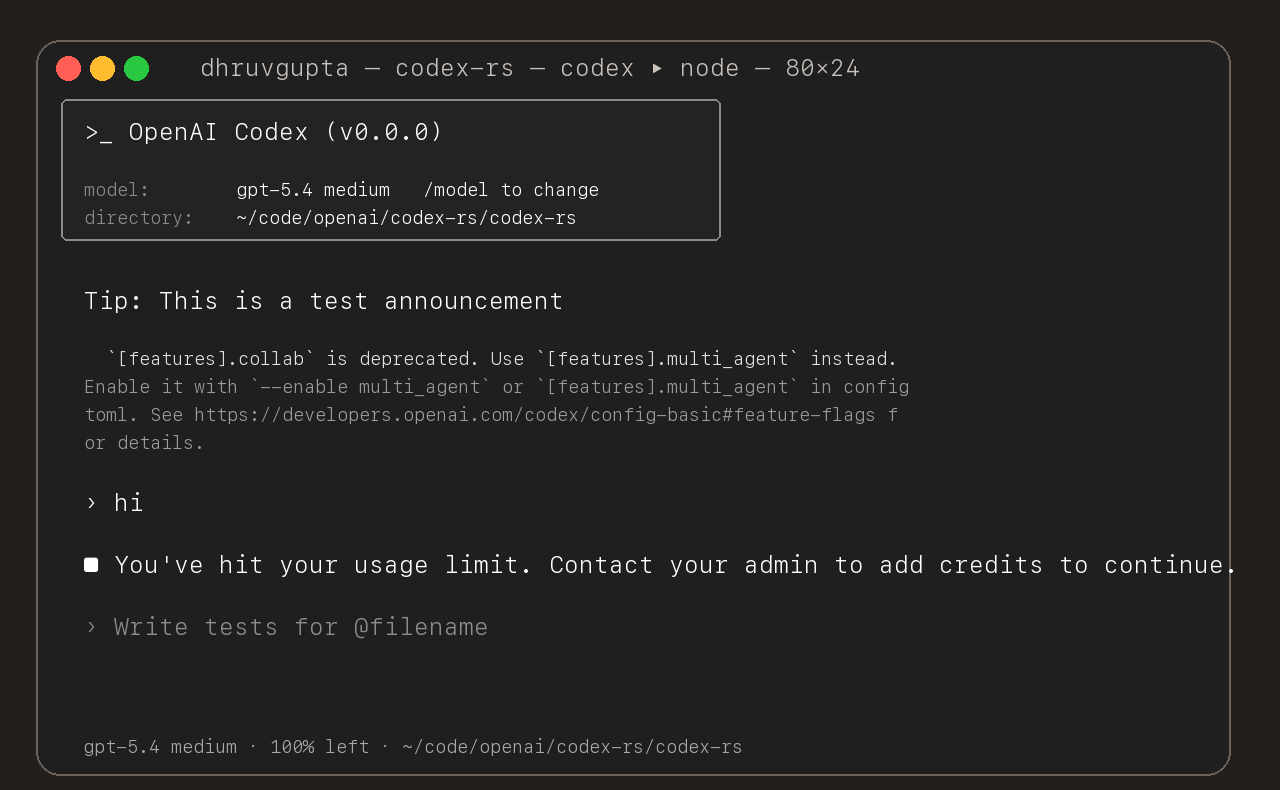
## Summary
- update the self-serve business usage-based limit message to direct
users to their admin for additional credits
- add a focused unit test for the self_serve_business_usage_based plan
branch
Added also:
If you are at a rate limit but you still have credits, codex cli would
tell you to switch the model. We shouldnt do this if you have credits so
fixed this.
## Test
- launched the source-built CLI and verified the updated message is
shown for the self-serve business usage-based plan
This adds a dummy v8-poc project that in Cargo links against our
prebuilt binaries and the ones provided by rusty_v8 for non musl
platforms. This demonstrates that we can successfully link and use v8 on
all platforms that we want to target.

In bazel things are slightly more complicated. Since the libraries as
published have libc++ linked in already we end up with a lot of double
linked symbols if we try to use them in bazel land. Instead we fall back
to building rusty_v8 and v8 from source (cached of course) on the
platforms we ship to.

There is likely some compatibility drift in the windows bazel builder
that we'll need to reconcile before we can re-enable them. I'm happy to
be on the hook to unwind that.
`CODEX_TEST_REMOTE_ENV` will make `test_codex` start the executor
"remotely" (inside a docker container) turning any integration test into
remote test.
## Why
The argument-comment lint now has a packaged DotSlash artifact from
[#15198](https://github.com/openai/codex/pull/15198), so the normal repo
lint path should use that released payload instead of rebuilding the
lint from source every time.

That keeps `just clippy` and CI aligned with the shipped artifact while
preserving a separate source-build path for people actively hacking on
the lint crate.

The current alpha package also exposed two integration wrinkles that the
repo-side prebuilt wrapper needs to smooth over:
- the bundled Dylint library filename includes the host triple, for
example `@nightly-2025-09-18-aarch64-apple-darwin`, and Dylint derives
`RUSTUP_TOOLCHAIN` from that filename
- on Windows, Dylint's driver path also expects `RUSTUP_HOME` to be
present in the environment

Without those adjustments, the prebuilt CI jobs fail during `cargo
metadata` or driver setup. This change makes the checked-in prebuilt
wrapper normalize the packaged library name to the plain
`nightly-2025-09-18` channel before invoking `cargo-dylint`, and it
teaches both the wrapper and the packaged runner source to infer
`RUSTUP_HOME` from `rustup show home` when the environment does not
already provide it.

After the prebuilt Windows lint job started running successfully, it
also surfaced a handful of existing anonymous literal callsites in
`windows-sandbox-rs`. This PR now annotates those callsites so the new
cross-platform lint job is green on the current tree.

## What Changed
- checked in the current
`tools/argument-comment-lint/argument-comment-lint` DotSlash manifest
- kept `tools/argument-comment-lint/run.sh` as the source-build wrapper
for lint development
- added `tools/argument-comment-lint/run-prebuilt-linter.sh` as the
normal enforcement path, using the checked-in DotSlash package and
bundled `cargo-dylint`
- updated `just clippy` and `just argument-comment-lint` to use the
prebuilt wrapper
- split `.github/workflows/rust-ci.yml` so source-package checks live in
a dedicated `argument_comment_lint_package` job, while the released lint
runs in an `argument_comment_lint_prebuilt` matrix on Linux, macOS, and
Windows
- kept the pinned `nightly-2025-09-18` toolchain install in the prebuilt
CI matrix, since the prebuilt package still relies on rustup-provided
toolchain components
- updated `tools/argument-comment-lint/run-prebuilt-linter.sh` to
normalize host-qualified nightly library filenames, keep the `rustup`
shim directory ahead of direct toolchain `cargo` binaries, and export
`RUSTUP_HOME` when needed for Windows Dylint driver setup
- updated `tools/argument-comment-lint/src/bin/argument-comment-lint.rs`
so future published DotSlash artifacts apply the same nightly-filename
normalization and `RUSTUP_HOME` inference internally
- fixed the remaining Windows lint violations in
`codex-rs/windows-sandbox-rs` by adding the required `/*param*/`
comments at the reported callsites
- documented the checked-in DotSlash file, wrapper split, archive
layout, nightly prerequisite, and Windows `RUSTUP_HOME` requirement in
`tools/argument-comment-lint/README.md`
Alternative approach, we use rusty_v8 for all platforms that its
predefined, but lets build from source a musl v8 version with bazel for
x86 and aarch64 only. We would need to release this on github and then
use the release.
Stacked PR 2/3, based on the stub PR.

Adds the exec RPC implementation and process/event flow in exec-server
only.

---------

Co-authored-by: Codex <noreply@openai.com>
## Why

To date, the argument-comment linter introduced in
https://github.com/openai/codex/pull/14651 had to be built from source
to run, which can be a bit slow (both for local dev and when it is run
in CI). Because of the potential slowness, I did not wire it up to run
as part of `just clippy` or anything like that. As a result, I have seen
a number of occasions where folks put up PRs that violate the lint, see
it fail in CI, and then have to put up their PR again.

The goal of this PR is to pre-build a runnable version of the linter and
then make it available via a DotSlash file. Once it is available, I will
update `just clippy` and other touchpoints to make it a natural part of
the dev cycle so lint violations should get flagged _before_ putting up
a PR for review.

To get things started, we will build the DotSlash file as part of an
alpha release. Though I don't expect the linter to change often, so I'll
probably change this to only build as part of mainline releases once we
have a working DotSlash file. (Ultimately, we should probably move the
linter into its own repo so it can have its own release cycle.)

## What Changed
- add a reusable `rust-release-argument-comment-lint.yml` workflow that
builds host-specific archives for macOS arm64, Linux arm64/x64, and
Windows x64
- wire `rust-release.yml` to publish the `argument-comment-lint`
DotSlash manifest on all releases for now, including alpha tags
- package a runnable layout instead of a bare library

The Unix archive layout is:

```text
argument-comment-lint/
  bin/
    argument-comment-lint
    cargo-dylint
  lib/
    libargument_comment_lint@nightly-2025-09-18-<target>.dylib|so
```

On Windows the same layout is published as a `.zip`, with `.exe` and
`.dll` filenames instead.

DotSlash resolves the package entrypoint to
`argument-comment-lint/bin/argument-comment-lint`. That runner finds the
sibling bundled `cargo-dylint` binary plus the single packaged Dylint
library under `lib/`, then invokes `cargo-dylint dylint --lib-path
<that-library>` with the repo's default lint settings.
Fix the CI job by updating it to use artifacts from a more recent
release (`0.115.0`) instead of the existing one (`0.74.0`).

This step in our CI job on PRs started failing today:


334164a6f7/.github/workflows/ci.yml (L33-L47)

I believe it's because this test verifies that the "package npm" script
works, but we want it to be fast and not wait for binaries to be built,
so it uses a GitHub workflow that's already done. Because it was using a
GitHub workflow associated with `0.74.0`, it seems likely that
workflow's history has been reaped, so we need to use a newer one.
### Motivation
- Pinning the action to an immutable commit SHA reduces the risk of
arbitrary code execution in runners with repository access and secrets.

### Description
- Replaced `uses: mlugg/setup-zig@v2` with `uses:
mlugg/setup-zig@d1434d0886 # v2` in three
workflow files.
- Updated the following files: ` .github/workflows/rust-ci.yml`, `
.github/workflows/rust-release.yml`, and `
.github/workflows/shell-tool-mcp.yml` to reference the immutable SHA
while preserving the original `v2` intent in a trailing comment.

### Testing
- No automated tests were run because this is a workflow-only change and
does not affect repository source code, so CI validation will occur on
the next workflow execution.

------
[Codex
Task](https://chatgpt.com/codex/tasks/task_i_69763f570234832d9c67b1b66a27c78d)
## Why

Once the repo-local lint exists, `codex-rs` needs to follow the
checked-in convention and CI needs to keep it from drifting. This commit
applies the fallback `/*param*/` style consistently across existing
positional literal call sites without changing those APIs.

The longer-term preference is still to avoid APIs that require comments
by choosing clearer parameter types and call shapes. This PR is
intentionally the mechanical follow-through for the places where the
existing signatures stay in place.

After rebasing onto newer `main`, the rollout also had to cover newly
introduced `tui_app_server` call sites. That made it clear the first cut
of the CI job was too expensive for the common path: it was spending
almost as much time installing `cargo-dylint` and re-testing the lint
crate as a representative test job spends running product tests. The CI
update keeps the full workspace enforcement but trims that extra
overhead from ordinary `codex-rs` PRs.

## What changed

- keep a dedicated `argument_comment_lint` job in `rust-ci`
- mechanically annotate remaining opaque positional literals across
`codex-rs` with exact `/*param*/` comments, including the rebased
`tui_app_server` call sites that now fall under the lint
- keep the checked-in style aligned with the lint policy by using
`/*param*/` and leaving string and char literals uncommented
- cache `cargo-dylint`, `dylint-link`, and the relevant Cargo
registry/git metadata in the lint job
- split changed-path detection so the lint crate's own `cargo test` step
runs only when `tools/argument-comment-lint/*` or `rust-ci.yml` changes
- continue to run the repo wrapper over the `codex-rs` workspace, so
product-code enforcement is unchanged

Most of the code changes in this commit are intentionally mechanical
comment rewrites or insertions driven by the lint itself.

## Verification

- `./tools/argument-comment-lint/run.sh --workspace`
- `cargo test -p codex-tui-app-server -p codex-tui`
- parsed `.github/workflows/rust-ci.yml` locally with PyYAML

---

* -> #14652
* #14651
This PR replicates the `tui` code directory and creates a temporary
parallel `tui_app_server` directory. It also implements a new feature
flag `tui_app_server` to select between the two tui implementations.

Once the new app-server-based TUI is stabilized, we'll delete the old
`tui` directory and feature flag.
Prevent binaries >500KB from being committed. And maintain an allowlist
if we need to bypass on a case-by-case basis.

I checked the currently tracked binary-like assets in the repo. There
are only 5 obvious committed binaries by extension/MIME type:
- `.github/codex-cli-splash.png`: `838,131` bytes, about `818 KiB`
- `codex-rs/vendor/bubblewrap/bubblewrap.jpg`: `40,239` bytes, about `39
KiB`
-
`codex-rs/skills/src/assets/samples/skill-creator/assets/skill-creator.png`:
`1,563` bytes
- `codex-rs/skills/src/assets/samples/openai-docs/assets/openai.png`:
`1,429` bytes
-
`codex-rs/skills/src/assets/samples/skill-installer/assets/skill-installer.png`:
`1,086` bytes

So `500 KB` looks like a good default for this repo. It would only trip
on one existing intentional asset, which keeps the allowlist small and
the policy easy to understand.

Here's a smoke-test from a throwaway branch that tries to commit a large
binary:
https://github.com/openai/codex/actions/runs/22971558828/job/66689330435?pr=14383
- raise the sdk workflow job timeout from 10 to 15 minutes to reduce
false cancellations near the current limit

---------

Co-authored-by: Codex <noreply@openai.com>
Bumps
[actions/download-artifact](https://github.com/actions/download-artifact)
from 7 to 8.
<details>
<summary>Release notes</summary>
<p><em>Sourced from <a
href="https://github.com/actions/download-artifact/releases">actions/download-artifact's
releases</a>.</em></p>
<blockquote>
<h2>v8.0.0</h2>
<h2>v8 - What's new</h2>
<h3>Direct downloads</h3>
<p>To support direct uploads in <code>actions/upload-artifact</code>,
the action will no longer attempt to unzip all downloaded files.
Instead, the action checks the <code>Content-Type</code> header ahead of
unzipping and skips non-zipped files. Callers wishing to download a
zipped file as-is can also set the new <code>skip-decompress</code>
parameter to <code>false</code>.</p>
<h3>Enforced checks (breaking)</h3>
<p>A previous release introduced digest checks on the download. If a
download hash didn't match the expected hash from the server, the action
would log a warning. Callers can now configure the behavior on mismatch
with the <code>digest-mismatch</code> parameter. To be secure by
default, we are now defaulting the behavior to <code>error</code> which
will fail the workflow run.</p>
<h3>ESM</h3>
<p>To support new versions of the @actions/* packages, we've upgraded
the package to ESM.</p>
<h2>What's Changed</h2>
<ul>
<li>Don't attempt to un-zip non-zipped downloads by <a
href="https://github.com/danwkennedy"><code>@danwkennedy</code></a> in
<a
href="https://redirect.github.com/actions/download-artifact/pull/460">actions/download-artifact#460</a></li>
<li>Add a setting to specify what to do on hash mismatch and default it
to <code>error</code> by <a
href="https://github.com/danwkennedy"><code>@danwkennedy</code></a> in
<a
href="https://redirect.github.com/actions/download-artifact/pull/461">actions/download-artifact#461</a></li>
</ul>
<p><strong>Full Changelog</strong>: <a
href="https://github.com/actions/download-artifact/compare/v7...v8.0.0">https://github.com/actions/download-artifact/compare/v7...v8.0.0</a></p>
</blockquote>
</details>
<details>
<summary>Commits</summary>
<ul>
<li><a
href="70fc10c6e5"><code>70fc10c</code></a>
Merge pull request <a
href="https://redirect.github.com/actions/download-artifact/issues/461">#461</a>
from actions/danwkennedy/digest-mismatch-behavior</li>
<li><a
href="f258da9a50"><code>f258da9</code></a>
Add change docs</li>
<li><a
href="ccc058e5fb"><code>ccc058e</code></a>
Fix linting issues</li>
<li><a
href="bd7976ba57"><code>bd7976b</code></a>
Add a setting to specify what to do on hash mismatch and default it to
<code>error</code></li>
<li><a
href="ac21fcf45e"><code>ac21fcf</code></a>
Merge pull request <a
href="https://redirect.github.com/actions/download-artifact/issues/460">#460</a>
from actions/danwkennedy/download-no-unzip</li>
<li><a
href="15999bff51"><code>15999bf</code></a>
Add note about package bumps</li>
<li><a
href="974686ed50"><code>974686e</code></a>
Bump the version to <code>v8</code> and add release notes</li>
<li><a
href="fbe48b1d27"><code>fbe48b1</code></a>
Update test names to make it clearer what they do</li>
<li><a
href="96bf374a61"><code>96bf374</code></a>
One more test fix</li>
<li><a
href="b8c4819ef5"><code>b8c4819</code></a>
Fix skip decompress test</li>
<li>Additional commits viewable in <a
href="https://github.com/actions/download-artifact/compare/v7...v8">compare
view</a></li>
</ul>
</details>
<br />
[](https://docs.github.com/en/github/managing-security-vulnerabilities/about-dependabot-security-updates#about-compatibility-scores)
Dependabot will resolve any conflicts with this PR as long as you don't
alter it yourself. You can also trigger a rebase manually by commenting
`@dependabot rebase`.
[//]: # (dependabot-automerge-start)
[//]: # (dependabot-automerge-end)
---
<details>
<summary>Dependabot commands and options</summary>
<br />
You can trigger Dependabot actions by commenting on this PR:
- `@dependabot rebase` will rebase this PR
- `@dependabot recreate` will recreate this PR, overwriting any edits
that have been made to it
- `@dependabot show <dependency name> ignore conditions` will show all
of the ignore conditions of the specified dependency
- `@dependabot ignore this major version` will close this PR and stop
Dependabot creating any more for this major version (unless you reopen
the PR or upgrade to it yourself)
- `@dependabot ignore this minor version` will close this PR and stop
Dependabot creating any more for this minor version (unless you reopen
the PR or upgrade to it yourself)
- `@dependabot ignore this dependency` will close this PR and stop
Dependabot creating any more for this dependency (unless you reopen the
PR or upgrade to it yourself)
</details>
Signed-off-by: dependabot[bot] <support@github.com>
Co-authored-by: dependabot[bot] <49699333+dependabot[bot]@users.noreply.github.com>
## Summary
- add a direct install script for Windows at
`scripts/install/install.ps1`
- extend release staging so `install.ps1` is published alongside
`install.sh`
- install the Windows runtime payload (`codex.exe`, `rg.exe`, and helper
binaries) from the existing platform npm package

## Dependencies
- Depends on https://github.com/openai/codex/pull/12740

## Testing
- Smoke-tested with powershell

