 5f4d0ec343
## Summary TL;DR: teaches `codex-rs` / app-server to request a desktop-provided attestation token and attach it as `x-oai-attestation` on the scoped ChatGPT Codex request paths. 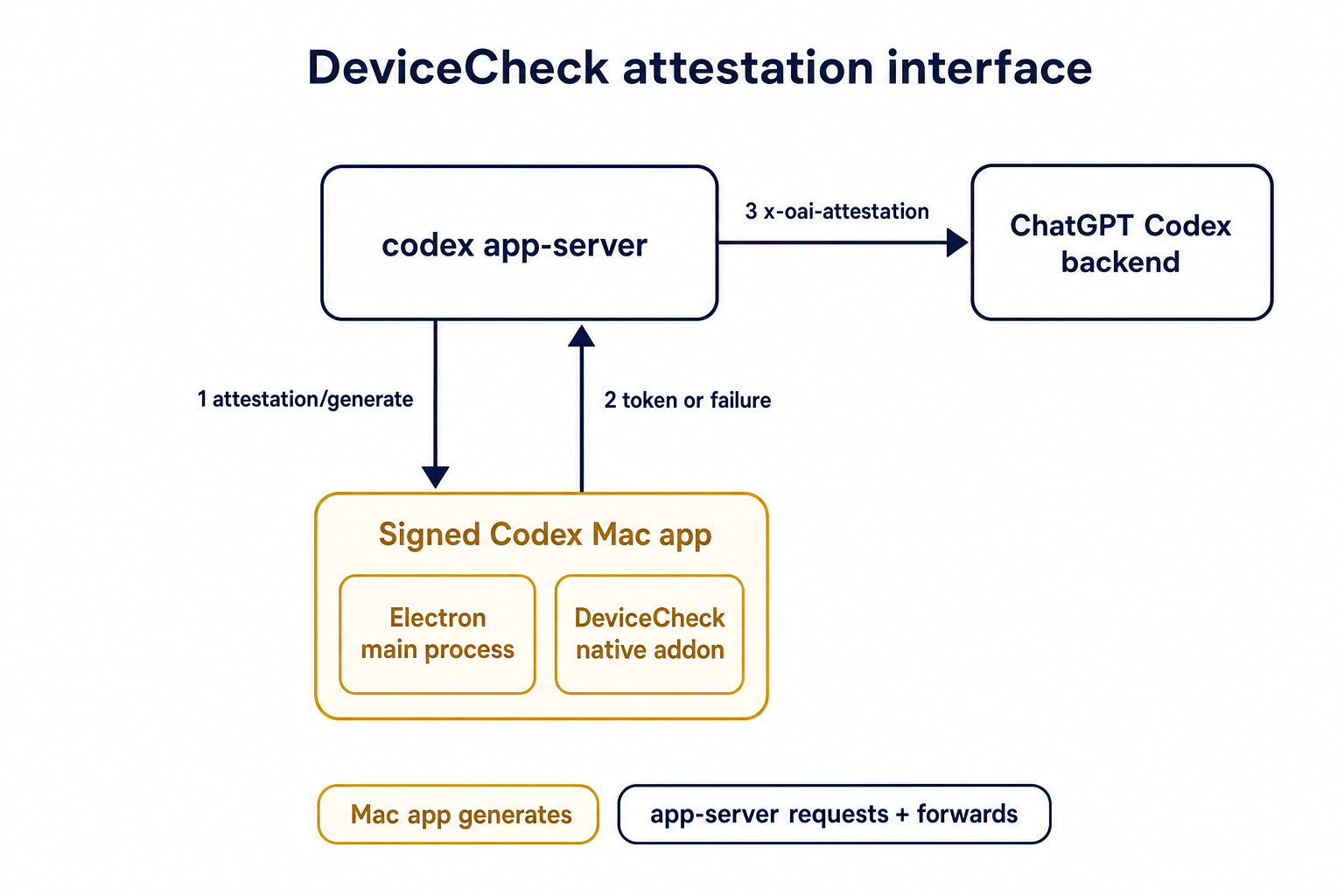 ## Details This PR teaches the Codex app-server runtime how to request and attach an attestation token. It does not generate DeviceCheck tokens directly; instead, it relies on the connected desktop app to advertise that it can generate attestation and then asks that app for a fresh header value when needed. The flow is: 1. The Codex desktop app connects to app-server. 2. During `initialize`, the app can advertise that it supports `requestAttestation`. 3. Before app-server calls selected ChatGPT Codex endpoints, it sends the internal server request `attestation/generate` to the app. 4. app-server receives a pre-encoded header value back. 5. app-server forwards that value as `x-oai-attestation` on the scoped outbound requests. The code in this repo is mostly protocol and runtime plumbing: it adds the app-server request/response shape, introduces an attestation provider in core, wires that provider into Responses / compaction / realtime setup paths, and covers the intended scoping with tests. The signed macOS DeviceCheck generation remains owned by the desktop app PR. ## Related PR - Codex desktop app implementation: https://github.com/openai/openai/pull/878649 ## Validation <details> <summary>Tests run</summary> ```sh cargo test -p codex-app-server-protocol cargo test -p codex-core attestation --lib cargo test -p codex-app-server --lib attestation ``` Also ran: ```sh just fix -p codex-core just fix -p codex-app-server just fix -p codex-app-server-protocol just fmt just write-app-server-schema ``` </details> <details> <summary>E2E DeviceCheck validation</summary> First validated the signed desktop app boundary directly: launched a packaged signed `Codex.app`, sent `attestation/generate`, decoded the returned `v1.` attestation header, and validated the extracted DeviceCheck token with `personal/jm/verify_devicecheck_token.py` using bundle ID `com.openai.codex`. Apple returned `status_code: 200` and `is_ok: true`. Then ran the fuller app + app-server flow. The packaged `Codex.app` launched a current-branch app-server via `CODEX_CLI_PATH`, and a local MITM proxy intercepted outbound `chatgpt.com` traffic. The app-server requested `attestation/generate` from the real Electron app process, and the intercepted `/backend-api/codex/responses` traffic included `x-oai-attestation` on both routes: ```text GET /backend-api/codex/responses Upgrade: websocket x-oai-attestation: present POST /backend-api/codex/responses Upgrade: none x-oai-attestation: present ``` The captured header decoded to a DeviceCheck token that also validated with Apple for `com.openai.codex` (`status_code: 200`, `is_ok: true`, team `2DC432GLL2`). </details> --------- Co-authored-by: Codex <noreply@openai.com>

codex-app-server-client
Shared in-process app-server client used by conversational CLI surfaces:
codex-execcodex-tui
Purpose
This crate centralizes startup and lifecycle management for an in-process
codex-app-server runtime, so CLI clients do not need to duplicate:
- app-server bootstrap and initialize handshake
- in-memory request/event transport wiring
- lifecycle orchestration around caller-provided startup identity
- graceful shutdown behavior
Startup identity
Callers pass both the app-server SessionSource and the initialize
client_info.name explicitly when starting the facade.
That keeps thread metadata (for example in thread/list and thread/read)
aligned with the originating runtime without baking TUI/exec-specific policy
into the shared client layer.
Transport model
The in-process path uses typed channels:
- client -> server:
ClientRequest/ClientNotification - server -> client:
InProcessServerEventServerRequestServerNotificationLegacyNotification
JSON serialization is still used at external transport boundaries (stdio/websocket), but the in-process hot path is typed.
Typed requests still receive app-server responses through the JSON-RPC result envelope internally. That is intentional: the in-process path is meant to preserve app-server semantics while removing the process boundary, not to introduce a second response contract.
Bootstrap behavior
The client facade starts an already-initialized in-process runtime, but thread bootstrap still follows normal app-server flow:
- caller sends
thread/startorthread/resume - app-server returns the immediate typed response
- richer session metadata may arrive later as a
SessionConfiguredlegacy event
Surfaces such as TUI and exec may therefore need a short bootstrap phase where they reconcile startup response data with later events.
Backpressure and shutdown
- Queues are bounded and use
DEFAULT_IN_PROCESS_CHANNEL_CAPACITYby default. - Full queues return explicit overload behavior instead of unbounded growth.
shutdown()performs a bounded graceful shutdown and then aborts if timeout is exceeded.
If the client falls behind on event consumption, the worker emits
InProcessServerEvent::Lagged and may reject pending server requests so
approval flows do not hang indefinitely behind a saturated queue.