mirror of
https://github.com/openai/codex.git
synced 2026-05-17 09:43:19 +00:00
 5f4d0ec343
## Summary TL;DR: teaches `codex-rs` / app-server to request a desktop-provided attestation token and attach it as `x-oai-attestation` on the scoped ChatGPT Codex request paths. 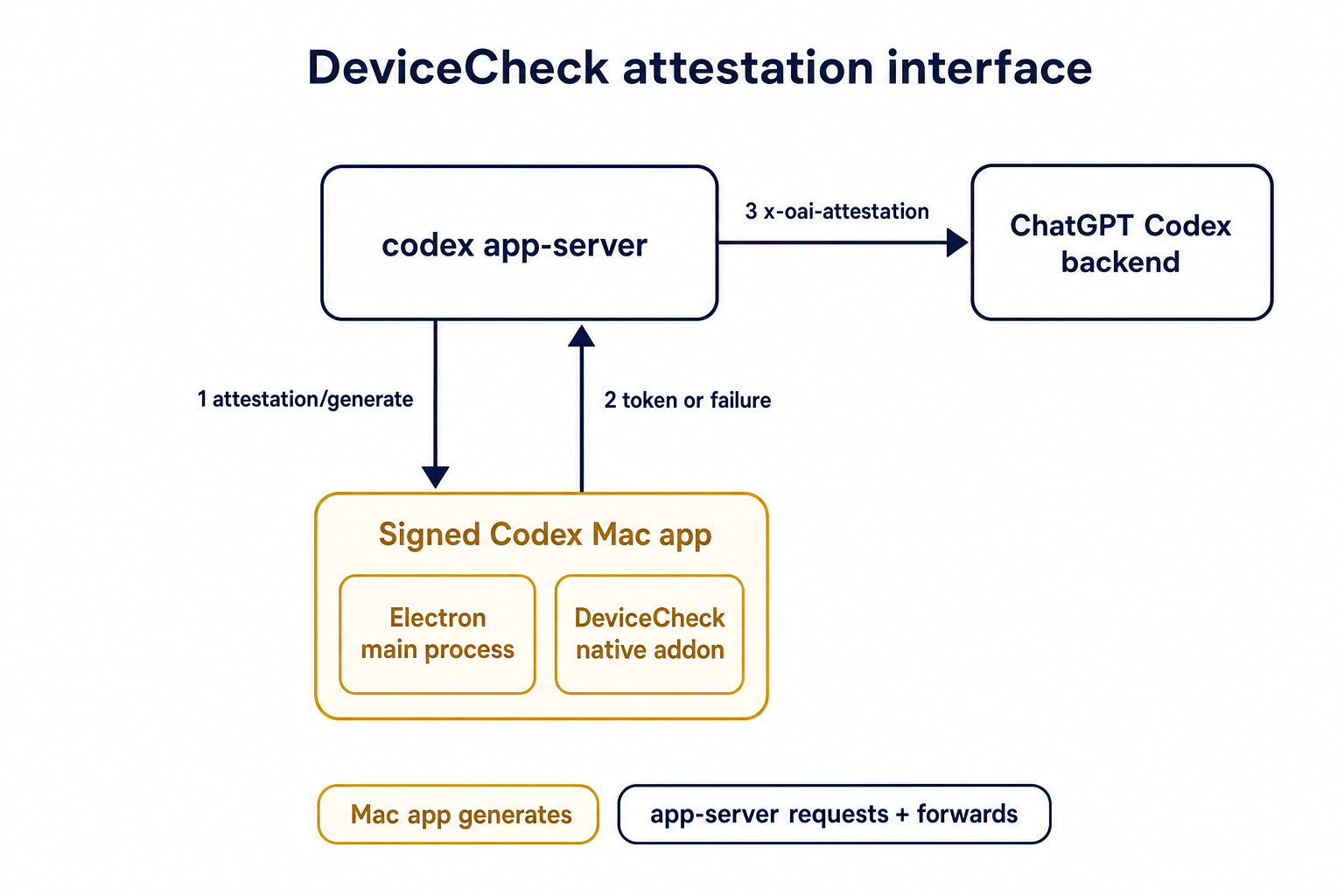 ## Details This PR teaches the Codex app-server runtime how to request and attach an attestation token. It does not generate DeviceCheck tokens directly; instead, it relies on the connected desktop app to advertise that it can generate attestation and then asks that app for a fresh header value when needed. The flow is: 1. The Codex desktop app connects to app-server. 2. During `initialize`, the app can advertise that it supports `requestAttestation`. 3. Before app-server calls selected ChatGPT Codex endpoints, it sends the internal server request `attestation/generate` to the app. 4. app-server receives a pre-encoded header value back. 5. app-server forwards that value as `x-oai-attestation` on the scoped outbound requests. The code in this repo is mostly protocol and runtime plumbing: it adds the app-server request/response shape, introduces an attestation provider in core, wires that provider into Responses / compaction / realtime setup paths, and covers the intended scoping with tests. The signed macOS DeviceCheck generation remains owned by the desktop app PR. ## Related PR - Codex desktop app implementation: https://github.com/openai/openai/pull/878649 ## Validation <details> <summary>Tests run</summary> ```sh cargo test -p codex-app-server-protocol cargo test -p codex-core attestation --lib cargo test -p codex-app-server --lib attestation ``` Also ran: ```sh just fix -p codex-core just fix -p codex-app-server just fix -p codex-app-server-protocol just fmt just write-app-server-schema ``` </details> <details> <summary>E2E DeviceCheck validation</summary> First validated the signed desktop app boundary directly: launched a packaged signed `Codex.app`, sent `attestation/generate`, decoded the returned `v1.` attestation header, and validated the extracted DeviceCheck token with `personal/jm/verify_devicecheck_token.py` using bundle ID `com.openai.codex`. Apple returned `status_code: 200` and `is_ok: true`. Then ran the fuller app + app-server flow. The packaged `Codex.app` launched a current-branch app-server via `CODEX_CLI_PATH`, and a local MITM proxy intercepted outbound `chatgpt.com` traffic. The app-server requested `attestation/generate` from the real Electron app process, and the intercepted `/backend-api/codex/responses` traffic included `x-oai-attestation` on both routes: ```text GET /backend-api/codex/responses Upgrade: websocket x-oai-attestation: present POST /backend-api/codex/responses Upgrade: none x-oai-attestation: present ``` The captured header decoded to a DeviceCheck token that also validated with Apple for `com.openai.codex` (`status_code: 200`, `is_ok: true`, team `2DC432GLL2`). </details> --------- Co-authored-by: Codex <noreply@openai.com>

218 lines
6.6 KiB
Rust
218 lines
6.6 KiB
Rust
use std::sync::Arc;
|
|
|
|
use axum::http::HeaderValue;
|
|
use codex_app_server_protocol::AttestationGenerateParams;
|
|
use codex_app_server_protocol::AttestationGenerateResponse;
|
|
use codex_app_server_protocol::ServerRequestPayload;
|
|
use codex_core::AttestationContext;
|
|
use codex_core::AttestationProvider;
|
|
use codex_core::GenerateAttestationFuture;
|
|
use serde::Serialize;
|
|
use tokio::time::Duration;
|
|
use tokio::time::timeout;
|
|
use tracing::warn;
|
|
|
|
use crate::outgoing_message::OutgoingMessageSender;
|
|
use crate::thread_state::ThreadStateManager;
|
|
|
|
const ATTESTATION_GENERATE_TIMEOUT: Duration = Duration::from_millis(100);
|
|
|
|
pub(crate) fn app_server_attestation_provider(
|
|
outgoing: Arc<OutgoingMessageSender>,
|
|
thread_state_manager: ThreadStateManager,
|
|
) -> Arc<dyn AttestationProvider> {
|
|
Arc::new(AppServerAttestationProvider {
|
|
outgoing,
|
|
thread_state_manager,
|
|
})
|
|
}
|
|
|
|
struct AppServerAttestationProvider {
|
|
outgoing: Arc<OutgoingMessageSender>,
|
|
thread_state_manager: ThreadStateManager,
|
|
}
|
|
|
|
impl std::fmt::Debug for AppServerAttestationProvider {
|
|
fn fmt(&self, formatter: &mut std::fmt::Formatter<'_>) -> std::fmt::Result {
|
|
formatter
|
|
.debug_struct("AppServerAttestationProvider")
|
|
.finish()
|
|
}
|
|
}
|
|
|
|
impl AttestationProvider for AppServerAttestationProvider {
|
|
fn header_for_request(&self, context: AttestationContext) -> GenerateAttestationFuture<'_> {
|
|
let outgoing = self.outgoing.clone();
|
|
let thread_state_manager = self.thread_state_manager.clone();
|
|
Box::pin(async move {
|
|
request_attestation_header_value_with_timeout(
|
|
outgoing,
|
|
thread_state_manager,
|
|
context.thread_id,
|
|
ATTESTATION_GENERATE_TIMEOUT,
|
|
)
|
|
.await
|
|
.and_then(|value| HeaderValue::from_bytes(value.as_bytes()).ok())
|
|
})
|
|
}
|
|
}
|
|
|
|
async fn request_attestation_header_value_with_timeout(
|
|
outgoing: Arc<OutgoingMessageSender>,
|
|
thread_state_manager: ThreadStateManager,
|
|
thread_id: codex_protocol::ThreadId,
|
|
timeout_duration: Duration,
|
|
) -> Option<String> {
|
|
let connection_id = thread_state_manager
|
|
.first_attestation_capable_connection_for_thread(thread_id)
|
|
.await?;
|
|
|
|
let connection_ids = [connection_id];
|
|
let (request_id, rx) = outgoing
|
|
.send_request_to_connections(
|
|
Some(&connection_ids),
|
|
ServerRequestPayload::AttestationGenerate(AttestationGenerateParams {}),
|
|
/*thread_id*/ None,
|
|
)
|
|
.await;
|
|
|
|
let result = match timeout(timeout_duration, rx).await {
|
|
Ok(Ok(Ok(result))) => result,
|
|
Ok(Ok(Err(err))) => {
|
|
warn!(
|
|
code = err.code,
|
|
message = %err.message,
|
|
"attestation generation request failed"
|
|
);
|
|
return app_server_attestation_header_value(
|
|
AppServerAttestationStatus::RequestFailed,
|
|
/*token*/ None,
|
|
);
|
|
}
|
|
Ok(Err(err)) => {
|
|
warn!("attestation generation request canceled: {err}");
|
|
return app_server_attestation_header_value(
|
|
AppServerAttestationStatus::RequestCanceled,
|
|
/*token*/ None,
|
|
);
|
|
}
|
|
Err(_) => {
|
|
let _canceled = outgoing.cancel_request(&request_id).await;
|
|
warn!(
|
|
timeout_seconds = timeout_duration.as_secs(),
|
|
"attestation generation request timed out"
|
|
);
|
|
return app_server_attestation_header_value(
|
|
AppServerAttestationStatus::Timeout,
|
|
/*token*/ None,
|
|
);
|
|
}
|
|
};
|
|
|
|
match serde_json::from_value::<AttestationGenerateResponse>(result) {
|
|
Ok(response) => app_server_attestation_header_value(
|
|
AppServerAttestationStatus::Ok,
|
|
Some(&response.token),
|
|
),
|
|
Err(err) => {
|
|
warn!("failed to deserialize attestation generation response: {err}");
|
|
app_server_attestation_header_value(
|
|
AppServerAttestationStatus::MalformedResponse,
|
|
/*token*/ None,
|
|
)
|
|
}
|
|
}
|
|
}
|
|
|
|
#[derive(Clone, Copy)]
|
|
enum AppServerAttestationStatus {
|
|
Ok,
|
|
Timeout,
|
|
RequestFailed,
|
|
RequestCanceled,
|
|
MalformedResponse,
|
|
}
|
|
|
|
impl AppServerAttestationStatus {
|
|
const fn code(self) -> u8 {
|
|
match self {
|
|
Self::Ok => 0,
|
|
Self::Timeout => 1,
|
|
Self::RequestFailed => 2,
|
|
Self::RequestCanceled => 3,
|
|
Self::MalformedResponse => 4,
|
|
}
|
|
}
|
|
}
|
|
|
|
#[derive(Serialize)]
|
|
struct AppServerAttestationEnvelope<'a> {
|
|
v: u8,
|
|
s: u8,
|
|
#[serde(skip_serializing_if = "Option::is_none")]
|
|
t: Option<&'a str>,
|
|
}
|
|
|
|
fn app_server_attestation_header_value(
|
|
status: AppServerAttestationStatus,
|
|
token: Option<&str>,
|
|
) -> Option<String> {
|
|
serde_json::to_string(&AppServerAttestationEnvelope {
|
|
v: 1,
|
|
s: status.code(),
|
|
t: token,
|
|
})
|
|
.map_err(|err| warn!("failed to serialize app-server attestation envelope: {err}"))
|
|
.ok()
|
|
}
|
|
|
|
#[cfg(test)]
|
|
mod tests {
|
|
use super::AppServerAttestationStatus;
|
|
use super::app_server_attestation_header_value;
|
|
use pretty_assertions::assert_eq;
|
|
|
|
#[test]
|
|
fn app_server_attestation_header_value_wraps_opaque_client_payloads() {
|
|
assert_eq!(
|
|
app_server_attestation_header_value(
|
|
AppServerAttestationStatus::Ok,
|
|
Some("v1.opaque-client-payload"),
|
|
),
|
|
Some(r#"{"v":1,"s":0,"t":"v1.opaque-client-payload"}"#.to_string())
|
|
);
|
|
}
|
|
|
|
#[test]
|
|
fn app_server_attestation_header_value_reports_app_server_failures() {
|
|
assert_eq!(
|
|
app_server_attestation_header_value(
|
|
AppServerAttestationStatus::Timeout,
|
|
/*token*/ None,
|
|
),
|
|
Some(r#"{"v":1,"s":1}"#.to_string())
|
|
);
|
|
assert_eq!(
|
|
app_server_attestation_header_value(
|
|
AppServerAttestationStatus::RequestFailed,
|
|
/*token*/ None,
|
|
),
|
|
Some(r#"{"v":1,"s":2}"#.to_string())
|
|
);
|
|
assert_eq!(
|
|
app_server_attestation_header_value(
|
|
AppServerAttestationStatus::RequestCanceled,
|
|
/*token*/ None,
|
|
),
|
|
Some(r#"{"v":1,"s":3}"#.to_string())
|
|
);
|
|
assert_eq!(
|
|
app_server_attestation_header_value(
|
|
AppServerAttestationStatus::MalformedResponse,
|
|
/*token*/ None
|
|
),
|
|
Some(r#"{"v":1,"s":4}"#.to_string())
|
|
);
|
|
}
|
|
}
|