## Summary
TL;DR: teaches `codex-rs` / app-server to request a desktop-provided
attestation token and attach it as `x-oai-attestation` on the scoped
ChatGPT Codex request paths.
## Details
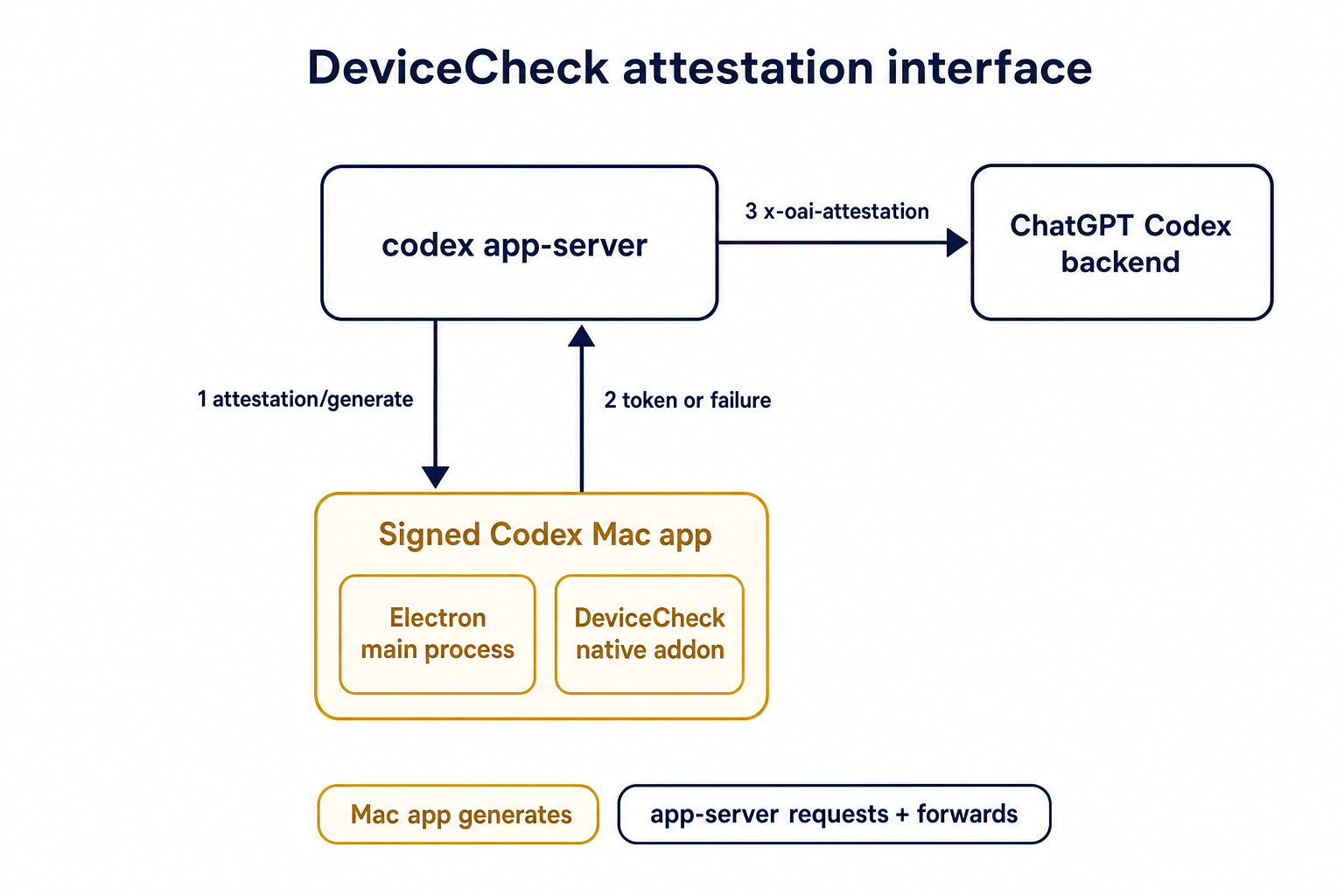
This PR teaches the Codex app-server runtime how to request and attach
an attestation token. It does not generate DeviceCheck tokens directly;
instead, it relies on the connected desktop app to advertise that it can
generate attestation and then asks that app for a fresh header value
when needed.
The flow is:
1. The Codex desktop app connects to app-server.
2. During `initialize`, the app can advertise that it supports
`requestAttestation`.
3. Before app-server calls selected ChatGPT Codex endpoints, it sends
the internal server request `attestation/generate` to the app.
4. app-server receives a pre-encoded header value back.
5. app-server forwards that value as `x-oai-attestation` on the scoped
outbound requests.
The code in this repo is mostly protocol and runtime plumbing: it adds
the app-server request/response shape, introduces an attestation
provider in core, wires that provider into Responses / compaction /
realtime setup paths, and covers the intended scoping with tests. The
signed macOS DeviceCheck generation remains owned by the desktop app PR.
## Related PR
- Codex desktop app implementation:
https://github.com/openai/openai/pull/878649
## Validation
<details>
<summary>Tests run</summary>
```sh
cargo test -p codex-app-server-protocol
cargo test -p codex-core attestation --lib
cargo test -p codex-app-server --lib attestation
```
Also ran:
```sh
just fix -p codex-core
just fix -p codex-app-server
just fix -p codex-app-server-protocol
just fmt
just write-app-server-schema
```
</details>
<details>
<summary>E2E DeviceCheck validation</summary>
First validated the signed desktop app boundary directly: launched a
packaged signed `Codex.app`, sent `attestation/generate`, decoded the
returned `v1.` attestation header, and validated the extracted
DeviceCheck token with `personal/jm/verify_devicecheck_token.py` using
bundle ID `com.openai.codex`. Apple returned `status_code: 200` and
`is_ok: true`.
Then ran the fuller app + app-server flow. The packaged `Codex.app`
launched a current-branch app-server via `CODEX_CLI_PATH`, and a local
MITM proxy intercepted outbound `chatgpt.com` traffic. The app-server
requested `attestation/generate` from the real Electron app process, and
the intercepted `/backend-api/codex/responses` traffic included
`x-oai-attestation` on both routes:
```text
GET /backend-api/codex/responses Upgrade: websocket x-oai-attestation: present
POST /backend-api/codex/responses Upgrade: none x-oai-attestation: present
```
The captured header decoded to a DeviceCheck token that also validated
with Apple for `com.openai.codex` (`status_code: 200`, `is_ok: true`,
team `2DC432GLL2`).
</details>
---------
Co-authored-by: Codex <noreply@openai.com>
## Why

`ToolName::display()` made it too easy to flatten tool identity and
accidentally compare rendered strings. Tool identity should stay
structural until a legacy string boundary actually requires the
flattened spelling.

## What

- Removes `ToolName::display()` and relies on the existing `Display`
impl for messages and errors.
- Adds structural ordering for `ToolName` and uses it for
sorting/deduping deferred tools.
- Carries `ToolName` through tool/sandbox plumbing, flattening only at
legacy boundaries such as hook payloads, telemetry tags, and Responses
tool names.
- Updates MCP normalization tests to assert `ToolName` structure instead
of rendered strings.

## Testing

- `cargo test -p codex-mcp test_normalize_tools`
- `cargo test -p codex-core unavailable_tool`
- `just fix -p codex-protocol`
- `just fix -p codex-mcp`
- `just fix -p codex-core`
## Why

Codex assisted-code attribution needs a client-side accepted-code source
that does not upload raw code. This adds a hash-only analytics event
derived from the turn diff so downstream attribution can compare
accepted Codex lines against commit or PR diffs.

## What Changed

- Parse accepted/effective added lines from the final turn diff and emit
`codex_accepted_line_fingerprints` analytics.
- Hash repo, path, and normalized line content before upload; raw code
and raw diffs are not included in the event.
- Chunk large fingerprint payloads and send accepted-line fingerprint
events in isolated requests while preserving normal batching for other
analytics events.
- Canonicalize Git remote URLs before repo hashing so SSH/HTTPS GitHub
remotes join to the same repo hash.
- Add parser coverage for unified diff hunk lines that look like `+++`
or `---` file headers.

## Verification

- `cargo test -p codex-analytics`
- `cargo test -p codex-git-utils canonicalize_git_remote_url`
- `just fix -p codex-analytics`
- `just bazel-lock-check`
- `git diff --check`
## Why

The earlier PRs add stdio transport support and the config-backed
environment provider, but the feature remains inert until normal Codex
entrypoints construct `EnvironmentManager` with enough context to
discover `CODEX_HOME/environments.toml`. This final stack PR activates
the provider while preserving the legacy `CODEX_EXEC_SERVER_URL`
fallback when no environments file exists.

**Stack position:** this is PR 5 of 5. It is the product wiring PR that
activates the configured environment provider added in PR 4.

## What Changed

- Thread `codex_home` into `EnvironmentManagerArgs`.
- Change `EnvironmentManager::new(...)` to load the provider from
`CODEX_HOME`.
- Preserve legacy behavior by falling back to
`DefaultEnvironmentProvider::from_env()` when `environments.toml` is
absent.
- Make `environments.toml`-backed managers start new threads with all
configured environments, default first, while keeping the legacy env-var
path single-default.
- Update the app-server, TUI, exec, MCP server, connector, prompt-debug,
and thread-manager-sample callsites to pass `codex_home` and handle
provider-loading errors.

## Self-Review Notes

- The multi-environment startup path is intentionally tied to the
`environments.toml` provider. Using `>1` configured environment as the
only signal would also expand the legacy `CODEX_EXEC_SERVER_URL`
provider because it keeps `local` addressable alongside `remote`.
- The startup environment list is still derived inside
`EnvironmentManager`; the provider only says whether its snapshot should
start new threads with all configured environments.
- The thread-manager sample was updated to pass the current
`ThreadManager::new(...)` installation id argument so the stack compiles
under Bazel.

## Stack

- 1. https://github.com/openai/codex/pull/20663 - Add stdio exec-server
listener
- 2. https://github.com/openai/codex/pull/20664 - Add stdio exec-server
client transport
- 3. https://github.com/openai/codex/pull/20665 - Make environment
providers own default selection
- 4. https://github.com/openai/codex/pull/20666 - Add CODEX_HOME
environments TOML provider
- **5. This PR:** https://github.com/openai/codex/pull/20667 - Load
configured environments from CODEX_HOME

Split from original draft: https://github.com/openai/codex/pull/20508

## Validation

- `just fmt`
- `git diff --check`
- `bazel build --config=remote --strategy=remote
--remote_download_toplevel
//codex-rs/thread-manager-sample:codex-thread-manager-sample`
- `bazel test --config=remote --strategy=remote
--remote_download_toplevel
//codex-rs/exec-server:exec-server-unit-tests`
- `bazel test --config=remote --strategy=remote
--remote_download_toplevel --test_sharding_strategy=disabled
--test_arg=default_thread_environment_selections_use_manager_default_id
//codex-rs/core:core-unit-tests`
- `bazel test --config=remote --strategy=remote
--remote_download_toplevel --test_sharding_strategy=disabled
--test_arg=start_thread_uses_all_default_environments_from_codex_home
//codex-rs/core:core-unit-tests`

## Documentation

This activates `CODEX_HOME/environments.toml`; user-facing documentation
should be added before this stack is treated as a documented public
workflow.

---------

Co-authored-by: Codex <noreply@openai.com>
* Pass installation ID for storage on enrollments server for
deduping/grouping multiple appservers per installation
* Pass installation ID in remoteControl/status/changed events
## Why

`/fast` was wired as a one-off slash command even though model metadata
now exposes service tiers as catalog data. That meant adding another
tier, such as a slower/cheaper tier, would require more hardcoded TUI
plumbing instead of letting the model catalog drive the available
commands.

This change makes service-tier commands data-driven: each advertised
`service_tiers` entry becomes a `/name` command using the catalog
description, while the request path sends the tier `id` only when the
selected model supports it.

## What Changed

- Removed the hardcoded `/fast` slash-command variant and introduced
dynamic service-tier command items in the composer and command popup.
- Added toggle behavior for service-tier commands: invoking `/name`
selects that tier, and invoking it again clears the selection.
- Preserved the existing Fast-mode keybinding/status affordances by
resolving the current model tier whose name is `fast`, while still
sending the tier request value such as `priority`.
- Persisted service-tier selections as raw request strings so non-fast
tiers can round-trip through config.
- Updated the Bedrock catalog entry to advertise fast support through
`service_tiers` with `id: "priority"` and `name: "fast"`.
- Added defensive filtering in core so unsupported selected service
tiers are omitted from `/responses` requests.

## Validation

- Added/updated coverage for dynamic service-tier slash command lookup,
popup descriptions, composer dispatch, TUI fast toggling, and
unsupported-tier omission in core request construction.
- Local tests were not run per request.

---------

Co-authored-by: Codex <noreply@openai.com>
Since https://github.com/openai/codex/pull/21255, `rust-ci-full` has
been failing due to a missing `bwrap`.

```
thread 'main' panicked at linux-sandbox/src/launcher.rs:43:13:
bubblewrap is unavailable: no system bwrap was found on PATH and no bundled codex-resources/bwrap binary was found next to the Codex executable
```

Since the happy path is now to use the system binary, let's ensure
that's installed.


8d51826631
was necessary for the `bwrap` executable to be discoverable when the
working directory is `/`.

I ran `rust-ci-full` at
https://github.com/openai/codex/actions/runs/25528074506

---------

Co-authored-by: Codex <noreply@openai.com>
## Summary

1. Removes the broad `DARWIN_USER_CACHE_DIR` write rule from the macOS
Seatbelt network policy.
2. Removes the now unused policy parameter plumbing for that cache path.
3. Adds sandboxing coverage that keeps `com.apple.trustd.agent` for TLS
while rejecting the cache write rule.

## Why

This closes the exact cache poisoning boundary. The earlier `gh` TLS
issue is now covered by trustd access, so the cache write is no longer
needed.

## Validation

1. Rust formatting passed.
2. The sandboxing crate tests passed.
3. Local macOS Seatbelt repro with patched policy passed. `gh api`
returned `21442` without the cache write rule.
Provider initialization installs process-global OTEL state, so invalid
trace metadata needs to fail before setup begins.

Use the same span attribute validator as config loading when traces are
exported so provider startup enforces the config contract without
duplicating validation logic.
## Why
Some consumers expect conventional hyphenated HTTP headers. Codex
already sends the session and thread IDs on outbound Responses requests,
but it only uses the underscore spellings today, which makes those IDs
harder to consume in systems that normalize or reject underscore header
names.

Full context here:
https://openai.slack.com/archives/C08KCGLSPSQ/p1778248578422369

## What changed
- `build_session_headers` now emits both `session_id` and `session-id`
when a session ID is present.
- It does the same for `thread_id` and `thread-id`.
- Added regression coverage in `codex-api/tests/clients.rs` and
`core/tests/suite/client.rs` so both the lower-level client tests and
the end-to-end request tests assert the two header spellings are
present.

## Test plan
- Added header assertions in `codex-api/tests/clients.rs`.
- Added request-header assertions in `core/tests/suite/client.rs` for
both the `/v1/responses` and `/api/codex/responses` request paths.
Fixes#21665.
## Why
The TUI status line is the right place for compact, glanceable session
state. The original request was motivated by the need to see the active
permission posture without opening `/permissions` or `/status`,
especially when switching between safer and more permissive modes during
a session.
This PR intentionally separates `permissions` from `approval-mode`
instead of combining them into one status-line item. They answer related
but different questions: `permissions` describes the active
sandbox/profile shape, while `approval-mode` describes how command
approvals are handled. Keeping them separate makes each item
independently configurable and avoids long combined labels in an already
space-constrained status line.
The tradeoff is that users who want the full permission posture in the
status line need to opt into both items. In exchange, users can show
only the sandbox/profile label, only the approval behavior, or both, and
named user-defined profiles remain concise. Non-standard permission
shapes are rendered as `Custom permissions` rather than trying to
squeeze detailed profile contents into the status line; `/status`
remains the fuller explanatory surface.
## What changed
- Added a configurable `permissions` status-line item.
- Added a separate `approval-mode` status-line item, with `approval` as
an alias.
- Render standard permission states compactly as `Read Only`,
`Workspace`, or `Full Access`.
- Preserve user-defined permission profile names directly in the status
line.
- Render unnamed non-standard permission shapes as `Custom permissions`.
- Refresh status surfaces when `/permissions` updates the permission
profile, approval policy, or approval reviewer.
- Updated status-line preview snapshot coverage for the new items.
## Verification
- `cargo test -p codex-tui
status_permissions_non_default_workspace_write_uses_workspace_label`
- `cargo test -p codex-tui
permissions_selection_emits_history_cell_when_selection_changes`
- `cargo insta pending-snapshots --manifest-path tui/Cargo.toml`
## Why

The configurable `/statusline` and terminal title can display session
token usage. That display was using the raw total token count, which
includes cached input tokens, so it significantly overstated the token
usage compared with the blended token count shown elsewhere (in
`/status` and tracked in goals). This inconsistency resulted in user
confusion. We don't want to report cached tokens because we don't charge
for them and they are somewhat of an implementation detail that users
shouldn't care about.

## What changed

- Use `TokenUsage::blended_total()` for the `used-tokens` status surface
item so cached input is excluded.
- Add a brief comment to `tokens_in_context_window()` clarifying that it
returns raw `total_tokens`, whose meaning depends on whether the caller
has last-turn or accumulated usage.
## Summary
- enable `apply_patch_freeform` by default in the feature registry

## Why
- make the freeform `apply_patch` tool available by default when model
metadata does not explicitly opt into another mode

## Validation
- `just fmt`
- did not run tests

---------

Co-authored-by: Codex <noreply@openai.com>
## Why

`service_tier` in `config.toml` and profile config was still modeled as
an enum, which blocked newer or experimental service tier IDs even
though the runtime paths already carry string IDs.

This change makes the TOML-facing config accept string service tier IDs
directly while keeping the legacy `fast` alias behavior by normalizing
it to the request value `priority`.

## What Changed

- change the TOML-facing `service_tier` fields in global and profile
config to `Option<String>`
- keep config-load normalization so legacy `fast` still resolves to
`priority`
- persist resolved service tier strings directly in config locks so
arbitrary IDs round-trip cleanly
- regenerate the config schema and add config coverage for arbitrary
string IDs plus legacy `fast` normalization

## Verification

- added config tests for arbitrary string service tiers and legacy
`fast` normalization
- ran `just write-config-schema`
- CI

---------

Co-authored-by: Codex <noreply@openai.com>
## What changed
- rewrote `shutdown_flushes_pending_metadata_irrelevant_updated_at` to
seed an existing pending `updated_at` touch directly in
`RolloutWriterState`
- kept the shutdown test focused on draining a pending touch, leaving
the separate coalescing test to cover timing-based deferral

## Why
The old test had to complete several async operations inside the 50 ms
test-only coalescing window. When that sequence took longer, the second
flush updated `threads.updated_at` immediately and the pre-shutdown
equality assertion failed, even though shutdown behavior was correct.

## Validation
- `cargo test -p codex-rollout
shutdown_flushes_pending_metadata_irrelevant_updated_at`
- `cargo test -p codex-rollout`

Co-authored-by: Codex <noreply@openai.com>
## Summary

API-key-auth remote compaction requests should not inherit
`service_tier` from normal `/responses` turns. This path needs to match
API auth expectations, while ChatGPT-auth remote compaction should keep
reusing the shared request fields that still apply there.

This change keeps the decision inline in
`codex-rs/core/src/compact_remote.rs` only. Under API key auth, the
classic remote `/responses/compact` path now omits `service_tier`; under
ChatGPT auth, it keeps reusing the configured tier.
`codex-rs/core/src/compact_remote_v2.rs` is unchanged. The remote
compaction parity coverage and snapshots were updated to assert the
API-key omission and preserve the ChatGPT-auth behavior.

## Testing

- Updated remote compaction parity coverage in
`codex-rs/core/tests/suite/compact_remote.rs` and the corresponding
snapshots.
## Why
`codex exec` still included the stale `research preview` label in its
human-readable startup banner, which makes the CLI look older and less
current than it is.
Fixes#21444.
## What Changed
Removed the hard-coded ` (research preview)` suffix from the `OpenAI
Codex v<version>` startup banner in
`codex-rs/exec/src/event_processor_with_human_output.rs`.
## Validation
Local validation was not required for this one-line startup banner text
cleanup.
Requires discoverability on plugin/share/updateTargets so the server can
manage workspace link access consistently, including auto-adding the
workspace principal for UNLISTED.

Also rejects LISTED on share creation and blocks client-supplied
workspace principals while preserving response parsing for LISTED.
## Summary

Codex's Amazon Bedrock provider signs Mantle requests with SigV4 using
credentials resolved by the AWS SDK. That worked for standard AWS
profiles and environment credentials, but AWS CLI console-login profiles
created by `aws login` require the SDK's `credentials-login` feature to
resolve `login_session` credentials.

This change enables that credential provider so Bedrock can use AWS
console-login credentials through the existing provider-owned AWS auth
path.

While testing the console-login path, we also hit a Mantle-specific
SigV4 regression from the new split between `session_id` and
`thread_id`. Mantle does not preserve legacy OpenAI compatibility
headers that use `snake_case` before SigV4 verification, so signing
those headers can make the server reconstruct a different canonical
request. The Bedrock auth path now removes that header class before
signing, keeping preserved hyphenated Codex/AWS headers such as
`x-codex-turn-metadata` signed normally.

## Changes

- Enable `aws-config`'s `credentials-login` feature in
`codex-rs/aws-auth`.
- Add a compile-time regression test for
`aws_config::login::LoginCredentialsProvider`.
- Strip `snake_case` compatibility headers from Bedrock Mantle SigV4
requests before signing.
- Expand the Bedrock auth regression test to cover `session_id`,
`thread_id`, and future headers of the same shape.
- Refresh Cargo and Bazel lockfiles for the added `aws-sdk-signin`
dependency.

## Tests
- tested with `aws login` locally and verified that it works as
intended.
## Summary
- Remove `perCwdExtraUserRoots` / `SkillsListExtraRootsForCwd` from the
`skills/list` app-server API.
- Drop Rust app-server and `codex-core-skills` extra-root plumbing so
skill scans are keyed by the normal cwd/user/plugin roots only.
- Regenerate app-server schemas and update docs/tests that only existed
for the removed extra-roots behavior.

## Validation
- `just write-app-server-schema`
- `just fmt`
- `cargo test -p codex-app-server-protocol`
- `cargo test -p codex-core-skills`
- `just fix -p codex-app-server-protocol`
- `just fix -p codex-core-skills`
- `just fix -p codex-app-server`
- `just fix -p codex-tui`

## Notes
- `cargo test -p codex-app-server --test all skills_list` ran the edited
skills-list cases, but the full filtered run ended on existing
`skills_changed_notification_is_emitted_after_skill_change` timeout
after a websocket `401`.
- `cargo test -p codex-tui --lib` compiled the changed TUI callers, then
failed two unrelated status permission tests because local
`/etc/codex/requirements.toml` forbids `DangerFullAccess`.
- Source-truth check found the OpenAI monorepo still has
generated/app-server-kit mirror references to the removed field; those
should be cleaned up when generated app-server types are synced or in a
companion OpenAI cleanup.
## Why

We want terminal tool review analytics, but the reducer should not stamp
review timing from its own wall clock.

This PR plumbs review timing through the real protocol and app-server
seams so downstream analytics can consume the emitter's timestamps
directly. Guardian reviews keep their enriched `started_at` /
`completed_at` analytics fields by deriving those legacy second-based
values from the same protocol-native millisecond lifecycle timestamps,
rather than sampling a separate analytics clock.

## What changed

- add `started_at_ms` to user approval request payloads
- add `started_at_ms` / `completed_at_ms` to guardian review
notifications
- preserve Guardian review `started_at` / `completed_at` enrichment from
the protocol-native timing source
- stamp typed `ServerResponse` analytics facts with app-server-observed
`completed_at_ms`
- thread the new timing fields through core, protocol, app-server, TUI,
and analytics fixtures

## Verification

- `cargo test -p codex-app-server outgoing_message --manifest-path
codex-rs/Cargo.toml`
- `cargo test -p codex-app-server-protocol guardian --manifest-path
codex-rs/Cargo.toml`
- `cargo test -p codex-tui guardian --manifest-path codex-rs/Cargo.toml`
- `cargo test -p codex-analytics analytics_client_tests --manifest-path
codex-rs/Cargo.toml`

---
[//]: # (BEGIN SAPLING FOOTER)
Stack created with [Sapling](https://sapling-scm.com). Best reviewed
with [ReviewStack](https://reviewstack.dev/openai/codex/pull/21434).
* #18748
* __->__ #21434
* #18747
* #17090
* #17089
* #20514
## Why

Remote compaction v2 consumes a normal Responses stream, but that
compaction-specific stream consumer dropped the `response.completed` id.
As a result, the `responses_websocket_response_processed` lifecycle
notification was emitted for normal turn sampling but not after a v2
remote compaction response was fully processed.

## What changed

- Return the completed response id alongside the v2 `context_compaction`
output item.
- After v2 compacted history is installed, send `response.processed`
through the same websocket session when the feature is enabled.
- Add websocket regression coverage for a remote compaction v2 request
followed by `response.processed`.

## Verification

- `cargo test -p codex-core --test all
responses_websocket_sends_response_processed_after_remote_compaction_v2
-- --nocapture`
- `cargo test -p codex-core
collect_context_compaction_output_accepts_additional_output_items --
--nocapture`
## Why

After stdio transports and provider-owned defaults exist, Codex needs a
config-backed provider that can describe more than the single legacy
`CODEX_EXEC_SERVER_URL` remote. This PR adds that provider without
activating it in product entrypoints yet, keeping parser/validation
review separate from runtime wiring.

**Stack position:** this is PR 4 of 5. It builds on PR 3's
provider/default model and adds the `environments.toml` provider used by
PR 5.

## What Changed

- Add `environment_toml.rs` as the TOML-specific home for parsing,
validation, and provider construction.
- Keep the TOML schema/provider structs private; the public constructor
added here is `EnvironmentManager::from_codex_home(...)`.
- Add `TomlEnvironmentProvider`, including validation for:
  - reserved ids such as `local` and `none`
  - duplicate ids
  - unknown explicit defaults
  - empty programs or URLs
  - exactly one of `url` or `program` per configured environment
- Support websocket environments with `url = "ws://..."` / `wss://...`.
- Support stdio-command environments with `program = "..."`.
- Add helpers to load `environments.toml` from `CODEX_HOME`, but do not
wire entrypoints to call them yet.
- Add the `toml` dependency for parsing.

## Stack

- 1. https://github.com/openai/codex/pull/20663 - Add stdio exec-server
listener
- 2. https://github.com/openai/codex/pull/20664 - Add stdio exec-server
client transport
- 3. https://github.com/openai/codex/pull/20665 - Make environment
providers own default selection
- **4. This PR:** https://github.com/openai/codex/pull/20666 - Add
CODEX_HOME environments TOML provider
- 5. https://github.com/openai/codex/pull/20667 - Load configured
environments from CODEX_HOME

Split from original draft: https://github.com/openai/codex/pull/20508

## Validation

Not run locally; this was split out of the original draft stack.

## Documentation

This introduces the config shape for `environments.toml`; user-facing
documentation should be added before this stack is treated as a
documented public workflow.

---------

Co-authored-by: Codex <noreply@openai.com>
Route view_image through selected environments so image reads use the selected turn environment and cwd, with schema exposure limited to multi-environment toolsets.\n\nCo-authored-by: Codex <noreply@openai.com>
## Why

The next PR in this stack introduces configured environments, where the
provider knows both which environments exist and which one should be
selected by default. The existing manager derived the default internally
by checking for the legacy `remote` and `local` ids, and it treated
"remote" as equivalent to "has a websocket URL." That does not work
cleanly for stdio-command remotes because they are remote environments
without an `exec_server_url`.

**Stack position:** this is PR 3 of 5. It is the environment-model
bridge between PR 2's transport enum and PR 4's TOML provider.

## What Changed

- Add `DefaultEnvironmentSelection` to the `EnvironmentProvider`
contract:
  - `Derived` preserves the old `remote`-then-`local` fallback behavior.
- `Environment(id)` lets a provider explicitly select a configured
default.
- `Disabled` lets a provider intentionally expose no default
environment.
- Move the legacy `CODEX_EXEC_SERVER_URL=none` default-disabling
behavior into `DefaultEnvironmentProvider`.
- Make `EnvironmentManager` validate explicit provider defaults and
return an error if the selected id is missing.
- Track `remote_transport` separately from `exec_server_url` so
stdio-command environments are still recognized as remote.
- Add `Environment::remote_stdio_shell_command(...)` for the TOML
provider added in the next PR.

## Stack

- 1. https://github.com/openai/codex/pull/20663 - Add stdio exec-server
listener
- 2. https://github.com/openai/codex/pull/20664 - Add stdio exec-server
client transport
- **3. This PR:** https://github.com/openai/codex/pull/20665 - Make
environment providers own default selection
- 4. https://github.com/openai/codex/pull/20666 - Add CODEX_HOME
environments TOML provider
- 5. https://github.com/openai/codex/pull/20667 - Load configured
environments from CODEX_HOME

Split from original draft: https://github.com/openai/codex/pull/20508

## Validation

Not run locally; this was split out of the original draft stack.

---------

Co-authored-by: Codex <noreply@openai.com>
Remove the remote thread-store backend and checked-in protobuf
artifacts. We've moved these into another crate that link against this
one.

Also remove the config settings for thread store backend selection,
since we'll instead pass an instantiated thread store into the core-api
crate's main entrypoint.
## Why

Configured environments need to connect to exec-server instances that
are not necessarily already listening on a websocket URL. A
command-backed stdio transport lets Codex start an exec-server process,
speak JSON-RPC over its stdio streams, and clean up that child process
with the client lifetime.

**Stack position:** this is PR 2 of 5. It builds on the server-side
stdio listener from PR 1 and provides the client transport used by later
environment/config PRs.

## What Changed

- Add `ExecServerTransport` variants for websocket URLs and stdio shell
commands.
- Add stdio command connection support for `ExecServerClient`.
- Move websocket/stdio transport setup into `client_transport.rs` so
`client.rs` stays focused on shared JSON-RPC client, session, HTTP, and
notification behavior.
- Tie stdio child process cleanup to the JSON-RPC connection lifetime
with a RAII lifetime guard.
- Keep existing websocket environment behavior by adapting URL-backed
remotes to `ExecServerTransport::WebSocketUrl`.

## Stack

- 1. https://github.com/openai/codex/pull/20663 - Add stdio exec-server
listener
- **2. This PR:** https://github.com/openai/codex/pull/20664 - Add stdio
exec-server client transport
- 3. https://github.com/openai/codex/pull/20665 - Make environment
providers own default selection
- 4. https://github.com/openai/codex/pull/20666 - Add CODEX_HOME
environments TOML provider
- 5. https://github.com/openai/codex/pull/20667 - Load configured
environments from CODEX_HOME

Split from original draft: https://github.com/openai/codex/pull/20508

## Validation

Not run locally; this was split out of the original draft stack and then
refactored to separate transport setup from the base client.

---------

Co-authored-by: Codex <noreply@openai.com>
Add Codex config for static trace span attributes and structured W3C
tracestate field upserts. The config flows through OtelSettings so
callers can attach trace metadata without touching every span call site.

Apply span attributes with an SDK span processor so every exported
trace span carries the configured metadata. Model tracestate as nested
member fields so configured keys can be upserted while unrelated
propagated state in the same member is preserved.

Validate configured tracestate before installing provider-global state,
including header-unsafe values the SDK does not reject by itself. This
keeps Codex from propagating malformed trace context from config.

Update the config schema, public docs, and OTLP loopback coverage for
config parsing, span export, propagation, and invalid-header rejection.
## Why
The goal of this PR is to align on app-server and `ThreadStore` API
updates for paginating through large threads.


#### app-server
##### `thread/turns/list`
- Updates `thread/turns/list` to support `itemsView?: "notLoaded" |
"summary" | "full" | null`, defaulting to `summary`.
- Implements the current `thread/turns/list` behavior over the existing
persisted rollout-history fallback:
  - `notLoaded` returns turn envelopes with empty `items`.
- `summary` returns the first user message and final assistant message
when available.
  - `full` preserves the existing full item behavior.

Note that this method still uses the naive approach of loading the
entire rollout file, and returns just the filtered slice of the data.
Real pagination will come later by leveraging SQLite.

##### `thread/turns/items/list`
- Adds the experimental `thread/turns/items/list` protocol, schema,
dispatcher, and processor stub. The app-server currently returns
JSON-RPC `-32601` with `thread/turns/items/list is not supported yet`.

#### ThreadStore
- Adds the experimental `thread/turns/items/list` protocol, schema,
dispatcher, and processor stub. The app-server currently returns
JSON-RPC `-32601` with `thread/turns/items/list is not supported yet`.
- Adds `ThreadStore` contract types and stubbed methods for listing
thread turns and listing items within a turn.
- Adds a typed `StoredTurnStatus` and `StoredTurnError` to avoid baking
app-server API enums or lossy string status values into the store-facing
turn contract.
- Adds a typed `StoredTurnStatus` and `StoredTurnError` to avoid baking
app-server API enums or lossy string status values into the store-facing
turn contract.

This also sketches the storage abstraction we expect to need once turns
are indexed/stored. In particular, `notLoaded` is useful only if
ThreadStore can eventually list turn metadata without loading every
persisted item for each turn.

## Validation

- Added/updated protocol serialization coverage for the new request and
response shapes.
- Added app-server integration coverage for `thread/turns/list` default
summary behavior and all three `itemsView` modes.
- Added app-server integration coverage that `thread/turns/items/list`
returns the expected unsupported JSON-RPC error when experimental APIs
are enabled.
- Added thread-store coverage that the default trait methods return
`ThreadStoreError::Unsupported`.

No developers.openai.com documentation update is needed for this
internal experimental app-server API surface.
## Summary

`cargo test` has entails both running standard Rust tests and doctests.
It turns out that the doctest discovery is fairly slow, and it's a cost
you pay even for crates that don't include any doctests.

This PR disables doctests with `doctest = false` for crates that lack
any doctests.

For the collection of crates below, this speeds up test execution by
>4x.

E.g., before this PR:

```
Benchmark 1: cargo test     -p codex-utils-absolute-path     -p codex-utils-cache     -p codex-utils-cli     -p codex-utils-home-dir     -p codex-utils-output-truncation     -p codex-utils-path     -p codex-utils-string     -p codex-utils-template     -p codex-utils-elapsed     -p codex-utils-json-to-toml
  Time (mean ± σ):      1.849 s ±  4.455 s    [User: 0.752 s, System: 1.367 s]
  Range (min … max):    0.418 s … 14.529 s    10 runs
```

And after:

```
Benchmark 1: cargo test     -p codex-utils-absolute-path     -p codex-utils-cache     -p codex-utils-cli     -p codex-utils-home-dir     -p codex-utils-output-truncation     -p codex-utils-path     -p codex-utils-string     -p codex-utils-template     -p codex-utils-elapsed     -p codex-utils-json-to-toml
  Time (mean ± σ):     428.6 ms ±   6.9 ms    [User: 187.7 ms, System: 219.7 ms]
  Range (min … max):   418.0 ms … 436.8 ms    10 runs
```

For a single crate, with >2x speedup, before:

```
Benchmark 1: cargo test -p codex-utils-string
  Time (mean ± σ):     491.1 ms ±   9.0 ms    [User: 229.8 ms, System: 234.9 ms]
  Range (min … max):   480.9 ms … 512.0 ms    10 runs
```

And after:

```
Benchmark 1: cargo test -p codex-utils-string
  Time (mean ± σ):     213.9 ms ±   4.3 ms    [User: 112.8 ms, System: 84.0 ms]
  Range (min … max):   206.8 ms … 221.0 ms    13 runs
```

Co-authored-by: Codex <noreply@openai.com>
A clean release build takes ~18m and an incremental build takes ~12m.
This is far too slow to iterate on performance related changes and the
build time is dominated by LTO.

This pull request adds a `profiling` profile for Cargo which takes ~13m
clean and ~6m incremental, the primary change is that LTO is disabled.
This matches a profile used in uv and follows the great work at
https://github.com/astral-sh/uv/pull/5955 — there's a bit of commentary
there about the trade-offs this implies.

We've found that this does not inhibit the ability to accurately
benchmark as measurements with LTO disabled are generally consistent
with the results with LTO enabled and it makes it much faster (~2x) to
rebuild after making a change.

This is motivated by my interest in improving Codex TUI performance,
which is blocked by the tragically builds right now.

I tested incremental build times by making a no-op change to the
`codex-cli` crate.
## Why

Codex desktop copies bundled Windows binaries out of `WindowsApps` into
a LocalAppData runtime cache before launching `codex.exe`. Sandboxed
commands can then need to execute helpers from that cache, but the
sandbox user group may not have read/execute access to the runtime bin
directory.

This makes the Windows sandbox refresh path repair that access directly
so the packaged desktop runtime remains usable from sandboxed sessions.

## What changed

- Added `setup_runtime_bin` to locate `%LOCALAPPDATA%\OpenAI\Codex\bin`,
matching the desktop bundled-binaries destination path, with the same
`USERPROFILE\AppData\Local` fallback shape.
- During refresh setup, check whether `CodexSandboxUsers` already has
read/execute access to the runtime bin directory.
- If access is missing, grant `CodexSandboxUsers` `OI/CI/RX` inheritance
on that directory.
- If the runtime bin directory does not exist, no-op cleanly.

## Verification

- `cargo build -p codex-windows-sandbox --bin
codex-windows-sandbox-setup`
- `cargo test -p codex-windows-sandbox --bin
codex-windows-sandbox-setup`
- Manual Windows ACL exercise against the installed packaged runtime
bin:
- existing inherited `CodexSandboxUsers:(I)(OI)(CI)(RX)` no-ops without
changing SDDL
- after disabling inheritance and removing the group ACE, setup adds
`CodexSandboxUsers:(OI)(CI)(RX)`
- with `LOCALAPPDATA` pointed at a fake location without
`OpenAI\Codex\bin`, setup exits successfully and does not create the
directory
- restored the real runtime bin with inherited ACLs and confirmed the
final SDDL matched the baseline exactly
- Route ThreadManager rollout-path resume/fork through ThreadStore
history reads.
- Add in-memory store coverage proving path-addressed reads are used.

This isn't strictly necessary for the ThreadStore migration, since these
ThreadManager methods _only_ work for path-based lookups, but I'm trying
to migrate all the rollout recorder callsites to use the threadstore
were possible for consistency.
## Summary

Fix `getConversationSummary` so thread-id summaries work for stored
threads that do not have a local rollout path, such as remote thread
stores.

The root cause was that `summary_from_stored_thread` returned `None`
when `StoredThread.rollout_path` was absent, and
`get_thread_summary_response_inner` treated that as an internal error.
This made conversation-id lookups depend on a local-only field even
though the thread store can address the thread by id.
- Route live thread renames through `ThreadStore` metadata updates.
- Read resumed thread names from store metadata with legacy local
fallback preserved in the store.
## Why

This is the next stacked step after deleting the tool-handler kind
indirection. Specs should come from the registered handlers themselves
so registry construction has a single source of truth for handler
behavior and exposed tool definitions.

## What changed

- Added `ToolHandler::spec()` plus handler-provided parallel/code-mode
metadata, and made `ToolRegistryBuilder::register_handler` automatically
collect specs from registered handlers.
- Moved builtin tool spec construction into the corresponding handlers
and their adjacent `_spec` modules, including shell, unified exec, apply
patch, view image, request plugin install, tool search, MCP resource,
goals, planning, permissions, agent jobs, and multi-agent tools.
- Reworked configurable handlers to receive their tool-building options
through constructors, with non-optional handler options where the
handler is always spec-backed. Shell fallback handlers keep an explicit
no-spec mode because they are also registered as hidden dispatch
aliases.
- Kept `CodeModeExecuteHandler` on the explicit configured wrapper so
the code-mode exec spec can still be built from the nested registry.

## Verification

- `cargo check -p codex-core`
- `cargo test -p codex-core tools::spec_plan::tests`
- `cargo test -p codex-core tools::spec::tests`
- `cargo test -p codex-core tools::handlers::multi_agents_spec::tests`
- `RUST_MIN_STACK=16777216 cargo test -p codex-core
tools::handlers::multi_agents::tests`
- `cargo test -p codex-core tools::handlers::apply_patch::tests`
- `cargo test -p codex-core tools::handlers::unified_exec::tests`
- `just fix -p codex-core`
- `git diff --check`
## Why

App-server config writes were leaving existing threads partially stale.
After a config mutation, the app-server told each live thread to run
`Op::ReloadUserConfig`, but that path only re-read the user
`config.toml` layer. Settings that came from the app-server's
materialized config snapshot did not propagate to existing threads until
restart.

This change prevent a FS access from `core` for CCA.

## What changed

- add `CodexThread::refresh_runtime_config()` and
`Session::refresh_runtime_config()` so the app-server can push a freshly
rebuilt config snapshot into a live thread
- rebuild the latest config with each thread's `cwd` after config
mutations, then refresh the thread from that snapshot instead of asking
it to reload only `config.toml`
- keep session-static settings unchanged during refresh, while updating
runtime-refreshable state such as the config layer stack,
`tool_suggest`, and derived hook/plugin/skill state
- keep `reload_user_config_layer()` as the file-backed fallback for
legacy local reload flows, but route the shared refresh logic through
the new runtime refresh path

## Testing

- add a session test that verifies `refresh_runtime_config()` rebuilds
hooks from refreshed config
- add a session test that verifies runtime-refreshable fields update
while session-static settings like `model` and `notify` stay unchanged

---------

Co-authored-by: Codex <noreply@openai.com>
## Summary

`codex --enable remote_control app-server --listen off` is the current
way to start a headless, remote-controllable app-server, but it is hard
to remember and exposes implementation details.

This adds `codex remote-control` as a friendly top-level wrapper for
that flow. The command starts a foreground app-server with local
transports disabled and enables `remote_control` only for that
invocation.

## Changes

- Add a visible `codex remote-control` CLI subcommand.
- Launch app-server with `AppServerTransport::Off`.
- Append `features.remote_control=true` after root feature toggles so
the explicit command wins over `--disable remote_control`.
- Reject root `--remote` / `--remote-auth-token-env`, matching other
non-TUI subcommands.
- Add tests for parsing, launch defaults, override ordering, and remote
flag rejection.

## Verification

- `cargo test -p codex-cli`
- `just fix -p codex-cli`
## Summary

This PR removes the synthetic `HashMap<String, ToolInfo>` keys from MCP
tool discovery. `McpConnectionManager::list_all_tools()` now returns
normalized `Vec<ToolInfo>`, and downstream code derives identity from
`ToolInfo::canonical_tool_name()`.

The motivation is to keep model-visible tool identity on
`ToolName`/`ToolInfo` instead of parallel string map keys, so future
namespace changes do not have to preserve otherwise-unused lookup keys.

## Changes

- Rename the MCP normalization path from `qualify_tools` to
`normalize_tools_for_model` and return tool values directly.
- Flow MCP tool lists through connectors, plugin injection, router/spec
building, code mode, and tool search as vectors/slices.
- Keep direct/deferred subtraction local to `mcp_tool_exposure`, using
`ToolName` values.
- Update tests to compare `ToolName` instances where MCP identity
matters.

## Validation

- `cargo test -p codex-mcp test_normalize_tools`
- `cargo test -p codex-core mcp_tool_exposure`
- `cargo test -p codex-core
direct_mcp_tools_register_namespaced_handlers`
- `cargo test -p codex-core
search_tool_registers_namespaced_mcp_tool_aliases`
- `just fix -p codex-mcp`
- `just fix -p codex-core`
## Why

We want to emit terminal review analytics for tool-related approval
flows, but the event contract needs to exist before the reducer can
publish anything.

This PR is the schema-only slice for the Codex review event family.

## What changed

- add the `ReviewEvent` analytics envelope in
`codex-rs/analytics/src/events.rs`
- define the review subject kind, reviewer, trigger, terminal status,
and post-review resolution enums
- define the review event payload with thread, turn, item, lineage,
tool, and timing fields that the emitter stack will populate

## Verification

- stacked verification in dependent PRs: `cargo test -p codex-analytics
analytics_client_tests --manifest-path codex-rs/Cargo.toml`

---
[//]: # (BEGIN SAPLING FOOTER)
Stack created with [Sapling](https://sapling-scm.com). Best reviewed
with [ReviewStack](https://reviewstack.dev/openai/codex/pull/18747).
* #18748
* #21434
* __->__ #18747
* #17090
* #17089
* #20514

