 5f4d0ec343
## Summary TL;DR: teaches `codex-rs` / app-server to request a desktop-provided attestation token and attach it as `x-oai-attestation` on the scoped ChatGPT Codex request paths. 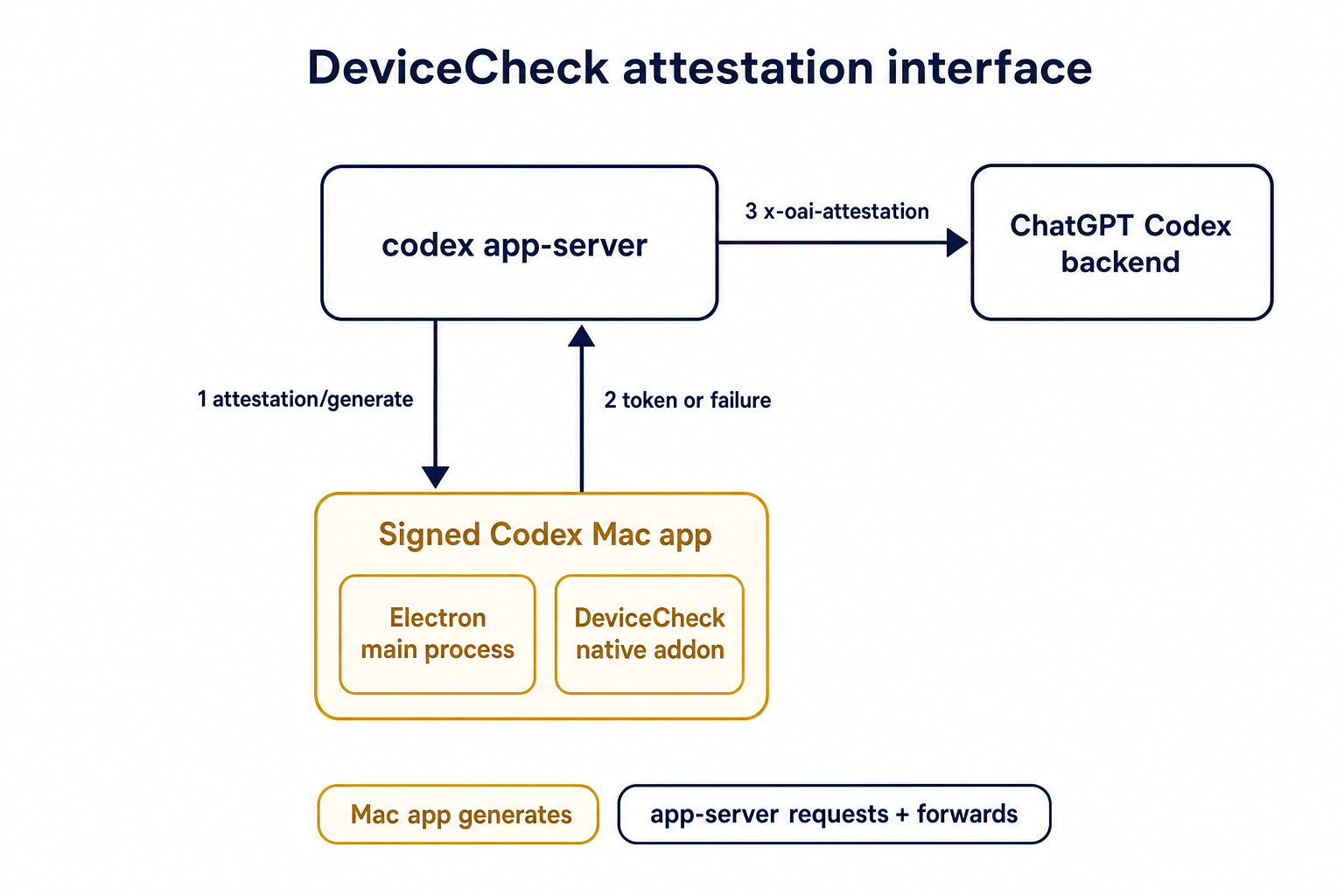 ## Details This PR teaches the Codex app-server runtime how to request and attach an attestation token. It does not generate DeviceCheck tokens directly; instead, it relies on the connected desktop app to advertise that it can generate attestation and then asks that app for a fresh header value when needed. The flow is: 1. The Codex desktop app connects to app-server. 2. During `initialize`, the app can advertise that it supports `requestAttestation`. 3. Before app-server calls selected ChatGPT Codex endpoints, it sends the internal server request `attestation/generate` to the app. 4. app-server receives a pre-encoded header value back. 5. app-server forwards that value as `x-oai-attestation` on the scoped outbound requests. The code in this repo is mostly protocol and runtime plumbing: it adds the app-server request/response shape, introduces an attestation provider in core, wires that provider into Responses / compaction / realtime setup paths, and covers the intended scoping with tests. The signed macOS DeviceCheck generation remains owned by the desktop app PR. ## Related PR - Codex desktop app implementation: https://github.com/openai/openai/pull/878649 ## Validation <details> <summary>Tests run</summary> ```sh cargo test -p codex-app-server-protocol cargo test -p codex-core attestation --lib cargo test -p codex-app-server --lib attestation ``` Also ran: ```sh just fix -p codex-core just fix -p codex-app-server just fix -p codex-app-server-protocol just fmt just write-app-server-schema ``` </details> <details> <summary>E2E DeviceCheck validation</summary> First validated the signed desktop app boundary directly: launched a packaged signed `Codex.app`, sent `attestation/generate`, decoded the returned `v1.` attestation header, and validated the extracted DeviceCheck token with `personal/jm/verify_devicecheck_token.py` using bundle ID `com.openai.codex`. Apple returned `status_code: 200` and `is_ok: true`. Then ran the fuller app + app-server flow. The packaged `Codex.app` launched a current-branch app-server via `CODEX_CLI_PATH`, and a local MITM proxy intercepted outbound `chatgpt.com` traffic. The app-server requested `attestation/generate` from the real Electron app process, and the intercepted `/backend-api/codex/responses` traffic included `x-oai-attestation` on both routes: ```text GET /backend-api/codex/responses Upgrade: websocket x-oai-attestation: present POST /backend-api/codex/responses Upgrade: none x-oai-attestation: present ``` The captured header decoded to a DeviceCheck token that also validated with Apple for `com.openai.codex` (`status_code: 200`, `is_ok: true`, team `2DC432GLL2`). </details> --------- Co-authored-by: Codex <noreply@openai.com>

Codex CLI (Rust Implementation)
We provide Codex CLI as a standalone executable to ensure a zero-dependency install.
Installing Codex
Today, the easiest way to install Codex is via npm:
npm i -g @openai/codex
codex
You can also install via Homebrew (brew install --cask codex) or download a platform-specific release directly from our GitHub Releases.
Documentation quickstart
- First run with Codex? Start with
docs/getting-started.md(links to the walkthrough for prompts, keyboard shortcuts, and session management). - Want deeper control? See
docs/config.mdanddocs/install.md.
What's new in the Rust CLI
The Rust implementation is now the maintained Codex CLI and serves as the default experience. It includes a number of features that the legacy TypeScript CLI never supported.
Config
Codex supports a rich set of configuration options. Note that the Rust CLI uses config.toml instead of config.json. See docs/config.md for details.
Model Context Protocol Support
MCP client
Codex CLI functions as an MCP client that allows the Codex CLI and IDE extension to connect to MCP servers on startup. See the configuration documentation for details.
MCP server (experimental)
Codex can be launched as an MCP server by running codex mcp-server. This allows other MCP clients to use Codex as a tool for another agent.
Use the @modelcontextprotocol/inspector to try it out:
npx @modelcontextprotocol/inspector codex mcp-server
Use codex mcp to add/list/get/remove MCP server launchers defined in config.toml, and codex mcp-server to run the MCP server directly.
Notifications
You can enable notifications by configuring a script that is run whenever the agent finishes a turn. The notify documentation includes a detailed example that explains how to get desktop notifications via terminal-notifier on macOS. When Codex detects that it is running under WSL 2 inside Windows Terminal (WT_SESSION is set), the TUI automatically falls back to native Windows toast notifications so approval prompts and completed turns surface even though Windows Terminal does not implement OSC 9.
codex exec to run Codex programmatically/non-interactively
To run Codex non-interactively, run codex exec PROMPT (you can also pass the prompt via stdin) and Codex will work on your task until it decides that it is done and exits. If you provide both a prompt argument and piped stdin, Codex appends stdin as a <stdin> block after the prompt so patterns like echo "my output" | codex exec "Summarize this concisely" work naturally. Output is printed to the terminal directly. You can set the RUST_LOG environment variable to see more about what's going on.
Use codex exec --ephemeral ... to run without persisting session rollout files to disk.
Experimenting with the Codex Sandbox
To test to see what happens when a command is run under the sandbox provided by Codex, we provide the following subcommands in Codex CLI:
# macOS
codex sandbox macos [--log-denials] [COMMAND]...

# Linux
codex sandbox linux [COMMAND]...

# Windows
codex sandbox windows [COMMAND]...

# Legacy aliases
codex debug seatbelt [--log-denials] [COMMAND]...
codex debug landlock [COMMAND]...
To try a writable legacy sandbox mode with these commands, pass an explicit config override such
as -c 'sandbox_mode="workspace-write"'.
Selecting a sandbox policy via --sandbox
The Rust CLI exposes a dedicated --sandbox (-s) flag that lets you pick the sandbox policy without having to reach for the generic -c/--config option:
# Run Codex with the default, read-only sandbox
codex --sandbox read-only

# Allow the agent to write within the current workspace while still blocking network access
codex --sandbox workspace-write

# Danger! Disable sandboxing entirely (only do this if you are already running in a container or other isolated env)
codex --sandbox danger-full-access
The same setting can be persisted in ~/.codex/config.toml via the top-level sandbox_mode = "MODE" key, e.g. sandbox_mode = "workspace-write".
In workspace-write, Codex also includes ~/.codex/memories in its writable roots so memory maintenance does not require an extra approval.
Code Organization
This folder is the root of a Cargo workspace. It contains quite a bit of experimental code, but here are the key crates:
core/contains the business logic for Codex. Ultimately, we hope this becomes a library crate that is generally useful for building other Rust/native applications that use Codex.exec/"headless" CLI for use in automation.tui/CLI that launches a fullscreen TUI built with Ratatui.cli/CLI multitool that provides the aforementioned CLIs via subcommands.
If you want to contribute or inspect behavior in detail, start by reading the module-level README.md files under each crate and run the project workspace from the top-level codex-rs directory so shared config, features, and build scripts stay aligned.