## Why

Service-tier slash commands are built from model-catalog metadata. If
the catalog returns a name like `Fast`, the TUI currently exposes
`/Fast` and exact dispatch expects that casing, which is inconsistent
with the lowercase command style used elsewhere.

## What

- Lowercase service-tier command names when converting catalog tiers
into `ServiceTierCommand` values.
- Add regression coverage that seeds a catalog tier named `Fast` and
expects the generated command to be `fast`.

## Testing

Not run locally per repo instruction; PR CI should run the new
`service_tier_commands_lowercase_catalog_names` coverage.
## Why

The Python SDK previously protected the stdio transport with a single
active turn-consumer guard. That avoided competing reads from stdout,
but it also meant one `Codex`/`AsyncCodex` client could not stream
multiple active turns at the same time. Notifications could also arrive
before the caller received a `TurnHandle` and registered for streaming,
so the SDK needed an explicit routing layer instead of letting
individual API calls read directly from the shared transport.

## What Changed

- Added a private `MessageRouter` that owns per-request response queues,
per-turn notification queues, pending turn-notification replay, and
global notification delivery behind a single stdout reader thread.
- Generated typed notification routing metadata so turn IDs come from
known payload shapes instead of router-side attribute guessing, with
explicit fallback handling for unknown notification payloads.
- Updated sync and async turn streaming so `TurnHandle.stream()`/`run()`
and `stream_text()` consume only notifications for their own turn ID,
while `AsyncAppServerClient` no longer serializes all transport calls
behind one async lock.
- Cleared pending turn-notification buffers when unregistered turns
complete so never-consumed turn handles do not leave stale queues
behind.
- Removed the internal stream-until helper now that turn completion
waiting can register directly with routed turn notifications.
- Updated Python SDK docs and focused tests for concurrent transport
calls, interleaved turn routing, buffered early notifications, unknown
notification routing, async delegation, and routed turn completion
behavior.

## Validation

- `uv run --extra dev ruff format scripts/update_sdk_artifacts.py
src/codex_app_server/_message_router.py src/codex_app_server/client.py
src/codex_app_server/generated/notification_registry.py
tests/test_client_rpc_methods.py
tests/test_public_api_runtime_behavior.py
tests/test_async_client_behavior.py`
- `uv run --extra dev ruff check scripts/update_sdk_artifacts.py
src/codex_app_server/_message_router.py src/codex_app_server/client.py
src/codex_app_server/generated/notification_registry.py
tests/test_client_rpc_methods.py
tests/test_public_api_runtime_behavior.py
tests/test_async_client_behavior.py`
- `uv run --extra dev pytest tests/test_client_rpc_methods.py
tests/test_public_api_runtime_behavior.py
tests/test_async_client_behavior.py`
- `git diff --check`

---------

Co-authored-by: Codex <noreply@openai.com>
## Why

The model-visible `<network>` context currently repeats indentation and
a pair of XML tags for every allowed or denied domain. Large domain sets
spend a surprising amount of prompt budget on that scaffolding instead
of the actual policy values.

## What changed

- Render allowed domains as one comma-separated `<allowed>` value
instead of one element per domain.
- Render denied domains the same way.
- Keep the full allow/deny domain sets model-visible while updating the
serialization and settings-update coverage for the denser shape.

## Example

Before:
```xml
<network enabled="true">
  <allowed>api.example.test</allowed>
  <allowed>cdn.example.test</allowed>
  <denied>blocked.example.test</denied>
</network>
```

After:
```xml
<network enabled="true"><allowed>api.example.test,cdn.example.test</allowed><denied>blocked.example.test</denied></network>
```

## Validation

- `cargo test -p codex-core environment_context`
- `cargo test -p codex-core
build_settings_update_items_emits_environment_item_for_network_changes`
- Ran a local `codex` session with a real network context containing 121
allowed domains and 42 denied domains, then inspected the raw prompt
with `raw_token_viewer_cli.py`. With the same domain set, the rendered
`<network>` section shrank from 7,175 characters across 161 lines to
3,666 characters on one line, and the containing environment-context
block fell from 6,428 tokens to 5,379 tokens.
Expose discoverability and full share principals in share context, carry
roles through save/updateTargets, hydrate local shared plugin reads, and
keep share URLs only under plugin.shareContext.
## Why

The app-server watcher relocation leaves the generic filesystem watcher
as the last watcher-specific implementation still living inside
`codex-core`. Moving that code to a small crate keeps `codex-core`
focused on thread execution and lets app-server depend on the watcher
without reaching back into core for filesystem watching primitives.

This PR is stacked on #21287.

## What changed

- Added a new `codex-file-watcher` crate containing the existing watcher
implementation and its unit tests.
- Updated app-server `fs_watch`, `skills_watcher`, and listener state to
import watcher types from `codex-file-watcher`.
- Removed the `file_watcher` module and `notify` dependency from
`codex-core`.
- Updated Cargo workspace metadata and `Cargo.lock` for the new internal
crate.

## Validation

- `cargo check -p codex-file-watcher -p codex-core -p codex-app-server`
- `cargo test -p codex-file-watcher`
- `cargo test -p codex-app-server
skills_changed_notification_is_emitted_after_skill_change`
- `just bazel-lock-update`
- `just bazel-lock-check`
- `just fix -p codex-file-watcher`
- `just fix -p codex-core`
- `just fix -p codex-app-server`
## Why

PR #21460 reverted the earlier move of skills change watching from
`codex-core` into app-server. This reapplies that boundary change so
app-server owns client-facing `skills/changed` notifications and core no
longer carries the watcher.

## What

- Restore the app-server `SkillsWatcher` and register it from thread
listener setup.
- Remove the core-owned skills watcher and its core live-reload
integration surface.
- Restore app-server coverage for `skills/changed` notifications after a
watched skill file changes.

## Validation

- `cargo test -p codex-app-server --test all
suite::v2::skills_list::skills_changed_notification_is_emitted_after_skill_change
-- --exact --nocapture`
- `cargo test -p codex-core --lib --no-run`
## Why

We'd like SQLite state to become required and load-bearing. As a first
step, let's remove the mechanism that allows us to blow away the SQLite
DB on a version bump, and instead rely on graceful migrations.

The original motivation
([PR](https://github.com/openai/codex/pull/10623)) behind this mechanism
was to care less about backwards compatibility while SQLite was being
landed, but I'd say it's quite important now to keep the data in it.

## What changed

- Make `STATE_DB_FILENAME` and `LOGS_DB_FILENAME` the full canonical
filenames: `state_5.sqlite` and `logs_2.sqlite`.
- Remove `STATE_DB_VERSION` / `LOGS_DB_VERSION` and the helper that
constructed filenames from versions.
- Stop `StateRuntime::init` from scanning for or deleting older SQLite
DB filenames at startup.
- Delete the tests that encoded legacy state/logs DB deletion behavior.

## Verification

- `cargo test -p codex-state`
## Why

Amazon Bedrock Mantle needs a stable client-agent header so requests
from the built-in Bedrock provider can be identified as coming from
Codex for safety stack.

## What changed

- Added `x-amzn-mantle-client-agent: codex` to the built-in Amazon
Bedrock provider default HTTP headers.
## Why

Desktop and mobile Codex clients need a machine-readable way to
bootstrap and manage `codex app-server` on remote machines reached over
SSH. The same flow is also useful for bringing up app-server with
`remote_control` enabled on a fresh developer machine and keeping that
managed install current without requiring a human session.

## What changed

- add the new experimental `codex-app-server-daemon` crate and wire it
into `codex app-server daemon` lifecycle commands: `start`, `restart`,
`stop`, `version`, and `bootstrap`
- add explicit `enable-remote-control` and `disable-remote-control`
commands that persist the launch setting and restart a running managed
daemon so the change takes effect immediately
- emit JSON success responses for daemon commands so remote callers can
consume them directly
- support a Unix-only pidfile-backed detached backend for lifecycle
management
- assume the standalone `install.sh` layout for daemon-managed binaries
and always launch `CODEX_HOME/packages/standalone/current/codex`
- add bootstrap support for the standalone managed install plus a
detached hourly updater loop
- harden lifecycle management around concurrent operations, pidfile
ownership, stale state cleanup, updater ownership, managed-binary
preflight, Unix-only rejection, forced shutdown after the graceful
window, and updater process-group tracking/cleanup
- document the experimental Unix-only support boundary plus the
standalone bootstrap/update flow in
`codex-rs/app-server-daemon/README.md`

## Verification

- `cargo test -p codex-app-server-daemon -p codex-cli`
- live pid validation on `cb4`: `bootstrap --remote-control`, `restart`,
`version`, `stop`

## Follow-up

- Add updater self-refresh so the long-lived `pid-update-loop` can
replace its own executable image after installing a newer managed Codex
binary.
## Why

The environment-backed exec-server transport currently hardcodes 5
second connect and initialize timeouts in `client_transport.rs`. That is
short for SSH-backed stdio environments and remote websocket
environments, and there is currently no way to raise those values from
`CODEX_HOME/environments.toml`.

This stacked follow-up raises the default environment transport timeouts
and lets each configured environment override them in
`environments.toml`.

## What Changed

- raise the default environment transport connect and initialize
timeouts from 5s to 10s
- store concrete timeout values on `ExecServerTransportParams` instead
of hardcoding them in `connect_for_transport(...)`
- add `connect_timeout_sec` and `initialize_timeout_sec` to
`[[environments]]` entries in `environments.toml`
- apply parse-time defaults so runtime transport code receives fully
resolved timeout values
- reject `connect_timeout_sec` on stdio environments because it only
applies to websocket transports
- extend parser tests to cover the new fields and defaults

## Stack

- base: https://github.com/openai/codex/pull/21794
- this PR: configurable environment transport timeouts

## Validation

- `cd
/Users/starr/code/codex-worktrees/exec-env-timeouts-config-20260508/codex-rs
&& just fmt`
- not run: tests

---------

Co-authored-by: Codex <noreply@openai.com>
## Summary

Support registry-backed remote executors end to end so downstream
services can resolve an executor id into an exec-server URL and make
that environment available to Codex without relying on the legacy cloud
environments flow.

## What changed

- switch remote executor registration to the executor registry bootstrap
contract
- allow named remote environments to be inserted into
`EnvironmentManager` at runtime
- add the experimental app-server RPC `environment/add` so initialized
experimental clients can register those remote environments for later
`thread/start` and `turn/start` selection

## Validation

Ran focused validation locally:
- `cargo test -p codex-exec-server environment_manager_`
- `cargo test -p codex-exec-server
register_executor_posts_with_bearer_token_header`
- `cargo test -p codex-app-server-protocol`
## Why

The app-server daemon work needs two app-server behaviors to be safe
when lifecycle management is driven by a helper process:

- a readiness probe must not become the process-wide client identity
just because it connects first
- a graceful reload signal needs to keep draining active turns even if
it is delivered more than once

## What changed

- Treat `codex_app_server_daemon` initialization as a probe-only client
for process-global originator and user-agent suffix state.
- Distinguish forceable shutdown signals from graceful-only ones, and
treat Unix `SIGHUP` as graceful-only while leaving `SIGTERM` and Ctrl-C
forceable.
- Add regression coverage for daemon probe initialization and repeated
`SIGHUP` delivery while a turn is still running.

## Testing

- `cargo test -p codex-app-server`
  - The new daemon-probe and repeated-`SIGHUP` coverage passed.
- The run still failed in the existing
`suite::conversation_summary::get_conversation_summary_by_relative_rollout_path_resolves_from_codex_home`
and
`suite::conversation_summary::get_conversation_summary_by_thread_id_reads_rollout`
tests because their initialize handshake timed out.
- `cargo test -p codex-app-server --test all
suite::conversation_summary::`
- Reproduced the same two existing initialize-timeout failures in
isolation.
## Summary
- make EnvironmentProvider::snapshot path-free and keep providers
focused on provider-owned remote environments
- let provider snapshots request local inclusion via include_local, with
environments.toml including local and CODEX_EXEC_SERVER_URL excluding
local
- move reserved local environment construction into EnvironmentManager
using ExecServerRuntimePaths

Follow-up to https://github.com/openai/codex/pull/20667

## Testing
- just fmt
- git diff --check
- devbox: bazel build --bes_backend= --bes_results_url=
//codex-rs/exec-server:exec-server
- devbox: bazel test --bes_backend= --bes_results_url=
//codex-rs/exec-server:exec-server-unit-tests

Co-authored-by: Codex <noreply@openai.com>
## Why

PR CI should test the exact commit that was pushed to the PR branch. By
default, GitHub's `pull_request` event checks out a synthetic merge
commit from `refs/pull/<number>/merge`, so the tested tree can include
an implicit merge with the current base branch instead of matching the
pushed head SHA.

Using the PR head SHA makes each check result correspond to a concrete
commit the author submitted. This also behaves better for stacked PR
workflows, including Sapling stacks and other Git stack tooling: a
middle PR's head commit already contains the lower stack changes in its
tree, without pulling in commits above it or GitHub's temporary merge
ref.

## What Changed

- Set every `actions/checkout` in `pull_request` workflows under
`.github/workflows` to use `github.event.pull_request.head.sha` on PR
events and `github.sha` otherwise.
- Updated `blob-size-policy` to compare
`github.event.pull_request.base.sha` and
`github.event.pull_request.head.sha`, since it no longer checks out
GitHub's merge commit where `HEAD^1`/`HEAD^2` represented the PR range.

## Verification

- Parsed the edited workflow YAML files with Ruby.
- Checked that every checkout block in the `pull_request` workflows has
the PR-head `ref`.
## Summary

Startup tool construction currently depends on connector directory
metadata for `tool_suggest` discoverables. On a cold directory cache,
that can put slow connector-directory requests on the blocking path even
though the tools array only needs directory data for install
suggestions, not for the live connector MCP tools themselves.

This PR keeps the discoverables path off that cold network fetch:
- read connector directory metadata from cache only when building
discoverable tools
- persist connector directory metadata to
`~/.codex/cache/codex_app_directory/<hash>.json` and use it to hydrate
the in-memory cache on later runs before the normal refresh path updates
it
- use connector-directory-specific cache naming to distinguish this
metadata cache from the separate Codex Apps tools-spec cache

This reduces first-turn startup work without changing how live connector
MCP tools are sourced. Longer term, directory-backed install suggestions
should move to a search-based flow so they no longer need to be inlined
into the tools prompt at all.

## Testing

- `cargo test -p codex-connectors`
- `cargo test -p codex-chatgpt`
- `cargo test -p codex-core
request_plugin_install_is_available_without_search_tool_after_discovery_attempts`
- `cargo test -p codex-core
tool_suggest_uses_connector_id_fallback_when_directory_cache_is_empty`
## Summary
In https://github.com/openai/codex/pull/21584, we disabled doctests for
crates that lack any doctests. We can enforce that property via `cargo
shear --deny-warnings`: crates that lack doctests will be flagged if
doctests are enabled, and crates with doctests will be flagged if
doctests are disabled.
A few additional notes:
- By adding `--deny-warnings`, `cargo shear` also flagged a number of
modules that were not reachable at all. Some of those have been removed.
- This PR removes a usage of `windows_modules!` (since `cargo shear` and
`rustfmt` couldn't see through it) in favor of simple `#[cfg(target_os =
"windows")]` macros. As a consequence, many of these files exhibit churn
in this PR, since they weren't being formatted by `rustfmt` at all on
main.
- Again, to make the code more analyzable, this PR also removes some
usages of `#[path = "cwd_junction.rs"]` in favor of a more standard
module structure. The bin sidecar structure is still retained, but,
e.g., `windows-sandbox-rs/src/bin/command_runner.rs` was moved to
`windows-sandbox-rs/src/bin/command_runner/main.rs`, and so on.
---------
Co-authored-by: Codex <noreply@openai.com>
## Why

The legacy `AfterToolUse` hook path was still wired through core tool
dispatch even though the hooks registry never populated any handlers for
it. The supported hook surface is `PostToolUse`, so the old
infrastructure was dead code on the hot path.

## What changed

- Removed the legacy `AfterToolUse` dispatch from `codex-core` tool
execution.
- Removed the unused legacy hook payload types and exports from
`codex-hooks`.
- Simplified legacy notify handling now that `HookEvent` only carries
`AfterAgent`.

## Validation

- `cargo test -p codex-hooks`
- `cargo test -p codex-core registry`
## Why

`apply_patch` is now a freeform/custom tool. Keeping the old
JSON/function-style registration and parsing path left another way for
models and tests to invoke `apply_patch`, which made the tool surface
harder to reason about.

## What changed

- Removed the `ApplyPatchToolType::Function` variant, JSON `apply_patch`
spec, and handler support for function payloads.
- Kept `apply_patch_tool_type = freeform` as the supported model
metadata path, including Bedrock catalog metadata.
- Migrated `apply_patch` tests and SSE fixtures to custom/freeform tool
calls.

## Verification

- `cargo test -p codex-tools -p codex-protocol -p codex-model-provider`
- `cargo test -p codex-core tools::handlers::apply_patch --lib`
- `cargo test -p codex-core --test all
apply_patch_tool_executes_and_emits_patch_events`
- `cargo test -p codex-core --test all
apply_patch_reports_parse_diagnostics`
- `cargo test -p codex-exec test_apply_patch_tool`
- `just fix -p codex-core`
- `just fix -p codex-tools -p codex-protocol -p codex-model-provider -p
codex-exec`
## Summary
TL;DR: teaches `codex-rs` / app-server to request a desktop-provided
attestation token and attach it as `x-oai-attestation` on the scoped
ChatGPT Codex request paths.
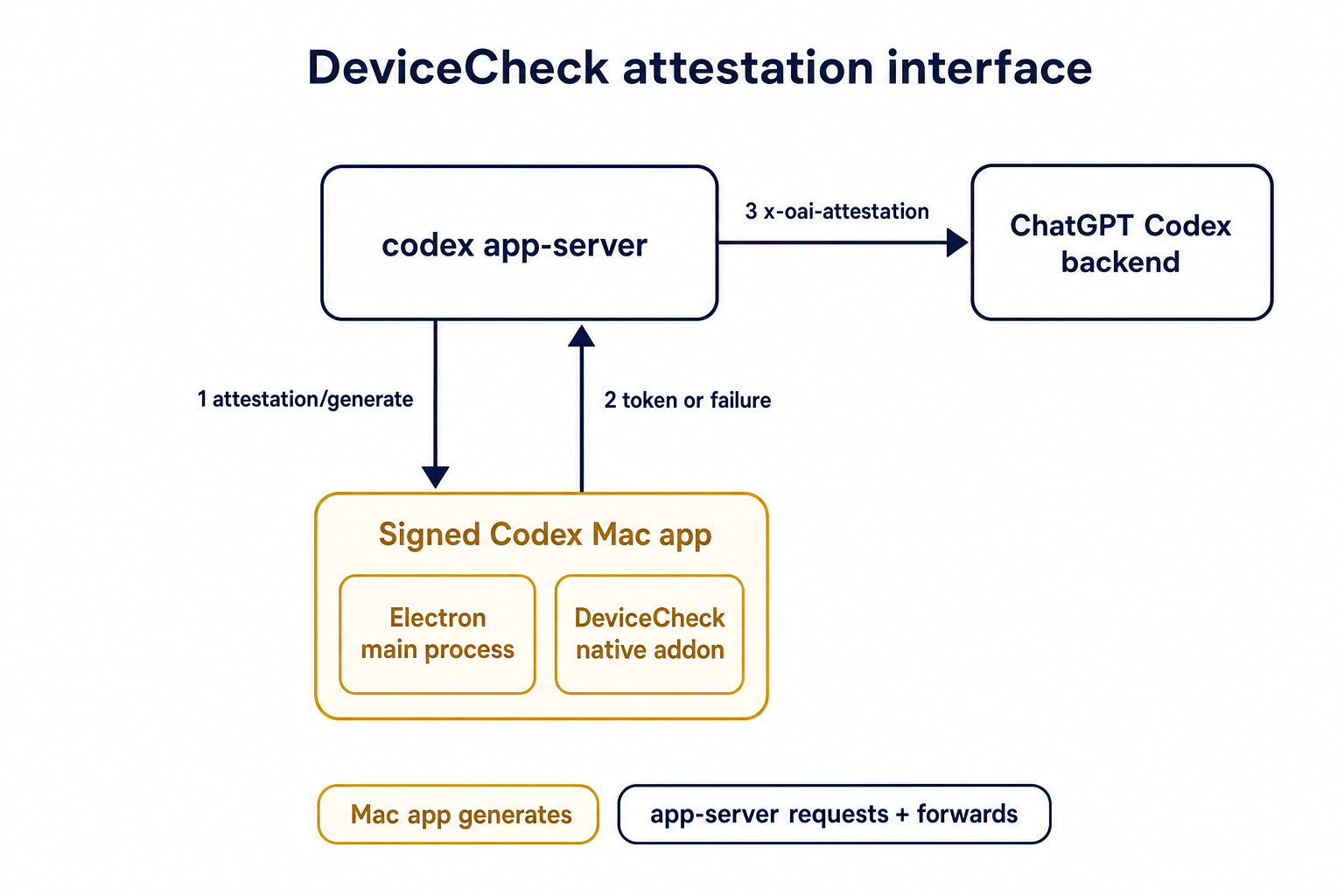
## Details
This PR teaches the Codex app-server runtime how to request and attach
an attestation token. It does not generate DeviceCheck tokens directly;
instead, it relies on the connected desktop app to advertise that it can
generate attestation and then asks that app for a fresh header value
when needed.
The flow is:
1. The Codex desktop app connects to app-server.
2. During `initialize`, the app can advertise that it supports
`requestAttestation`.
3. Before app-server calls selected ChatGPT Codex endpoints, it sends
the internal server request `attestation/generate` to the app.
4. app-server receives a pre-encoded header value back.
5. app-server forwards that value as `x-oai-attestation` on the scoped
outbound requests.
The code in this repo is mostly protocol and runtime plumbing: it adds
the app-server request/response shape, introduces an attestation
provider in core, wires that provider into Responses / compaction /
realtime setup paths, and covers the intended scoping with tests. The
signed macOS DeviceCheck generation remains owned by the desktop app PR.
## Related PR
- Codex desktop app implementation:
https://github.com/openai/openai/pull/878649
## Validation
<details>
<summary>Tests run</summary>
```sh
cargo test -p codex-app-server-protocol
cargo test -p codex-core attestation --lib
cargo test -p codex-app-server --lib attestation
```
Also ran:
```sh
just fix -p codex-core
just fix -p codex-app-server
just fix -p codex-app-server-protocol
just fmt
just write-app-server-schema
```
</details>
<details>
<summary>E2E DeviceCheck validation</summary>
First validated the signed desktop app boundary directly: launched a
packaged signed `Codex.app`, sent `attestation/generate`, decoded the
returned `v1.` attestation header, and validated the extracted
DeviceCheck token with `personal/jm/verify_devicecheck_token.py` using
bundle ID `com.openai.codex`. Apple returned `status_code: 200` and
`is_ok: true`.
Then ran the fuller app + app-server flow. The packaged `Codex.app`
launched a current-branch app-server via `CODEX_CLI_PATH`, and a local
MITM proxy intercepted outbound `chatgpt.com` traffic. The app-server
requested `attestation/generate` from the real Electron app process, and
the intercepted `/backend-api/codex/responses` traffic included
`x-oai-attestation` on both routes:
```text
GET /backend-api/codex/responses Upgrade: websocket x-oai-attestation: present
POST /backend-api/codex/responses Upgrade: none x-oai-attestation: present
```
The captured header decoded to a DeviceCheck token that also validated
with Apple for `com.openai.codex` (`status_code: 200`, `is_ok: true`,
team `2DC432GLL2`).
</details>
---------
Co-authored-by: Codex <noreply@openai.com>
## Why

`ToolName::display()` made it too easy to flatten tool identity and
accidentally compare rendered strings. Tool identity should stay
structural until a legacy string boundary actually requires the
flattened spelling.

## What

- Removes `ToolName::display()` and relies on the existing `Display`
impl for messages and errors.
- Adds structural ordering for `ToolName` and uses it for
sorting/deduping deferred tools.
- Carries `ToolName` through tool/sandbox plumbing, flattening only at
legacy boundaries such as hook payloads, telemetry tags, and Responses
tool names.
- Updates MCP normalization tests to assert `ToolName` structure instead
of rendered strings.

## Testing

- `cargo test -p codex-mcp test_normalize_tools`
- `cargo test -p codex-core unavailable_tool`
- `just fix -p codex-protocol`
- `just fix -p codex-mcp`
- `just fix -p codex-core`
## Why

Codex assisted-code attribution needs a client-side accepted-code source
that does not upload raw code. This adds a hash-only analytics event
derived from the turn diff so downstream attribution can compare
accepted Codex lines against commit or PR diffs.

## What Changed

- Parse accepted/effective added lines from the final turn diff and emit
`codex_accepted_line_fingerprints` analytics.
- Hash repo, path, and normalized line content before upload; raw code
and raw diffs are not included in the event.
- Chunk large fingerprint payloads and send accepted-line fingerprint
events in isolated requests while preserving normal batching for other
analytics events.
- Canonicalize Git remote URLs before repo hashing so SSH/HTTPS GitHub
remotes join to the same repo hash.
- Add parser coverage for unified diff hunk lines that look like `+++`
or `---` file headers.

## Verification

- `cargo test -p codex-analytics`
- `cargo test -p codex-git-utils canonicalize_git_remote_url`
- `just fix -p codex-analytics`
- `just bazel-lock-check`
- `git diff --check`
## Why

Published Python SDK builds depend on an exact `openai-codex-cli-bin`
runtime package, but the release workflow did not publish that runtime
package to PyPI. That left the SDK packaging story incomplete: release
artifacts could produce Codex binaries, but Python users still needed a
matching wheel carrying the platform-specific runtime and helper
executables.

This PR is stacked on #21787 so release jobs can include helper binaries
in runtime wheels: Linux wheels include `bwrap` for sandbox fallback,
and Windows wheels include the signed sandbox/elevation helpers beside
`codex.exe`.

## What changed

- Builds platform-specific `openai-codex-cli-bin` wheels from signed
release binaries on macOS, Linux, and Windows release runners.
- Packages Linux `bwrap` into musllinux runtime wheels.
- Packages Windows sandbox helper executables into Windows runtime
wheels.
- Uploads runtime wheels as GitHub release assets and publishes them to
PyPI using trusted publishing from the `pypi` GitHub environment.
- Keeps the new Python runtime publish job non-blocking so failures need
follow-up but do not fail the Rust release workflow.
- Pins the PyPA publish action to the `v1.13.0` commit SHA for
reproducible release publishing.
- Documents that runtime wheels are platform wheels published through
PyPI trusted publishing.

## Testing

- `ruby -e 'require "yaml"; ARGV.each { |f| YAML.load_file(f); puts "ok
#{f}" }' .github/workflows/rust-release.yml
.github/workflows/rust-release-windows.yml`
- `git diff --check`

CI is the real end-to-end verification for the release workflow path.

---------

Co-authored-by: Codex <noreply@openai.com>
## Why

Some Codex runtime distributions need helper executables beside the main
bundled binary. Linux sandbox fallback needs a packaged `bwrap` when no
suitable system `bwrap` is available, and Windows sandbox/elevation
needs helper executables discoverable beside `codex.exe`. The checked-in
`openai-codex-cli-bin` template already packages everything under
`codex_cli_bin/bin/**`, but the staging script only copied the main
Codex binary into that directory.

This PR adds the generic staging primitive needed by release workflows
to build complete platform runtime wheels without baking
platform-specific helper names into the package template.

## What changed

- Added repeatable `stage-runtime --resource-binary` support so release
workflows can copy extra executables beside the bundled Codex binary.
- Kept resource selection in workflow code, where the platform target is
known.
- Added tests that verify resource binaries are copied into the staged
runtime package, that the wheel include config covers them, and that the
CLI forwards repeated `--resource-binary` values.

## Testing

- `uv run ruff check scripts/update_sdk_artifacts.py
tests/test_artifact_workflow_and_binaries.py`
- `uv run --extra dev pytest
tests/test_artifact_workflow_and_binaries.py::test_stage_runtime_release_copies_resource_binaries
tests/test_artifact_workflow_and_binaries.py::test_runtime_resource_binaries_are_included_by_wheel_config
tests/test_artifact_workflow_and_binaries.py::test_stage_runtime_stages_binary_without_type_generation`

Full `tests/test_artifact_workflow_and_binaries.py` still has unrelated
schema-normalization drift in the local checkout.

---------

Co-authored-by: Codex <noreply@openai.com>
## Why

The earlier PRs add stdio transport support and the config-backed
environment provider, but the feature remains inert until normal Codex
entrypoints construct `EnvironmentManager` with enough context to
discover `CODEX_HOME/environments.toml`. This final stack PR activates
the provider while preserving the legacy `CODEX_EXEC_SERVER_URL`
fallback when no environments file exists.

**Stack position:** this is PR 5 of 5. It is the product wiring PR that
activates the configured environment provider added in PR 4.

## What Changed

- Thread `codex_home` into `EnvironmentManagerArgs`.
- Change `EnvironmentManager::new(...)` to load the provider from
`CODEX_HOME`.
- Preserve legacy behavior by falling back to
`DefaultEnvironmentProvider::from_env()` when `environments.toml` is
absent.
- Make `environments.toml`-backed managers start new threads with all
configured environments, default first, while keeping the legacy env-var
path single-default.
- Update the app-server, TUI, exec, MCP server, connector, prompt-debug,
and thread-manager-sample callsites to pass `codex_home` and handle
provider-loading errors.

## Self-Review Notes

- The multi-environment startup path is intentionally tied to the
`environments.toml` provider. Using `>1` configured environment as the
only signal would also expand the legacy `CODEX_EXEC_SERVER_URL`
provider because it keeps `local` addressable alongside `remote`.
- The startup environment list is still derived inside
`EnvironmentManager`; the provider only says whether its snapshot should
start new threads with all configured environments.
- The thread-manager sample was updated to pass the current
`ThreadManager::new(...)` installation id argument so the stack compiles
under Bazel.

## Stack

- 1. https://github.com/openai/codex/pull/20663 - Add stdio exec-server
listener
- 2. https://github.com/openai/codex/pull/20664 - Add stdio exec-server
client transport
- 3. https://github.com/openai/codex/pull/20665 - Make environment
providers own default selection
- 4. https://github.com/openai/codex/pull/20666 - Add CODEX_HOME
environments TOML provider
- **5. This PR:** https://github.com/openai/codex/pull/20667 - Load
configured environments from CODEX_HOME

Split from original draft: https://github.com/openai/codex/pull/20508

## Validation

- `just fmt`
- `git diff --check`
- `bazel build --config=remote --strategy=remote
--remote_download_toplevel
//codex-rs/thread-manager-sample:codex-thread-manager-sample`
- `bazel test --config=remote --strategy=remote
--remote_download_toplevel
//codex-rs/exec-server:exec-server-unit-tests`
- `bazel test --config=remote --strategy=remote
--remote_download_toplevel --test_sharding_strategy=disabled
--test_arg=default_thread_environment_selections_use_manager_default_id
//codex-rs/core:core-unit-tests`
- `bazel test --config=remote --strategy=remote
--remote_download_toplevel --test_sharding_strategy=disabled
--test_arg=start_thread_uses_all_default_environments_from_codex_home
//codex-rs/core:core-unit-tests`

## Documentation

This activates `CODEX_HOME/environments.toml`; user-facing documentation
should be added before this stack is treated as a documented public
workflow.

---------

Co-authored-by: Codex <noreply@openai.com>
* Pass installation ID for storage on enrollments server for
deduping/grouping multiple appservers per installation
* Pass installation ID in remoteControl/status/changed events
This does two things:

- We use `persist-credentials: false` everywhere now. This is
unfortunately not the default in GitHub Actions, but it prevents
`actions/checkout` from dropping `secrets.GITHUB_TOKEN` onto disk.
- We interpose (some) template expansions through environment variables.
I've limited this to contexts that have non-fixed values; contexts that
are fixed (like `*.result`) are not dangerous to expand directly inline
(but maybe we should clean those up in the future for consistency
anyways).

This is a medium-risk change in terms of CI breakage: I did a scan for
usage of `git push` and other commands that implicitly use the persisted
credential, but couldn't find any. Even still, some implicit usages of
the persisted credentials may be lurking. Please ping ww@ if any issues
arise.
## Summary

Codex keeps trying to add documentation to the `docs/` directory. With
the exception of app server API documentation, the docs for Codex should
not live in this repo. We don't want the local `docs/` folder to become
a stale shadow of the official docs.

This PR updates `AGENTS.md` to make that boundary explicit and scopes
the existing API documentation guidance to app-server docs/examples. It
also removes the extra `docs/config.md` sections that were recently
added.
## Why

`/fast` was wired as a one-off slash command even though model metadata
now exposes service tiers as catalog data. That meant adding another
tier, such as a slower/cheaper tier, would require more hardcoded TUI
plumbing instead of letting the model catalog drive the available
commands.

This change makes service-tier commands data-driven: each advertised
`service_tiers` entry becomes a `/name` command using the catalog
description, while the request path sends the tier `id` only when the
selected model supports it.

## What Changed

- Removed the hardcoded `/fast` slash-command variant and introduced
dynamic service-tier command items in the composer and command popup.
- Added toggle behavior for service-tier commands: invoking `/name`
selects that tier, and invoking it again clears the selection.
- Preserved the existing Fast-mode keybinding/status affordances by
resolving the current model tier whose name is `fast`, while still
sending the tier request value such as `priority`.
- Persisted service-tier selections as raw request strings so non-fast
tiers can round-trip through config.
- Updated the Bedrock catalog entry to advertise fast support through
`service_tiers` with `id: "priority"` and `name: "fast"`.
- Added defensive filtering in core so unsupported selected service
tiers are omitted from `/responses` requests.

## Validation

- Added/updated coverage for dynamic service-tier slash command lookup,
popup descriptions, composer dispatch, TUI fast toggling, and
unsupported-tier omission in core request construction.
- Local tests were not run per request.

---------

Co-authored-by: Codex <noreply@openai.com>
Cargo uses libgit2 by default. In uv, we gave up this entirely and
always call out to the git CLI because it is much more reliable. This is
a part of my attempt to reduce flakes in `rust-ci-full`.
Since https://github.com/openai/codex/pull/21255, `rust-ci-full` has
been failing due to a missing `bwrap`.

```
thread 'main' panicked at linux-sandbox/src/launcher.rs:43:13:
bubblewrap is unavailable: no system bwrap was found on PATH and no bundled codex-resources/bwrap binary was found next to the Codex executable
```

Since the happy path is now to use the system binary, let's ensure
that's installed.


8d51826631
was necessary for the `bwrap` executable to be discoverable when the
working directory is `/`.

I ran `rust-ci-full` at
https://github.com/openai/codex/actions/runs/25528074506

---------

Co-authored-by: Codex <noreply@openai.com>
## Summary

1. Removes the broad `DARWIN_USER_CACHE_DIR` write rule from the macOS
Seatbelt network policy.
2. Removes the now unused policy parameter plumbing for that cache path.
3. Adds sandboxing coverage that keeps `com.apple.trustd.agent` for TLS
while rejecting the cache write rule.

## Why

This closes the exact cache poisoning boundary. The earlier `gh` TLS
issue is now covered by trustd access, so the cache write is no longer
needed.

## Validation

1. Rust formatting passed.
2. The sandboxing crate tests passed.
3. Local macOS Seatbelt repro with patched policy passed. `gh api`
returned `21442` without the cache write rule.

